Smart Hydrogels Empowering Tissue Repair: Material Design, Emerging Applications, Repair Mechanisms, and Future Challenges
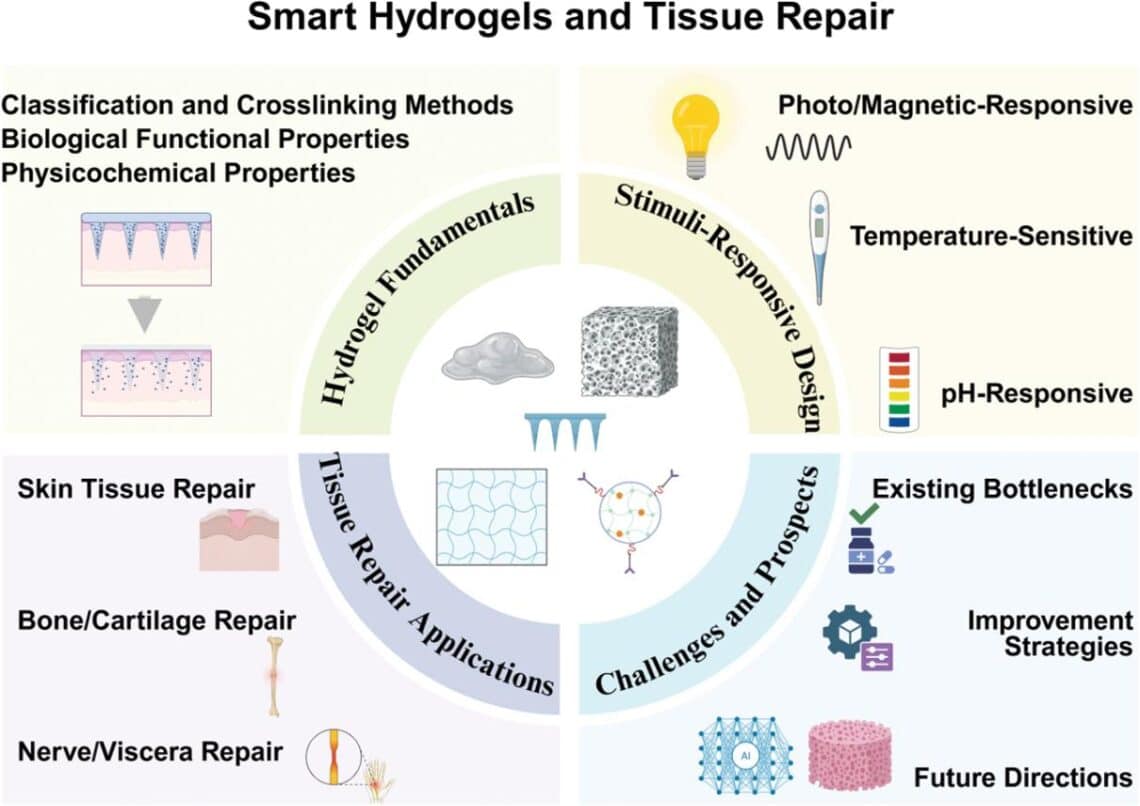
Announcing a new article publication in BIO Integration. Smart hydrogels are attracting considerable interest in the biomedical field, because of their high water content, excellent biocompatibility and biodegradability, and distinctive properties in response to stimuli. Their three-dimensional mesh structure effectively mimics the microenvironment of human tissue, by maintaining moist conditions conducive to wound healing while also serving as a support for active ingredients, thus ensuring their precise and controlled release. Consequently, these materials have excellent potential for use in tissue regeneration.
This article first classifies smart hydrogels according to their response mechanisms, specifically systems that respond to temperature, pH, light, and magnetic fields. It then systematically examines potential applications of smart hydrogels in tissue regeneration, according to their ability to dynamically adapt to different tissue microenvironments, particularly the regeneration of skin, bone and cartilage, nerve tissue, and internal organs. Despite their promising potential, smart hydrogels still face several challenges, including imbalances in the rates of tissue degradation and regeneration, insufficient mechanical properties, and relatively limited functionality.
Future research should focus on material modification and optimization, AI-assisted design, and interdisciplinary collaboration between medicine and engineering to develop hydrogels’ multifunctional, personalized integration and clinical application, and ultimately enable smarter, more effective solutions for tissue engineering and regenerative medicine.
Read full open access article: https://www.scienceopen.com/hosted-document?doi=10.15212/bioi-2026-0004
# # # # # #
BIO Integration is fully open access journal which will allow for the rapid dissemination of multidisciplinary views driving the progress of modern medicine.
As part of its mandate to help bring interesting work and knowledge from around the world to a wider audience, BIOI will actively support authors through open access publishing and through waiving author fees in its first years. Also, publication support for authors whose first language is not English will be offered in areas such as manuscript development, English language editing and artwork assistance.
Please visit www.bio-integration.org to learn more about the journal.
Editorial Board: https://bio-integration.org/editorial-board/
BIOI is available on the ScienceOpen platform (https://www.scienceopen.com/search#collection/55f45bac-fd64-431c-9fe7-50fd6a7f8781).
Submissions may be made using ScholarOne (https://mc04.manuscriptcentral.com/bioi).
There are no author submission or article processing fees.
Follow BIOI on Twitter @JournalBio; Facebook (https://www.facebook.com/BIO-Integration-Journal-108140854107716/) and LinkedIn (https://www.linkedin.com/company/bio-integration-journal/).
ISSN 2712-0074
eISSN 2712-0082
Yiming Gong, Bowen Sun, Xinyan Xiao al. Smart Hydrogels Empowering Tissue Repair: Material Design, Emerging Applications, Repair Mechanisms, and Future Challenges. BIOI. 2026. Vol. 7(1). DOI: 10.15212/BIOI-2026-0004.


You May Also Like
Prevalence, Incidence, and Demographic Patterns of Mental Health Conditions in Prediabetes: A Real-World Cohort Study in 578,972 Adults
Phytochemicals as a Promising Approach to Rheumatoid Arthritis: Current Perspectives