


Prevalence, Incidence, and Demographic Patterns of Mental Health Conditions in Prediabetes: A Real-World Cohort Study in 578,972 Adults
1Faculty of Nursing, Chulalongkorn University, Bangkok 10330, Thailand
2Center of Excellence for Enhancing Well-being in Vulnerable and Chronic Illness Populations, Faculty of Nursing, Chulalongkorn University, Bangkok 10330, Thailand
3Department of Family Medicine and Biobehavioral Health, University of Minnesota Medical School, Duluth, Minnesota 55812, USA
4International PhD Program in Biotech and Healthcare Management, Taipei Medical University, Taipei City 110, Taiwan
5Department of Psychological Medicine, Faculty of Medicine, University Malaya, Kuala Lumpur 50603, Malaysia
6Faculty of Medicine, Universitas Negeri Semarang, Semarang 50229, Indonesia
*Correspondence to: Assistant Professor Faizul Hasan, PhD, Faculty of Nursing, Chulalongkorn University, Boromarajonani Srisataphat Building, 12th Floor, Rama1 Road, Wang Mai, Pathum Wan, Bangkok 10330, Thailand, Tel.: +66-2218-1342. E-mail: faizul.h@chula.ac.th
Received: May 11 2026; Revised: July 12 2026; Accepted: July 29 2026; Published Online: September 9 2026.
Cite this paper:
Hasan F, al’Absi M, Muhtar MS et al. Prevalence, Incidence, and Demographic Patterns of Mental Health Conditions in Prediabetes: A Real-World Cohort Study in 578,972 Adults. BIO Integration 2026; 7: 1–10.
DOI: 10.15212/bioi-2026-0081. Available at: https://bio-integration.org/
Download citation
© 2026 The Authors. This is an open access article distributed under the terms of the Creative Commons Attribution License (https://creativecommons.org/licenses/by/4.0/). See https://bio-integration.org/copyright-and-permissions/
Abstract
Background: Prediabetes has a high prevalence worldwide; however, the prevalence of mental health conditions within the population with prediabetes is not well understood. This study was aimed at determining the prevalence and incidence of insomnia, fatigue, anxiety, and depression among a large, real-world cohort of adults with prediabetes, and examining demographic patterns by age and sex.
Methods: This retrospective cohort analysis used data from 578,972 individuals with laboratory-confirmed prediabetes (HbA1c 5.7%–6.4%) in the TriNetX Global Collaborative Network. Outcomes were identified with ICD-10-CM codes. Prevalence was assessed over a 25-year period (2000–2025). Cumulative incidence required a 90-day washout after prediabetes diagnosis and excluded patients with prior diagnoses. Incidence rates per 1,000 person-years with 95% confidence intervals (CIs) were calculated. Analyses were stratified by age (19–39 vs. 40–65 years) and sex.
Results: Anxiety, depression, fatigue, and insomnia were assessed among 578,972 participants with prediabetes (mean age 53 ± 11 years; 56.2% female). The overall prevalence of these conditions was 37.8% (95% CI: 37.78–37.82), 26.0% (95% CI: 25.98–26.02), 23.9% (95% CI: 23.88–23.92), and 15.7% (95% CI: 15.67–15.73), respectively. During a median follow-up of 628 days (IQR: 1,134 days), the cumulative incidence of these new-onset conditions (≥90 days after diagnosis, excluding prior cases) was 8.6% (95% CI: 8.53–8.67), 4.8% (95% CI: 4.74–4.86), 5.7% (95% CI: 5.64–5.76), and 4.0% (95% CI: 3.95–4.05), respectively. The incidence rates per 1,000 person-years were 34.9 (95% CI: 34.54–35.26), 22.6 (95% CI: 22.31–22.89), 20.5 (95% CI: 20.26–20.74), and 12.9 (95% CI: 12.73–13.07), respectively. In stratified analyses, middle-aged adults (40–65 years) had substantially higher incidence of all outcomes than younger adults (19–39 years) (risk ratios: 0.263–0.298; all P < 0.001). Women had consistently higher incidence than men (risk ratios: 0.593–0.754; all P < 0.001). A secondary race-stratified prevalence analysis indicated that the prevalence was highest in White individuals and lowest in Asian individuals.
Conclusion: Mental health conditions affected more than one-third of patients with prediabetes. Middle-aged adults and women had the highest observed incidence. Routine mental health screening in prediabetes care is warranted, particularly among these high-risk demographic subgroups.
Keywords
Anxiety, depression, epidemiology, insomnia, mental health, prediabetes.
Introduction
Prediabetes, a condition of glucose dysregulation defined by hemoglobin A1c (HbA1c) levels of 5.7%–6.4%, fasting plasma glucose levels of 100–125 mg/dL, or impaired glucose tolerance, affects approximately 720 million people worldwide [1–3]. The incidence of prediabetes has substantially increased over the past 20 years, owing to increasing obesity rates, sedentary habits, and population aging [4]. Individuals with prediabetes face a substantially elevated risk of progression to type 2 diabetes mellitus, with an estimated annual conversion rate of 5%–10%, and as many as 70% of people with prediabetes ultimately develop diabetes over their lifetimes [5, 6]. Beyond diabetes risk, prediabetes is also independently associated with heightened risk of cardiovascular disease, chronic renal disease, and overall mortality; consequently, it is a crucial focus for public health initiatives [7, 8]. Despite this growing burden, the prevalence and incidence of mental health conditions in prediabetic populations remain poorly characterized, thus representing a critical gap in understanding of the full clinical spectrum of this condition.
Alongside the increasing prevalence of prediabetes, mental health conditions have become a primary contributor to disability worldwide [9]. Anxiety disorders, major depressive disorder, insomnia, and chronic fatigue syndrome affect hundreds of millions of people worldwide, and substantially affect quality of life, healthcare utilization, and economic output [10, 11]. The reciprocal association between mental health and metabolic disorders is increasingly recognized. Depression and anxiety are distinct risk factors for the onset of insulin resistance and type 2 diabetes mediated by neurohormonal mechanisms including dysregulation of the hypothalamic-pituitary-adrenal axis; chronic low-grade inflammation; autonomic nervous system imbalance; and detrimental health behaviors such as suboptimal diet and physical inactivity [12–14]. In contrast, the diagnosis of a metabolic disorder such as prediabetes can induce or exacerbate psychological distress, as individuals face medical advice to implement lifestyle changes, anxiety regarding disease development, and a perceived decline in health [15, 16].
Notwithstanding this acknowledged interaction, the mental health burden among individuals with prediabetes remains insufficiently described. The current literature has examined primarily people with diagnosed diabetes, in whom the prevalence of depression has been reported to be 25%–30%, approximately twice that in the general population [17, 18]. A limited number of studies have investigated mental health consequences during the prediabetic stage; consequently, a substantial knowledge gap exists. The early detection of mental health disorders in prediabetes is crucial, because unaddressed depression and anxiety can hinder adherence to lifestyle modifications, such as dietary changes, physical exercise, and weight control, that are fundamental to diabetes prevention [19]. Mental health conditions may expedite the transition from prediabetes to diabetes through biological and behavioral pathways, thus potentially establishing a detrimental cycle of deteriorating metabolic and psychological health [16, 20].
Age and sex are recognized drivers of prediabetes risk and mental health outcomes; however, limited research has comprehensively investigated how these demographic characteristics influence mental health conditions in prediabetic populations. Young adults with prediabetes are a notably susceptible demographic, because they experience prolonged exposure to metabolic risk and may encounter heightened psychological distress due to the apparent disjunct between their young age and a diagnosis of “metabolic aging” [21]. Moreover, substantial sex differences are evident in the incidence of mental health conditions: the lifetime rates of anxiety and depression are approximately 1.5 to 2 times greater in women than men [22, 23]. Whether this female predominance persists or is amplified in the setting of prediabetes remains uncertain. In addition, racial differences in metabolic and mental health conditions were examined in a secondary exploratory analysis, given the established disparities in healthcare access and diagnostic practices [24].
This study was aimed at addressing these knowledge gaps by using a large, real-world electronic health record (EHR) database. Our objectives were (1) to assess the overall prevalence and cumulative incidence of four common mental health conditions (insomnia, fatigue, anxiety, and depression) in a large cohort of individuals with laboratory-confirmed prediabetes and (2) to investigate variations in the incidence of these conditions by age group and sex. We anticipated that mental health conditions would be prevalent among individuals with prediabetes, and would exhibit considerable variation across age and sex groups.
Materials and methods
Data source and study design
This retrospective cohort study was based on data from the TriNetX Global Collaborative Network, a federated health research network that compiles de-identified EHR data from more than 171 healthcare organizations worldwide (https://trinetx.com). TriNetX collects extensive longitudinal patient data encompassing demographics, diagnoses (according to ICD-10-CM codes), procedures, laboratory results, and medication prescriptions. This study was exempt from institutional review board clearance, and the requirement for informed consent was waived because of the de-identified nature of the data. Moreover, this research adhered to the Strengthening the Reporting of Observational Studies in Epidemiology (STROBE) reporting guidelines.
Study population and cohort selection
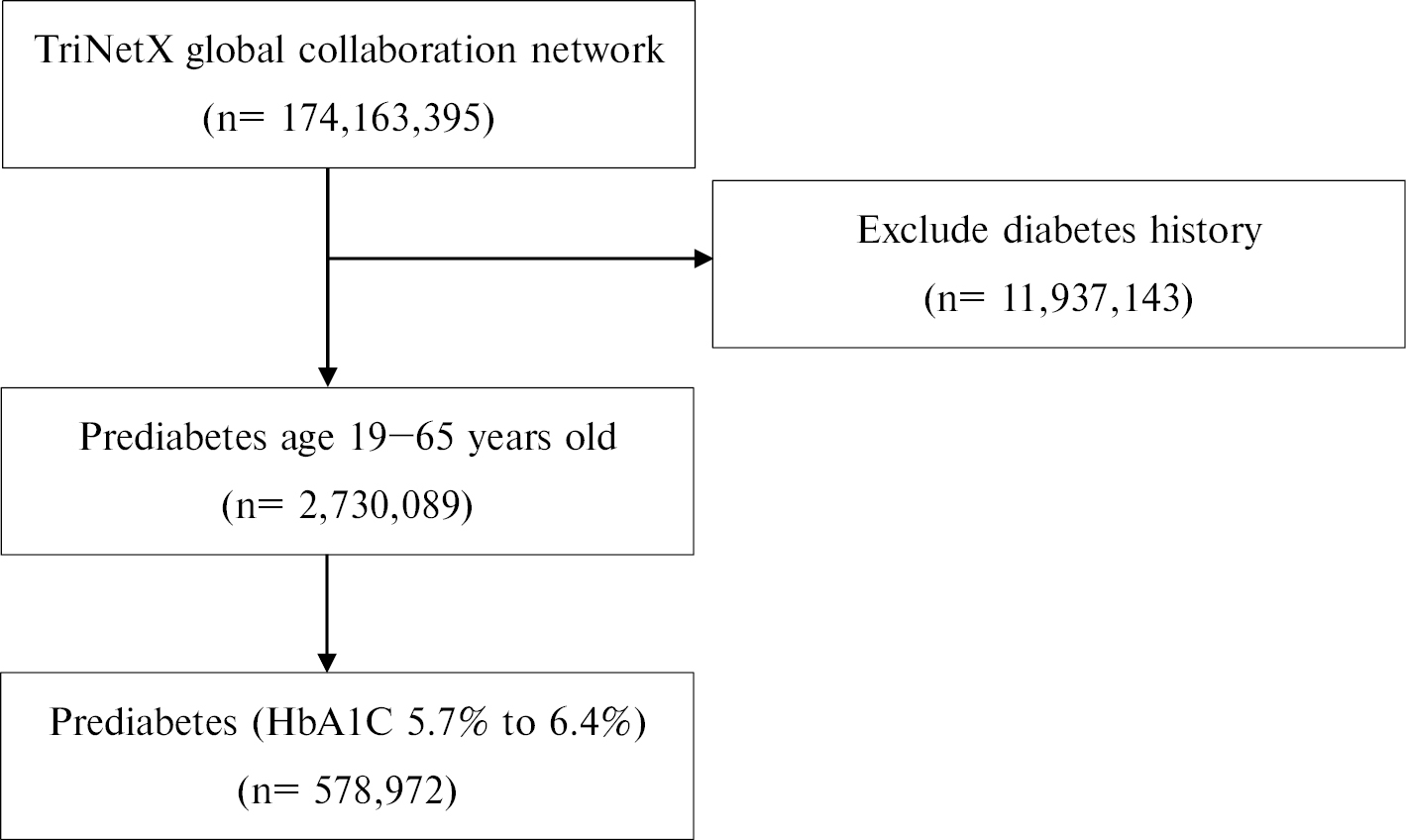
The original source population comprised 174,163,395 patients within the TriNetX Global Collaborative Network. We systematically implemented inclusion and exclusion criteria for this population (Figure 1). Initially, patients with a verified history of diabetes mellitus (ICD-10-CM: E08–E13) were excluded (11,937,143 participants). Subsequently, we limited the cohort to adults 19–65 years of age diagnosed with prediabetes, thus leaving 2,730,089 participants. Prediabetes is defined by the American Diabetes Association as a hemoglobin A1c (HbA1c) level of 5.7%–6.4% (inclusive). The final analytic cohort comprised 578,972 individuals with laboratory-confirmed prediabetes who had comprehensive data available on the primary exposures and outcomes of interest.
Figure 1 Patient flowchart.
Definition of outcomes
The primary outcomes of interest were newly diagnosed cases of four mental health conditions: insomnia, fatigue, anxiety, and depression. All outcomes were identified according to ICD-10-CM codes (Supplementary Table 1). To ensure temporal plausibility and decrease the risk of reverse causality, we required that outcomes occur at least 90 days after the index date (first prediabetes diagnosis with confirmatory HbA1c). Patients with a prior diagnosis of the outcome of interest before the index date were excluded from the respective incidence analysis. This 90-day washout period was applied to minimize the inclusion of pre-existing undiagnosed cases and to decrease detection bias.
Covariates and baseline characteristics
Baseline characteristics were obtained from the EHR on the date of the initial prediabetes diagnosis, defined as the earliest date of an HbA1c reading of 5.7%–6.4%. The following variables were identified: demographics (age at index, presented as mean ± standard deviation [SD], sex [male or female], and race [White; Black or African American; Asian; American Indian or Alaska Native; Native Hawaiian or other Pacific Islander; other race]), anthropometric measurements (body mass index calculated in kg/m2 from the height and weight recorded closest to the index date), comorbidities (disorders of lipoprotein metabolism/other lipidemias, hypertensive diseases, overweight/obesity, ischemic heart diseases, and cerebrovascular diseases, all classified according to ICD-10-CM codes), medication use (sedatives/hypnotics, benzodiazepine derivatives, and antidepressants identified from prescription records), and laboratory results (hemoglobin A1c [%], serum glucose [mg/dL], and cortisol [mcg/dL], documented as mean ± SD). All comorbid diseases and pharmaceutical exposures were evaluated within 12 months before to 30 days after the index date, to ensure thorough baseline documentation.
Statistical analysis
All statistical analyses were conducted with the integrated analytics tools in the TriNetX platform. Descriptive statistics was used to summarize baseline characteristics, with categorical data reported as frequencies and percentages, and continuous variables reported as means with SD.
Prevalence was defined as the proportion of patients with at least one recorded diagnosis of the condition at any point during the 25-year study period (2000–2025), without exclusion of prior cases. The cumulative incidence proportion (risk) was calculated as the number of patients with a new outcome diagnosis occurring at least 90 days after the index date, divided by the number of at-risk patients (those without a prior diagnosis of the outcome). Incidence rates were calculated as the number of new cases divided by total person-time (person-days), and are reported as cases per 1,000 person-years. Finally, 95% confidence intervals (CIs) for proportions were calculated with the Wilson score method; for incidence rates, 95% CIs were calculated with the Poisson (exact) method.
For age- and sex-stratified comparative analyses, propensity score matching was performed to minimize confounding. For sex stratification, patients were matched 1:1 by age, race, comorbidities (hyperlipidemia, hypertension, obesity, ischemic heart disease, and cerebrovascular disease), medication use (sedatives/hypnotics, antidepressants, and benzodiazepines), and laboratory values (hemoglobin, glucose, cortisol, and body mass index). After matching, 212,436 men and 212,436 women with balanced baseline characteristics (all standardized differences <0.1) were included in the analysis. For age stratification, patients 19–39 years of age were matched 1:1 with patients aged 40–65 years by sex, race, comorbidities, medication use, and laboratory values. After matching, 20,442 patients in each age group with balanced baseline characteristics were included.
A priori stratified analyses were performed by age group (19–39 or 40–65 years) and sex (female or male). Race-stratified prevalence was examined as a secondary exploratory analysis, because of the descriptive nature of these comparisons and the absence of healthcare utilization data to adjust for detection bias. No multivariable adjustment was conducted for race-stratified comparisons; consequently, these findings should be interpreted with caution.
Risk ratios with 95% CIs and P-values were calculated for sex and age comparisons. Kaplan-Meier survival analyses were performed for each outcome by sex and age group, and differences were assessed with the log-rank test. No multivariable adjustment was conducted for the key descriptive comparisons, because our aim was to determine unadjusted real-world prevalence and incidence estimates. However, stratified comparisons were adjusted through propensity score matching. No imputation was performed for missing data, and analyses were conducted on the basis of available cases. All reported percentages and rates pertain to the complete analytic cohort unless stated otherwise.
Results
Baseline characteristics of the study population
The final analysis comprised 578,972 individuals with prediabetes (Figure 1); a mean age of 53 ± 11 years; and a mean body mass index of 33.35 ± 8.22 kg/m2, thus indicating that the cohort comprised primarily patients with overweight or obesity. The cohort comprised predominantly women (56.16%, n = 325,151). The main racial groups were White (51.71%, n = 299,386), Black or African American (25.20%, n = 145,901), and Asian (8.13%, n = 47,070). The predominant comorbidities included abnormalities of lipoprotein metabolism (43.52%), hypertension (35.93%), and overweight/obesity (35.68%). Medication use was prevalent, and sedatives/hypnotics (31.67%), benzodiazepine derivatives (29.76%), and antidepressants (23.86%) were routinely administered (Supplementary Table 2). The median follow-up was 628 days (IQR: 1,134 days), and the mean follow-up was 918 days (SD: 916 days).
Overall prevalence and incidence of mental health conditions
Over the 25-year study period, the prevalence of mental health conditions was substantial. Anxiety was the most prevalent condition, affecting 37.8% (95% CI: 37.78–37.82) of the cohort, and was followed by depression (26.0%, 95% CI: 25.98–26.02), fatigue (23.9%, 95% CI: 23.88–23.92), and insomnia (15.7%, 95% CI: 15.67–15.73) (Table 1).
Table 1 Prevalence and Incidence of Mental Health Conditions in Patients with Prediabetes
| Outcome | Total (n) | Prevalence (%) (95% CI)a | At-Risk Cohort (n)b | Incident Cases (n)b | Cumulative Incidence (%) (95% CI)b | PYc | Incidence Rate (per 1,000 PY) (95% CI)c |
|---|---|---|---|---|---|---|---|
| Insomnia | 578,972 | 15.7 (15.67–15.73) | 532,192 | 21,251 | 4.0 (3.95–4.05) | 1,651,000 | 12.9 (12.73–13.07) |
| Anxiety | 578,972 | 37.8 (37.78–37.82) | 411,880 | 35,503 | 8.6 (8.53–8.67) | 1,016,000 | 34.9 (34.54–35.26) |
| Depression | 578,972 | 26.0 (25.98–26.02) | 473,407 | 22,738 | 4.8 (4.74–4.86) | 1,005,000 | 22.6 (22.31–22.89) |
| Fatigue | 578,972 | 23.9 (23.88–23.92) | 491,638 | 28,073 | 5.7 (5.64–5.76) | 1,369,000 | 20.5 (20.26–20.74) |
CI: confidence interval; n: number of participants; PY: person-years.
aPrevalence reflects the proportion of patients with at least one recorded diagnosis at any point during the 25-year study period (2000–2025); 95% CIs were calculated with the Wilson score method.
bIncident cases and cumulative incidence reflect patients who developed the condition at least 90 days after prediabetes diagnosis, excluding those with prior diagnoses. Follow-up: median 628 days (IQR: 1,134 days); mean 918 days (SD: 916 days); 95% CIs were calculated with the Wilson score method.
cIncidence rates are expressed as cases per 1,000 person-years; 95% CIs were calculated with the Poisson (exact) method. Person-years were derived from the incidence rate (cases/person-day) reported by TriNetX.
To assess incident (new) cases, we excluded patients with pre-existing diagnoses and required a 90-day washout period after prediabetes diagnosis. During a median follow-up of 628 days (IQR: 1,134 days), the cumulative incidence of new-onset conditions was highest for anxiety (8.6%; 95% CI: 8.53–8.67; 35,503 of 411,880 at-risk patients), which was followed by fatigue (5.7%; 95% CI: 5.64–5.76; 28,073 of 491,638 at-risk patients), depression (4.8%; 95% CI: 4.74–4.86; 22,738 of 473,407 at-risk patients), and insomnia (4.0%; 95% CI: 3.95–4.05; 21,251 of 532,192 at-risk patients).
The corresponding incidence rates per 1,000 person-years were 34.9 (95% CI: 34.54–35.26) for anxiety, 22.6 (95% CI: 22.31–22.89) for depression, 20.5 (95% CI: 20.26–20.74) for fatigue, and 12.9 (95% CI: 12.73–13.07) for insomnia.
Age-stratified analysis
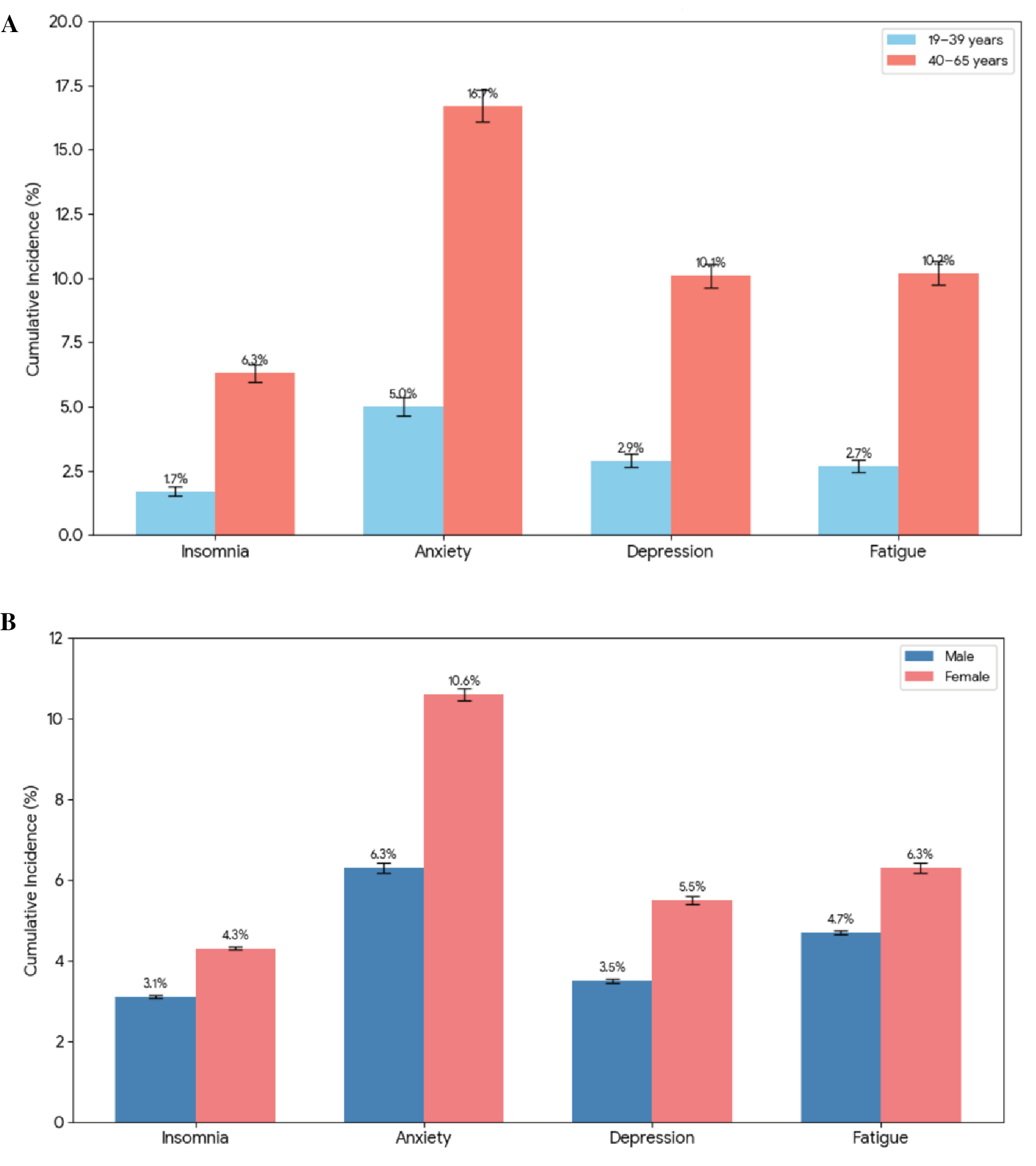
In the propensity-score-matched analysis comparing younger adults (19–39 years) with middle-aged adults (40–65 years) (Supplementary Table 3), middle-aged adults had substantially higher incidence of all conditions (Table 2 and Figure 2A).
Table 2 Age-stratified Incidence of Mental Health Conditions in Patients with Prediabetes
| Outcome | Age Group | At-Risk Cohort (n) | Incident Cases (n) | Cumulative Incidence (%) (95% CI) | Risk Ratio (19–39 vs. 40–65) (95% CI)a | P-Value | Log-Rank P-Valueb |
|---|---|---|---|---|---|---|---|
| Insomnia | 19–39 years | 18,397 | 313 | 1.7 (1.52–1.88) | 0.269 (0.238–0.304) | <0.001 | 0.046 |
| 40–65 years | 18,433 | 1,165 | 6.3 (5.95–6.65) | ||||
| Anxiety | 19–39 years | 13,131 | 654 | 5.0 (4.63–5.37) | 0.298 (0.274–0.324) | <0.001 | <0.001 |
| 40–65 years | 14,117 | 2,357 | 16.7 (16.08–17.32) | ||||
| Depression | 19–39 years | 15,435 | 455 | 2.9 (2.64–3.16) | 0.293 (0.265–0.324) | <0.001 | <0.001 |
| 40–65 years | 15,982 | 1,608 | 10.1 (9.64–10.56) | ||||
| Fatigue | 19–39 years | 16,794 | 451 | 2.7 (2.46–2.94) | 0.263 (0.238–0.292) | <0.001 | 0.010 |
| 40–65 years | 16,891 | 1,722 | 10.2 (9.75–10.65) |
CI: confidence interval; n: number of participants.
aRisk ratios were calculated with the compare outcomes analysis after propensity score matching. A risk ratio <1.0 indicates lower risk in younger adults (19–39 years) than middle-aged adults (40–65 years).
bLog-rank P-values from Kaplan-Meier survival analyses comparing age groups.
All analyses excluded patients with the outcome before the time window and required a 90-day washout period after prediabetes diagnosis. Propensity score matching was performed on sex, race, comorbidities, medication use, and laboratory values. After matching, 20,442 patients in each age group with balanced baseline characteristics (all standardized differences <0.1) were included. Follow-up differed between age groups (mean: 377 days vs. 1,686 days; median: 238 days vs. 1,542 days).
Figure 2 Incidence of mental health conditions in (A) age-stratified analysis and (B) sex-stratified analysis.
Sex-stratified analysis
In the propensity-score-matched analysis (Supplementary Table 4), women had substantially higher incidence of all conditions than men (Table 3 and Figure 2B).
Table 3 Sex-stratified Incidence of Mental Health Conditions in Patients with Prediabetes
| Outcome | Sex | At-Risk Cohort (n) | Incident Cases (n) | Cumulative Incidence (%) (95% CI) | Risk Ratio (Male vs. Female) (95% CI)a | P-Value | Log-Rank P-Valueb |
|---|---|---|---|---|---|---|---|
| Insomnia | Male | 189,677 | 5,929 | 3.1 (3.06–3.14) | 0.733 (0.703–0.750) | <0.001 | <0.001 |
| Female | 187,528 | 8,073 | 4.3 (4.26–4.34) | ||||
| Anxiety | Male | 156,883 | 9,823 | 6.3 (6.18–6.42) | 0.593 (0.579–0.608) | <0.001 | <0.001 |
| Female | 140,931 | 14,870 | 10.6 (10.44–10.76) | ||||
| Depression | Male | 176,785 | 6,171 | 3.5 (3.45–3.55) | 0.633 (0.612–0.652) | <0.001 | <0.001 |
| Female | 165,150 | 9,129 | 5.5 (5.39–5.61) | ||||
| Fatigue | Male | 179,148 | 8,444 | 4.7 (4.65–4.75) | 0.753 (0.733–0.775) | <0.001 | <0.001 |
| Female | 169,417 | 10,590 | 6.3 (6.18–6.42) |
CI: confidence interval; n: number of participants.
aRisk ratios were calculated with the compare outcomes analysis after propensity score matching. A risk ratio <1.0 indicates lower risk in men than women.
bLog-rank P-values from Kaplan-Meier survival analyses comparing men and women.
Note: All analyses excluded patients with the outcome before the time window and required a 90-day washout period after prediabetes diagnosis. Propensity score matching was performed on age, race, comorbidities, medication use, and laboratory values. After matching, 212,436 men and 212,436 women with balanced baseline characteristics (all standardized differences <0.1) were included.
Secondary race-stratified prevalence analysis
In a secondary exploratory analysis, the prevalence of mental health conditions varied among racial groups (Supplementary Table 5). White individuals had the highest observed prevalence of anxiety (44.42%), depression (30.51%), and insomnia (17.80%), whereas Asian individuals had the lowest observed prevalence of anxiety (21.96%), depression (11.19%), and insomnia (10.88%). These findings should be interpreted with caution, because they reflect unadjusted prevalence estimates and might have been influenced by differences in healthcare access, diagnostic practices, and cultural reporting patterns rather than true differences in disease burden.
Discussion
This large real-world cohort study involving 578,972 individuals with laboratory-confirmed prediabetes revealed an elevated prevalence of mental health conditions. Anxiety affected more than one-third of participants (37.8%), and was followed by depression (25.9%), fatigue (23.9%), and insomnia (15.7%). After application of a 90-day washout period to minimize reverse causality, and exclusion of prevalent cases, the cumulative incidence of new-onset conditions was 8.6% for anxiety, 4.8% for depression, 5.7% for fatigue, and 4.0% for insomnia over a median follow-up of 628 days. The incidence rates per 1,000 person-years were 34.9 for anxiety, 22.6 for depression, 20.5 for fatigue, and 12.9 for insomnia. The data indicated that mental health conditions are widespread in patients with prediabetes and occur at rates markedly exceeding those in the general population. The National Comorbidity Survey Replication (NCS-R) indicated 12-month prevalence rates of 18.1% for anxiety disorders and 9.5% for major depressive disorder among U.S. adults [10, 25].
This study is among the largest to thoroughly delineate the prevalence of several mental health conditions in a prediabetic cohort by using real-world EHR data. The National Health and Nutrition Examination Survey (NHANES) has estimated the prevalence of depression in the general adult population to be approximately 8%–10% [26]. The substantially elevated rates identified in our study indicated a bidirectional association between prediabetes and mental health conditions. Individuals diagnosed with prediabetes might encounter psychological distress because of their condition, the need for lifestyle changes, and the fear of progression to diabetes [15]. In contrast, depression and anxiety are recognized risk factors for the onset of insulin resistance and type 2 diabetes via neuroendocrine mechanisms, such as dysregulation of the hypothalamic-pituitary-adrenal axis, heightened inflammation, and autonomic dysfunction [13, 14].
Our age-stratified analysis, comparing younger adults (19–39 years) with middle-aged adults (40–65 years), revealed that middle-aged adults had substantially higher incidence of all conditions, with risk ratios ranging from 0.263 for fatigue to 0.298 for anxiety. This finding contrasted with those in our initial descriptive analysis, thus suggesting higher prevalence in younger age groups; however, the descriptive analysis did not account for differential follow-up time or exclude prevalent cases. After rigorous propensity score matching and application of a 90-day washout period, middle-aged adults demonstrated substantially higher incidence of new-onset mental health conditions. This pattern is particularly concerning, given the aging population with prediabetes and the cumulative metabolic burden in middle-aged adults [4, 27]. Kaplan-Meier survival analyses supported these findings, by indicating consistently lower survival probabilities (i.e., higher cumulative incidence) in middle-aged vs. younger adults across all outcomes. The survival probability at the end of follow-up was notably lower in middle-aged adults for fatigue (53.94% vs. 83.70%) and anxiety (55.72% vs. 53.45%), thereby indicating substantial long-term risk in this age group.
Our analysis indicated marked sex differences: women had substantially higher incidence of all mental health conditions than men, with risk ratios (male vs. female) ranging from 0.593 for anxiety to 0.754 for fatigue, in agreement with Global Burden of Disease data indicating 1.5×–2× greater female prevalence [9]. In prediabetes, factors include sex differences in glucose metabolism and insulin sensitivity [28], greater weight and body-image psychological burden in women than men [29], and mood effects from hormonal fluctuations interacting with glycemic dysregulation [30]. These findings underscore the need for routine mental health screening in women with prediabetes, particularly during reproductive transitions. Kaplan-Meier analyses confirmed these sex differences, by indicating substantially lower survival probabilities in women than men for all outcomes (all log-rank P < 0.001).
In secondary exploratory analyses, we observed variations in the prevalence of mental health conditions across racial groups. White individuals had the highest observed prevalence, whereas Asian individuals had the lowest. However, these findings must be interpreted with considerable caution for several reasons. First, these unadjusted prevalence estimates do not account for differences in healthcare utilization, socioeconomic status, or other confounders. Second, lower recorded prevalence in minority populations might reflect underdiagnosis rather than truly lower disease burden, because minority populations often receive fewer mental health diagnoses than non-minority populations despite comparable symptom severity [24, 31]. Third, data on healthcare utilization (e.g., the number of outpatient visits and mental health service use) to formally test these explanations were lacking. Therefore, we do not interpret these findings as evidence of differential risk but as observed differences in recorded diagnoses that warrant further investigation.
We acknowledge that fatigue (ICD-10-CM: R53.83) is a non-specific symptom rather than a distinct mental health disorder. In clinical practice, fatigue can be caused by various conditions including anemia, heart failure, hypothyroidism, malignancies, or medication adverse effects. However, fatigue was included in this analysis because (1) it is a prominent and frequently documented concern in patients with prediabetes; (2) it might reflect underlying depression, anxiety, insomnia, or metabolic dysfunction; and (3) understanding fatigue patterns in this population is clinically relevant for guiding comprehensive patient assessment. Nevertheless, we have revised the terminology herein to refer to “conditions” rather than “mental health disorders” when discussing fatigue together with the other outcomes. Fatigue was prevalent in our population (23.9%) and warrants clinical attention. It might stem from prediabetes-related mechanisms, such as glucose fluctuation, insulin resistance-induced mitochondrial dysfunction, or low-grade inflammation [32], or it might reflect underlying depression, anxiety, or insomnia, given their frequent comorbidity [33]. The observed correlation with these mental health conditions in our cohort indicated symptom overlap and syndemic interactions. Therefore, clinicians evaluating fatigue in prediabetes should screen for concurrent mental health and sleep disturbances rather than attributing it solely to metabolic dysfunction [34].
Strengths and limitations
This study’s strengths include its large sample size (n = 578,972), which enabled precise estimation of the incidence and prevalence of mental health conditions across demographic subgroups; the use of real-world EHR data reflecting standard clinical practice; the laboratory validation of prediabetes through HbA1c criteria; the comprehensive assessment of four outcomes; and the application of a 90-day washout period to enhance temporal plausibility. The calculation of incidence rates per 1,000 person-years with 95% confidence intervals provides an interpretable measure of disease frequency that accounts for variable follow-up times. This study is among the first to simultaneously examine age- and sex-specific patterns of multiple conditions in a prediabetic cohort.
Several study limitations should be acknowledged. The retrospective, observational approach prevents causal inferences from being drawn regarding the directions of relationships between prediabetes and mental health conditions. Second, the use of ICD-10-CM codes for outcome determination might have been prone to misclassification bias, because mental health conditions are frequently underdiagnosed or inadequately classified in standard clinical practice, particularly in primary care environments [24]. Third, the TriNetX database lacks standardized, validated instruments (e.g., the Patient Health Questionnaire-9 for depression or Generalized Anxiety Disorder-7 for anxiety), thus potentially leading to underestimation of the actual prevalence. Fourth, we were unable to account for many possible confounders, such as socioeconomic status, physical activity, diet, educational attainment, health insurance coverage, and social support systems, all of which are recognized predictors of mental health [25]. Fifth, we lacked data on the duration of prediabetes, glycemic trajectory (progression vs. regression), or treatment modalities (e.g., lifestyle interventions), which might potentially have influenced mental health risk [26]. Sixth, we lacked data on healthcare utilization (e.g., the number of outpatient visits and mental health service use) to assess detection bias across racial/ethnic groups, which remains an important area for future research. Seventh, fatigue (R53.83) is a non-specific symptom rather than a distinct mental health disorder, and its inclusion as an outcome might potentially have diluted the specificity of our findings regarding mental health conditions. Eighth, the race-stratified findings should be interpreted with caution, because differences in recorded prevalence might reflect disparities in healthcare access, diagnostic practices, cultural reporting patterns, or EHR capture rather than true differences in disease burden. Given the nature of the platform, a race-stratified incidence analysis could not be performed; however, a secondary race-stratified prevalence analysis was feasible and was conducted. Ninth, the age-stratified analysis after propensity score matching had differential follow-up between groups (mean: 377 days for patients 19–39 years of age vs. 1,686 days for patients 40–65 years of age), which might have partially explained the higher observed incidence in middle-aged than younger adults.
Despite these limitations, our results have substantial clinical and public health ramifications. The high observed prevalence of depression, anxiety, insomnia, and fatigue among patients with prediabetes indicated that regular mental health assessments should be incorporated into prediabetes management protocols. The American Diabetes Association’s current guidelines advocate for screening for diabetes distress, depression, and anxiety in patients with diabetes, although they offer less definitive recommendations for groups with prediabetes [27]. Our findings support the expansion of these recommendations to encompass patients with prediabetes, particularly middle-aged adults and women, who appear to have the greatest risk.
Integrated care strategies that concurrently address metabolic and mental health conditions in primary care environments have potential to enhance clinical results and quality of life [35]. Moreover, lifestyle interventions for prediabetes, such as dietary changes and increased physical activity, have been demonstrated to effectively alleviate depressive symptoms and enhance psychological well-being; therefore, the reciprocal relationship between prediabetes and mental health might be modifiable through integrated interventions [36].
In conclusion, mental health conditions were found to affect more than one-third of adults with prediabetes, among which anxiety was the most common. middle-aged adults (40–65 years) and women had the highest observed incidence. The application of a 90-day washout period and person-time adjusted incidence rates strengthened the validity of these estimates. Routine mental health screening in prediabetes care is warranted, particularly among middle-aged adults and women. Integrated care approaches addressing both metabolic and psychological health have potential to improve clinical outcomes and quality of life in this growing population.
Data availability statement
The study’s original contributions are detailed in the article and Supplementary Material. Inquiries should be directed to the corresponding author.
Ethics statement
This research used completely de-identified data. The TriNetX platform has obtained a waiver of informed consent from the Western Institutional Review Board, because it only compiles de-identified data. This study protocol was also approved by the Health Research Ethics Committee, Faculty of Medicine, Halu Oleo University, Indonesia (number 160/UN29.20.2/ETIK/2025).
Author contributions
Faizul Hasan and Muhammad Solihuddin Muhtar contributed to conceptualization, investigation, data curation, formal analysis, project administration, and manuscript drafting and revision. Faizul Hasan additionally handled resources, funding acquisition, and writing—original draft preparation. Muhammad Solihuddin Muhtar additionally contributed to visualization. Mustafa al’Absi contributed to manuscript revision and language editing. Rusdi Bin ABD Rashid and Dina Nur Anggraini Ningrum supervised the project and contributed to manuscript revision. All authors reviewed the manuscript, approved the final version, and agreed to be accountable for the content of the work.
Funding
This research was supported by the Exchange Faculty Travel Grant. Ratchadaphiseksomphot Endowment Fund for Fiscal Year 2025 (B.E. 2568) no. TG169004.
Acknowledgement
None.
Conflict of interest
The authors declare that there are no conflicts of interest.
Supplementary materials
Supplementary data associated with this article are available online https://bio-integration.org/wp-content/uploads/2026/09/bioi20260081_Supplemental.zip.
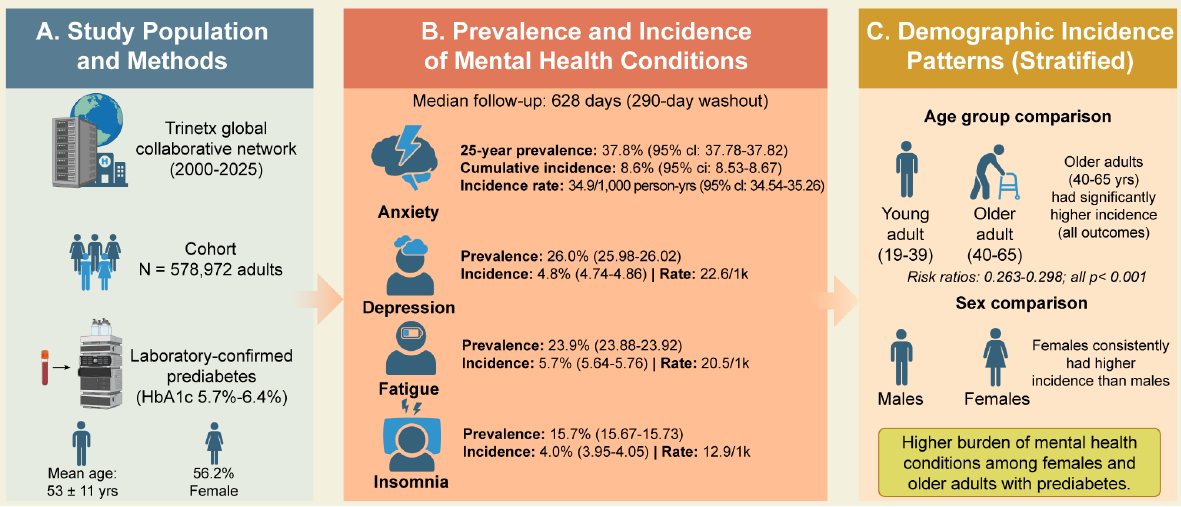
Graphical abstract
Highlights
- The mental health burden in prediabetes remains poorly characterized. We examined the prevalence and incidence of insomnia, fatigue, anxiety, and depression in 578,972 adults with laboratory-confirmed prediabetes.
- Anxiety was the most common condition (37.78% prevalence; 8.6% cumulative incidence), and was followed by depression, fatigue, and insomnia.
- The highest observed incidence of these four conditions was among middle-aged adults (40–65 years) and women.
- Routine mental health screening is warranted in prediabetes care, particularly for middle-aged adults and women.
In brief
In this real-world cohort of 578,972 adults with prediabetes, more than one-third had mental health conditions, among which anxiety (37.8%) and depression (26.0%) were most prevalent. Over ~1.7 years, new-onset anxiety, depression, fatigue, and insomnia were frequent (12.9–34.9 per 1,000 person-years). middle-aged adults (40–65 years) and women had substantially elevated incidence. The prevalence was highest in White individuals and lowest in Asian individuals. The findings support routine mental health screening in prediabetes care, particularly for middle-aged adults and women.
References
- Genitsaridi I, Salpea P, Salim A, Sajjadi SF, Tomic D, et al. 11th edition of the IDF Diabetes Atlas: global, regional, and national diabetes prevalence estimates for 2024 and projections for 2050. Lancet Diabetes Endocrinol 2026;14(2):149-56. [PMID: 41412135 DOI: 10.1016/S2213-8587(25)00299-2]
- Ogurtsova K, Guariguata L, Barengo NC, Ruiz PL, Sacre JW, et al. IDF diabetes Atlas: global estimates of undiagnosed diabetes in adults for 2021. Diabetes Res Clin Pract 2022;183:109118. [PMID: 34883189 DOI: 10.1016/j.diabres.2021.109118]
- Rooney MR, Fang M, Ogurtsova K, Ozkan B, Echouffo-Tcheugui JB, et al. Global prevalence of prediabetes. Diabetes Care 2023;46(7):1388-94. [PMID: 37196350 DOI: 10.2337/dc22-2376]
- Andes LJ, Cheng YJ, Rolka DB, Gregg EW, Imperatore G. Prevalence of prediabetes among adolescents and young adults in the United States, 2005-2016. JAMA Pediatr 2020;174(2):e194498. [PMID: 31790544 DOI: 10.1001/jamapediatrics.2019.4498]
- Tabák AG, Herder C, Rathmann W, Brunner EJ, Kivimäki M. Prediabetes: a high-risk state for diabetes development. Lancet 2012;379(9833):2279-90. [PMID: 22683128 DOI: 10.1016/S0140-6736(12)60283-9]
- Unnikrishnan R, Shaw JE, Chan JCN, Wild SH, Peters AL, et al. Prediabetes. Nat Rev Dis Primers 2025;11(1):49. [PMID: 40676018 DOI: 10.1038/s41572-025-00635-0]
- Huang Y, Cai X, Mai W, Li M, Hu Y. Association between prediabetes and risk of cardiovascular disease and all cause mortality: systematic review and meta-analysis. BMJ 2016;355:i5953. [PMID: 27881363 DOI: 10.1136/bmj.i5953]
- Warren B, Pankow JS, Matsushita K, Punjabi NM, Daya NR, et al. Comparative prognostic performance of definitions of prediabetes: aprospective cohort analysis of the Atherosclerosis Risk in Communities (ARIC) study. Lancet Diabetes Endocrinol 2017;5(1):34-42. [PMID: 27863979 DOI: 10.1016/S2213-8587(16)30321-7]
- GBD 2019 Mental Disorders Collaborators. Global, regional, and national burden of 12 mental disorders in 204 countries and territories, 1990–2019: a systematic analysis for the Global Burden of Disease Study 2019. Lancet Psychiatry 2022;9(2):137-50. [PMID: 35026139 DOI: 10.1016/S2215-0366(21)00395-3]
- Kessler RC, Petukhova M, Sampson NA, Zaslavsky AM, Wittchen H-U. Twelve-month and lifetime prevalence and lifetime morbid risk of anxiety and mood disorders in the United States. Int J Methods Psychiatr Res 2012;21(3):169-84. [PMID: 22865617 DOI: 10.1002/mpr.1359]
- Morin CM, Buysse DJ. Management of insomnia. N Engl J Med 2024;391(3):247-58. [PMID: 39018534 DOI: 10.1056/NEJMcp2305655]
- Liu D, McIntyre RS, Li R, Yang M, Xue Y, et al. Genetic association between major depressive disorder and type 2 diabetes mellitus: shared pathways and protein networks. Prog Neuropsychopharmacol Biol Psychiatry 2021;111:110339. [PMID: 33915220 DOI: 10.1016/j.pnpbp.2021.110339]
- Moulton CD, Pickup JC, Ismail K. The link between depression and diabetes: the search for shared mechanisms. Lancet Diabetes Endocrinol 2015;3(6):461-71. [PMID: 25995124 DOI: 10.1016/S2213-8587(15)00134-5]
- Joseph JJ, Golden SH. Cortisol dysregulation: the bidirectional link between stress, depression, and type 2 diabetes mellitus. Ann N Y Acad Sci 2017;1391(1):20-34. [PMID: 27750377 DOI: 10.1111/nyas.13217]
- Coccaro EF, Lazarus S, Joseph J, Wyne K, Drossos T, et al. Emotional regulation and diabetes distress in adults with type 1 and type 2 diabetes. Diabetes Care 2021;44(1):20-5. [PMID: 33444157 DOI: 10.2337/dc20-1059]
- Mangoulia P, Milionis C, Vlachou E, Ilias I. The interrelationship between diabetes mellitus and emotional well-being: current concepts and future prospects. Healthcare (Basel) 2024;12(14):1457. [PMID: 39057600 DOI: 10.3390/healthcare12141457]
- Anderson RJ, Freedland KE, Clouse RE, Lustman PJ. The prevalence of comorbid depression in adults with diabetes: a meta-analysis. Diabetes Care 2001;24(6):1069-78. [PMID: 11375373 DOI: 10.2337/diacare.24.6.1069]
- Koyama AK, Hora IA, Bullard KM, Benoit SR, Tang S, et al. State-specific prevalence of depression among adults with and without diabetes—United States, 2011–2019. Prev Chronic Dis 2023;20:E70. [PMID: 37562067 DOI: 10.5888/pcd20.220407]
- Magkos F, Hjorth MF, Astrup A. Diet and exercise in the prevention and treatment of type 2 diabetes mellitus. Nat Rev Endocrinol 2020;16(10):545-55. [PMID: 32690918 DOI: 10.1038/s41574-020-0381-5]
- Luo C, Yu XM, Zeng MQ, Duan CZ, Xu SY, et al. Breaking the diabetes-depression cycle: exploring shared mechanisms, neuroinflammation, and emerging interventions for metabolic-mood comorbidities. World J Diabetes 2025;16(7):107406. [PMID: 40697597 DOI: 10.4239/wjd.v16.i7.107406]
- Lascar N, Brown J, Pattison H, Barnett AH, Bailey CJ, et al. Type 2 diabetes in adolescents and young adults. Lancet Diabetes Endocrinol 2018;6(1):69-80. [PMID: 28847479 DOI: 10.1016/S2213-8587(17)30186-9]
- Albert PR. Why is depression more prevalent in women? J Psychiatry Neurosci 2015;40(4):219-21. [PMID: 26107348 DOI: 10.1503/jpn.150205]
- Kuehner C. Why is depression more common among women than among men? Lancet Psychiatry 2017;4(2):146-58. [PMID: 27856392 DOI: 10.1016/S2215-0366(16)30263-2]
- Cook BL, Trinh NH, Li Z, Hou SS, Progovac AM. Trends in racial-ethnic disparities in access to mental health care, 2004–2012. Psychiatr Serv 2017;68(1):9-16. [PMID: 27476805 DOI: 10.1176/appi.ps.201500453]
- Kessler RC, Berglund P, Demler O, Jin R, Merikangas KR, et al. Lifetime prevalence and age-of-onset distributions of DSM-IV disorders in the National Comorbidity Survey Replication. Arch Gen Psychiatry 2005;62(6):593-602. [PMID: 15939837 DOI: 10.1001/archpsyc.62.6.593]
- Brody DJ, Pratt LA, Hughes JP. Prevalence of depression among adults aged 20 and over: United States, 2013–2016. Hyattsville, MD: US Department of Health and Human Services, Centers for Disease Control and Prevention; 2018.
- Echouffo-Tcheugui JB, Perreault L, Ji L, Dagogo-Jack S. Diagnosis and management of prediabetes: a review. JAMA 2023;329(14):1206-16. [PMID: 37039787 DOI: 10.1001/jama.2023.4063]
- Mauvais-Jarvis F. Gender differences in glucose homeostasis and diabetes. Physiol Behav 2018;187:20-3. [PMID: 28843891 DOI: 10.1016/j.physbeh.2017.08.016]
- Doğan H, Çaltekin MD. Does polycystic ovary syndrome with phenotype D affect the cardiovascular endurance, core endurance, body awareness, and the quality of life? A prospective, controlled study. Turk J Obstet Gynecol 2021;18(3):203-11. [PMID: 34580552 DOI: 10.4274/tjod.galenos.2021.72547]
- Yılmazer E. Hormonal underpinnings of emotional regulation: bridging endocrinology and psychology. J Neuro Sci 2024;11(2):60-75. [DOI: 10.32739/uha.jnbs.11.1539123]
- Alegria M, Vallas M, Pumariega A. Racial and ethnic disparities in pediatric mental health. Child Adolesc Psychiatr Clin N Am 2010;19(4):759-74. [PMID: 21056345 DOI: 10.1016/j.chc.2010.07.001]
- Kalra S, Sahay R. Diabetes fatigue syndrome. Diabetes Ther 2018;9(4):1421-9. [PMID: 29869049 DOI: 10.1007/s13300-018-0453-x]
- Jiang X, Wang X, Liu B, Yu L, He J, et al. Associations of depression, anxiety, and insomnia symptoms in subthreshold depression: a network analysis. BMC Psychiatry 2025;25(1):970. [PMID: 41074002 DOI: 10.1186/s12888-025-07437-4]
- Topaloğlu US, Erol K. Fatigue, anxiety and depression in patients with prediabetes: a controlled cross-sectional study. Diabetol Int 2022;13(4):631-6. [PMID: 36117928 DOI: 10.1007/s13340-022-00583-0]
- Kalmbach DA, Anderson JR, Drake CL. The impact of stress on sleep: pathogenic sleep reactivity as a vulnerability to insomnia and circadian disorders. J Sleep Res 2018;27(6):e12710. [PMID: 29797753 DOI: 10.1111/jsr.12710]
- Oh MS, Bliwise DL, Smith AL, Collop NA, Quyyumi AA, et al. Obstructive sleep apnea, sleep symptoms, and their association with cardiovascular disease. Laryngoscope 2020;130(6):1595-602. [PMID: 31532856 DOI: 10.1002/lary.28293]