


Low-intensity Pulsed Ultrasound (LIPUS) Modulates Organ Function via Meridian Mechanisms: A Systematic Review
1Department of Acupuncture and Moxibustion, Yueyang Hospital of Integrated Traditional Chinese and Western Medicine, Shanghai University of TCM, Shanghai 200437, China
2Department of Integrative Medicine, Huashan Hospital, Fudan University, Shanghai, China
3Department of Orthopaedic Surgery, Yong Loo Lin School of Medicine, National University of Singapore, Singapore
4Fudan University – Dr. Kong Joint Research Center for Sports Medicine and Health Footwear, Fudan University Institute of Sports Medicine (Jinqiao Laboratory), Shanghai, China
5Department of Sports Medicine, Huashan Hospital, Fudan University, Shanghai, China
6Fudan Zhangjiang Institute, Fudan University, Shanghai, China
7Department of Orthopaedics, Jiaxing Key Laboratory of Basic Research and Clinical Translation on Orthopedic Biomaterials, The Second Affiliated Hospital of Jiaxing University (Sports Hospital of Jiaxing), 1518 North Huancheng Road, Jiaxing 314000, PR China
8Department of Orthopedics, Ward 5, 11th Floor, Surgery Building, Nanjing Jinling Hospital, Affiliated Hospital of Medical School, Nanjing University, 305 Zhongshan East Road, Xuanwu District Nanjing, Jiangsu Province 210002, China
aThese authors make equal contributions to this work.
*Correspondence to: Zhiwen Luo, BSc (Hons), M.D., Ph.D., Academic Director of Sports Hospital of Jiaxing, Zhejiang, China; Academic Director, Fudan University – Dr. Kong Joint Research Center for Sports Medicine and Health Footwear, Shanghai, China; Department of Sports Medicine, Huashan Hospital, Fudan University, No. 12 Wulumuqi Zhong Road, Shanghai, China. E-mail: zhiwen.luo_fudan@hotmail.com; Jing Li, M.D., Ph.D., Department of Acupuncture, Yueyang Hospital of Integrated Traditional Chinese and Western Medicine, Shanghai University of Traditional Chinese Medicine, Shanghai, PR China. E-mail: LIJINGacu@126.com; Zhang Ting, M.D., Ph.D., Department of Integrated Medicine, Huashan Hospital, Fudan University, 12 Middle Wulumuqi Road, Shanghai, China. E-mail: cczthd18@gmail.com
Received: November 4 2025; Revised: January 16 2026; Accepted: January 31 2026; Published Online: April 1 2026
Cite this paper:
Li X, Feng K, Hu Z et al. Low-intensity Pulsed Ultrasound (LIPUS) Modulates Organ Function via Meridian Mechanisms: A Systematic Review. BIO Integration 2026; 7: 1–16.
DOI: 10.15212/bioi-2025-0196. Available at: https://bio-integration.org/
Download citation
© 2026 The Authors. This is an open access article distributed under the terms of the Creative Commons Attribution License (https://creativecommons.org/licenses/by/4.0/). See https://bio-integration.org/copyright-and-permissions/
Abstract
Low-intensity pulsed ultrasound (LIPUS) provides a non-invasive, quantifiable, and deep stimulation method for acupoints, offering a promising alternative to manual acupuncture. This review summarizes evidence indicating the efficacy of LIPUS in regulating internal organ functions via meridian-based mechanisms, demonstrating improvements in gastrointestinal motility, reducing inflammation, and enhancing tissue regeneration. Mechanistically, LIPUS acts through multiple pathways, including neural, immune, and cellular pathways, sharing common ground with acupuncture, while differing in its biomechanical mode of action. Despite encouraging results, variations in treatment parameters and a paucity of large-scale randomized trials limit broader clinical use. By bridging traditional meridian theory with biophysical principles, LIPUS exemplifies a modernized strategy for complementary medicine. Future well-controlled studies are essential to establish standardization and validate therapeutic applicability.
Keywords
Acupuncture, low-intensity pulsed ultrasound (LIPUS), meridian.
Introduction
Low-intensity pulsed ultrasound (LIPUS) is a type of medium-frequency ultrasound (0.7–3 MHz) that operates in pulsed wave mode (100–1000 Hz) and is applied at a significantly lower intensity (<3 W/cm2) compared to conventional ultrasound [1]. The distinctive feature of LIPUS lies in the strictly controlled low-energy output, which mainly elicits non-thermal biological effects rather than thermal effects [2]. The acoustic energy propagates through soft tissues to generate mechanical stimulation at the cellular level, including membrane deformation, ion channel activation, and cytoskeletal remodeling. These subcellular alterations subsequently trigger intracellular signaling cascades that regulate gene expression and protein synthesis, ultimately influencing cellular proliferation, differentiation, and tissue regeneration processes [3–6].
LIPUS demonstrates a wide range of therapeutic potential, most notably in promoting bone healing and exerting anti-inflammatory effects [1, 7–9]. In recent years evidence has also supported the therapeutic effects and mechanisms underlying LIPUS on neurodegenerative and surgical diseases [10–14]. Furthermore, LIPUS can modulate visceral function through superficial stimulation, particularly via acupoints, highlighting the potential for systemic and remote therapeutic effects. LIPUS offers advantages, including quantifiable stimulation parameters, controlled energy delivery, and non-invasive deep tissue penetration, compared to manual acupuncture. These features highlight the role of LIPUS as a technological advance that may facilitate the modernization of traditional Chinese medicine (TCM).
The TCM meridian system, a complex network all over the body, serves as the conduit for Qi-blood circulation and visceral communication. Contemporary anatomic studies have revealed that acupoints are specialized anatomic regions that are characterized by dense nerve endings, mast cell aggregations, and extensive capillary networks [15, 16]. Acupuncture exerts multifaceted therapeutic effects by applying mechanical stimulation to these acupoints through the coordinated regulation of the nervous, endocrine, and immune systems [17]. Importantly, these three systems do not function independently but interact dynamically, forming an integrated network that maintains physiologic homeostasis. This integrated neuro-endocrine-immune regulatory network provides a scientific framework for understanding acupoint-mediated visceral modulation.
This study summarized the existing evidence on the combination of LIPUS and acupoint stimulation, systematically evaluated the clinical efficacy and underlying biological mechanisms, and integrated TCM meridian theory with modern biophysics. By expanding the therapeutic scope of LIPUS beyond musculoskeletal disorders to visceral dysfunction, this study will identify promising research directions and provide evidence-based strategies for chronic diseases. This interdisciplinary approach is expected to advance the integration and modernization of TCM within contemporary healthcare frameworks.
Methods
Search strategy
A systematic search was performed in PubMed, Embase, Web of Science, China National Knowledge Infrastructure (CNKI), the Chinese Science and Technology Periodicals database (VIP), and the Wanfang database that covered the period from the inception of each database to 25 August 2025 with no language restrictions. The search strategy was developed with expert assistance and included two terms: “LIPUS”; and “acupuncture”. The detailed search strategy is included in the Supplementary Materials. To improve comprehensiveness, supplementary retrieval was performed by tracing reference lists of the included studies and screening core reviews in the field, which further refined the literature pool. Targeted literature retrieval was performed in the Web of Science and CNKI for the analysis of publication trends related to acupuncture and LIPUS. Publication trend visualization was implemented using R software (version 4.3.1) with generalized additive models embedded in the ggplot2 package to fit approximate curves for publication volumes, thereby characterizing the temporal trends of research output.
Inclusion and exclusion criteria
Studies meeting the following criteria were included: (a) clinical studies involving human participants; (b) participants who were treated with LIPUS, which was defined as medium-frequency ultrasound (0.7–3 MHz) operating in the pulsed wave mode (100–1000 Hz) at a low intensity (<3 W/cm2); and (c) application of LIPUS to acupoints or meridians in the human body. No restrictions were imposed regarding age, gender, disease stage, co-morbidities, or prior treatments.
Studies meeting the following criteria were excluded: (a) systematic review or meta-analysis; (b) studies from which greater than two required information elements could not be extracted; and (c) duplicate publications or overlapping datasets.
Literature screening
Duplicate records were automatically removed by EndNote 20. Two independent reviewers (XRL and KLF) screened the studies based on the predefined inclusion and exclusion criteria. The titles and abstracts were skimmed to identify potentially eligible articles. Irrelevant studies were excluded and the remaining full texts were further assessed for relevance.
Data extraction
A data extraction form, including authors, year, sample size, study design, treatment, acupoints, frequency, intensity, duration, RoB tool, overall bias, outcomes, and conclusion, was built to keep a record of the main characteristics of the included studies. Data extraction was performed independently by two reviewers (XRL and ZFH) with references managed using EndNote 20. Disagreements between reviewers were first resolved by discussion and an additional reviewer (TZ) was consulted when necessary.
Risk of bias assessment
The risk of bias for the included studies was assessed using standardized tools appropriate to each study design. The SYstematic Review Centre for Laboratory animal Experimentation (SYRCLE) risk-of-bias tool was used for randomized controlled animal experiments. This tool was specifically designed for in vivo experiments and evaluates 10 domains, including selection, performance, detection, attrition, and reporting biases [18]. The revised Cochrane risk-of-bias tool for randomized trials was used for randomized controlled trials to assess bias across five domains: randomization process; deviations from intended interventions; missing outcome data; measurement of the outcome; and selection of the reported result [19]. The Risk Of Bias In Non-randomized Studies – of Interventions (ROBSIN-I) tool was applied for non-randomized controlled trials to evaluate bias across seven domains, such as confounding, participant selection, classification of interventions, and deviations from intended interventions [20]. Two reviewers (XRL and CCY) independently conducted the assessments. Disagreements were initially resolved through discussion and if consensus could not be reached, a third reviewer (JL) was consulted for arbitration.
Results
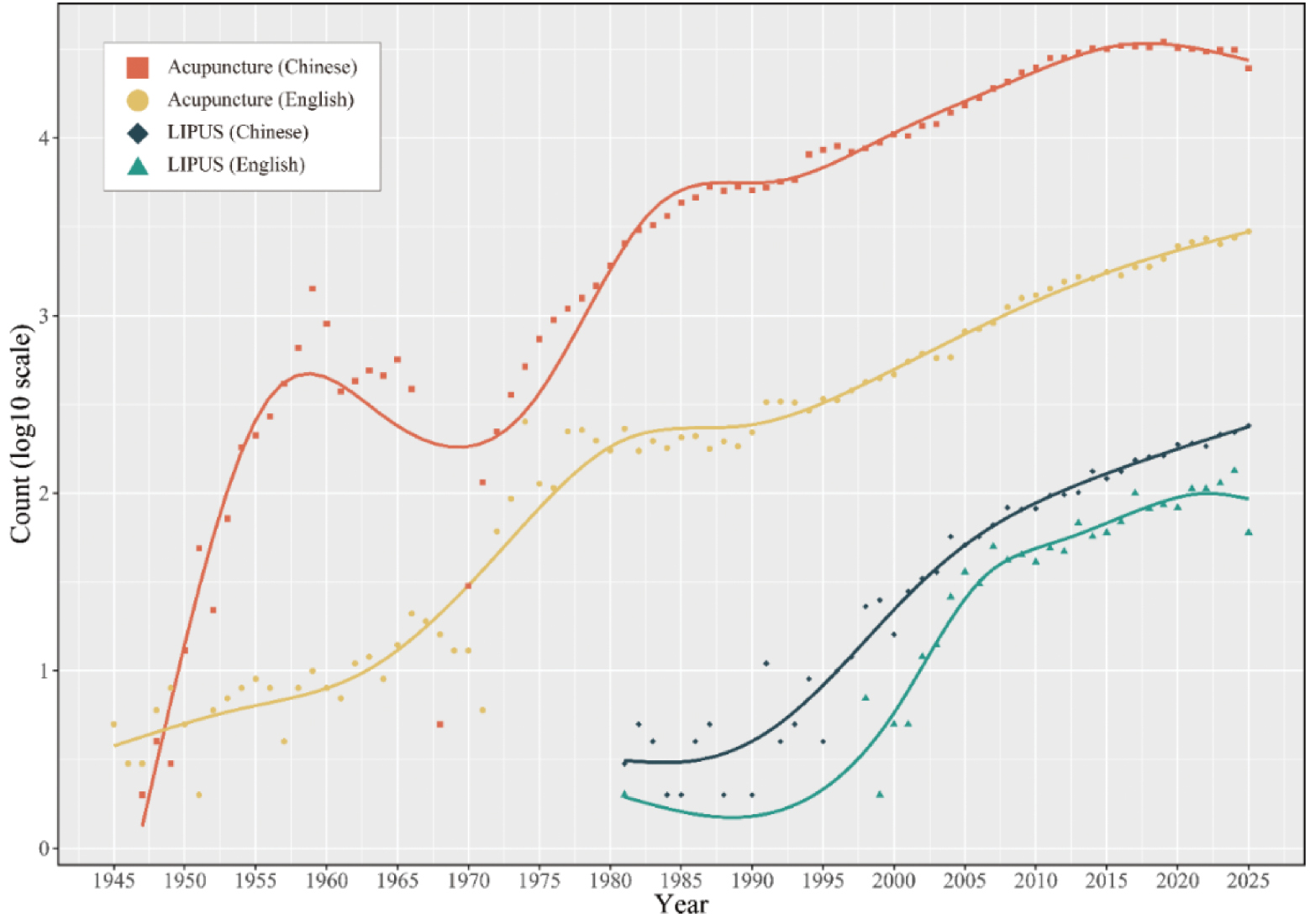
LIPUS publication trends and acupuncture research were systematically examined in the English and Chinese academic literature in Figure 1. Acupuncture-related Chinese publications with the largest publication volume underwent three phases: a low-output period with <500 papers annually before 1980; an accelerated expansion with a compound annual growth rate 8.42% from 1980–2015; and a stable phase after 2015. English publications on acupuncture maintained steady growth from 1990, although emerging later, with an average annual growth rate of 7.73%. Both the Chinese and English literature showed consistent LIPUS growth with notable publication acceleration. The acupuncture field demonstrates a substantial and maturing research base, whereas LIPUS-related research remains in a developmental stage. These distinct developmental stages highlight opportunities for interdisciplinary collaboration between the two fields.
Figure 1 Trends in the year of publication. The year of publication is shown on the x-axis. The annual publication count is displayed on a common logarithmic scale on the y-axis to facilitate visual comparison of growth trends despite the large disparity in absolute numbers.
The PRISMA flow diagram (Figure 2) illustrates the systematic screening process for the six included studies in Table 1. These studies, published between 1987 and 2024, primarily focused on the ST36 (Zusanli) acupoint. Specifically, one study investigated the REN4 (Guanyuan) and REN6 (Qihai) acupoints, while another study explored the combined effect of ST25 (tianshu) and ST36 (Zusanli). Data extraction was incomplete for one dataset in two of the studies, potentially due to the earlier implementation of these experiments when standardized protocols had not yet been established. Among the successfully extracted data, all studies adopted LIPUS parameters within the defined range (0.5–1.1 MHz; 0.5–1 W/cm2), with each treatment session lasting 5–20 min.
Figure 2 Flow diagram of the study selection process.
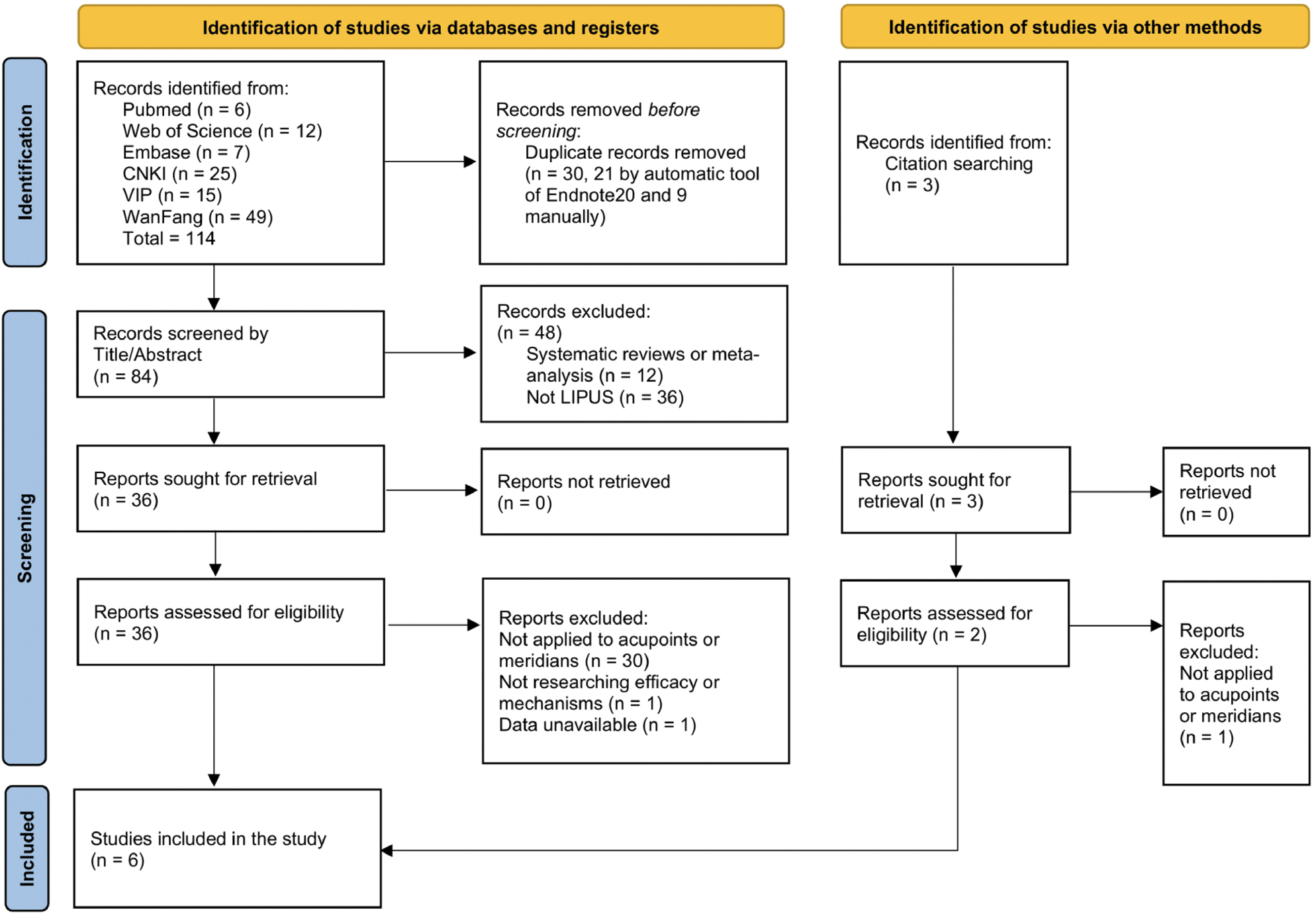
Table 1 Summary of Studies on LIPUS Combined with Acupoint Stimulation
| No. | Author | Year | Sample Size | Study Design | Treatment | Acupoints | Frequency | Intensity | Duration | RoB Tool | Overall Bias | Outcomes | Conclusion |
|---|---|---|---|---|---|---|---|---|---|---|---|---|---|
| 1 | Han et al. [22] | 2023 | 30 | Randomized controlled animal experiment | LIPUS | Bilateral ST36 | 1.1 MHz | 0.88 W/cm2 | 20 min/day for 2 weeks | SRYCLE | Low | Glucose tolerance, gastric emptying rate, gastric motility, the levels of c-Kit, TNF-α, p-NF-κB p-65, NF-κB p-65, and p-IKKβ, IKKβ | Improves gastric motility |
| 2 | Han et al. [23] | 2024 | 30 | Randomized controlled animal experiment | LIPUS | Bilateral ST36 | 1.1 MHz | 0.88 W/cm2 | 20 min/day, 5 times/week for 4 weeks | SRYCLE | Low | Gastric emptying rate, GSMC contraction ability, the level of related proteins/mRNAs | Improves gastric motility |
| 3 | Han et al. [26] | 2024 | 16 | Randomized controlled animal experiment | LIPUS | Bilateral ST36 | 1.1 MHz | 0.88 W/cm2 | 20 min | SRYCLE | Moderate | Tension changes, 5-HT levels | Alters the muscle tone of the surrounding tissue |
| 4 | Othman et al. [25] | 2023 | 66 | Randomized controlled trial | LIPUS (+bee venom) | REN4 and REN6 | 0.5 MHz | 0.5 W/cm2 | 5 min/day, 3 days/week for 3 weeks | Cochrane | Some concern | VAS, CRP, hip ROM | Relieves pain, inflammation, and improves range of motion |
| 5 | Li et al. [21] | 2011 | 32 | Randomized controlled animal experiment | LIPUS | Bilateral ST36 | 1 MHz | – | 20 min/day for 1 week | SRYCLE | High | The prostaglandin E2 level, index of gastric mucosa lesion | Treats gastric mucosal damage |
| 6 | Jin et al. [24] | 1987 | 56 | Non-randomized controlled trial | LIPUS | Bilateral ST36 or ST25 | – | 0.7~1 W/cm2 | 2 min/acupoint | ROBINS-I | High | Intestinal peristalsis frequency and bowel sounds | Suppresses excessive intestinal peristalsis |
The results of the risk of bias assessment are also summarized in Table 1. Among the six included studies and the four randomized controlled animal experiments assessed using the SYRCLE tool, two studies were judged as “Low” risk, one as “Moderate” risk, and one as “High” risk due to factors, such as the lack of blinding in experimental designs. The single randomized controlled trial, which was assessed using the RoB 2.0 tool, was rated as having “Some concerns,” primarily arising from the selection of the reported result. The single non-randomized controlled trial assessed with the ROBINS-I tool was judged as “High” risk because the study was early with limitations in design and reporting. Overall, the methodologic quality of the included studies was heterogeneous, necessitating caution in interpreting the efficacy conclusions and highlighting the need for more rigorous designs in future research. The detailed information for each domain assessment is available in Supplementary Material 3.
The six included studies collectively demonstrated the therapeutic efficacy of LIPUS when applied to specific acupoints, covering multiple clinical application fields. In terms of gastrointestinal regulation, LIPUS application at ST36 has been shown to treat gastric mucosal damage in human trials [21] and to delay the recovery time of gastric emptying and enhance gastric function in diabetic rats [22, 23], achieving therapeutic effects comparable to acupuncture needles. For intestinal function regulation, LIPUS stimulation at bilateral ST36 or bilateral ST25 acupoints inhibit hyperactive intestinal peristalsis and normalize intestinal function [24]. In terms of postoperative rehabilitation, the combined application of LIPUS and bee venom at REN4 and REN6 significantly alleviate hip joint pain, reduce inflammation, and improve the range of motion of the joint after surgery [25]. Mechanistically, LIPUS stimulation at ST36 induced measurable changes in muscle tension around the acupoint, resembling the “de qi” sensation observed in traditional acupuncture [26].
Notably, three of the six studies used consistent parameters (1.1 MHz, 0.88 W/cm2, and 20-min sessions), suggesting a potential standardization for clinical protocols. However, studies adopting other frequencies, intensities, or shorter treatment durations also demonstrated efficacy. These findings collectively highlight the capacity of LIPUS to modulate localized tissue mechanics and systemic physiologic functions through acupoint-related pathways.
Discussion
Therapeutic spectrum of LIPUS in multiple diseases
LIPUS has emerged as a promising non-invasive therapeutic modality with substantial therapeutic potential across multiple disease systems. The LIPUS applications are well-established in musculoskeletal disorders [27], in which LIPUS primarily functions through multi-dimensional modulation of bone marrow-derived mesenchymal stem cell (BMSC) activity. LIPUS activates the IL-11–Wnt/β-catenin signaling pathway in bone healing to regulate BMSC differentiation toward chondrogenesis, while suppressing adipogenesis, thereby accelerating fracture repair [7, 8]. LIPUS enhances the activity of BMSC-derived exosomes in osteoarthritis and directly induces calcium oscillations along with calcium-dependent autophagy of chondrocytes, mitigating cartilage damage [28]. Moreover, LIPUS improves BMSC homing ability, which optimizes the tissue-repair efficiency of stem cell-based therapies [29]. When combined with biomaterials, LIPUS stimulates angiogenesis and the expression of osteogenic genes, activates the Piezo1 mechanosensitive channel, and ultimately promotes cell adhesion, migration, and osteogenic differentiation [30–32].
Notably, the therapeutic scope of LIPUS has expanded to include internal medicine and neurologic diseases, confirming the capacity for remote effects where the stimulation site is distant from the pathologic target [22, 33–38]. This remote efficacy suggests that LIPUS may engage systemic mechanistic pathways beyond localized physical interactions.
LIPUS stimulation at the ST36 acupoint activates the RhoA/Rock pathway in the treatment of gastrointestinal motility disorders, which upregulates contraction markers, such as p-MLC and α-SMA in gastric smooth muscle cells. Simultaneously, LIPUS regulates the MALAT1/miR-449a/DLL1 pathway of long non-coding RNA, inhibits fibrotic signaling, restores smooth muscle function, and improves gastric emptying. A 4-week LIPUS intervention (0.88 W/cm2; 20 min/day) significantly enhanced the gastric emptying rate in diabetic gastroparesis rats from 32.21 ± 5.19% to 57.08 ± 11.95% (P < 0.001) at 60 min. The gastric muscle strip contractility of isolated gastric smooth muscle strips recovered from 0.65 ± 0.29 g to 1.16 ± 0.39 g (p < 0.01) [22]. When targeted at the spleen to stimulate the spleen nerve, LIPUS alleviated the immune response, regulated the proportion and function of CD4+ Treg and macrophages by activating the cholinergic anti-inflammatory pathway, and reduced heart inflammatory injury and improved cardiac remodeling [33].
LIPUS promotes the upregulation of neurotrophic factors in neurologic diseases, decreases inhibitory signaling pathways, enhances the stability of the blood-brain barrier, and suppresses the release of pro-inflammatory cytokines, thereby providing a non-invasive strategy to overcome the blood-brain barrier [10]. LIPUS may promote oligodendrocyte maturation and remyelination by down-regulating the interleukin-17A/Notch1 signaling pathway in ischemic stroke, protect oligodendrocytes and neurons in the early stage after stroke, and promote long-term white matter repair and functional recovery [34]. LIPUS treatment improves neurologic outcomes in intracerebral hemorrhage and reduces glia-mediated inflammation by inhibiting PI3K/Akt-NF-κB signaling [35]. LIPUS exerts neurorestorative effects in vascular dementia, likely through upregulation of hippocampal Fndc5/irisin levels [36]. Moreover, LIPUS treatment delayed disease onset from 93.8 to 98.2 d and prolonged lifespan from 126.0 to 136.1 d in amyotrophic lateral sclerosis mouse models by significantly enhancing cerebral blood flow in the motor cortex by approximately 120.02%. This effect is mediated through preservation of vascular endothelial integrity and increased microvascular density, potentially via TRPV4 ion channel activation and accompanied by reduced expression of neuroinflammation-related genes [37]. In addition, abdominal LIPUS stimulation has been shown to enhance cognitive ability by reducing intestinal inflammation [38].
In the field of surgical disease, low-intensity ultrasound tibial nerve stimulation significantly prolongs the contraction interval and induces a latency period in bladder reflex inhibition, thereby improving bladder function [14]. The transducer probe was positioned approximately 1 cm above the inner ankle of Sprague-Dawley rats for ultrasound stimulation, a location that coincides with the anatomic course of the Three Yin Meridians of the foot according to TCM meridian theory, which is commonly utilized for the treatment of urinary system disorders.
Intriguingly, the effective stimulation sites for LIPUS in several of these conditions, such as the ST36 acupoint for gastrointestinal motility, the splenic region for cardiac inflammation, and the inner ankle area for urinary dysfunction, closely matches the classic acupuncture points used for similar disorders. This spatial correspondence suggests that the remote actions of LIPUS might share common ground with the meridian-based mechanisms hypothesized for acupuncture.
While this proposition requires further validation and mechanistic dissection, it undeniably offers a novel perspective for exploring the clinical effects of LIPUS. The non-invasiveness, remote efficacy, and compatibility with biomaterials and traditional medical theories highlight the significant translational potential for clinical practice.
Acupoint stimulation in disease management
Acupuncture, a well-established practice in TCM, involves the insertion of fine needles into specific skin locations, which are known as acupoints to manage various diseases. The distinctive feature lies in the ability to regulate visceral disorders by stimulating distal acupoints, a therapeutic effect grounded in the theory of meridians. For example, stimulating ST36 (Zusanli), a He-sea point of the Foot-Yangming Stomach Meridian on the lateral lower leg, can improve gastric function. Recent studies have further elucidated the underlying mechanisms and clinical efficacy of LIPUS, demonstrating that acupuncture exerts systemic regulatory effects often through modulating immune responses, alleviating inflammation, or relieving symptoms.
Acupuncture has been widely applied in the management of chronic pain and shown to alleviate symptoms by reversing abnormal glucose metabolism in some brain regions [39]. Acupuncture resulted in greater improvements in pain and joint function in patients with knee osteoarthritis compared to minimal or no acupuncture, although the benefits diminished over time [40]. When combined with transcranial direct current stimulation, acupuncture produced superior outcomes in pain relief and functional improvement, potentially linked to reduced brain functional connectivity [41]. Positive effects were also observed in pain-specific disability among patients with degenerative lumbar spinal stenosis and neurogenic claudication [42]. In addition, acupuncture reduced methadone dosage and opioid craving [43] with single-cell RNA transcriptomics and multi-omics analyses identifying the bile acid–galectin–interferon axis as a key mechanism [44].
Acupuncture serves as a safe and effective method for bidirectional immunomodulatory functions in oncology, offering a clinical effect on immune promotion in patients with malignant tumors and improving prognosis [45]. Acupuncture is also an effective modality for cancer care and symptom management [46]. Acupuncture, along with other Chinese medicine therapies, such as herbal compounds and extracts, complements conventional treatments and improves outcomes in breast cancer patients [47]. Furthermore, acupuncture can effectively alleviate nocturia in prostate cancer survivors [48, 49]. Acupuncture can enhance anti-tumor immune responses by promoting natural killer (NK) cell activity in modulating the tumor microenvironment, regulating macrophage M1/M2 polarization, and balancing helper T cell subsets, thereby alleviating tumor-associated immunosuppression [50]. Acupuncture influences key pathways at the signal transduction level, including mammalian target of rapamycin (mTOR), nuclear factor-kappa B (NF-κB), and mitogen-activated protein kinases (MAPK), thereby regulating tumor cell proliferation, apoptosis, and inflammatory responses in the microenvironment [51–53]. Regarding neuroimmune regulation, acupuncture acts through the neuro-endocrine-immune network, such as the hypothalamic-pituitary-adrenal axis and the vagus nerve pathway, to modulate the release of inflammatory cytokines and alleviate cancer-related fatigue and related symptoms [54]. Together, these mechanisms constitute the scientific basis for acupuncture in comprehensive cancer care and provide a theoretical foundation for further application in oncology rehabilitation.
Acupuncture significantly improves symptoms of functional dyspepsia, particularly epigastric pain and anxiety [55], through mechanisms, including enhanced gastric motility, regulation of brain-gut peptides, improved intestinal mucosal integrity, and alleviation of co-morbid psychological symptoms [56]. Acupuncture also ameliorates abdominal pain and stool consistency in diarrhea-predominant irritable bowel syndrome [57]. Electroacupuncture reduces the duration of postoperative ileus after laparoscopic gastrectomy for gastric cancer [58].
Acupuncture modulates obesity via the microbiota-gut-brain axis in metabolic and endocrine diseases, representing a complementary strategy to nutritional interventions in restoring metabolic homeostasis [59]. Acupuncture attenuates experimental autoimmune thyroiditis by modulating intestinal microbiota and palmitic acid metabolism [60]. When combined with an anti-inflammatory diet, acupuncture enhances mental health, reduces HbA1c levels, and decreases abdominal obesity effectively [61].
Acupuncture alleviates Th2 airway inflammation in allergic asthma by modulating lung CD11b+DC activities in respiratory diseases [62]. Target analyses suggested the potential in treating acute lung injury [63]. Acupuncture attenuates ferroptosis induced by myocardial ischemia/reperfusion injury via the Nrf2/HO-1 pathway [64]. Acupuncture improves white matter integrity on MRI, alleviates acute concussion symptoms, and reduces long-term neural damage in neurologic disorders [65] with efficacy observed in mild traumatic brain injury [66]. Acupuncture also alleviated depressive-like behaviors induced by chronic social defeat stress by modulating synaptic plasticity in the vCA1 region of the hippocampus [67].
Acupuncture improves symptoms and quality of life in patients with diminished ovarian reserve by regulating the PI3K/AKT/mTOR pathway, increasing FSH receptor expression, and modulating anti- and pro-apoptotic proteins. Treatment at specific acupoints, such as CV4 and SP6, demonstrates favorable outcomes and safety [68]. Acupuncture also improves reproductive outcomes and reduced pain and anxiety in women undergoing in vitro fertilization [69]. Acupuncture potentially improves skin symptoms, emotional well-being, sleep quality, and overall quality of life in patients with chronic spontaneous urticaria without increasing adverse events, serving as a beneficial adjunct or alternative to conventional antihistamines [70].
Overall, stimulating acupuncture points can treat a diverse array of diseases, primarily through immune modulation, anti-inflammatory effects, and neuromodulation. These findings support acupuncture as a versatile therapeutic modality across multiple medical disciplines.
Biomechanical mechanism of LIPUS on acupoints
Ultrasound has been extensively applied in medical imaging and diagnostic technologies, and the therapeutic potential has increasingly emerged in recent years. Based on spatial peak-temporal average intensity, ultrasound can be categorized into low-intensity ultrasound (≤3 W/cm2), which accelerates specific biological processes, and high-intensity ultrasound (>5 W/cm2), capable of selective tissue destruction. Both low- and high-intensity ultrasound can be used therapeutically, operating through thermal and non-thermal mechanisms. LIPUS refers to a form of ultrasound mediated primarily by non-thermal effects, utilizing a pulsed-wave mode that allows targeted delivery of ultrasonic energy to specific sites [2]. The effective penetration depth of ultrasound, typically ranging from 2–20 cm, depends on parameters, such as frequency, intensity, and tissue properties, enabling ultrasound to reach deep acupoint structures, like muscles and fascia beyond the skin and subcutaneous layers [71]. This penetration capability covers the common stimulation depth of traditional acupuncture, providing a physical basis for the non-invasive simulation of acupuncture sensation. LIPUS exerts ultrasonic cavitation, mechanical stress, and chemical effects [11, 72], and influences biological processes across organs, tissues, and cells via mechano-transduction, contributing to immunomodulation and anti-inflammatory responses (Figure 3) [73].
Figure 3 Biomechanical mechanism underlying LIPUS on acupoints and a comparison with manual acupuncture. LIPUS delivers non-invasive, quantifiable, and deep mechanical stimulation to acupoints, which are characterized by dense innervation, mast cells, and mechanosensitive ion channels. Cellular responses to LIPUS involve vinculin-mediated Rac1 activation and FAK-Rab5-Rac1 signaling, enhancing endocytosis, and cell motility. LIPUS modulates synaptic activity via calcium influx and glutamate release at the neural level, recruiting excitatory networks. Immunomodulatory effects include polarization of M2 macrophages, Treg/Th17 balance regulation via extracellular vesicles, and adjustment of TLR, NF-κB, MAPK and FAK/PI3K/Akt pathways. Parallels with manual acupuncture are highlighted, emphasizing shared clinical efficacy and multiple mechanisms of LIPUS and manual acupuncture. Key abbreviations: FAK, focal adhesion kinase; Rab5, a GTPase regulating early endosome trafficking; Rac1, a Rho-family GTPase controlling actin dynamics; TLR, Toll-like receptor; NF-κB, nuclear factor kappa-light-chain-enhancer of activated B cells; MAPK, mitogen-activated protein kinase; PI3K, phosphatidylinositol 3-kinase; Akt, protein kinase B; TGF-β, transforming growth factor-beta; FBXL2, F-box and leucine-rich repeat protein 2; TRAF6, TNF receptor-associated factor 6; VEGF-eNOS, vascular endothelial growth factor – endothelial nitric oxide synthase pathway; IL-17/22/10, interleukin-17/22/10; Glu, glutamate; AMPAR, α-amino-3-hydroxy-5-methyl-4-isoxazolepropionic acid receptor; NMDAR, N-methyl-D-aspartate receptor. (Created in https://BioRender.com).
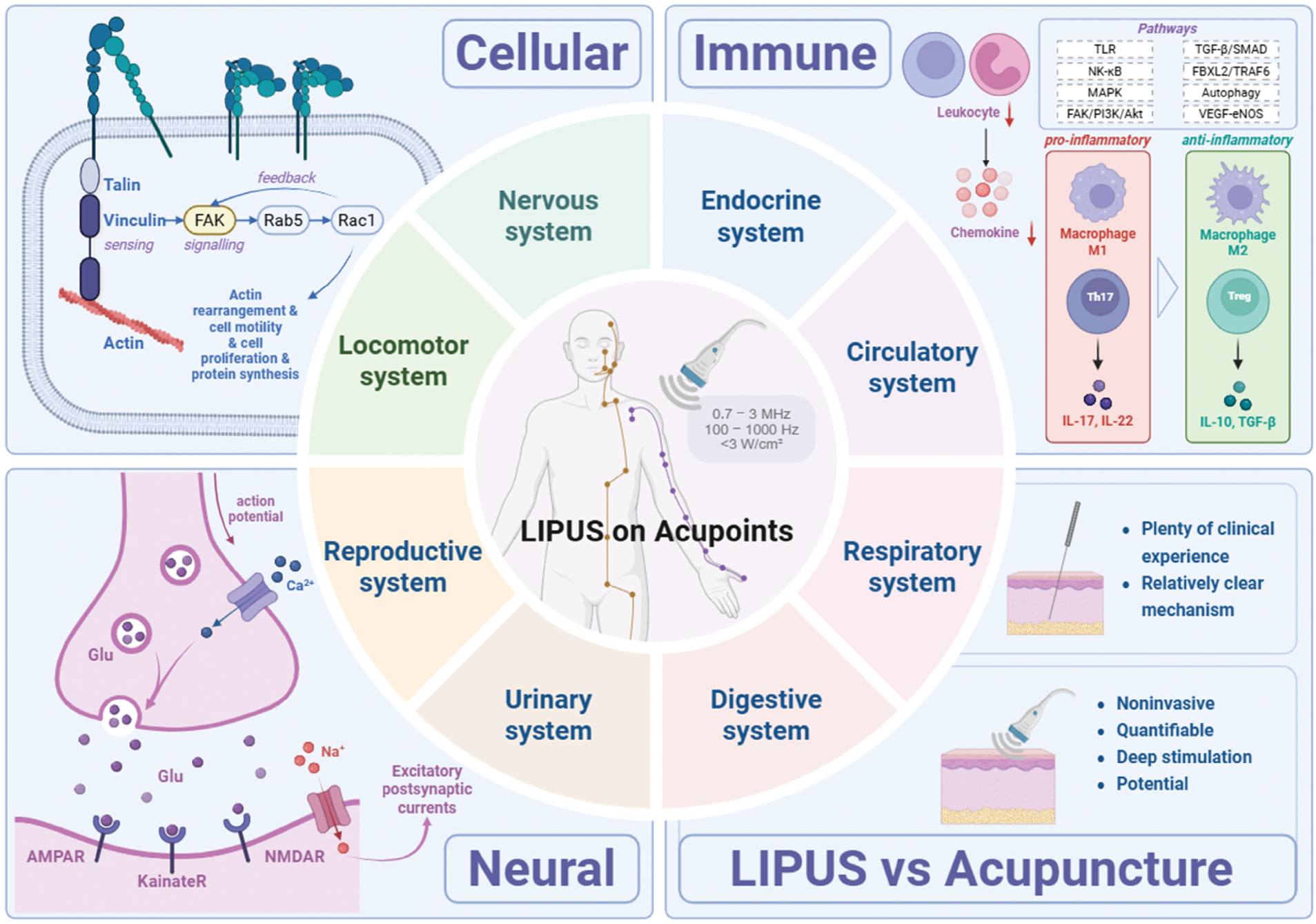
From a biophysical perspective, the core actions of LIPUS lie in its mechanical and cavitation effects. By inducing oscillatory shear stress in the extracellular matrix and strain on cellular membranes at the acupoint, the deep tissue mechanical vibrations generated by LIPUS simulate the “Deqi” sensation of manual acupuncture, which often described as soreness, numbness, or distension. Simultaneously, the cavitation effect of LIPUS promotes local tissue fluid flow and metabolic exchange, simulating the acceleration effect of metabolism of acupuncture. Meanwhile, LIPUS can also trigger the release of bioactive substances from immune cells like mast cells to modulate the local microenvironment. Acupoints, distinct from ordinary tissue sites, are not only located in areas with concentrated neural innervation but are also enriched in regions with high densities of mast cells, lymphatic vessels, and arteriovenous plexuses [74]. Acupoint regions contain abundant collagen fibers, mechanosensitive nerve endings, and high-density mechanosensitive ion channels. This unique biomechanical microenvironment enables acupoints to specifically respond to mechanical stimuli like LIPUS, forming the structural basis for LIPUS-acupoint interaction.
LIPUS is sensed by cell-matrix adhesions through vinculin at the cellular level, which in turn modulates the Rab5-Rac1 pathway to control ultrasound-mediated endocytosis and cell motility. A similar FAK-Rab5-Rac1 pathway also controls cell spreading upon fibronectin [75]. LIPUS has been shown to promote proliferation and alter protein synthesis in various cell types. For example, LIPUS enhances cyclin D1 expression by activating the GSK-3β/β-catenin signaling pathway, thereby promoting Schwann cell viability and proliferation [76]. LIPUS also facilitates the proliferation, differentiation, and migration of mesenchymal stem cells [29]. LIPUS inhibits inflammatory and catabolic processes through the NF-κB pathway in human degenerative nucleus pulposus cells [77].
At the neural level the mechanical effects of ultrasound directly influence synaptic circuitry. Ultrasound induces excitatory postsynaptic currents with increased frequency and amplitude, which enhances glutamatergic synaptic transmission. Extracellular calcium influx, action potential firing, and synaptic transmission occur during ultrasound stimulation, recruiting recurrent excitatory network activity that persists for tens-to-hundreds of seconds [78]. When applied to acupoints, the mechanical vibrations of LIPUS directly stimulate the abundant nerve endings, transmitting signals via peripheral nerves to the central nervous system to regulate autonomic functions. This mechanism shares similarities with the regulation of nerves in manual acupuncture but operates more gently.
The biomechanical stimulation induced by LIPUS at acupoints can also achieve local and systemic immune modulation depending on multi-level coordinated regulation of immune cells, soluble inflammatory mediators, and intracellular signaling pathways. Specifically, LIPUS reduces the count of peripheral blood leukocytes and local leukocyte infiltration to inflammatory sites, promotes the polarization of pro-inflammatory M1 macrophages toward anti-inflammatory M2 phenotypes, and modulates T lymphocyte subsets. Concurrently, LIPUS prevents pro-inflammatory pathways, such as TLR, NF-κB, and p38-MAPK, which reduces the production of pro-inflammatory mediators, including IL-1β, TNF-α, and CXCL1, while activating the integrin, focal adhesion kinase (FAK), phosphatidylinositol 3-kinase (PI3K), and serine-threonine kinase (Akt) pathway to enhance anti-inflammatory effects [11, 73]. In addition to direct regulation, LIPUS exerts indirect immunomodulation by inducting the secretion of extracellular vesicles (EVs). Lipus stimulates endothelial cells to produce EVs loaded with miR-99a and these EVs, upon uptake by CD4+T cells, regulate cell differentiation and metabolism by inhibiting the expression of mTOR and TRIB2, thereby increasing regulatory T cells (Treg) and decreasing T helper 17 cells (Th17) to suppress inflammation [79]. When stimulating BMSCs, LIPUS significantly promotes EV secretions and these LIPUS-induced EVs inhibit the MAPK pathway via miR-328-5p/miR-487b-3p, exhibiting stronger anti-inflammatory activity than non-stimulated EVs [1]. In addition, LIPUS markedly inhibits the production of mature IL-1β in vitro and in vivo, a process closely associated with upregulating autophagy levels and promoting the autophagy-related protein p62 (SQSTM1)-mediated degradation of pyruvate kinase muscle (PKM2) in macrophages [10]. Simultaneously, LIPUS enhances macrophage infiltration, reduces senescent cell accumulation, and activates the reactive oxygen species (ROS)-dependent p38-NF-κB pathway, further reinforcing the immunomodulatory effects [80].
Comparison between LIPUS and other non-invasive neuromodulation techniques
LIPUS was systematically compared to other mainstream non-invasive neuromodulation techniques to further clarify the unique therapeutic position of LIPUS, including transcranial magnetic stimulation (TMS), transcranial direct/alternating current stimulation (tDCS/tACS), transcutaneous vagus nerve stimulation (tVNS), and transcutaneous electrical nerve stimulation (TENS). Although all these techniques are non-invasive, fundamental differences in the energy forms, mechanisms of action, and therapeutic targets determine the respective unique advantages.
First, regarding energy form and penetration depth, TMS uses time-varying magnetic fields to induce electric fields intracranially and tDCS/tACS applies weak currents via extracranial electrodes, yet both struggle to target deep brain nuclei and the electric field intensity decays rapidly with tissue depth. tVNS and TENS stimulate peripheral nerves, such as the auricular branch of the vagus nerve and peripheral sensory nerves, via transcutaneous electrical currents with relatively superficial targets [81, 82]. In contrast, the mechanical pressure waves utilized by LIPUS are attenuated less in homogeneous soft tissues, enabling effective penetration of several centimeters. This feature allows non-invasive targeting of deep acupoint structures and deep neurovascular bundles located within muscles and fascia, a critical advantage for meridian-based deep acupoint stimulation.
Second, the core mechanisms differ substantially. The abovementioned electrical or magnetic stimulation techniques primarily modulate neuronal membrane potentials, which influence the excitation or inhibition balance of neural networks with the effects centered on neuro-electrophysiologic modulation [83, 84]. In contrast, the core mechanism underlying LIPUS is mechano-transduction. Consequently, the effects of LIPUS extend beyond neurons to directly regulate the biological functions of various non-neuronal cells, such as fibroblasts, immune cells, and mesenchymal stem cells, and can influence extracellular matrix synthesis and alignment. This dual capacity to modulate both neural and non-neural tissues forms a crucial biophysical basis for the ability to simulate the holistic effects of acupuncture.
In summary, compared to other non-invasive neuromodulation techniques, LIPUS offers a unique deep-targeted mechano-biological effect. LIPUS converts mechanical energy into broad cellular signaling, enabling coordinated modulation of neural circuits and the tissue microenvironment. This positioning establishes LIPUS not merely as a neuromodulation tool but as a tissue-level biophysical modulator capable of engaging in a profound dialogue with TCM meridian theory, offering a novel technological pathway for integrating modern biomechanics with traditional medical wisdom.
LIPUS regulates internal organ function through meridian effects
The mechanism underlying acupuncture
Current research involving the mechanisms underlying acupuncture has progressively deepened with the widely recognized pathways encompassing the nervous system, endocrine system, and immune system [17].
Acupuncture operates through specific neural pathways with notable functional differences between stimulation at acupoints and non-acupoints. Using retrograde tracing techniques, it has been demonstrated that acupoint stimulation induces focused neural projections to regions, such as the primary motor cortex (M1), secondary motor cortex (M2), gigantocellular reticular nucleus (Gi), and ventrolateral periaqueductal gray (VLPAG), whereas stimulation at subcutaneous non-points results in more diffuse and less specific projections [85]. The autonomic neural pathways activated by acupuncture are also selective and anatomically defined [86, 87]. For example, low-intensity electrostimulation at hindlimb regions drives the vagal-adrenal axis, producing anti-inflammatory effects that depend on NPY+ adrenal chromaffin cells, while high-intensity electrostimulation at the abdomen activates NPY+ splenic noradrenergic neurons via the spinal-sympathetic axis [88]. Stimulation at CV23 (Lianquan), which is located in the depression superior to the hyoid bone, has been shown to ameliorate dysphagia through the M1-PBN-NTS neural circuit, which mediates the protective effect of electroacupuncture at CV23 on swallowing dysfunction [89]. Scalp acupuncture for neurologic disorders is also precisely matched with specific cortical targets [90].
Acupuncture also modulates the endocrine system, particularly through the hypothalamic-pituitary-adrenal (HPA), hypothalamic-pituitary-gonadal (HPG), and hypothalamic-pituitary-thyroid (HPT) axes. Electroacupuncture negatively regulates the Nesfatin-1/ERK/CREB pathway to alleviate HPA axis hyperactivity and anxiety-like behaviors induced by surgical trauma [91]. Acupuncture also reduces leptin resistance [92] and has been shown to significantly decrease androgen levels in patients with polycystic ovary syndrome. This effect may be mediated through reduced neurotransmitter secretion in the HPG axis and modulation of the HPA axis and its cortisol release [93].
Regarding immunomodulation, mast cells are recognized as a key cellular basis and an objective indicator of acupoint sensitization. When mechanical signals are transmitted to subcutaneous tissue, mast cell aggregation and degranulation are induced. This mast cell aggregation and degranulation lead to subsequent effects on surrounding structures, including blood vessels, muscles, and nerve endings, thereby mediating acupuncture effects and contributing to acupoint, central, and peripheral sensitization processes [94]. Concurrently, local inflammatory cell infiltration occurs at acupoints, accompanied by increased levels of cytokines (e.g., IL-1β, IL-6, IL-8, TNF-α, and IL-4) and adhesion molecules (E-selectin and L-selectin). Furthermore, acupuncture influences both specific and non-specific immunity by enhancing the number and function of phagocytes, increasing the number and activity of natural killer cells, promoting the synthesis, secretion, and bioactivity of cytokines, and modulating serum complement levels, as well as regulating the production and secretion of immunoglobulins and facilitating cytokine secretion by T-helper lymphocytes.
It is important to note that these three systems do not operate in isolation, rather the nervous, endocrine, and immune systems interact and coordinate with each other, forming an integrated network essential for maintaining physiologic homeostasis. A representative example is ST36, historically and in contemporary practice one of the most frequently used acupoints, which has been extensively studied for distal therapeutic effects. Acupuncture at ST36 activates local signaling pathways, such as TRPV1/CaMKII/AMPK/PGC1α. As a thermosensitive and pain-sensitive receptor, TRPV1 has a significant role in pain perception and inflammatory modulation. ST36 stimulation effectively promotes TRPV1 expression and activity in muscle tissue, contributing to analgesic effects [95]. Electroacupuncture at ST36 activates neurons that subsequently regulate immune cell activity and cytokine balance, thereby suppressing severe inflammation in various diseases [96]. Moreover, stimulation at ST36 helps maintain systemic homeostasis through modulation of neuroendocrine axes.
The mechanism underlying LIPUS for the treatment of visceral disease
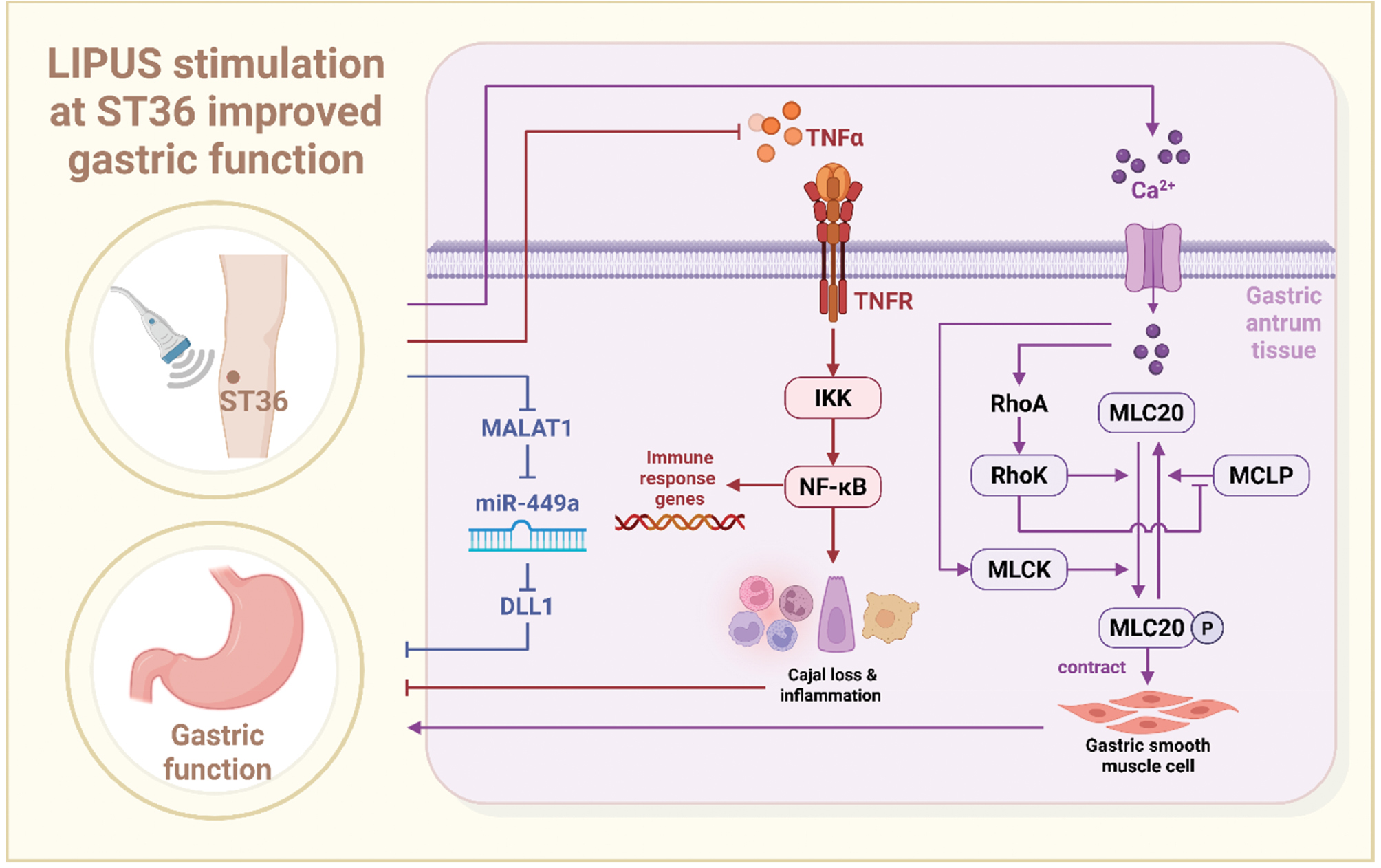
LIPUS applied to acupoints on the body surface, specifically acupoints located along meridians defined in TCM theory, can effectively regulate visceral function. For example, LIPUS stimulation at ST36 significantly improved gastric motility dysfunction in a rat model of diabetic gastroparesis. This effect was achieved through suppression of the TNF-α/IKKβ/NF-κB inflammatory signaling pathway, ameliorating damage to the interstitial cells of Cajal network, and directly promoting the recovery of gastric emptying [22]. At the molecular level, LIPUS concurrently activated the RhoA/Rock pathway to upregulate contractile markers in gastric smooth muscle cells and modulated the MALAT1/miR-449a/DLL1 axis by downregulating MALAT1 and DLL1, while upregulating miR-449a, thereby inhibiting fibrotic signaling and restoring smooth muscle function [23]. These coordinated actions synergistically enhance gastric smooth muscle contraction. Furthermore, LIPUS-induced changes in tissue tension at ST36 mimic the biomechanical effects of Deqi sensation in acupuncture, providing a mechanistic basis for the non-invasive therapeutic advantage [26] (Figure 4). Importantly, the mechanisms described above are directly supported by experimental evidence from published LIPUS studies, rather than being inferred from the acupuncture literature.
Figure 4 LIPUS stimulation at ST36 improves gastric function. LIPUS stimulation at the ST36 acupoint improves gastric function. LIPUS suppresses the TNF-α/IKKβ/NF-κB pathway, reducing inflammation and loss of interstitial cells of Cajal. Simultaneously, LIPUS activates the RhoA/Rock axis to upregulate contractile markers in gastric smooth muscle cells. Furthermore, LIPUS modulates the MALAT1/miR-449a/DLL1 signaling axis, which downregulates fibrotic signaling and restoring smooth muscle contractility. These actions synergistically enhance gastric emptying and motility, mimicking the therapeutic effects of manual acupuncture and offering a non-invasive remote visceral regulation. Key abbreviations: MALAT1, metastasis-associated lung adenocarcinoma transcript 1 (long non-coding RNA); miR-449a, microRNA-449a; DLL1, delta-like ligand 1 (notch pathway ligand); TNF-α, tumor necrosis factor-alpha; IKK, IκB kinase; RhoA, Ras homolog family member A; RhoK, Rho-associated protein kinase; MLCP, myosin light chain phosphatase; MLC20, 20 kDa regulatory myosin light chain; MLCK, myosin light chain kinase. (Created in https://BioRender.com).
Together, these findings demonstrated that LIPUS functions through a multi-target synergistic mechanism, enabling non-invasive and targeted therapy from the body surface and highlighting the potential as a novel treatment strategy for some visceral disorders. LIPUS offers quantifiable stimulation parameters, controllable energy delivery, and non-invasive deep-tissue penetration compared to traditional acupuncture, providing a technological innovation for the modernization of TCM.
Shared mechanisms and advantages of LIPUS over acupuncture
LIPUS and acupuncture share fundamental biological mechanisms, primarily engaging the nervous, endocrine, and immune systems to achieve multi-dimensional regulation of both local and distal tissue functions.
At the neural level, both modalities exhibit acupoint specificity and function mediated via neural pathways. Each modality demonstrates differential effects between acupoint and non-acupoint stimulation. Acupuncture activates peripheral sensory nerve fibers through mechanical stimulation, projecting signals to the central nervous system and driving autonomic pathways. In contrast, LIPUS employs non-thermal mechanical energy to penetrate deep tissues and directly modulate synaptic circuitry. In addition, both modalities facilitate distal functional modulation through neural signaling. For example, acupuncture improves swallowing function via the M1-PBN-NTS circuit, while LIPUS restores gastric motility in diabetic gastroparesis rat models, reflecting a shared “acupoint – central nervous system – target organ” logic. Differences lie in the initiation of neural activation and molecular mediation. Acupuncture relies on direct sensation at peripheral nerve endings and can enhance effects via adenosine release and A1 receptor upregulation, whereas LIPUS triggers synaptic changes through biomechanical stress, converting mechanical signals into neural responses.
Regarding endocrine mechanisms, both modalities contribute to the functional homeostasis of target organs through pathway modulation. Acupuncture directly regulates classic endocrine axes, such as the HPA and HPG axes, to precisely control hormone secretion. Although LIPUS does not directly engage these axes, LIPUS upregulates contractile markers in gastric smooth muscle cells via RhoA/Rock activation and modulates the MALAT1/miR-449a/DLL1 axis to suppress smooth muscle fibrosis, thereby indirectly maintaining endocrine microenvironment homeostasis in digestive tissues. However, acupuncture exerts broader and more direct regulatory effects on multiple endocrine axes related to stress, reproduction, and metabolism, while evidence for LIPUS in endocrine regulation remains limited and organ-specific.
In terms of immunomodulation, both modalities regulate pro- and anti-inflammatory balance and mediate cellular immune responses. Acupuncture reduces pro-inflammatory cytokine release and activates the cholinergic anti-inflammatory pathway, while LIPUS directly suppresses the TNF-α/IKKβ/NF-κB pathway and stimulates mesenchymal stem cells to secrete anti-inflammatory extracellular vesicles, additionally alleviating oxidative stress via the PI3K-Akt/Nrf2 axis. Second, both rely on cellular signaling. Acupuncture involves mast cells as key sensitization actors and modulates innate immunity through phagocytes and NK cells, whereas LIPUS primarily influences immune responses via mesenchymal stem cell activation. Nevertheless, acupuncture provides systemic immunomodulation covering innate and adaptive immunity, while the immunoregulatory role of LIPUS appears more localized, focusing on NF-κB suppression and specific cell types without clearly documented effects on the complement system or adaptive immunity.
Notably, LIPUS offers distinct clinical advantages, including non-invasive deep-tissue targeting, standardized energy delivery, and avoidance of needle-related risks, particularly at high-risk acupoints on the chest and back, which improves patient compliance and reduces operator variability. Fundamentally, LIPUS and acupuncture (including electroacupuncture) share the same therapeutic logic (i.e., delivering precise physical energy to acupoints to modulate the interconnected nervous, endocrine, and immune systems for remote visceral regulation). This logic is reflected in the common biological outcomes, such as activating shared neural pathways, suppressing pro-inflammatory signaling, and promoting tissue repair. The primary distinction lies in the energy form and initial transduction. Acupuncture or electroacupuncture utilizes mechanical pressure or electrical currents, which directly engage neuronal membranes and induce neurochemical release. In contrast, LIPUS employs mechanical waves that act via mechano-transduction, ultimately converging on similar downstream pathways. These mechanistic parallels underscore the significant potential of LIPUS. By building upon the established framework of acupuncture, LIPUS presents a promising, non-invasive, and quantifiable modality worthy of further clinical exploration in acupoint-based therapy.
Parameter standardization and clinical translation prospects
Current studies reveal considerable heterogeneity in LIPUS parameters, which limits clinical reproducibility and translation. Building on available evidence and informed by the TCM principles of supplementation and draining, we propose a preliminary parameter optimization framework. Milder stimulation with lower frequency, lower intensity, and shorter duration is suggested for deficiency patterns (supplementation). Stronger stimulation with higher frequency, higher intensity, and longer duration may be considered for excess patterns (draining). Although this framework stems from theoretical extrapolation and requires empirical validation, the framework offers an initial roadmap for systematically investigating parameter-efficacy relationships.
It is important to recognize that different acupoints require distinct parameter settings due to variations in the anatomic and physiologic features. For example, ST36, located in the tibialis anterior muscle with relatively thick soft tissue, is suitable for deep stimulation. In contrast, REN4/REN6 on the abdomen has thinner subcutaneous tissue and proximity to abdominal organs, necessitating lower intensity to avoid deep tissue injury. This acupoint-parameter-efficacy correspondence suggests that future parameter optimization should integrate local anatomy, target tissue depth, and TCM pattern differentiation to enable personalized and precise therapeutic interventions.
As a non-invasive modality, LIPUS exhibits a favorable short-term safety profile with adverse reactions generally limited to local warmth or mild erythema. However, potential long-term or cumulative effects on local tissues, neural integrity, and immune function remain unclear. Furthermore, for acupoints located over the chest, back, or projections of vital organs, stimulation intensity and depth should be carefully controlled to avoid unnecessary mechanical or thermal effects on the heart, lungs, and other structures.
Looking forward, LIPUS holds considerable promise for clinical translation and integrative medicine. The non-invasive nature, quantifiable parameters, and favorable patient tolerance make LIPUS suitable for long-term and even home-based therapeutic settings. LIPUS can be synergistically combined with traditional acupuncture, moxibustion, and herbal medicine to form multimodal integrative regimens, thereby extending applications to internal medicine fields. Advancing multicenter randomized controlled trials, dose-response studies, and device standardization will facilitate the integration of LIPUS into evidence-based guidelines for integrative medicine, ultimately promoting the standardized adoption of this meridian-based biophysical intervention in modern healthcare systems.
Potential challenges
Despite the promising therapeutic potential of LIPUS in modulating organ function via meridian mechanisms, the clinical translation of LIPUS faces several conceptual and practical challenges.
First, a contradiction exists between the standardization and personalized application of treatment parameters. Parameters, such as frequency, intensity, pulse characteristics, and duration, vary considerably across studies, complicating cross-trial comparisons and clinical reproducibility. Moreover, tissue heterogeneity and individual variability in meridian responses make establishing universal parameters exceedingly difficult. The parameter optimization framework based on TCM principles of supplementation and draining remains a theoretical hypothesis, awaiting rigorous validation in well-designed dose-response studies.
Second, a translational gap exists from animal models to human efficacy. Although preclinical studies have revealed neural-endocrine-immune mechanisms shared by LIPUS and acupuncture, animal experiments, conducted under controlled conditions using homogeneous strains and induced pathologies, cannot fully replicate the complexity of human chronic diseases. Species-specific differences in anatomy, physiology, and immune response add another layer of uncertainty. The promising results from rodent models of diabetic gastroparesis or neuroinflammation require confirmation in human populations with diverse genetic backgrounds, comorbidities, and lifestyles.
Third, the mechanism of action is not fully elucidated and a unified evaluation system across studies is lacking. The precise process by which the mechanical energy of LIPUS is transduced into biochemical signals within the meridian system remains unclear. Concurrently, the field suffers from a disconnect in evaluation metrics between basic and clinical research. Animal studies rely on molecular and functional endpoints, while clinical trials often prioritize patient-reported outcomes and gross functional measures. This disconnect makes it difficult to directly correlate mechanistic findings with clinical efficacy, hindering the rational development of biomarkers for treatment response. Future research could bridge this gap by incorporating translatable, objective biomarkers into clinical trial designs.
In conclusion, overcoming these challenges requires the following concerted efforts: establishing dose-response relationships through large-scale randomized controlled trials with sham controls; optimizing parameters based on biological effects and personalized principles; developing translatable, objective biomarkers to bridge basic and clinical research; and fostering interdisciplinary collaboration to merge meridian theory with modern biomechanics and systems biology. Exploring the synergistic potential of LIPUS with existing acupuncture treatments holds promise for pioneering integrative therapeutic strategies. Ultimately, merging meridian theory with biomechanics will not only deepen our understanding of LIPUS but also promote acceptance in evidence-based medical practice.
Data availability statement
All data are available in the main text or the supplementary materials. The materials generated are available from the lead contact upon reasonable request.
Author contributions
XL, KF, ZH, and CC contributed equally to this work. Conceptualization: XL, KF, ZH, CC, JL, ZT, and ZL. Methodology and protocol design: XL, KF, ZH, CC, TW, and MX. Systematic literature search and study selection: XL, KF, ZH, CC, and MX. Data extraction and quality/risk-of-bias assessment: XL, KF, ZH, CC, and TW. Formal analysis and synthesis: XL, KF, ZH, CC, and MX. Visualization and figure preparation: XL, KF, CC, MX, and TW. Writing—original draft: XL, KF, ZH, and CC. Writing—review & editing: JL, ZT, ZL, TW, and MX. Supervision: JL, ZT, and ZL. Project administration: JL and ZT. Guarantors of the work: JL, ZT, and ZL. All authors read and approved the final manuscript.
Acknowledgements and Funding
We thank ChatGPT5 for language editing and BioRender.com for creation of schematics. This work was supported by the National Natural Science Foundation of China (Grant No. 82505803). The Graphical abstract was created by BioRender. https://BioRender.com.
Conflict of interest
Dr Zhiwen Luo is the Executive Editor of BIOI. This manuscript was reviewed by other independent editors.
Supplementary material
Supplementary Material can be downloaded from https://bio-integration.org/wp-content/uploads/2026/04/bioi20250196_Supplemental.pdf.
Graphical abstract
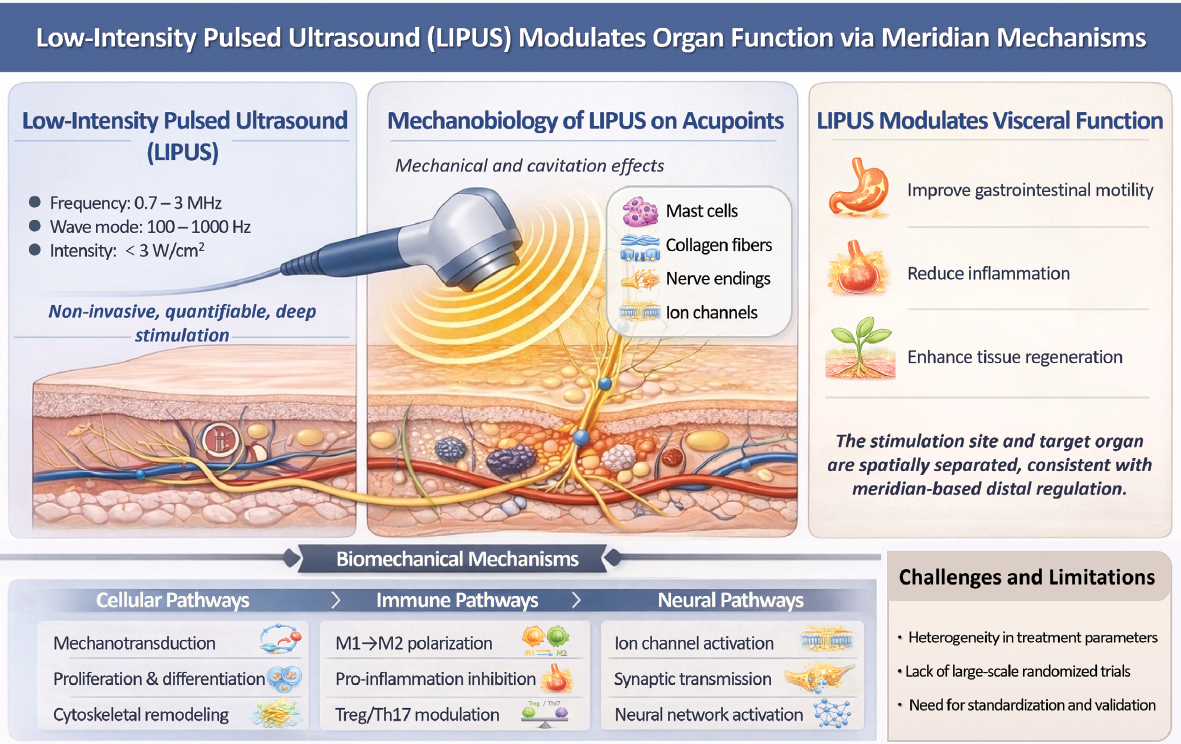
Highlights
- LIPUS is a non-invasive, quantifiable, and deep stimulation method offering a promising alternative to manual acupuncture.
- LIPUS improves gastrointestinal motility, reduces inflammation, and enhances tissue regeneration via meridian-based mechanisms.
- LIPIUS shares similar mechanisms with acupuncture, involving neural, immune, and cellular pathways.
- LIPUS exemplifies a modernized strategy for complementary medicine by bridging traditional meridian theory with biophysical principles.
- Parameter heterogeneity and limited trials hinder clinical translation, requiring standardized research and multi-omics validation.
In brief
This systematic review synthesizes evidence that low-intensity pulsed ultrasound (LIPUS) applied to acupoints modulates organ function via meridian mechanisms, sharing neural, immune and cellular pathways with acupuncture. LIPUS improves gastrointestinal motility, reduces inflammation, and promotes tissue regeneration. By bridging traditional meridian theory with modern biophysics, LIPUS offers a promising strategy for complementary medicine, though parameter standardization and validations are needed.
References
- Li X, Zhong Y, Zhou W, Song Y, Li W, et al. Low-intensity pulsed ultrasound (LIPUS) enhances the anti-inflammatory effects of bone marrow mesenchymal stem cells (BMSCs)-derived extracellular vesicles. Cell Mol Biol Lett 2023;28(1):9. [PMID: 36717768 DOI: 10.1186/s11658-023-00422-3]
- Jiang X, Savchenko O, Li Y, Qi S, Yang T, et al. A review of low-intensity pulsed ultrasound for therapeutic applications. IEEE Trans Biomed Eng 2019;66(10):2704-18. [PMID: 30596564 DOI: 10.1109/tbme.2018.2889669]
- Xin Z, Lin G, Lei H, Lue TF, Guo Y. Clinical applications of low-intensity pulsed ultrasound and its potential role in urology. Transl Androl Urol 2016;5(2):255-66. [PMID: 27141455 DOI: 10.21037/tau.2016.02.04]
- Palanisamy P, Alam M, Li S, Chow SKH, Zheng YP. Low-intensity pulsed ultrasound stimulation for bone fractures healing: a review. J Ultrasound Med 2022;41(3):547-63. [PMID: 33949710 DOI: 10.1002/jum.15738]
- Qin H, Luo Z, Sun Y, He Z, Qi B, et al. Low-intensity pulsed ultrasound promotes skeletal muscle regeneration via modulating the inflammatory immune microenvironment. Int J Biol Sci 2023;19(4):1123-45. [PMID: 36923940 DOI: 10.7150/ijbs.79685]
- Marcotulli M, Barbetta A, Scarpa E, Bini F, Marinozzi F, et al. Jingle cell rock: steering cellular activity with low-intensity pulsed ultrasound (LIPUS) to engineer functional tissues in regenerative medicine. Ultrasound Med Biol 2024;50(12):1973-86. [PMID: 39289118 DOI: 10.1016/j.ultrasmedbio.2024.08.016]
- Han Y, Gao H, Gao J, Yang Y, He C. Low-intensity pulsed ultrasound regulates bone marrow mesenchymal stromal cells differentiation and inhibits bone loss by activating the IL-11-Wnt/β-catenin signaling pathway. Int Immunopharmacol 2024;143(Pt 1):113380. [PMID: 39405933 DOI: 10.1016/j.intimp.2024.113380]
- Wu B, Zhang T, Chen H, Shi X, Guan C, et al. Exosomes derived from bone marrow mesenchymal stem cell preconditioned by low-intensity pulsed ultrasound stimulation promote bone-tendon interface fibrocartilage regeneration and ameliorate rotator cuff fatty infiltration. J Orthop Translat 2024;48:89-106. [PMID: 39189009 DOI: 10.1016/j.jot.2024.07.009]
- Ying S, Tan M, Feng G, Kuang Y, Chen D, et al. Low-intensity Pulsed Ultrasound regulates alveolar bone homeostasis in experimental Periodontitis by diminishing Oxidative Stress. Theranostics 2020;10(21):9789-807. [PMID: 32863960 DOI: 10.7150/thno.42508]
- Zhang B, Chen H, Ouyang J, Xie Y, Chen L, et al. SQSTM1-dependent autophagic degradation of PKM2 inhibits the production of mature IL1B/IL-1β and contributes to LIPUS-mediated anti-inflammatory effect. Autophagy 2020;16(7):1262-78. [PMID: 31500508 DOI: 10.1080/15548627.2019.1664705]
- Seasons GM, Pellow C, Kuipers HF, Pike GB. Ultrasound and neuroinflammation: immune modulation via the heat shock response. Theranostics 2024;14(8):3150-77. [PMID: 38855178 DOI: 10.7150/thno.96270]
- Yang B, Li M, Lei H, Xu Y, Li H, et al. Low intensity pulsed ultrasound influences the myogenic differentiation of muscle satellite cells in a stress urinary incontinence rat model. Urology 2019;123:297.e1-8. [PMID: 30273612 DOI: 10.1016/j.urology.2018.09.020]
- Ren Y, Zhu Y, Liu L, Yu T, Dong X. Ultrasound induces contraction of the bladder smooth muscle. Int Urol Nephrol 2016;48(8):1229-36. [PMID: 27262850 DOI: 10.1007/s11255-016-1298-8]
- He Z, Liu Q, Yang R, Zhou Y, Liu X, et al. Low-intensity ultrasound tibial nerve stimulation suppresses bladder activity in rats. Neuromodulation 2025;28(1):95-102. [PMID: 39078346 DOI: 10.1016/j.neurom.2024.06.005]
- Yao W, Yang H, Yin N, Ding G. Mast cell-nerve cell interaction at acupoint: modeling mechanotransduction pathway induced by acupuncture. Int J Biol Sci 2014;10(5):511-9. [PMID: 24910530 DOI: 10.7150/ijbs.8631]
- Li HY, Wang F, Chen M, Zheng ZJ, Yin YJ, et al. An acupoint-originated human interstitial fluid circulatory network. Chin Med J (Engl) 2021;134(19):2365-9. [PMID: 34561330 DOI: 10.1097/cm9.0000000000001796]
- Ding SS, Hong SH, Wang C, Guo Y, Wang ZK, et al. Acupuncture modulates the neuro-endocrine-immune network. QJM 2014;107(5):341-5. [PMID: 24106314 DOI: 10.1093/qjmed/hct196]
- Hooijmans CR, Rovers MM, de Vries RB, Leenaars M, Ritskes-Hoitinga M, et al. SYRCLE’s risk of bias tool for animal studies. BMC Med Res Methodol 2014;14(1):43. [PMID: 24667063 DOI: 10.1186/1471-2288-14-43]
- Sterne JAC, Savović J, Page MJ, Elbers RG, Blencowe NS, et al. RoB 2: a revised tool for assessing risk of bias in randomised trials. BMJ 2019;366:l4898. [PMID: 31462531 DOI: 10.1136/bmj.l4898]
- Sterne JA, Hernán MA, Reeves BC, Savović J, Berkman ND, et al. ROBINS-I: a tool for assessing risk of bias in non-randomised studies of interventions. BMJ 2016;355:i4919. [PMID: 27733354 DOI: 10.1136/bmj.i4919]
- Li N, Zou J, Ding X, Gao Y, Zhang X, et al. Influence of ultrasound acupuncture of zusanli on prostaglandin E2 in alcohol-induced gastric mucosal lesion rabbits (in Chinese). Chin J Ultrasound Med 2011;27(10):878-81.
- Han N, Jiang W, Li G, Lu L, Shan J, et al. Low-intensity pulsed ultrasound at ST36 improves the gastric motility by TNF-α/IKKβ/NF-κB signaling pathway in diabetic rats. J Gastroenterol Hepatol 2023;38(11):2018-26. [PMID: 37581362 DOI: 10.1111/jgh.16321]
- Han N, Cheng S, Jin Y, Li G, Wang H, et al. Low-intensity pulsed ultrasound combined with ST36 modulate gastric smooth muscle contractile marker expression via RhoA/Rock and MALAT1/miR-449a/DLL1 signaling in diabetic rats. Neurogastroenterol Motil 2024;36(8):e14843. [PMID: 38873849 DOI: 10.1111/nmo.14843]
- Jin W, Wang S, Dai D, Wang H, Li W, editors. Experimental study on the effect of ultrasound-guided needle stimulation at Zusanli (ST36) and Tianshu (ST25) acupoints on intestinal function. Establishment of the World Federation of Acupuncture-Moxibustion Societies (WFAS) and the 1st World Congress on Acupuncture-Moxibustion (in Chinese). Beijing, China; 1987.
- Othman EM, Abdelbasset WK, Elsayed SH, Hussein RS, Mohamady HM. Effect of ultrasound-enhanced bee venom on selected post inguinal hernioplasty complications: a single-blind randomized controlled trial. Eur Rev Med Pharmacol Sci 2023;27(2):483-92. [PMID: 36734719 DOI: 10.26355/eurrev_202301_31048]
- Han N, Shan J, Lu L, Wang Q, Jin L. Value of shear wave elastography in evaluation to muscular tension change caused by stimulation at Zusanli acupoint by low-intensity pulsed ultrasound (in Chinese). Chin Imaging J Integr Tradit West Med 2024;22(01):28-31+6.
- Poolman RW, Agoritsas T, Siemieniuk RA, Harris IA, Schipper IB, et al. Low intensity pulsed ultrasound (LIPUS) for bone healing: a clinical practice guideline. BMJ 2017;356:j576. [PMID: 28228381 DOI: 10.1136/bmj.j576]
- Guan M, Han X, Liao B, Han W, Chen L, et al. LIPUS promotes calcium oscillation and enhances calcium dependent autophagy of chondrocytes to alleviate osteoarthritis. Adv Sci (Weinh) 2025;12(16):e2413930. [PMID: 40013941 DOI: 10.1002/advs.202413930]
- Xia P, Shi Y, Wang X, Li X. Advances in the application of low-intensity pulsed ultrasound to mesenchymal stem cells. Stem Cell Res Ther 2022;13(1):214. [PMID: 35619156 DOI: 10.1186/s13287-022-02887-z]
- Jia W, Wang T, Chen F, Liu Z, Hou X, et al. Low-intensity pulsed ultrasound responsive scaffold promotes intramembranous and endochondral ossification via ultrasonic, thermal, and electrical stimulation. ACS Nano 2025;19(4):4422-39. [PMID: 39901850 DOI: 10.1021/acsnano.4c13357]
- Liu C, Yu B, Zhang Z, Su L, Wang R, et al. LIPUS activated piezoelectric pPLLA/SrSiO3 composite scaffold promotes osteochondral regeneration through P2RX1 mediated Ca2+ signaling pathway. Biomaterials 2025;317:123084. [PMID: 39754966 DOI: 10.1016/j.biomaterials.2025.123084]
- Qiu L, Ma S, Yang R, Zheng D, Huang Y, et al. Ultrasound-activated piezoelectric heterojunction drives nanozyme catalysis to induce bacterial cuproptosis-like death and promote bone vascularization and osseointegration. Biomaterials 2025;320:123249. [PMID: 40056613 DOI: 10.1016/j.biomaterials.2025.123249]
- Liu T, Fu Y, Shi J, He S, Chen D, et al. Noninvasive ultrasound stimulation to treat myocarditis through splenic neuro-immune regulation. J Neuroinflammation 2023;20(1):94. [PMID: 37069636 DOI: 10.1186/s12974-023-02773-2]
- Wang J, Gao Y, Wang B, Zhang C, Yuan Y, et al. Low-intensity pulsed ultrasound promotes oligodendrocyte maturation and remyelination by down-regulating the interleukin-17A/Notch1 signaling pathway in mice with ischemic stroke. Research (Wash D C) 2025;8:0676. [PMID: 40290135 DOI: 10.34133/research.0676]
- Su WS, Wu CH, Song WS, Chen SF, Yang FY. Low-intensity pulsed ultrasound ameliorates glia-mediated inflammation and neuronal damage in experimental intracerebral hemorrhage conditions. J Transl Med 2023;21(1):565. [PMID: 37620888 DOI: 10.1186/s12967-023-04377-z]
- Song D, Chen X, Zhou N, Yuan Y, Geng S, et al. Low-intensity pulsed ultrasound triggers a beneficial neuromodulation in dementia mice with chronic cerebral hypoperfusion via activation of hippocampal Fndc5/irisin signaling. J Transl Med 2023;21(1):139. [PMID: 36823656 DOI: 10.1186/s12967-022-03824-7]
- Liu Z, Zhang H, Lu K, Chen L, Zhang Y, et al. Low-intensity pulsed ultrasound modulates disease progression in the SOD1G93A mouse model of amyotrophic lateral sclerosis. Cell Rep 2024;43(9):114660. [PMID: 39180748 DOI: 10.1016/j.celrep.2024.114660]
- Zheng Y, Yu Y, Chen M, Zhang H, Wang W, et al. Abdominal LIPUS stimulation prevents cognitive decline in hind limb unloaded mice by regulating gut microbiota. Mol Neurobiol 2025;62(6):7313-29. [PMID: 39878866 DOI: 10.1007/s12035-025-04709-8]
- Ma L, Wang Y, Zhao Y, Sun M, Zhu T, et al. The relationship between abnormal glucose metabolism and chronic pain. Cell Biosci 2025;15(1):86. [PMID: 40544297 DOI: 10.1186/s13578-025-01430-w]
- Witt C, Brinkhaus B, Jena S, Linde K, Streng A, et al. Acupuncture in patients with osteoarthritis of the knee: a randomised trial. Lancet 2005;366(9480):136-43. [PMID: 16005336 DOI: 10.1016/s0140-6736(05)66871-7]
- Nie Q, He F, Dong L, Lin X, Lin J, et al. Effects of transcranial direct current stimulation combined with acupuncture therapy on brain network functional connectivity in patients with knee osteoarthritis: a single-center randomized controlled trial. J Neuroeng Rehabil 2025;22(1):160. [PMID: 40660313 DOI: 10.1186/s12984-025-01692-y]
- Gong C, Gu S. Effect of acupuncture on neurogenic claudication among patients with degenerative lumbar spinal stenosis. Ann Intern Med 2025;178(7):1062. [PMID: 40658968 DOI: 10.7326/annals-25-01060]
- Fan AY. Effect of acupuncture for methadone reduction. Ann Intern Med 2025;178(8):1211. [PMID: 40825219 DOI: 10.7326/annals-25-01515]
- Chen Y, Fan B, Zeng J, Zou Y, Tao C, et al. Single-Cell RNA transcriptomics and multi-omics analyses reveal the clinical effects of acupuncture on methadone reduction. Research (Wash D C) 2025;8:0741. [PMID: 40556944 DOI: 10.34133/research.0741]
- Wang Y, Sui B, Zhang Y, Fang L, Xie Y, et al. Effect of acupuncture and moxibustion on the immune function of patients with malignant tumors: a systematic review and meta-analysis. Front Immunol 2025;16:1583522. [PMID: 40787472 DOI: 10.3389/fimmu.2025.1583522]
- Wang B, Zhang J. Exploring acupuncture: a promising adjunct in cancer care and symptom management. Sci China Life Sci 2025;68(11):3404-6. [PMID: 40622656 DOI: 10.1007/s11427-024-2965-2]
- Song P, Liu T, Zhang Y, Shao T, Li R, et al. Traditional Chinese medicine in the treatment of breast cancer. Mol Cancer 2025;24(1):209. [PMID: 40750898 DOI: 10.1186/s12943-025-02416-5]
- Liou KT, Carlsson S, Ajay D, Sandhu JS, Li Y, et al. Acupuncture for nocturia in survivors of prostate cancer: the NOCTURNAL Randomized Clinical Trial. JAMA Oncol 2025;11(7):791-4. [PMID: 40440022 DOI: 10.1001/jamaoncol.2025.1199]
- Masone MC. Acupuncture to reduce nocturia in survivors of prostate cancer. Nat Rev Urol 2025;22(7):409. [PMID: 40523932 DOI: 10.1038/s41585-025-01059-x]
- Wang N, Zhao L, Zhang D, Kong F. Research progress on the immunomodulatory mechanism of acupuncture in tumor immune microenvironment. Front Immunol 2023;14:1092402. [PMID: 36865562 DOI: 10.3389/fimmu.2023.1092402]
- Zhang Y, Lou Y, Wang J, Yu C, Shen W. Research status and molecular mechanism of the traditional Chinese medicine and antitumor therapy combined strategy based on tumor microenvironment. Front Immunol 2021;11:609705. [PMID: 33552068 DOI: 10.3389/fimmu.2020.609705]
- Wang W, Zhou Y, Cai Y, Wang S, Shao F, et al. Phosphoproteomic profiling of rat’s dorsal root ganglia reveals mTOR as a potential target in bone cancer pain and electro-acupuncture’s analgesia. Front Pharmacol 2021;12:593043. [PMID: 33995007 DOI: 10.3389/fphar.2021.593043]
- Lv Z, Liu R, Su K, Gu Y, Fang L, et al. Acupuncture ameliorates breast cancer-related fatigue by regulating the gut microbiota-gut-brain axis. Front Endocrinol (Lausanne) 2022;13:921119. [PMID: 36093113 DOI: 10.3389/fendo.2022.921119]
- El Iskandarani S, Deng G. Acupuncture in hematologic malignancies and hematopoietic cell transplantation. Blood Rev 2022;56:100985. [PMID: 35725779 DOI: 10.1016/j.blre.2022.100985]
- Mao Y, Zhang P, He Z, Teng Y, Tian Z, et al. Effects of acupuncture versus moxibustion on functional dyspepsia: a randomized clinical trial. Chin Med 2025;20(1):131. [PMID: 40847362 DOI: 10.1186/s13020-025-01187-x]
- Fan M, Pan X, Liu Y. Comprehensive treatment of functional dyspepsia using traditional Chinese medicine: a review based on pathophysiological perspectives. Drug Des Devel Ther 2025;19:5349-67. [PMID: 40584922 DOI: 10.2147/dddt.S514042]
- Yang JW, Qi LY, Yan SY, She YF, Li Y, et al. Efficacy of ACupuncTure in irritable bOwel syNdrome (ACTION): a multicenter randomized controlled trial. Gastroenterology 2025;169(5):958-69.e5. [PMID: 40441496 DOI: 10.1053/j.gastro.2025.05.016]
- Pei L, Wang G, Yang S, Zhou S, Xu T, et al. Electroacupuncture reduces duration of postoperative ileus after laparoscopic gastrectomy for gastric cancer: a multicenter randomized trial. Gastroenterology 2025;169(1):73-84. [PMID: 39978558 DOI: 10.1053/j.gastro.2025.02.006]
- Ma K, Wang F, Zhang X, Guo L, Huang Y. Acupuncture and nutritional parallels in obesity: a narrative review of multi-pathway modulation of the microbiota-gut-brain axis. Front Nutr 2025;12:1610814. [PMID: 40851901 DOI: 10.3389/fnut.2025.1610814]
- Li H, Qi F, Li D, Fan Y, Liu J, et al. Acupuncture attenuates experimental autoimmune thyroiditis by modulating intestinal microbiota and palmitic acid metabolism. Front Immunol 2025;16:1541728. [PMID: 40356922 DOI: 10.3389/fimmu.2025.1541728]
- Irandoost P, Firouzjaei A, Heshmati J, Sadeghi E, Ayati MH, et al. The effects of an anti-inflammatory diet alone or in combination with acupuncture on mental health, anthropometric indices, and metabolic status in diabetic patients with depression: a randomized, controlled clinical trial. Nutr Diabetes 2025;15(1):18. [PMID: 40316554 DOI: 10.1038/s41387-025-00373-y]
- Cheng M, Shang PP, Wei DD, Long J, Zhang X, et al. Modulation of lung CD11b+ dendritic cells by acupuncture alleviates Th2 airway inflammation in allergic asthma. Chin Med 2025;20(1):67. [PMID: 40405264 DOI: 10.1186/s13020-025-01119-9]
- Huang HK, Liu SP, Deng X, Zhao RL, Feng Y, et al. Crosstalk between macrophages and diverse immune cells accelerates the development of acute lung injury. Life Sci 2025;380:123925. [PMID: 40876736 DOI: 10.1016/j.lfs.2025.123925]
- Li X, Sun YX, Tjahjono AW, Wei Y, Li X, et al. Acupuncture attenuates myocardial ischemia/reperfusion injury-induced ferroptosis via the Nrf2/HO-1 pathway. Chin Med 2025;20(1):61. [PMID: 40346679 DOI: 10.1186/s13020-025-01114-0]
- Wang ZN, Ding JR, Li X, Shi L, Yin B, et al. Acupuncture improves MRI brain microstructure with postconcussion symptoms in mild TBI: a randomized controlled trial. Radiology 2025;316(1):e250315. [PMID: 40693935 DOI: 10.1148/radiol.250315]
- Narayana PA. Efficacy of acupuncture in treating mild traumatic brain injury. Radiology 2025;316(1):e251873. [PMID: 40693932 DOI: 10.1148/radiol.251873]
- Cong L, Ding S, Guo Y, Tian J, Liu L, et al. Acupuncture alleviates CSDS-induced depressive-like behaviors by modulating synaptic plasticity in vCA1. Theranostics 2025;15(10):4808-22. [PMID: 40225589 DOI: 10.7150/thno.106751]
- Liu Y, Wei M, Deng Y, Fan Y, Zheng Y, et al. Advances in traditional Chinese Medicine for managing diminished ovarian reserve: mechanisms and clinical insights. Drug Des Devel Ther 2025;19:5597-614. [PMID: 40620463 DOI: 10.2147/dddt.S505689]
- Fu QW, Zhu SM, Chen J, Liu YQ, Liang CH, et al. Acupuncture for women undergoing in vitro fertilization: an updated systematic review and meta-analysis with trial sequential analysis. Int J Nurs Stud 2025;168:105097. [PMID: 40412094 DOI: 10.1016/j.ijnurstu.2025.105097]
- Yu Y, Wu J, Hu G, Deng J, Yang X, et al. Manual acupuncture for the treatment of chronic spontaneous urticaria: a systematic review and meta-analysis. Int J Surg 2025;111(10):7285-300. [PMID: 40696933 DOI: 10.1097/js9.0000000000002887]
- Cao Q, Hu Y, Zhou Q, Guo R. Research and advances in ultrasonic bioeffects (in Chinese). J Med Res 2020;49(12):126-8+8.
- Miller DL, Smith NB, Bailey MR, Czarnota GJ, Hynynen K, et al. Overview of therapeutic ultrasound applications and safety considerations. J Ultrasound Med 2012;31(4):623-34. [PMID: 22441920 DOI: 10.7863/jum.2012.31.4.623]
- Liang W, Liang B, Yan K, Zhang G, Zhuo J, et al. Low-intensity pulsed ultrasound: a physical stimulus with immunomodulatory and anti-inflammatory potential. Ann Biomed Eng 2024;52(8):1955-81. [PMID: 38683473 DOI: 10.1007/s10439-024-03523-y]
- Cai R, Yu C, Luo X, Xu N, Yu J, et al. Advances in medical devices for augmented acupuncture therapy. Adv Sci (Weinh) 2025;12(32):e05318. [PMID: 40679074 DOI: 10.1002/advs.202505318]
- Atherton P, Lausecker F, Harrison A, Ballestrem C. Low-intensity pulsed ultrasound promotes cell motility through vinculin-controlled Rac1 GTPase activity. J Cell Sci 2017;130(14):2277-91. [PMID: 28576970 DOI: 10.1242/jcs.192781]
- Ren C, Chen X, Du N, Geng S, Hu Y, et al. Low-intensity pulsed ultrasound promotes Schwann cell viability and proliferation via the GSK-3β/β-catenin signaling pathway. Int J Biol Sci 2018;14(5):497-507. [PMID: 29805301 DOI: 10.7150/ijbs.22409]
- Yi W, Chen Q, Liu C, Li K, Tao B, et al. LIPUS inhibits inflammation and catabolism through the NF-κB pathway in human degenerative nucleus pulposus cells. J Orthop Surg Res 2021;16(1):619. [PMID: 34663388 DOI: 10.1186/s13018-021-02739-1]
- Li F, Jiang H, Lin J, Qiao C, Augustine GJ. Low intensity pulsed ultrasound activates excitatory synaptic networks in cultured hippocampal neurons. Ultrasound Med Biol 2025;51(8):1250-60. [PMID: 40393896 DOI: 10.1016/j.ultrasmedbio.2025.04.011]
- Sun P, Li Y, Li Y, Ji H, Mang G, et al. Low-intensity pulsed ultrasound protects from inflammatory dilated cardiomyopathy through inciting extracellular vesicles. Cardiovasc Res 2024;120(10):1177-90. [PMID: 38696702 DOI: 10.1093/cvr/cvae096]
- Gwak H, Hong S, Lee SH, Kim IW, Kim Y, et al. Low-intensity pulsed ultrasound treatment selectively stimulates senescent cells to promote SASP factors for immune cell recruitment. Aging Cell 2025;24(5):e14486. [PMID: 39821933 DOI: 10.1111/acel.14486]
- do Carmo Almeida TC, Dos Santos Figueiredo FW, Barbosa Filho VC, de Abreu LC, Fonseca FLA, et al. Effects of transcutaneous electrical nerve stimulation on proinflammatory cytokines: systematic review and meta-analysis. Mediators Inflamm 2018;2018:1094352. [PMID: 29805310 DOI: 10.1155/2018/1094352]
- Chen SH, Lin YW, Tseng WL, Lin WT, Lin SC, et al. Ultrahigh frequency transcutaneous electrical nerve stimulation for neuropathic pain alleviation and neuromodulation. Neurotherapeutics 2024;21(3):e00336. [PMID: 38368171 DOI: 10.1016/j.neurot.2024.e00336]
- Hassanzahraee M, Zoghi M, Jaberzadeh S. How different priming stimulations affect the corticospinal excitability induced by noninvasive brain stimulation techniques: a systematic review and meta-analysis. Rev Neurosci 2018;29(8):883-99. [PMID: 29604209 DOI: 10.1515/revneuro-2017-0111]
- Oriuwa C, Mollica A, Feinstein A, Giacobbe P, Lipsman N, et al. Neuromodulation for the treatment of functional neurological disorder and somatic symptom disorder: a systematic review. J Neurol Neurosurg Psychiatry 2022;93(3):280-90. [PMID: 35115389 DOI: 10.1136/jnnp-2021-327025]
- Liang J, Sun W, Zhou Y, Zhang P, Chen Y, et al. Study on the central neural pathways connecting the brain and peripheral acupoints using neural tracers. CNS Neurosci Ther 2025;31(8):e70554. [PMID: 40762123 DOI: 10.1111/cns.70554]
- Liu S, Wang Z, Su Y, Qi L, Yang W, et al. A neuroanatomical basis for electroacupuncture to drive the vagal-adrenal axis. Nature 2021;598(7882):641-5. [PMID: 34646018 DOI: 10.1038/s41586-021-04001-4]
- Kupari J, Ernfors P. Pricking into autonomic reflex pathways by electrical acupuncture. Neuron 2020;108(3):395-7. [PMID: 33181070 DOI: 10.1016/j.neuron.2020.09.026]
- Liu S, Wang ZF, Su YS, Ray RS, Jing XH, et al. Somatotopic organization and intensity dependence in driving distinct NPY-expressing sympathetic pathways by electroacupuncture. Neuron 2020;108(3):436-50.e7. [PMID: 32791039 DOI: 10.1016/j.neuron.2020.07.015]
- Yao L, Ye Q, Liu Y, Yao S, Yuan S, et al. Electroacupuncture improves swallowing function in a post-stroke dysphagia mouse model by activating the motor cortex inputs to the nucleus tractus solitarii through the parabrachial nuclei. Nat Commun 2023;14(1):810. [PMID: 36781899 DOI: 10.1038/s41467-023-36448-6]
- Wu Y, Kong Q, Li Y, Feng Y, Zhang B, et al. Potential scalp acupuncture and brain stimulation targets for common neurological disorders: evidence from neuroimaging studies. Chin Med 2025;20(1):58. [PMID: 40329319 DOI: 10.1186/s13020-025-01106-0]
- Zheng J, Wang Y, Zhang C, Zhang A, Zhou Y, et al. Electroacupuncture negatively regulates the Nesfatin-1/ERK/CREB pathway to alleviate HPA axis hyperactivity and anxiety-like behaviors caused by surgical trauma. Chin Med 2024;19(1):108. [PMID: 39153974 DOI: 10.1186/s13020-024-00974-2]
- Jung J, Lee SM, Lee MJ, Ryu JS, Song JH, et al. Lipidomics reveals that acupuncture modulates the lipid metabolism and inflammatory interaction in a mouse model of depression. Brain Behav Immun 2021;94:424-36. [PMID: 33607237 DOI: 10.1016/j.bbi.2021.02.003]
- Liu YX, Han YH, Jiang Y, Zhang J, Zhang YH. Experimental analysis of acupuncture’s effects on hyperandrogenemia and related symptoms in PCOS patients. Front Med (Lausanne) 2025;12:1531506. [PMID: 40776915 DOI: 10.3389/fmed.2025.1531506]
- Li R, Liu M, Lv Y, Jing F. Mast cells in acupoint sensitization: mechanisms and research advances. Am J Chin Med 2025;53(5):1265-84. [PMID: 40626405 DOI: 10.1142/s0192415x25500491]
- Chen Z, Yao K, Wang X, Liu Y, Du S, et al. Acupuncture promotes muscle cells ATP metabolism in ST36 acupoint local exerting effect by activating TRPV1/CaMKII/AMPK/PGC1α signaling pathway. Chin Med 2025;20(1):112. [PMID: 40660305 DOI: 10.1186/s13020-025-01169-z]
- Ulloa L. Electroacupuncture activates neurons to switch off inflammation. Nature 2021;598(7882):573-4. [PMID: 34646023 DOI: 10.1038/d41586-021-02714-0]