


Drug Delivery and Repurposing Approaches for Albendazole Formulations
1Department of Quality Assurance, ISF College of Pharmacy, Moga, Affiliated to IK Gujral Punjab Technical University, Jalandhar, Punjab 142001, India
2Department of Biotechnology, School of Life Sciences, HNB Garhwal University (A Central University), Srinagar Garhwal, Uttarakhand 246174, India
3Department of Pharmaceutical Sciences, School of Health Science & Technology, UPES, Energy Acres Building, Bidholi Dehradun, Uttarakhand 248007, India
4Department of Pharmaceutics, Sanjivani College of Pharmaceutical Education & Research, Savitribai Phule Pune University, Kopargaon, Maharashtra, India
5Chitkara College of Pharmacy, Chitkara University, Rajpura, Punjab, India
6Department of Pharmaceutics, NIMS Institute of Pharmacy, NIMS University Rajasthan, Jaipur, Rajasthan, India
7Department of Biotechnology Engineering, Chandigarh University, Mohali, Punjab, India
8Department of Pharmaceutical Sciences, School of Sciences, HNB Garhwal University (A Central University), Srinagar Garhwal, Uttarakhand 246174, India
9Department of Pharmaceutical Sciences, Maharshi Dayanand University, Rohtak, Haryana, India
*Correspondence to: Dr. Charan Singh (M. Pharm, Ph.D.) Associate Professor, Department of Pharmaceutical Sciences, Maharshi Dayanand University, Rohtak, Haryana, Email ID: c.singhniper009@gmail.com; Dr. Sandeep Kumar, Professor, Department of Pharmaceutics, Chitkara College of Pharmacy Chitkara University Punjab, Email ID: ssandeepkatarea@gmail.com, sandeep.kumar4298@chitkara.edu.in
Received: March 3 2025; Revised: May 24 2025; Accepted: January 29 2026; Published Online: April 1 2026
Cite this paper:
Virlley S, Arya M, Singh A et al. Drug Delivery and Repurposing Approaches for Albendazole Formulations. BIO Integration 2026; 7: 1–23.
DOI: 10.15212/bioi-2025-0045. Available at: https://bio-integration.org/
Download citation
© 2026 The Authors. This is an open access article distributed under the terms of the Creative Commons Attribution License (https://creativecommons.org/licenses/by/4.0/). See https://bio-integration.org/copyright-and-permissions/
Abstract
According to World Health Organization (WHO) reports, parasitic infections substantially affect the world’s population and are responsible for more than 16 million annual deaths in developing countries. Trichomoniasis, giardiasis, cryptosporidiosis, and toxoplasmosis, the most common helminthic infections in humans, are treated with anthelmintics and antibiotics that achieve synergistic effects. The key anthelmintic drug Albendazole (ABZ) has drawbacks of low solubility. Anthelmintics fall under biopharmaceutics classification system (BCS) class II and are therefore administered through conventional approaches and novel nanomedicine techniques to enhance their biopharmaceutical properties and therapeutic efficacy. This review examined the literature on anthelmintics with appreciable benefits. Because the nanomedicine development of ABZ was contemporaneous with its repurposing as an anticancer agent, with or without nanoformulation, this review also addresses the repositioning of ABZ to treat diverse cancers including colon cancer, brain tumors, malignant melanoma, and breast cancer.
Keywords
ABZ, anthelmintic, anticancer, drug delivery, nanomedicine, parasitic infection.
Introduction
A World Health Organization [1] report has highlighted that approximately 1.5 billion people are infected with multiple parasites each year, 600 million of whom show clinical symptoms; moreover, 16 million people die annually because of parasitic infections in developing countries [2].
Parasites are organisms that live inside or on a host, and depend on the host for nutrients and survival, which, by definition, causes parasitic infections [3, 4]. Human parasitic pathogens are broadly classified into protozoa, such as Entamoeba, Giardia, and Plasmodium, and helminths, including nematodes (roundworms), trematodes (flukes), and cestodes (tapeworms). These pathogens account for a substantial global illness burden and affect more than one-quarter of the world’s population. Despite their biological diversity, protozoa and helminths share common transmission pathways and clinical outcomes, including gastrointestinal, systemic, and vector-borne diseases that require prompt diagnosis, accurate treatment, and robust prevention strategies [5]. Trichomoniasis, giardiasis, cryptosporidiosis, and toxoplasmosis are examples of parasitic infections [6, 7]. The most common symptoms of parasitic infections are abdominal pain, motion sickness, gas and bloating [8], diarrhea, anal and rectal itch, and drastic weight loss [9, 10]. Parasitic infections can be transmitted through the mouth, skin, blood transfusions, or injection with previously used hypodermic needles [11–13]. Anthelmintics and antibiotics are frequently applied in the management of parasitic infections. Notably, specific combinations of these agents achieve synergistic effects that enhance therapeutic efficacy against a range of parasitic diseases beyond that of either agent alone [14, 15].
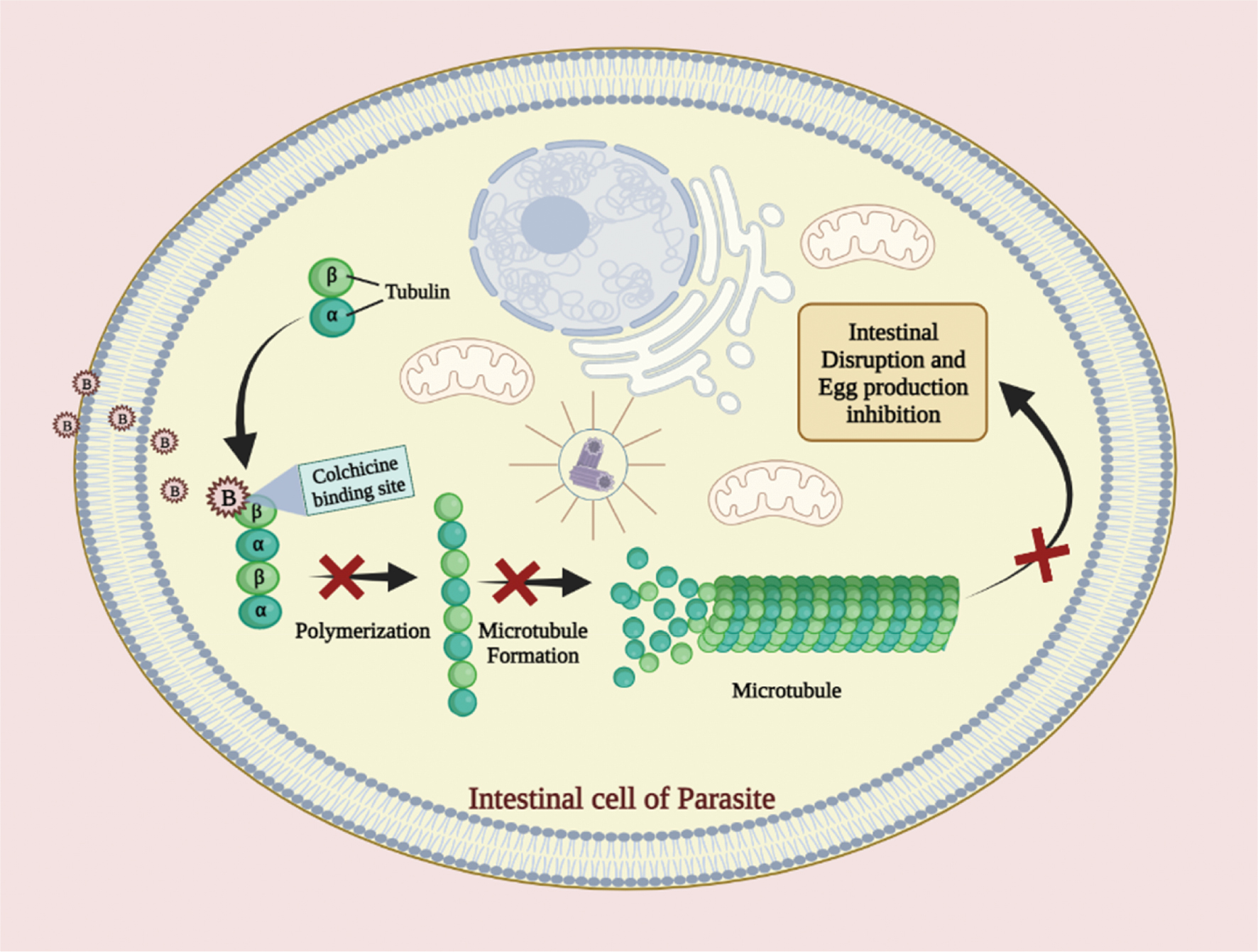
Anti-worm drugs used to treat these infections (albendazole [ABZ], mebendazole, fenbendazole, or flubendazole) are classified as benzimidazoles [16, 17]. These drugs act primarily by binding β-tubulin and inhibiting microtubule polymerization (Figure 1) [18, 19]. Consequently, cell division and structural integrity are disrupted in targets, i.e., parasites in helminth infections or rapidly dividing cells in cancers. The drugs’ ability to arrest cells in G2/M phase, induce DNA damage, and trigger apoptosis and pyroptosis has recently been demonstrated in glioblastoma and triple-negative breast cancer models [20, 21]. ABZ and mebendazole remain staples in mass drug administration against soil-transmitted helminths. However, rising resistance, e.g., β-tubulin SNPs such as F200Y in Trichuris, currently limits their efficacy in regions including Haiti, Kenya, and Panama [22]. Preclinical studies of this drug class have also highlighted their potent antitumor action. Mebendazole significantly decreases tumor growth and metastasis in triple-negative breast cancer xenografts by inhibiting tubulin polymerization and downregulating cancer stem cell markers (CD44 and OCT3/4) [21]. Similarly, parbendazole has nanomolar-range antiproliferative effects against pancreatic cancer cells and shows synergy with gemcitabine [23]. Flubendazole, fenbendazole, and mebendazole induce concurrent apoptosis and pyroptosis in glioblastoma models, and therefore have promise in treating TMZ-resistant brain tumors [21].
Figure 1 Anthelmintic activity of ABZ.
Most benzimidazole drugs are class II in the Biopharmaceutics Classification System (BCS), and are characterized by low solubility in aqueous media and high intestinal permeability [24]. This low solubility alters their potency with oral administration [25]. Consequently, formulation research has focused on development of nano-formulations of this drug [26] (e.g., albumin nanoparticles [NPs], dendrimers, host-guest inclusion complexes, solid dispersions [SDs], or polymeric NPs), to increase its solubility and ultimately improve its bioavailability in the systemic circulation [27–31].
Over the past three decades, nanotechnology has been extensively investigated across scientific disciplines. Nanomedicines can address physical, chemical, and physiological challenges by leveraging unique material properties at the nanoscale [32–34]. Nano-delivery systems offer advantages of targeting, thus enabling decreases in dose, dose frequency, and/or toxicity, and facilitating diagnosis (e.g., in theranostics). Nano-formulations’ nanoscale sizes (i.e., 1–100 nm) enable efficient passage across capillary membranes. In addition, many nanomaterials show organ specificity, and enable directed delivery or stimulated drug release [35–37].
In drug repurposing, new pharmacological uses are identified for existing drugs [38]. Anthelmintics are being repurposed to treat various types of malignancies [39]. The benzimidazole family of anthelmintics is frequently used in humans to treat parasitic infections [40] and is currently being repurposed as an anticancer agent [41]. Many studies have reported its remarkable antineoplastic efficacy in a wide range of cancers [42–46]. This review describes current trends in strategies or approaches to improve the therapeutic efficacy of novel drug delivery system of albendazole (e.g., lipid NPs, SDs, complexes, and polymeric NPs) in parasitic infections. The repurposing of ABZ to treat a wide range of cancers, such as colon cancer, brain tumors, malignant melanoma, and breast cancer, is also discussed. Motivated by contemporaneous developments such as the use of ABZ with nanocarriers as either anthelmintics or repurposed agents, this review explores and consolidates the current literature on both topics. Table 1 shows the physicochemical properties of ABZ.
Table 1 Physicochemical Properties of Albendazole
| Characteristics | Description |
|---|---|
| Occurrence | Synthetic benzimidazole derivative |
| Chemical class | Benzimidazoles |
| IUPAC name | Methyl N-(6-propylsulfanyl-1H-benzimidazol-2-yl) carbamate |
| Molecular formula | C12H15N3O2S |
| Molecular weight | 265.33 g/mol |
| Melting point | 208°C to 210°C (406°F to 410°F) |
| Appearance | White to off-white powder |
| Stability | Stable under ambient storage conditions |
| Solubility | In water, 41 mg/L at 25°C |
| pKa | 6.9 |
| logP | 2.7–3.07 |
| BCS class | Class II drug |
Enhancing the anthelmintic activity of ABZ-nanocarriers: drug delivery approach
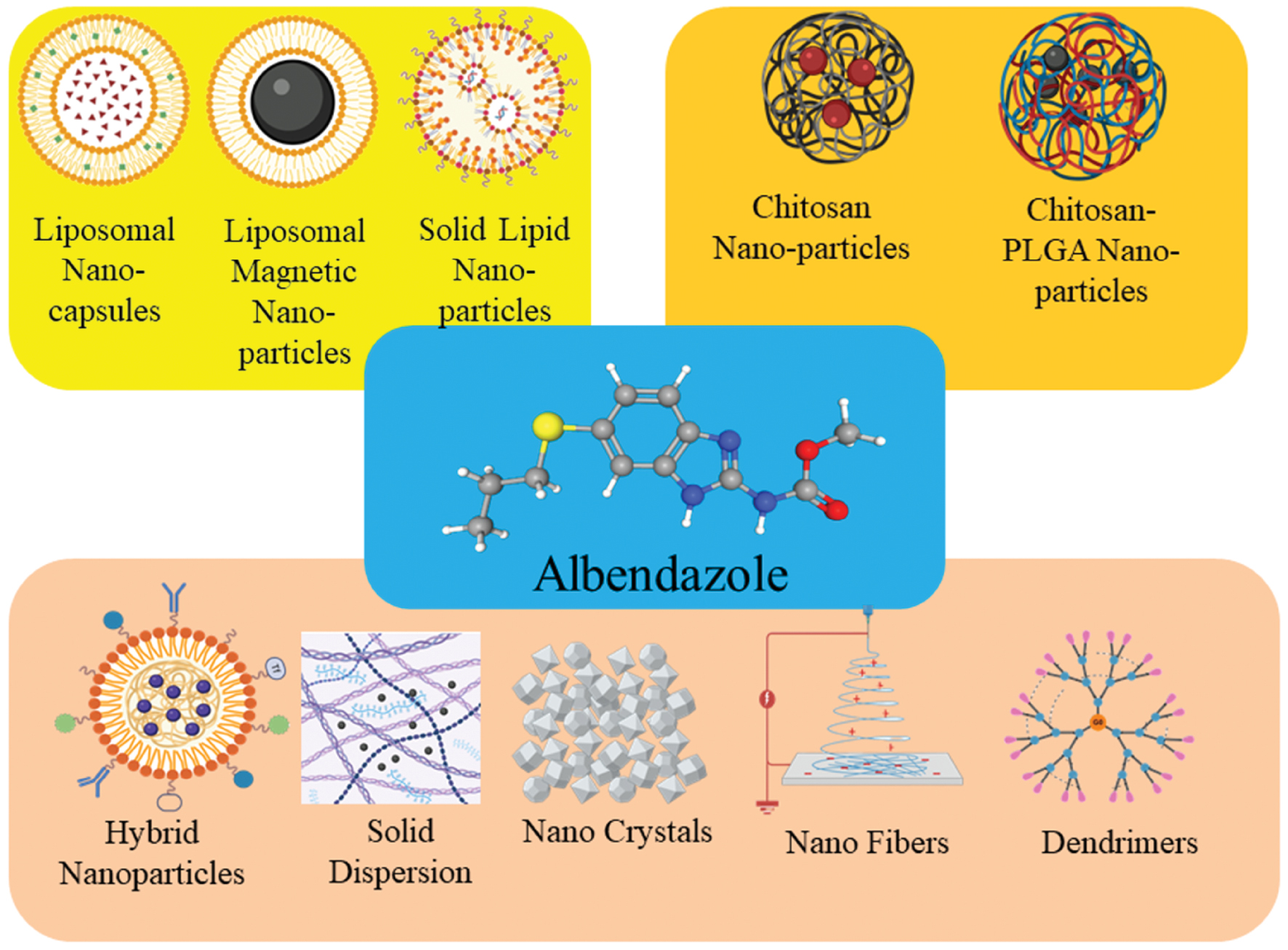
Nanomaterials carrying drugs, or drugs themselves at the nanoscale, exhibit enhanced drug efficacy or diminished toxicity, because of principles including increased surface area [47], drug targeting (passive/active) to sites of action [32, 48], controlled and sustained drug release [49], solubility and stability enhancement [32, 50], intracellular uptake and endocytosis [51], and theranostics [52]. Various nanomaterial-based approaches have been reported to achieve positive outcomes (Figure 2).
Figure 2 ABZ loaded carrier systems for improved therapeutic potential.
Lipid carrier systems
Lipid-based nano-carriers include systems combining solid or liquid lipids and emulsifiers to form a shell that encapsulates an aqueous core containing materials or drugs. Lipid carrier systems enhance drug delivery by mimicking biological membranes, and enable efficient encapsulation of both hydrophilic and lipophilic drugs. Lipid-based carriers improve the solubility and stability of encapsulated drugs, protect them against enzymatic and chemical degradation, promote lymphatic transport, and ultimately decrease hepatic first-pass metabolism and enhance systemic bioavailability [53].
ABZ’s efficacy as an anthelmintic has been examined with administration with cationized albumin-conjugated solid lipid NPs (SLNs; B-SLN + ABZ) against Echinococcus granulosus, the parasite causing cystic echinococcosis. The improved NPs exhibited a consistent size (309–460 nm), elevated entrapment effectiveness (up to 99%), and a prolonged drug-release profile. In in vivo experiments in infected mice treated with the B-SLN + ABZ formulation indicated markedly lower hydatid cyst numbers and weights than observed in mice receiving free ABZ or untreated controls. When given chemoprophylaxis, mice treated with B-SLN + ABZ had only 0.9 ± 0.73 cysts that weighed 15.01 ± 10.46 mg, whereas the control group had 6.5 ± 1.58 cysts that weighed 56.8 ± 11.73 mg.
Therapeutic examination indicated that cyst weight decreased to 29.37 ± 13.82 mg with B-SLN + ABZ, whereas control mice exhibited a cyst weight of 59.78 ± 3.80 mg. Transmission electron microscopy revealed highly damaged parasite cyst layers, with loss of microtriches and germinal layer breakdown. The enhanced antiparasitic effects of NP coupling with albumin were ascribed to enhanced ABZ solubility, bioavailability, and ability to penetrate cysts. In conclusion, B-SLN + ABZ NPs enhanced anthelmintic activity and might provide an effective new method of drug delivery to treat cystic echinococcosis [54].
Susar et al. [55] have reported innovations in lipid carrier systems by using liposomal formulations of ABZ and levamisole (LVM) as a viable nanocarrier strategy to augment anthelmintic efficacy. The thin-film hydration technique was used to create liposomes with egg phosphatidylcholine and cholesterol as the lipid matrix, dissolved in chloroform-methanol solutions of varying ratios. Under an aqueous buffer, the lipid film was rehydrated to form vesicular suspensions. Subsequently, the drug loading, particle size, polydispersity index (PDI), zeta potential, encapsulation efficiency, and scanning electron microscopy (SEM) morphological analysis were assessed. The sizes of the particles in LVM formulations substantially varied, from approximately 380.9 nm in Lipo LVM to more than 7200 nm in Lipo LVM–PBS. The PDI values were between 0.527 and 0.896, whereas the zeta potentials varied from −7.6 mV to −46.8 mV. For liposomes containing ABZ, the PDI was approximately 0.529 for the low dose and about 0.896 for the high dose. The corresponding zeta potentials were −8.2 ± 0.4 mV and −18.4 ± 0.6 mV, respectively. The encapsulation efficiencies of ABZ formulations were remarkably high (>99%), as expected for lipophilic compounds such as ABZ that are easily incorporated into lipid bilayers. The optimal formulation was determined to be high-dose ABZ-loaded liposomes (HD Lipo ABZ), which showed stable particle sizes, desirable surface charge, and high encapsulation efficiency [55].
Liu et al. [56] have developed a phospholipid compound of ABZ (ABZ-PC) to overcome the limitations of ABZ’s low water solubility and low bioavailability with oral administration. The solvent-evaporation method was used to prepare the complex, which combined ABZ with soybean phosphatidylcholine in optimal molar ratios. The lipid mixture was transformed into particles, thereby improving its solubility and ability to cross membranes. Further characterization revealed that the particles were in the nanoscale range, and had an average hydrodynamic diameter of approximately 180–200 nm and a negative zeta potential of approximately −28 mV. Consequently, the particles were stable in colloidal form and were evenly dispersed. The nanocomplex’s low polydispersity index (~0.25) indicated similarly sized particles and consequently predictable release kinetics. Fourier-transform infrared spectroscopy (FTIR) and differential scanning calorimetry (DSC) indicated that ABZ and phospholipid showed strong hydrogen bonding and less crystallinity in comparison to free ABZ. X-ray diffraction tests indicated that the peaks were less sharp in comparison to the peak of a crystalline material, and ABZ was therefore dispersed in the lipid matrix. These changes in physicochemical properties markedly enhanced the substance’s solubility in water, thus resulting in five times faster dissolution than that of pure ABZ. In vivo pharmacokinetic studies indicated that ABZ-PC NPs had far better absorption than unformulated ABZ: the Cmax and area under the curve (AUC) values were several times higher, and the relative bioavailability was more than three times better. The nanosized lipid matrix facilitated contact between intestinal membranes, thereby enabling passive diffusion and possibly lymphatic uptake [56].
Soleymani et al. [57] have designed a lipid nano-polymeric capsule method to provide ABZ, either alone or in conjunction with mebendazole or praziquantel, and assessed its in vitro protoscolicidal efficacy against Echinococcus granulosus cysts. Synthesized nanocapsules were analyzed with particle size analysis, zeta potential measurements, SEM, and solubility tests. The nanocapsules had a mean hydrodynamic diameter of approximately 193.01 nm and a negative surface charge (zeta potentials as low as approximately −35.78 mV) when they contained only ABZ. The diameters of the nanocapsules of mebendazole and praziquantel were approximately 170.40 nm and 180.44 nm, respectively. SEM imaging verified spherical morphology. In protoscolicidal experiments, six formulations (ABZ, MBZ, PZQ, ABZ + MBZ, ABZ + PZQ, and PZQ + MBZ) were evaluated at doses of 1.0, 0.5, and 0.25 mg/mL, and exposure durations of 10, 60, and 120 minutes. The ABZ + MBZ nanocapsules killed most of the cells within 120 minutes at the highest dose (1 mg/mL), whereas the protoscolicidal activity decrease was statistically significant at slightly lower concentrations [57]. Another study has further explored the possibility of ABZ nanostructured lipid carriers (NLCs) as a potent hepatocellular cancer treatment. ABZ-NLCs were constructed with the ultrasonication method for emulsification. The statistical Box–Behnken design was used to optimize the lipid (X1) and surfactant (X2) concentrations, and the sonication duration (X3), which are critical process parameters affecting the quality attributes or properties of the particles. The optimized formulation had a mean particle size of 166.13 ± 3.72 nm, a PDI of 0.17 ± 0.01, and a zeta potential of −39.86 ± 1.84 mV. The zeta potential indicated the particles’ stability in a colloidal state. The entrapment efficiency of the formulation was very high, at 94.25 ± 6.12%, whereas the loading capacity was 99.93 ± 7.15 mg/g, i.e., approximately 10% of the matrix. The chitosan-coated ABZ-CS-NLCs maintained these physicochemical qualities, but it changed the zeta potential to positive side, i.e., +24.61 ± 1.32 mV, thus facilitating the molecules’ interaction with cell membranes. In vitro cytotoxicity studies against HepG2 cells indicated that ABZ-CS-NLCs had superior efficacy to uncoated NLCs and free ABZ, and achieved an IC50 of 8.89 μM. The findings emphasize the importance of surface modification in enhancing cellular absorption and efficacy. ABZ-CS-NLCs are a viable platform for targeted hepatic cancer therapy, because they are small, having high loading of drug, and have a positive surface charge. The Box–Behnken architecture enabled precise optimization of the formulation, and enhanced stability and reproducibility. ABZ-CS-NLCs have potential to address the shortcomings of traditional ABZ administration, including inadequate solubility and low bioavailability, while facilitating targeted delivery to liver cancer cells. This method highlights the utility of NLCs for repurposing existing medications for cancer treatment. The formulation might provide a basis for subsequent preclinical and clinical studies designed to improve therapeutic efficacy and decrease systemic toxicity. Research has provided compelling evidence of the use of lipid-based nanocarriers in the treatment of hepatocellular cancer [58].
Zhang et al. [59] have studied the metabolites of liposomal ABZ (L-ABZ) in sheep plasma and other cells through UPLC-Q-TOF-MS. The protein precipitation method was used to prepare the plasma and tissue samples. The separation of various metabolites from the original drug was achieved with a UPLC BEH C-18 column, and ions were detected with mass spectrometry (TOF mass analyzer). The ion detection results for the metabolites were [M + H]+ at m/z 266.096, m/z 282.091, m/z 298.086, m/z 240.081, and m/z 296.104, which corresponded to ABZ, albendazole sulfoxide (ABZSO), albendazole sulfone (ABZSO2), and albendazole-2-aminosulfone (ABZSO2NH2), respectively. In vitro studies indicated that L-ABZ was rapidly absorbed in sheep plasma. The Cmax and AUC were compared for L-ABZ and pure ABZ. No accumulation of ABZSO was observed in plasma after oral administration, whereas ABZSO2 accumulated in minimal amounts after two or more doses of both formulations, i.e., L-ABZ and ABZ. Importantly, extensive distribution of L-ABZ metabolites in different tissues, particularly in the liver and lungs, was observed. Therefore, these two metabolites warrant further in vivo study. Furthermore, the drug distribution in the brain and cerebrospinal fluid indicated that metabolites of L-ABZ cross the blood-brain barrier and therefore have promise as a treatment for cerebral echinococcosis [59].
Vinarov et al. [60] have examined the solution formulation of ABZ by using phospholipid surfactant aggregates, and observed the influence of 17 surfactants on drug solubility at pH 3 and 6.5. Relationships between the molecular structure of the surfactant and ABZ solubilization were examined. The ingredients of the formulation included biocompatible surfactants, AOT and phospholipids, and NaDPPG. The colloidal agglomerates were confirmed by light scattering, whereas dilution stability was confirmed after human serum model experiments. In addition, surfactants were added in different ratios, and the smallest colloidal agglomerate size of 11 mm was formulated. This new formulation increased the drug solubility, and showed low toxicity and high drug loading capacity [60].
Researchers have prepared magnetic SLNs to increase the release rates of antiparasitic drugs and performed physicochemical characterization to visualize their encapsulation efficiency. The particle size of the magnetic solid lipid NPS was assumed to be between 2 nm and 120 nm. This large range of size is because it depends on exposure to ultrasonic irradiation. Furthermore, in vitro, 84% of ABZ was gradually released within 36 hours. This approach was efficient, fast, and environmentally friendly [61]. Rafiei et al. [62] have investigated the in vitro potency of ABZ and ABZ-SLNs on fertile or infertile hydatid cysts. SLNs were prepared with a high shear homogenization technique and micro-emulsification by HPLC. The effects of ABZ and ABZ-SLNs on sheep liver hydatid cysts were evaluated with transmission electron microscopy and optical microscopy. ABZ-loaded SLNs were more effective against hydatid cysts than ABZ alone [62].
Permana et al. [63] has developed a sophisticated technique for dissolving SLNs in microneedles (MNs) to deliver anthelmintics intradermally. The in vitro release rate of ABZ entrapped in SLNs was far better than that of conventional drugs. Additionally, skin studies have detected >40% of the drug in newborn pig skin dermis for 24 hours after MN administration. In addition, in vivo studies have shown that MNs are removed from rats after 24 hours and show no signs of irritation after removal. The relative bioavailability of SLN-MN has been found to be approximately 100% [63].
Soltani et al. [64] have designed an ABZ and ABZSO-loaded SLN delivery system to assess the permeation of ABZ and ABZSO into hydatid cysts. Drug-loaded SLNs were formulated with self-emulsification and high-shear techniques, and physicochemical characterization was performed to analyze the particle size, polydispersity index, in vitro drug release, and other aspects. The sizes of both the formulations were <180 nm. In vitro drug release was evaluated through dialysis. For determination of intracystic drug concentrations, permeation studies were performed on the hydatid cysts infecting the liver in sheep, and concentrations were analyzed with reverse-phase HPLC. The overall data indicated better permeability of ABZSO than ABZ; hence, ABZSO-loaded SLNs showed efficient therapeutic effects on hydatid cysts [64].
Gong et al. [65] have not revealed the type of nanoparticles, but it was revealed from the method of drug loading (de-emulsification) that the nanoparticles were lipid-based. However, their focus was evaluating the synergy of ABZ and atovaquone (ATO) NPs on cystic echinococcosis. The synthesized NPs exhibited uniform size, stability, high drug loading, and a zeta potential of −21.6 mV, thereby indicating favorable colloidal stability. In vitro assays demonstrated that the ATO-ABZ NPs had superior protoscolex-killing efficacy to the free drugs. In in vivo experiments in mice infected with Echinococcus granulosus, ATO-ABZ NPs significantly decreased vesicle size and protected various organs against damage. The NPs disrupted the parasite’s energy metabolism by increasing reactive oxygen species (ROS) levels and pyruvic acid content, while decreasing lactate dehydrogenase activity, lactic acid content, and ATP production. Additionally, ATO-ABZ NP treatment decreased DHODH protein expression in protoscoleces, thereby suggesting a mechanism involving inhibition of energy production pathways [65].
In a recent study, lipid (liposomal) carriers of ABZ were successfully prepared, and their physicochemical properties were characterized; however, no in vitro or in vivo studies were conducted. Among the ABZ liposomal formulations, HD Lipo ABZ and LD Lipo ABZ had polydispersity indices of 0.529 ± 0.066 and 0.896 ± 0.085, respectively, thus indicating moderate distribution uniformity. The measured zeta potentials of −18.4 ± 0.6 mV for HD Lipo ABZ and −8.2 ± 0.4 mV for LD Lipo ABZ indicated negative surface charge stability. Interestingly, the formulation showed increasing particle size with increasing ABZ loading, thus reflecting a relationship between drug payload and colloidal stability. Moreover, the liposomal encapsulation efficiency of ABZ was higher than that of LVM, probably because ABZ’s lipophilicity favored its incorporation into the lipid bilayer. These quantitative results indicated that lipid carrier systems enhance the solubilization and delivery potential of ABZ, thus paving the way to improved anthelmintic efficacy in drug delivery in vivo [55].
Li et al. [66] have fabricated an L-ABZ formulation to treat complex alveolar echinococcosis with contrast-enhanced ultrasound, CT, and PET/CT. The authors examined all patients with complex alveolar echinococcosis who were hospitalized in the prior 10 years in a retrospective biophysical study. Tests were conducted to investigate the clinical efficacy of L-ABZ in patients with caprine arthritis and encephalitis, who were followed for 3–10 years. Ten patients (83.3%) had an intermediate ratio of 1.1 or less in liver tissues, whereas six patients (50.0%) had a ratio of 0.9 or much less. CT tests indicated an exceptional exposure rate of 91.6%, and PET/(CT) indicated a maximum standardized uptake value (SUVmax), 75.0%. In three patients, high absorption of fluorodeoxyglucose with an SUVmax of 2.5 was observed, and inspection of L-ABZ demonstrated the intended clinical efficacy [66].
Supplementary Table 1 summarizes the lipidic nanocarriers of ABZ.
Among the techniques discussed above, PEG-coating and MN-mediated delivery require optimization to achieve systemic retention, and minimize toxicity or immune clearance. Several studies have reported increased plasma levels of active metabolites (e.g., ABZSO), improved cyst reduction, and enhanced drug penetration across physiological barriers, including the blood-brain barrier in comparison to the free ABZ and/or its metabolites. Furthermore, combination therapies (e.g., ABZ with ATO) have shown promising synergistic effects against parasites through oxidative stress and metabolic disruption.
In the field of lipid NP formulations, green synthesis methods, e.g., for supercritical fluids or magnetic lipid systems, should be encouraged to ensure environmentally sustainable production of nanomedicines.
Polymer carrier systems
Polymer-based nanocarriers have been reported to enhance the therapeutic profiles of various drugs. These carriers, such as chitosan (CS) and poly(lactic-co-glycolic acid) (PLGA), offer improved bioavailability, targeted delivery, and diminished toxicity. These nanoformulations show enhanced pharmacokinetics, prolonged circulation, and favorable interaction with infected tissues. Their polymeric nature confers unique attributes that make them the carrier of choice for drug delivery. PNPs’ unmatched tunability and functional versatility enable tailoring to specific therapeutic, targeting, and release needs, whereas such tailoring is not easily achieved with other nanocarriers [67].
One study using ABZ-loaded CS-NPs has aimed at increasing therapeutic efficacy against trichinellosis. In in vivo studies, 50 experimentally infected male albino mice received an oral dose of 100 mg/kg/day. The treatment efficiently decreased the infection rate (97.3% vs. 71.3% with ABZ alone). The increased efficacy was attributed to CS-dependent enhancement in nitric oxide synthase expression activity [68].
Darvishi et al. [69] have encapsulated ABZ within chitosan-coated PLGA NPs (CS-PLGA NPs) to enhance the oral bioavailability of this hydrophobic drug through enhanced dissolution and mucoadhesion. A dual design strategy maximized bioavailability by leveraging PLGA’s ability to improve the solubility of hydrophobic drugs and used a chitosan coating to improve gastrointestinal absorption. In in vivo experiments, mice treated with ABZ-SO-loaded CS-PLGA NPs demonstrated statistically significantly lower cyst weight and volume than untreated controls, whereas improvements were not seen with free ABZ-SO. This observation underscores the NP system’s superior therapeutic effects. Accordingly, the NP system provided a significant improvement over conventional administration routes by enhancing drug efficacy rather than simply altering pharmacokinetics. In contrast to previous attempts to formulate ABZ as nanocrystals, which marginally improved absorption, this study delivering ABZ with CS-PLGA NP technology demonstrated a tangible therapeutic gain in treating cystic echinococcosis. This innovation marks a major contribution to anthelmintic therapy by providing a proof of concept that nanocarrier design can translate into enhanced antiparasitic outcomes by improving drug delivery and bioavailability [69].
Naseri et al. [70] have enhanced albendazole-sulfoxide (ABZSO) delivery by formulating it with PLGA-PEG nanopolymeric particles in a W1/O/W2 double-emulsion. This design leveraged PLGA’s biodegradable and sustained-release properties, together with PEG’s stealth characteristics. These properties overcame ABZ-SO’s poor solubility and low absorption, which limit its therapeutic efficacy against cystic echinococcosis. A 100% scolicidal rate was achieved with ABZ-loaded PLGA-PEG at 150 and 200 μg/mL concentrations for all exposure times (5–60 min). In contrast, free ABZ achieved only 94%–100% mortality after longer exposure times. Additionally, both treatments significantly elevated caspase-3 mRNA expression, thus confirming a molecular mechanism of apoptosis induction in protoscoleces. However, the enhancement by the nanocarrier alone was not significantly greater [70].
Another study has investigated the effectiveness of ABZ-CSNPs in the treatment of both intestinal and muscular phases of Trichinella spiralis infection in mice. The ABZ-CSNP conjugate at a full dose (50 mg/kg) decreased adult worms in the intestines by 99.33% and muscle larvae by 100%, and performed substantially better than free ABZ. Interestingly, the half-dose (25 mg/kg) formulation achieved a 98.11% decrease in intestinal worms, which was near that achieved with the full dose, thereby validating its considerable dose-sparing capability. Histopathological evidence revealed normal intestinal villi with few inflammatory cells, and restoration of muscle architecture in the drug and formulation-treated groups. The histopathological observation of tissues of the infected control groups exhibited significant tissue damage and inflammation. Supplementary Table 2 summarizes the polymeric nanocarriers of ABZ.
A proof-of-concept liver-targeted antiparasitic medication has been produced with a biodegradable PLGA-PEG-PLGA polymeric NP system containing the new carbazole amino alcohol chemical H1402. The formulation produced homogeneous ~55 nm spherical NPs with high encapsulation effectiveness (~82.1%) and drug loading (~8.2%), and preserved outstanding colloidal stability. In vitro tests indicated that the NPs rapidly penetrated Echinococcus pre-cyst walls, and significant intra-cystic accumulation occurred within 1 hour, thus significantly enhancing medication delivery to the parasite location. The NP formulation had a four-fold greater CC50 (~61.5 μM) than free H1402 (~14.9 μM) in cytotoxicity experiments in human HepG2 hepatocytes. In antiparasitic effectiveness testing against E. multilocularis metacestodes, the NP formulation achieved full parasite eradication within 12 hours at 28.5 μM, thereby surpassing both the free medication and ABZ. In vivo biodistribution studies revealed preferential hepatic accumulation of the NPs and prolonged retention lasting 24 hours, thereby improving local delivery to parasite lesions. In a mouse model of hepatic alveolar echinococcosis, 30-day oral treatment with H1402-loaded NPs (100 mg/kg/day) significantly decreased the parasite burden (~89.9% decrease in metacestode size) and normalized liver weights, and outperformed free H1402 and ABZ. Importantly, the NP-treated group showed no evidence of hepatotoxicity or systemic toxicity, in contrast to the elevated transaminases and histological changes observed with the free drug and ABZ. These findings clearly suggested that replacing H1402 with ABZ or its active metabolite in a comparable PLGA-PEG-based NP technology might solve ABZ’s limitations of low bioavailability and systemic toxicity, while also improving liver targeting and therapeutic effectiveness [71].
The recent research discussed above highlights polymeric systems’ ability to enhance therapeutic outcomes through improved solubility, stability, and systemic availability. Beyond suggestions for all developing technologies, including an emphasis on clinical translation, pharmacokinetic optimization, green synthesis approaches, cost-effective scale-up technology, and safety profiling in humans, the investigation of combinatorial polymer systems (e.g., PLGA-CS, PEGylated carriers) to achieve synergistic improvements is another area to be explored.
Hybrid NPs
Hybrid NPs are two materials that achieve desirable synergistic effects in an expedited manner. These typically include polymeric, lipidic, or protein-based NPs that synergistically enhance drug delivery performance. These systems are aimed at improving drug encapsulation, stability, bioavailability, and targeted release through integrated functionalities such as mucoadhesion, enzymatic resistance, or controlled release kinetics. Hybrid NPs offer dual functionality, for example, by combining mucoadhesive and enzymatic protection. They also enable multi-drug loading, site-specific action, and enhanced therapeutic synergy, which single-component nanocarriers often lack [72].
Alamdarnejad et al. [73] have successfully synthesized and characterized thiolated carboxymethyl chitosan-cyclodextrin (CS-CD) NPs. They used an ionic gelation method to synthesize TGA-CMC-CD NPs, and confirmed their encapsulation efficiency through thermal and spectral analyses. Furthermore, rheological studies demonstrated that the adhesion strength improved with the addition of thiol groups. These promising results indicated that TGA-CMC-CD NPs are highly effective drug carriers for ABZ [73]. Supplementary Table 3 briefly describes the lipidic-polymeric hybrid nanocarriers of ABZ.
El-Wakil et al. [74] have tested the effectiveness of bovine serum albumin (BSA) NPs loaded with ABZ and berberine against trichinellosis in mice. The nano-formulation markedly decreased adult worm and larval numbers, inflammation, and NLRP3 expression. Histological examination revealed enhanced intestine and muscle tissue regeneration, although larval capsule thickness was diminished. Berberine increased ABZ’s antiparasitic and anti-inflammatory properties. Overall, ABZ-berberine-BSA-NPs outperformed monotherapies in the intestinal and muscular stages of trichinellosis [74]. Sharma et al. [2] have created beeswax-derived ABZ-loaded SLNs (SLN-A) for targeted treatment of Haemonchus contortus. The particles demonstrated substantial drug loading (83.3 ± 6.5 mg/g) and sustained release (84% in 24 hours). SLN-A increased ABZ effectiveness by as much as 50-fold through intestinal absorption and sustained release. Rhodamine B-labeled particles demonstrated time-dependent absorption in the worm stomach. SLN-A was not harmful to HEK293 cells and caused more oxidative stress in worms than ABZ alone. In anthelmintic experiments, SLN-A paralyzed and killed worms at 10 μM, thus achieving comparable effects to 1 mM free ABZ. The IC50 values of 10 μM (SLN-A) and 1 mM (ABZ) indicated enhanced potency [2].
The above hybrid NPs showed excellent mucoadhesive properties and efficient drug loading, and therefore are effective ABZ carriers. Other studies have revealed enhanced antiparasitic and anti-inflammatory outcomes in trichinellosis and markedly improved ABZ potency (by ~100×), thereby demonstrating high bioavailability and selective toxicity to parasites without harming mammalian cells. Future research should explore customizable hybrid architectures based on disease-specific requirements, such as combining immune modulators with antiparasitics. Additionally, comparative in vivo studies between hybrid and conventional nanocarriers would help establish clear therapeutic and pharmacoeconomic advantages for clinical translation.
Solid dispersions
SDs effectively improve the dissolution of poorly water-soluble medications and increase their bioavailability. SDs are defined as dispersions of one or more active pharmacological ingredients in a carrier at a solid state. A major issue with many medication types is their poor water solubility; consequently, several strategies have been developed to improve these pharmaceuticals’ solubility [75]. This formulation completely eliminates crystal lattice energy and consequently markedly improves dissolution and bioavailability [76]. Use of dispersal instead of encapsulation provides a solution for high-dose drugs that require further formulation development [77].
Simonazzi et al. [78] have successfully formulated amorphous SDs with Poloxamer 407, which significantly enhance antiparasitic drug bioavailability. Their physicochemical properties have been thoroughly evaluated with FTIR, X-ray diffraction, and SEM. In vitro experiments have demonstrated the significantly enhanced efficiency of ABZ-SDs and indicated the promise of this formulation. Nevertheless, in vivo studies will be necessary to verify these encouraging data [78].
Dong et al. [79] have developed an SD of ABZ with PEG6000 and Poloxamer 188 in a 1:2 ratio via the fusion method, to overcome ABZ’s poor solubility and absorption. Characterization by SEM, PXRD, FTIR, and molecular docking confirmed the level of hydrogen-bond association, which relates to enhanced solubility. In beagle dogs, the SD yielded significantly higher Cmax and AUC than commercial ABZ tablets, and demonstrated markedly improved oral bioavailability. In contrast to NP-based systems, this simpler, scalable, and effective formulation strategy tangibly enhances ABZ’s therapeutic potential through improved systemic exposure [79].
Yang et al. [80] have developed an amorphous SD achieving efficient drug release rates. Physicochemical characterization and dissolution studies with polymers such as Soluplus, PEG-600, and Kollidon VA64 indicated the intended results, and additionally used polymers such as Soluplus, PEG-600, and Kollidon VA64. Interestingly, Kollidon VA64, compared with the others, showed extensive release of ABZ [80].
Further confirmation of ABZ in SD through UV spectroscopy, equilibrium solubility studies, surface morphology, and crystallinity analysis demonstrated promising results. Moreover, characterization studies verified the complete loss of ABZ crystallinity in SDs and consequently the significantly enhanced dissolution rate of SD-ABZ. Notably, despite the absence of dissolution reactions at high drug loading levels within the carriers, this advantageous outcome warrants further investigation [81]. Supplementary Table 4 summarizes the SD-based carriers of ABZ.
Because ABZ is nearly insoluble in most organic solvents, the fusion process has been used primarily to create solid ABZ dispersions. However, the solvent approach might have a benefit of achieving homogeneous mixing at the molecular level. In one solvent approach, trace amounts of HCl in methanol have been applied to manufacture ABZ SD. This method significantly increased the solubility of ABZ. ABZ SDs were then constructed with carriers such as PVP K30/Poloxamer 188 (PVP: polyvinylpyrrolidone) and PEG6000/Poloxamer 188 (PEG: polyethylene glycol). ABZ’s crystalline state was successfully changed into an amorphous state by the SD, thus leading to a 5.9-fold increase in exposure and markedly improving in vivo absorption. Furthermore, the exposure rose to 1.64 times that of commercial ABZ tablets. In comparison with readily accessible ABZ tablets, PEG6000/Poloxamer 188 and PVP K30/Poloxamer 188 SDs achieved improved pharmacokinetic profiles and dissolution rates.
A novel solvent method has been found to achieve ABZ SDs with enhanced in vivo bioavailability. In this method, 0.5% concentrated HCl was added to the ABZ suspension in methanol. This technique yielded a transparent solution of ABZ, which could be easily mixed with other carriers to create SDs. This approach overcame the drawbacks of the conventional solvent methods using pure organic solvents and enabled scalable SD production. Pure ABZ exhibited poor dissolution, with <22% release in 60 min and <28% in 120 min, respectively, because of its extremely low solubility (0.01 mg/mL) and poor wettability, represented by a 90° contact angle. Microscopic studies confirmed the crystalline morphology of pure ABZ, whereas SDs prepared with PVP K30/Poloxamer 188 or PEG6000/Poloxamer 188 showed irregular surfaces indicating transformation to an amorphous state.
Pharmacokinetic studies in mice demonstrated marked improvements in plasma drug levels with SDs. Compared with ABZ alone (Cmax = 15.07 ng/mL; AUClast = 19.82 ng·h/mL), PEG6000/Poloxamer 188 SD achieved a Cmax of 176.52 ng/mL (11.7-fold increase) and AUClast of 108.73 ng·h/mL (5.49-fold increase). PVP K30/Poloxamer 188 SD achieved even better performance, with a Cmax of 202.54 ng/mL (13.4-fold increase) and AUClast of 116.85 ng·h/mL (5.9-fold increase). The mean residence time decreased from 4.03 h for ABZ alone to ~1.4 h for both SD formulations, thus indicating faster absorption [82].
The above SD methods have been reported to eliminate the crystallinity of ABZ, improve the stability of the drug dispersion, and significantly enhance bioavailability after oral administration. Despite the high in vitro dissolution rate, further in vivo validation is required to achieve translation into human studies. Research using mucoadhesive or pH-responsive polymers to further enhance site-specific drug release in the gastrointestinal tract might be an area of interest. Comparison with other nanocarrier systems might aid in understanding the trade-offs among efficacy, stability, and manufacturing costs.
Nanocrystals
Nanocrystals are pure, solid drug particles that are generally smaller than 1000 nm, consist entirely of the active pharmaceutical ingredient, and are stabilized by surfactants or polymers to inhibit aggregation; they are used primarily to enhance the dissolution rate and bioavailability of poorly soluble drugs [83, 84]. Unlike polymeric or lipid-based carriers, nanocrystals consist almost entirely of the active pharmaceutical ingredient and therefore enable maximum drug loading. A smaller particle size enhances the surface area, and results in rapid dissolution, improved bioavailability, and rapid onset of action. Nanocrystals also obviate the need for complex carrier materials, and therefore decreased formulation complexity and excipient burden. Nanocrystals are the solid form of the drug, whereas nanosuspensions are the final liquid formulation of these particles.
Simonazzi et al. [78] have evaluated the pharmacokinetic response and bioavailability of ABZ-loaded nanocrystals for treating parasitic infections. After administration of SNDS and standard drugs to six healthy dogs, plasma concentrations were analyzed with chromatographic techniques, and fecal Ancylostoma caninum egg counts were assessed with McMaster’s method. The AUC, Tmax, and Cmax demonstrated significantly higher pharmacokinetics and therapeutic efficacy than those of conventional drugs [78].
Paredes et al. [85] have assessed the pharmacokinetic response and therapeutic efficacy of ABZ nanocrystals. Using spray drying and high-shear homogenization, they prepared NCs and performed characterization. The pharmacokinetic parameters showed a significant improvement over control formulations (p < 0.05) [85].
Liang et al. [86] have created ABZ nanocrystals with a bottom-up acid-base neutralization recrystallization technique using high-speed mixing. This method achieved 2.2–118.3 times higher solubility in different solvents and 396.172 ± 0.053 μg/mL in water, and 118.3 times higher solubility than native ABZ (3.349 ± 0.098 μg/mL). ABZ nanocrystals extended plasma detectability (96 h vs. 72 h). However, both natural ABZ and ABZ nanocrystals achieved peak plasma concentrations quickly, according to pharmacokinetic investigations (0.61 ± 0.06 μg/mL at 0.60 ± 0.22 h vs. 0.66 ± 0.19 μg/mL at 0.5 h, respectively). The secondary metabolite ABZSO2 reached higher levels (1.71 ± 0.30 μg/mL at 7.33 ± 1.03 h) (Figure 3). ABZ nanocrystals exhibited higher absorption than native ABZ, and the nanosuspension group showed elevated pharmacokinetic parameters: MRTlast (101.72 ± 20.83 hμg/mL, 1.40-fold), T1/2 (32.98 ± 3.33 h, 1.02-fold), and AUC0-∞ (83.73 ± 22.96 h, 1.04-fold) relative to native ABZ (72.46 ± 6.18 hμg/mL, 32.02 ± 3.00 h, 79.91 ± 12.65 h). The ABZ prototype in nanocrystals had a higher AUC0-∞ (16.38 ± 1.8 hμg/mL, 1.05-fold), MRTlast (43.24 ± 4.15 h, 1.23-fold), and T1/2 (66.78 ± 10.77 h, 2.02-fold) than native ABZ (14.66 ± 4.04 hμg/mL, 35.17 ± 3 h). Table 2 shows pharmacokinetic parameters for native ABZ against nanocrystals for ABZ and its metabolites [86]. Multiple studies on ABZ nanocrystals have demonstrated superior pharmacokinetics and efficacy to those of conventional formulations. Collectively, these findings have confirmed that ABZ nanocrystals enhance drug absorption and therapeutic effects, particularly for parasitic infections. Because crystallization is a slow and complex process requiring precise attention and skills, its scale-up is limited. Future efforts should therefore focus on simple, quick, and easily executable processes (e.g., spray drying and high-speed homogenization) to achieve industrial feasibility. Comparative studies between nanocrystals and hybrid or polymeric systems in specific diseases could further refine material selection for personalized drug delivery applications.
Figure 3 Concentration vs. time curves of total active ingredient (D), ABZ (A), ABZSO (B), ABZSO2 (C), and ABZ (A) in SD rats after oral administration of native ABZ at a dose of 100 mg/kg body weight and nanocrystals [86]. The figure is reproduced under a Creative Commons license (https://creativecommons.org/licenses/by/4.0/).
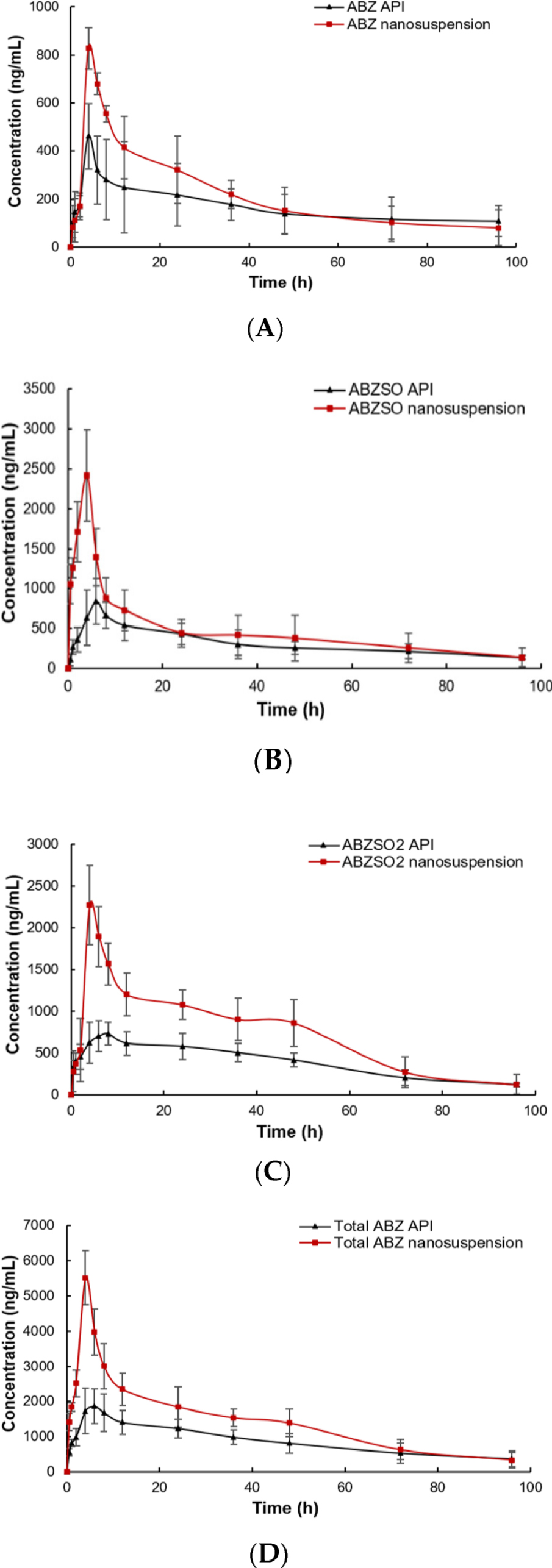
Table 2 Pharmacokinetic Characteristics of Both Native ABZ and Nanocrystals, Assessed After an Oral Dose of 100 mg/kg in SD Rats (Mean ± Standard Deviation, n = 6)
| Parameters | Units | ABZ | ABZSO | ABZSO2 | Total | ||||
|---|---|---|---|---|---|---|---|---|---|
| Native | Nanosuspension | Native | Nanosuspension | Native | Nanosuspension | Native | Nanosuspension | ||
| Tmax | H | 0.60 ± 0.22 | 5.00 | 5.00 ± 1.15 | 4.67 ± 1.03b | 8.00 | 7.33 ± 1.03b | 5.60 ± 1.67 | 5.67 ± 1.51b |
| Cmax | μg/mL | 0.61 ± 0.06 | 0.66 ± 0.19 | 1.18 ± 0.16 | 2.08 ± 0.38a | 1.03 ± 0.11 | 1.71 ± 0.30a | 2.08 ± 0.35 | 3.37 ± 0.82b |
| AUC0 → ∞ | μg/mL | 14.7 ± 4.04 | 41.6 ± 11.6b | 31.6 ± 7.49 | 46.1 ± 11.1a | 30.7 ± 2.25 | 35.9 ± 3.59a | 725 ± 6.18 | 102 ± 20.3b |
| VZ | mL/kg | 341 ± 85.5 | 340 ± 77.9b | 143 ± 14.2 | 104 ± 16.9b | 125 ± 10.2 | 113 ± 21.6b | 89,468 ± 34,099 | 41,904 ± 13,965b |
| CL | mL/h/kg | 5.70 ± 1.81 | 3.42 ± 1.39a | 3.62 ± 0.22 | 2.82 ± 0.52b | 2.82 ± 0.52 | 2.35 ± 0.52a | 1101 ± 521 | 926 ± 233b |
| MRTlast | h | 35.2 ± 3.27 | 43.2 ± 4.15a | 30.9 ± 4.4 | 34.3 ± 2.10b | 30.6 ± 2.59 | 31.3 ± 5.11a | 32.0 ± 3.00 | 33.0 ± 3.33a |
| Ke | 1/h | 0.01 ± 0.001 | 0.01 ± 0.002a | 0.010 ± 0.001 | 0.010 ± 0.003b | 0.01 ± 0.002 | 0.008 ± 0.002b | 0.009 ± 0.001 | 0.009 ± 0.002a |
| T1/2 | h | 62.4 ± 7.88 | 66.8 ± 10.8b | 67.3 ± 8.24 | 75.79 ± 21.68b | 87.2 ± 21.55 | 90.5 ± 26.4b | 79.7 ± 12.7 | 83.7 ± 23.0b |
| F | % | 114.7 | 172 | 113 | 140 | ||||
aStatistical significances compared to native ABZ are p < 0.05. bStatistical significances compared to native ABZ are p < 0.01.
Nanosuspensions
Submicron colloidal dispersions of drug particles that are nanosized and stabilized by surfactants are called nanosuspensions [87]. Poorly water-soluble medications are suspended in dispersion in nanosuspensions, which are devoid of any matrix components. These formulations can be used to increase the solubility of medications that are not highly soluble in fat or water. They also offer flexibility for oral, parenteral, and topical delivery while being cost-effective and scalable for industrial production.
Enhanced drug delivery has been achieved by integrating dry nanosuspensions into microcrystalline cellulose. Rigorous investigations, including in vitro dissolution profiling, thermodynamic solubility studies, and solid-state characterization, have demonstrated significant improvements in dissolution and solubility rates. Advanced imaging techniques such as AFM and SEM have confirmed the successful incorporation of ABZ into the solid MCC support structure, thus reinforcing its potential for superior pharmaceutical performance [88].
Similarly, Mekkawy et al. [89], by using the Box–Behnken design, have formulated an ABZ nanosuspension for the oral treatment of pinworm infection. With the advanced anti-solvent sonoprecipitation technique, they formulated ABZ nanosuspensions, then characterized them with SEM, DSC, XRD, and FTIR. The particle size and polydispersity index were also analyzed. With increasing lecithin and PVP concentration, the particle size gradually increased. This optimization strategy markedly increased the dissolution rate, which was ten times faster than that of standard dosage forms. Most importantly, the ABZ nanosuspensions, compared with the free drug, resulted in a significantly lower risk of paralysis and mortality time, and therefore provided a superior therapeutic alternative [89].
As described above, the nanosuspension formulation of ABZ enhanced the drug’s poor water solubility and bioavailability by decreasing the particle size to the nanoscale range, thus enhancing dissolution and absorption. This method enables higher drug loading, faster therapeutic action, and versatility in routes of administration such as oral or parenteral routes.
Nanocomposites/complexes
Nanocomposites are multiphase materials in which at least one component exhibits dimensions in the nanometer range (typically less than 100 nm). Consequently, these composites have unique and often enhanced properties, such as mechanical strength, thermal stability, electrical conductivity, and other functional characteristics, with respect to those of their individual constituents [90]. Nanocomposite or nanocomplex formulations of drugs may achieve improved solubility and bioavailability by incorporating the drug into nanostructured carriers, thus enhancing dissolution and consequently absorption. These formulations protect drugs against degradation, enable controlled or targeted drug release, and decrease systemic adverse effects. These systems can also improve the stability of the drugs and allow flexibility for oral, transdermal, or injectable delivery. Additionally, nanocomposites are suitable for scaling up and can be tailored with biocompatible materials for safe and effective therapy [91].
Shakir et al. [92] have systematically developed CdS NPs (CdS-G and CdS-M) with glucose and maltose, respectively. Their particle size, optical properties, and morphology have been thoroughly analyzed and compared through SEM, XRD, DSC, FTIR, and photocatalytic degradation studies. Furthermore, evaluation of the remarkable antiparasitic potential of CdS-G and CdS-M NPs against the Pheretima posthuma earthworm has highlighted their promising biomedical applications [92].
Zafar et al. [93] have successfully engineered ABZ-CuO nanocomposites that have revolutionized the treatment of lymphatic filariasis. The physicochemical properties of these nanocomposites were analyzed with UV spectroscopy, AFM, SEM, and FTIR. Notably, relative motility assays confirmed their enhanced efficacy by showing a significant increase in parasite motility rates. Therefore, ABZ-CuO nanocomposites are a promising approach for dealing with lymphatic filariasis [93].
Moreover, de Macedo et al. [94] have synthesized novel LaFeO3 NPs that have revolutionized the differential pulse voltammetric detection of ABZ. Highly advanced characterization techniques such as SEM, TEM, FTIR, and XRD analysis confirmed the NP structure, and XRD distinctly indicated the monophase perovskite-LaFeO3 composition. Although microscopic imaging could not accurately identify the sizes of the particles and pores, the high catalytic activity of perovskite-type LaFeO3 NPs with sonogel carbon paste electrodes significantly improved detection of ABZ. This innovation has enabled highly efficient electroanalysis and provided a novel method for ABZ determination [94].
Se NPs have been prepared from Bacillus sp. MSh-1 against protoscoleces of E. granulosus. Afifi and Oshiba [95] have investigated the therapeutic effects of ABZ-loaded Se NPs on Echinococcus granulosus protoscoleces cultured in test tubes containing RPMI 1640 medium. Feasibility was evaluated with a 0.1% eosin solution, and SEM was also performed. The Se NPs exhibited strong killing effects toward E. granulosus protoscoleces with increasing doses and exposure times [95].
García et al. [96] have synthesized a beta-cyclodextrin (β-CD) citrate derivative to improve its physicochemical properties. An in vitro study indicated a 100% dissolution rate in only 20 minutes. Therefore, this derivative has immense potential for improving biopharmaceutical properties and represents a major breakthrough in drug development.
Similarly, García et al. [96] have strategically formulated inclusion complexes to enhance dissolution rates and significantly improve solubility in aqueous solutions. Advanced analytical tools, such as DSC, XRD, and ESI-MS, verified the successful preparation of the inclusion complexes. Furthermore, convincing in vivo studies in a mouse model of trichinellosis have demonstrated their superior efficacy to standard treatments in achieving markedly lower muscle parasite levels. Therefore, β-CD complexes are a revolutionary and promising strategy for combating parasitic infections [96].
Ferreira et al. [97], in a detailed study on β-CD complexes through 13C and 15N solid-state nuclear magnetic resonance, have revealed critical differences arising from drug-complex interactions. Spectral differences provided strong evidence of the stability of various samples of cyclodextrin, thus supporting their use in pharmaceuticals [97].
Stepniak et al. [98] have explored the interaction of drugs with cyclodextrin complexes in aqueous solution. The solubility was measured with UV spectroscopy and ITC, and in vivo experiments were conducted in 50 C57BL/6 mice (20–22 g) to test the bioavailability. Remarkably, ABZ-CD bioavailability showed a consistent gradual increase in the mouse model [98].
García et al. [99] have investigated a cyclodextrin complex comprising a novel itaconyl-cyclodextrin derivative and demonstrated its ability to efficiently load ABZ. Extensive physicochemical characterization, such as phase solubility profiles and dissolution efficiency studies, confirmed the formation of the complexes in an equimolar ratio. Most importantly, in vitro studies revealed a significantly faster drug release rate of the drug than expected, and the inclusion complex achieved 88-fold greater solubility than traditional drug delivery systems. This innovative approach highlights remarkable results and great promise in future pharmaceutical applications [99].
Supplementary Table 6 briefly summarizes research on nanomaterial complexes. The nanocomposite or nanocomplex formulation of ABZ enhances its poor water solubility and bioavailability by encapsulating the drug in nanostructured matrices, thereby improving dissolution and absorption. Moreover, the formulation protects the drug against environmental degradation, and allows for controlled or targeted release, and hence decreased dosing frequency and adverse effects. To optimize the formulation, biocompatible carriers such as chitosan, silica, or cyclodextrins can be used to make the formulation safe for patients.
Bakhtiar et al. [100] have investigated a cyclodextrin-based delivery system to improve the scolicidal activity of ABZ. To overcome the issues of ABZ’s water solubility and bioavailability, ABZ was mixed with β-CD to form ABZ-β-CD NPs. The scolicidal activity of ABZ-β-CD was investigated in vitro against protoscoleces through analysis of mortality rates over consecutive days, apoptosis induction through caspase-3 activity, and transcript levels of parasite antioxidant genes. To kill all the protoscoleces within 4 days, a free ABZ concentration of 800 μg/mL was required, whereas lower concentrations (200 or 400 μg/mL) required 9 days. In contrast, 400 μg/mL ABZ-β-CD killed all scoli by day 5. Moreover, ABZ-β-CD elicited increased caspase-3 activity and more significant morphological damage (as evidenced by SEM) than free ABZ, thus signifying enhanced apoptotic induction. At the molecular level, ABZ-β-CD more effectively decreased the levels of EgArg and EgTPx mRNA, and consequently weakened the parasite’s defenses against oxidative stress. This study demonstrated that complexation with β-CD increases the efficacy of ABZ and expedites the elimination of parasites at reduced dosages, thereby supporting the repurposing of ABZ with nanostructured carriers. The ABZ-β-CD system shows promise for better treatment of cystic echinococcosis, but it must still be tested in living organisms to determine its pharmacokinetics and toxicity [100].
Dendrimers
Dendrimers are radially symmetric, nanoscale molecules with a distinct, uniform, and monodisperse structure comprising arms or branches that resemble trees [101].
Mansuri et al. [102] have developed an innovative muco-dendrimer delivery system including ABZ-based sustained-release tablets. This novel formulation based on chitosan and PPI achieved significantly improved solubility, dissolution, and half-life in vitro. Furthermore, in vivo studies in male albino mice indicated superior plasma drug concentrations, as measured by HPLC analysis, of the mucoadhesive tablet, with higher Cmax values than those of conventional drugs. This approach therefore has high potential to change the future of parasitic infection treatments [102]. Supplementary Table 5 summarizes the dendrimers, nanocrystals, nanofibers, nanosuspensions, and nanocomposites of ABZ.
These formulations enhance bioavailability by encapsulating or conjugating the drug to the highly branched, nanometer-sized structure of dendrimers, which have a large surface area and multiple functional groups for efficient drug loading. Consequently, better solubilization, prevention of premature degradation of ABZ, and targeted delivery of the drug to the infected tissues can decrease systemic toxicity and adverse effects. For optimization, biocompatible dendrimers such as PAMAM or PEGylated dendrimers should be used to minimize cytotoxicity, along with surface modifications for targeted delivery and controlled release.
Nanofibers
Nanofibers are a general category of fibrous materials with high aspect ratios, which have at least one dimension <100 nm. Glass fibers belong to the submicron category. The formulation of drugs in nanofibrous matrices has been shown to improve solubility and bioavailability by incorporating the drug into a polymeric nanofibrous matrix with a high surface-to-volume ratio, thus accelerating dissolution. Nanofibers aid in the controlled release of drugs, and consequently enable decreased frequency of drug administration and potentially improved patient compliance. Moreover, nanofibers can be used to protect ABZ against degradation and can be designed for site-specific drug delivery. Additionally, they offer flexibility in administration routes, including oral, buccal, or transdermal applications [103].
Kamble et al. [104] have enhanced the dissolution of ABZ by preparing nanofibers with electrospinning. Physicochemical analysis was performed, and SEM images showed fibers. Importantly, the in vitro drug release demonstrated a five-fold increase in dissolution, and the ex vivo permeability studies in goat oral mucosa showed a 3.2-fold increase in the permeability of PVA-loaded ABZ nanofibers. The significant increase in biopharmaceutical properties indicated that this method might provide a promising approach for older patients, by improving drug efficacy and therapeutic potential [104].
Recent research has shown that nanofiber formulations of ABZ exhibit improved solubility and bioavailability by encapsulating the drug in a polymeric nanofibrous matrix, which has a large surface area and facilitates rapid dissolution. This method enables controlled or sustained release of the drug, provides protection against degradation, and allows flexibility in delivery routes of administration, including oral, buccal, or transdermal routes. For optimization, biocompatible polymers such as PLGA may be used in combination with electrospinning to produce homogeneous nanofibers. A direct comparison among various strategy formulations has not been conducted to provide a conclusive evaluation of the appropriateness of the nanomaterials.
Miscellaneous
To improve the solubility and dissolution rate of ABZ sulfoxide, de Souza and Marchetti [105] have focused on the formulation and characterization of Eudragit microparticles loaded with ABZ sulfoxide and simultaneously evaluated the in vitro release profile of the microparticles. The liquefaction process was found to follow a pseudo-second-order kinetic model. Importantly, the microparticles, compared with the micronized and free drug, significantly improved the dissolution rate (p < 0.05). In general, Eudragit microparticles loaded with ABZSO improved solubility and increased the therapeutic efficacy of the antiparasitic drug [105].
Buchter et al. [106] have reported that, among the antifungal medications to treat parasitic infections, ABZ and MBZ are currently the two most frequently used. Through the formulation of ABZ into different delivery systems for improved delivery, many polymers have been identified, including 20 cryoprotectants, polyvinyl alcohol, microcrystalline chitosan, and polysorbate 80 (an emulsifier used in oil-in-water emulsions). All formulations have been characterized according to their unique properties. Comparative in vitro solubility testing indicated that all formulations had higher solubility than the ABZ standard in vitro. The ED50 values obtained from in vivo animal studies were 4.1 mg/kg for the ABZ-P80 formulation and 7.0 mg/kg for neat ABZ. Therefore, ABZ-CH and ABZ-P80 formulations can be considered superior ABZ formulations, because of their ability to overcome poor solubility of ABZ in an aqueous environment, and therefore have the greatest potential for future use in the treatment of parasitic infections [106].
Biodegradable polymeric carriers based on β-1,3-D-glucan from Saccharomyces cerevisiae have been used to encapsulate ABZ. Consequently, ABZ-loaded glucan particles have been developed. The glucan particles protect ABZ against enzymatic degradation and efflux in the gastrointestinal tract, in which β-glucanases are absent in humans. Characterization indicated that ABZ-loaded glucan particles maintained their structural integrity, had a spheroid shape, and exhibited maximum drug loading and drug encapsulation efficiency. In vitro uptake assays in RAW 264.7 macrophages indicated that ABZ-GPs showed maximal uptake at 2 hours; therefore, GPs help deliver drugs to macrophages through recognition by dectin-1 and complement receptor 3 (CR3). Pharmacokinetic studies in rats and mice demonstrated that ABZ-GPs, compared with free ABZ, exhibited accelerated absorption (shorter tmax) and expedited elimination in plasma, and showed markedly elevated retention and AUC in liver tissue, thereby indicating improved hepatic targeting. In vivo fluorescence imaging in mice demonstrated that after repeated oral administration, ABZ-GPs accumulated predominantly in the liver. Additionally, target indices and concentration ratios corroborated their liver selectivity in comparison to that of conventional ABZ [107].
Supplementary Table 6 summarizes research on miscellaneous nanomaterials.
Enhanced anticancer activity of ABZ-nanocarriers: repurposed approach
Recently, in the pursuit of faster, more efficient drug development, drug repurposing has emerged as a key area of interest. A major advantage of repurposed drugs is that their safety profiles are already well established, because they have been previously approved to treat less severe conditions. Therefore, even if the effective dose required for a new indication is significantly higher than the original dose, the drug could still be considered for repurposing [108].
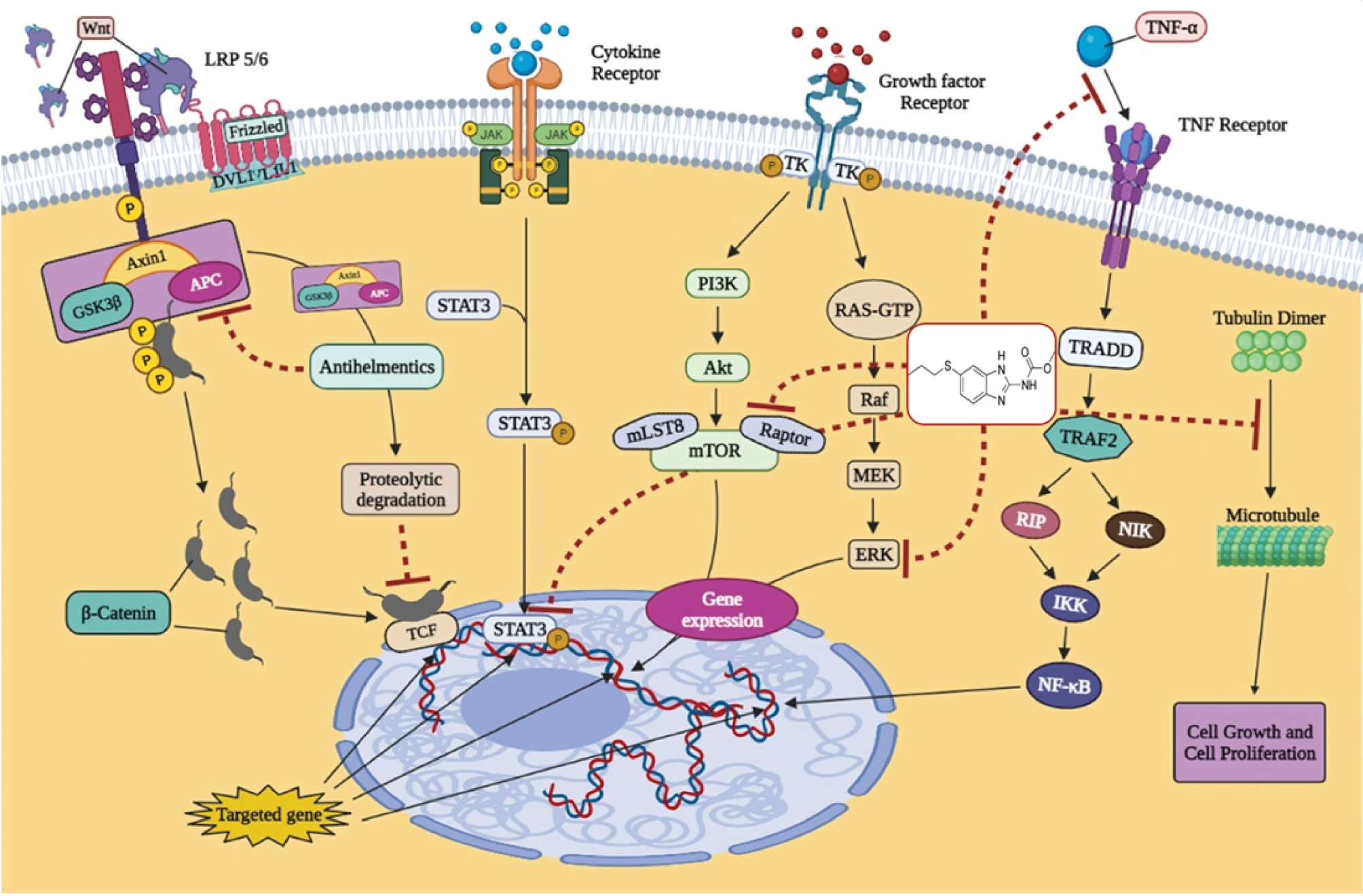
ABZ, along with anthelmintics, has demonstrated significant anti-cancer potential through multiple therapeutic mechanisms. The primary anticancer activity of ABZ is attributed to its ability to disrupt microtubule dynamics by binding β-tubulin, inhibiting polymerization, and thereby arresting the cell cycle in G2/M phase. This disruption leads to mitotic arrest and subsequent induction of apoptosis in rapidly dividing cancer cells [109]. Beyond tubulin, ABZ has been observed to modulate key signaling pathways. For example, ABZ activates AMPK and disrupts mTORC1 (Raptor-containing) signaling in cholangiocarcinoma, blocks autophagic flux, and drives apoptosis [110]. Several benzimidazoles also affect MAPK/ERK signaling: for example, parbendazole enhances cytotoxicity and overcomes chemoresistance via ERK1/2-dependent regulation of HSF1 in colorectal cancer models [111]. Degradation of oncoproteins can also be triggered: ABZ downregulates the E3 ligase RNF20 and its monoubiquitination of the kinesin Eg5, thereby promoting Eg5 degradation via the proteasome and impairing mitotic spindle assembly [109]. Emerging reports suggest that benzimidazoles might also inhibit Wnt/β-catenin signaling, which depends on the Axin–APC destruction complex, although direct links remain under study. Together, in vitro and in vivo studies have confirmed that repurposed benzimidazoles act on multiple cancer-promoting targets (e.g., microtubules, mTORC1, ERK, and proteasomal pathways) and consequently suppress tumor growth [111] (Figure 4).
Figure 4 Drug repurposing activity of ABZ.
Anwar et al. [58] have developed ABZ-loaded NLCs (ABZ-NLCs), which significantly improve drug encapsulation and cellular uptake. After chitosan coating (thus forming ABZ-CS-NLCs), the surface charge changes from negative to positive, and consequently enhances interaction with negatively charged cancer cell membranes. This modification increases cytotoxicity against HepG2 liver cancer cells (IC50 = 8.89 μM), and achieves therapeutic potential through improved cellular internalization and sustained drug release [58].
Similarly, Guo et al. [112] have formulated ABZ nanosuspension by using Kollidon® VA64 and sodium lauryl sulfate as stabilizers, thus resulting in NPs <300 nm in size. These NPs were further coated with microcrystalline cellulose and encapsulated in EUDRACAP® for colon-targeted delivery. The formulation showed approximately 60% drug release under colonic conditions, and exhibited strong anticancer properties, with low IC50 values of 1.18 μM and 3.59 μM in HCT116 and HT-29 human colorectal cancer cell lines, respectively. Moreover, 3D tumor assays validated strong tumor growth inhibition properties with respect to those of the free drug. The therapeutic action therefore combines microtubule inhibition, improved pharmacokinetics with nanocarriers, and targeted cell interactions for enhanced cytotoxicity [112].
Ghasemi et al. [113] have experimentally evaluated the effect of ABZ on head and neck squamous cell carcinoma. Their study emphasizes the use of ABZ as an inexpensive and efficient drug for tumor cells. In addition, methods such as western blotting, live-dead assays, scratch assays, immunofluorescence, and flow cytometry were used. ABZ was found to significantly suppress cell proliferation [113].
The potent anti-angiogenic properties of ABZ have been demonstrated by Cho et al. [114] in a corneal suture model in mice. A significant decrease in corneal neovascularization and lymphangiogenesis was observed after treatment with ABZ, particularly when co-administered with bevacizumab. The combined effects of the two drugs exceeded those of bevacizumab alone, thereby indicating the promising potential of ABZ to significantly improve treatment outcomes [114].
Zhang et al. [115] have examined the antitumor effects of ABZ and its effects on squamous cell carcinoma. Systematic research indicated that ABZ increases the levels of certain enzymes, promotes cell viability, and strongly inhibits the colony-forming activity of carcinoma cells [115].
Zhou et al. [116] have verified the strong inhibitory effects of ABZ in non-small cell lung cancer, including its ability to decrease HIF-1 and VEGF levels in an A549 mouse model, thus leading to cancer cell regression. In addition, the results have been confirmed through western blotting and various assays. Consequently, the study emphasizes the potential of ABZ as a promising drug for NSCLC [116].
Wang et al. [117] have investigated the potential of ABZ against human leukemia U937 cells and emphasized its ability to inhibit malignant tumor growth. ABZ was found to cause SIRT3 knockdown, thus activating U937 cells via the SIRT3/ROS/p38 MAPK/TTP pathway and resulting in tumor necrosis factor overexpression [117].
Chen et al. [118] have analyzed the anti-cancer properties of ABZ as a protective drug against pancreatic cancer, and assessed cell proliferation with MTT assays, colony formation assays, and Transwell assays. In addition, in vitro experiments in SW1990 and PANC-1 cell lines and in vivo experiments in xenograft mouse models showed remarkable efficacy against pancreatic cells. ABZ therefore has potential as a future therapeutic agent against pancreatic cancer [118].
Yang et al. [119] have assessed the potential of ABZ against gastric cancers by inhibiting the STAT3 and STAT5 signaling pathways. ABZ was found to suppress phosphorylation of these proteins, a process essential for the proliferation of cancerous cells in the gastrointestinal tract. Moreover, in vitro studies including MTT assays, western blot analysis, immunocytometry, and RT-PCR were performed in cell lines such as SNU-1, SNU-16, and GES-1. ABZ was found to effectively decrease the viability of cancerous cells [119]. In addition, Wang et al. [120] have examined the antileukemic activity of ABZ on K562 cells and demonstrated that ABZ induces SIRT3 upregulation, which consequently slows cell apoptosis [120].
Supplementary Table 7 presents the drug repurposing activity of ABZ alone.
Lipid carrier systems
Movahedi et al. [121] have aimed to improve the solubility and antineoplastic activity of ABZ by combining lipid-coated Ca3(PO4)2 NPs specifically designed for improved solubility and release at acidic pH. The cytotoxic effects were evaluated with MTT assays in cell lines including B16F0, HEK293T, and MCF-7. Importantly, LCP-ABZ exhibited potent antineoplastic activity by inducing apoptosis, because of excessive ROS production and inhibition of beta-tubulin polymerization, without showing any toxic effects on normal cells [121]. Maqbool et al. [122] have highlighted the importance of functionalized liposomes loaded with ABZ and bombesin(6-14) to specifically target GRPR, thus improving drug delivery to malignant tumor cells via supercritical fluid technology. Importantly, bombesin(6-14)-functionalized ABZ liposomes, in contrast to non-functionalized liposomes, significantly decreased cellular fitness [122]. Marslin et al. [123] have studied the cytotoxicity of ASLNs in U-87-MG glioma cell lines. ASLNs were prepared with a lipid carrier, glyceryl trimyristate, thus yielding 80 ASLNs with an average size of 218.4 × 5.1 nm by homogenization and mixing. Additionally, through probe sonication, in vitro drug release patterns were observed. The 82% release rate of ABZ from ASLNs within 24 hours demonstrated effective absorption by the cells [123].
Figure 4 shows the anticancer activity of ABZ via multiple targets for repurposing activity.
ABZ was first used as an anthelmintic; however, it has been modified to stearyl amine-modified elastic cerosomes (SA-EC-ALB) for use as an anticancer drug. To enhance tumor targeting, drug loading, and anticancer efficacy, researchers have used a flexible lipid vesicular delivery method. A D-optimal experimental design was applied to change the surfactant quantity, sonication period, ceramide type, and surfactant type to achieve optimal entrapment efficiency, particle size (PS), and PDI. The optimal SA-EC-ALB had an entrapment efficiency of 92.03 ± 3.53% and a particle size of 312.05 ± 9.32 nm. Morphologically, the cerosomes had elongated, fiber-like vesicles interspersed with occasional spherical forms, as evidenced by TEM imaging. DSC indicated the absence of the distinctive ABZ melting peak in the cerosome formulation, thus validating the incorporation of the amorphous drug. In silico docking and molecular dynamics demonstrated robust hydrogen bonding and hydrophobic interactions between ABZ and cerosome components (phospholipids, ceramide III, stearyl amine, and Pluronic L121), hence affirming the structural stability of the nanoassembly. In vivo antitumor assessment in a solid Ehrlich tumor model revealed that SA-EC-ALB significantly diminished the tumor volume relative to free ABZ solution, thereby indicating improved anticancer activity. Frontiers+2 PMC+2 Histopathological results showed that the tumor cells died more quickly, the surrounding muscle showed less dying, and the tissue architecture was better preserved than free ABZ solution. In general, this repurposed lipid-vesicle nanocarrier system greatly improved the anticancer effectiveness of ABZ by enabling high loading, a favorable nanostructure, persistent molecular interactions, and enhanced tumor suppression in vivo. Therefore, ABZ can be used in anti-cancer and anthelmintic applications through enhanced nano-delivery [124].
Polymer carrier systems
Chitosan-coated ABZ-loaded PLGA NPs have been developed by Kang et al. [125] to enhance solubility and mucoadhesive properties. The in vitro anticancer effects of ABZ have been evaluated with zeta potential measurement and MTT assays. Validation of the ABZ-CS-coated PLGA NPs with physicochemical characterization revealed an optimal particle size range of 260–480 nm and an NP yield of 58.5–67.8%. Stability was maintained for as many as 4 weeks, and the in vitro release rate of ABZ from the NPs significantly surpassed that of unmodified ABZ. Notably, these NPs showed better mucoadhesive properties and stronger anticancer effects than free ABZ [125]. Racoviceanu et al. [126] have demonstrated improved solubility of ABZ by encapsulation in homogeneous polyurethane matrices. Physico-chemical characterization and spectral analysis confirmed the encapsulation efficiency of ABZ in ABZ-PU. Moreover, in vitro experiments conducted in two breast cancer cell lines, MCF-7 and MDA-MB-231, confirmed the strong anti-cancer properties of both ABZ-PU and pure ABZ. A thorough analysis of these studies emphasizes the strong ability of ABZ-PUs to induce apoptosis and promote cell death. Several studies have reported nominal in vitro cytotoxicity [126].
In a study in colorectal cancer cells, zein, an amphiphilic protein, has been used to formulate ABZ-loaded NPs. The Box–Behnken design was used to optimize the NPs, with polyvinyl alcohol, acetic acid concentration, and zein weight as key variables. The optimized NPs had a diameter of 84.3 nm (±0.41 nm), a PDI of 0.13 (±0.012), and a zeta potential of 42.5 mV (±2.35). The NPs showed pH-sensitive drug release properties, with no release at pH 1.2 and 92.4% release in 24 hours in a colon-simulated environment, in addition to promising anticancer properties [127].
Khot et al. [128] have incorporated ABZ into NLCs in a gel formulation to explore the delivery potential. The ABZ-NLCs were prepared with a melt-emulsification ultrasonication method that was optimized with a Box–Behnken design to determine the optimal combination of particle size and entrapment efficiency. The optimal NLCs had an average size of approximately 176.5 nm and an entrapment efficiency of approximately 89.85%. Because the zeta potentials were also optimal, the NLCs were stable in a colloidal state. These NLCs were then combined with a Carbopol-934 gel matrix (1% w/v) to prepare a topical formulation. The combined system kept the pH between 5.1 and 6.0 and the viscosity at approximately 6.64 Pa·s. In vitro release experiments indicated significantly greater ABZ release from NLCs and NLC gel than from conventional gel, with approximately 93.1% (NLC) and 80.8% (NLC-gel) released over 48 hours, compared with approximately 20.4% for free ABZ dispersion at pH 6.8. The NLC-gel released approximately 84.6% ABZ at an acidic pH of 5.5, which is similar to that of the skin microenvironment. In contrast, the traditional gel released only approximately 33.7% ABZ.
The improved release was due to the increased movement of lipids and the breakdown of the NLC structure in acidic environments. Ex vivo permeation through goat ear skin showed that the flux of ABZ from NLCs and NLC gel was 5.1-fold and 4.5-fold higher, respectively, than that of conventional gel (flux 6.2 vs. 5.5 vs. 1.27 μg·cm−2·h−1). The cytotoxicity of ABZ-NLCs against melanoma (B16F10) cells was approximately 1.7 times (IC50 ~1.87 μM) that of pure ABZ (IC50 ~3.18 μM). In contrast, the NLC gel had diminished effects (IC50 ~4.13 μM), probably because of slower release kinetics. Importantly, the formulations showed very little toxicity (less than 15% decrease in viability) in HaCaT normal skin cells, thus demonstrating their biocompatibility. Stability experiments conducted over 12 weeks at 4 ± 2°C validated the maintenance of encapsulation efficiency (80%–90%) and indicated negligible alterations in particle size or gel viscosity [128].
Cyclodextrin complexes
Cyclodextrins are cyclic oligosaccharides that form inclusion complexes with various drug molecules, and consequently enhance the drugs’ aqueous solubility, stability, and bioavailability. Their unique ability to encapsulate hydrophobic drugs within their hydrophilic outer shell makes them valuable carriers in oral, parenteral, and topical drug delivery systems. Recent advances have explored chemically modified cyclodextrins for controlled release and targeted delivery applications, thereby broadening their pharmaceutical utility [129].
Priotti et al. [130] have investigated the potential of anthelmintic drugs in treating triple-negative breast cancer by enhancing their solubility with cyclodextrin inclusion complexes. They formulated cyclodextrin complexes of ABZ and RBZ and conducted physicochemical characterization studies to confirm the solid state of these complexes. Comprehensive in vitro and in vivo experiments were performed in breast carcinoma cell lines (4T1) and BALB/c mice. In vitro, ABZ exhibited stronger anti-proliferative effects than RBZ in the 4T1 cell line. Furthermore, in vivo findings demonstrated that the ABZ cyclodextrin complex significantly decreased tumor growth in BALB/c mice without causing toxicity. Therefore, cyclodextrin complexes effectively improved ABZ solubility and anticancer efficacy [130].
Albumin NPs
Albumin NPs have emerged as highly promising drug delivery systems, because their inherent biocompatibility, biodegradability, long circulatory half-life, and multifaceted drug-binding ability enable efficient encapsulation of hydrophobic therapeutics and targeted delivery to tumors via both receptor-mediated uptake and the EPR effect [131].
Noorani et al. [132] have developed ABZ-loaded albumin NPs (200–300 nm) to enhance solubility and address the poor solubility that limits therapeutic efficacy. Dynamic light scattering analysis confirmed their particle size distribution and low PDI, thus ensuring stability of the formulation. Moreover, the encapsulation of ABZ was verified with high-performance liquid chromatography. The albumin NPs demonstrated an uptake efficiency above 80%. In vitro experiments were performed in ovarian cancer cell lines (OVCAR3, SKOV3, and A2780), HOSE, and Chinese hamster ovary cell lines. No significant toxicity to normal cells was observed. Therefore, nab-ABZ is a highly promising approach for the treatment of ovarian cancer treatment, because of its low toxicity and high uptake efficiency [132].
Lu et al. [133] have investigated albumin NPs of ABZ for the treatment of multicellular pancreatic tumors. ABZ was loaded into BSA-polycaprolactone NPs with a particle size of approximately 100 nm, along with two other sizes of BSA-ABZ-NPs (10 nm and 200 nm), prepared through the desolvation method. The NPs were tested on cultured AsPC-1 cells in 2D culture and 3D multicellular tumor spheroids. Notably, the 100 nm NPs showed strong cytotoxicity against 2D cultured AsPC-1 cells in culture and strong inhibition of 3D tumor spheroids. Moreover, sulforhodamine B assays validated the in vitro cytotoxicity of both BSA-ABZ and free ABZ. Therefore, ABZ-loaded BSA – polycaprolactone NPs are a promising candidate for the treatment of pancreatic cancer [133].
Miscellaneous
A study has compared the oral absorption of two weak bases in pH-independent controlled-release formulations, particularly in elution studies, and tested applications under enteric pH conditions simulating those in healthy volunteers and patients with achlorhydria. Unlike pH-dependent physical mixtures or commercial tablets, pH-independent tablets and mixtures demonstrated this drawback. In contrast, when SDs and granules were used, the elution and intended absorption were not affected by pH [134]. Moreover, experiments in Caco-2 cell lines supported the intended benefits, as indicated by Sugawara et al. against malignancies [135]. Tang et al. [136] have designed a self-assembling nanosystem that delivers both trichosanthin and ABZ to combat multidrug resistance and metastasis. The medicines were encapsulated in albumin-coated silver NPs (rTL/ABZ-BSA/Ag NP), which showed excellent cellular absorption and potent anticancer action in A549/T drug-resistant cells. Cytotoxicity studies demonstrated low IC50 values (0.08 μg/mL for ABZ) and negligible toxicity to normal cells. In vivo, rTL/ABZ-BSA/Ag NP decreased tumor development in A549/T mice by 86%. The study focused on improving the efficacy of silver NP-based co-delivery systems in cancer treatment [136]. Koradia et al. [137] have successfully optimized ABZ nanocrystals to address low solubility issues. Nanocrystals were formulated with a solvent precipitation technique combined with spray drying. Crystallization enhanced the dissolution rate and significantly improved bioavailability, thus resulting in superior therapeutic efficacy to that of pure ABZ. Furthermore, characterization confirmed the crystallinity of nanocrystals, which remained stable even after rigorous stability studies. Nanocrystals are therefore an encouraging strategy to enhance the antitumor activities of ABZ [137].
One research group has developed a dual drug-loaded nanomicelle system encapsulating ABZ and paclitaxel with a novel carrier matrix comprising D-α-tocopheryl polyethylene glycol 1000 succinate (TPGS), Soluplus, and folic acid. The formulation process was optimized through a 32 factorial design, focusing on polymer ratios to achieve desirable particle size, zeta potential, PDI, and entrapment efficiency. The optimized nanomicelles demonstrated a critical micelle concentration of 0.0015 mg/mL for the TPGS-folic acid conjugate, thereby indicating improved dilution stability. Characterization techniques, including DSC, nuclear magnetic resonance, and FTIR, confirmed the successful encapsulation of both drugs. The release profile exhibited an initial burst followed by sustained release over 90 hours. In vitro cytotoxicity assays in SKOV3 ovarian cancer cell lines demonstrated the dual drug-loaded micelles’ superior cytotoxic potential to those of the individual drugs. In vivo studies confirmed the presence of both drugs in plasma and tumor tissues, thus suggesting effective targeting and penetration [138].
Spherical MCM-41 NPs measuring approximately 220 ± 11.5 nm were synthesized and subsequently expanded to approximately 293 ± 8.7 nm after ABZ loading. The zeta potential remained negative (−36.3 mV for blank and −33.0 mV for ABZ-MCM-41). The drug loading efficiency was approximately 30%. Encapsulation decreased the pore size, surface area, and pore volume, in line with the drug taking up space in the mesopores. Biological assays demonstrated that ABZ-loaded MCM-41 NPs significantly increased cytotoxicity against liver cancer cells: the IC50 decreased from 23 μM (free ABZ) to 7.9 μM (nano formulation), thus indicating an approximate 2.9-fold enhancement in potency. In addition, both free ABZ and ABZ-NPs slowed cell movement by approximately 12%. This study demonstrated that mesoporous silica carriers can successfully repurpose ABZ by increasing cellular uptake and local concentration in cancer cells, thus achieving enhanced effects in halting cell growth. The nano-encapsulation strategy shows promise in making ABZ a stronger anti-cancer drug, but more studies in living organisms and on safety are needed [139].
Supplementary Table 8 summarizes research on drug repurposing of ABZ nanocarriers.
Toxicity and scale-up considerations
The many nanocarriers investigated in nanomedicine, including lipid-based systems and dendrimers, have diverse and well-documented toxicity profiles that influence clinical development. Lipid nanocarriers, such as liposomes and SLNs, are generally believed to be biocompatible; however, they have been shown to cause specific toxicities such as complement activation-related pseudo allergy, oxidative stress from lipid peroxidation, and unintended drug accumulation in non-target tissues, because of altered pharmacokinetics [140]. Because nanomedicines might have more risks than benefits, they are currently available only in deadly situations such as cancers or skin-related disorders, in which absence of penetration has been demonstrated [141].
Surface modifications, such as PEGylation, might elicit immunological responses after repeated dosing and consequently accelerate blood clearance. Dendrimers, particularly those with positively charged amine terminals, have enhanced cytotoxicity because their strong interactions with negatively charged cell membranes result in membrane rupture, apoptosis, and oxidative stress. Greater-generation dendrimers are also known to be more hazardous, because of their higher surface charge density and limited renal clearance, thus prompting concerns regarding long-term bioaccumulation. Given these unique toxic effects, nanocarrier composition and surface properties must be adjusted to avoid undesirable biological interactions and ensure therapeutic safety [142].
According to Yang et al. [143], TiO2 NPs have significant cytotoxic effects, particularly on corneal endothelial cells. TiO2 NPs have been found to limit cell growth, disturb cellular shape, and damage mitochondria in mouse primary corneal endothelium cells. Moreover, these NPs cause considerable oxidative stress, as evidenced by elevated ROS and malondialdehyde levels, as well as diminished antioxidant enzyme activity (SOD and GSH-Px). Flow cytometry analysis has demonstrated elevated apoptosis and G2/M cell cycle arrest. TiO2 NPs negatively affect cell function by down-regulating important proteins such as ZO-1, β-catenin, and Na+/K+-ATPase. These findings highlight the possible ocular toxicity of TiO2 NPs [143].
Ilinskaya et al. [144] have revealed that mesoporous silica NPs (MSNs) induce shape-dependent toxicity after oral administration. MSNs with high aspect ratios (e.g., 5) exhibited diminished biodegradation and excretion and consequently show prolonged retention in the body. Notably, MSNs cause renal toxicity characterized by hemorrhage, vascular congestion, and renal tubular necrosis, with severity increasing with the particle aspect ratio. Therefore, MSNs’ shape significantly influences their toxicological profile, particularly in terms of causing kidney damage; consequently, careful design is critical in biomedical applications to minimize nanotoxicity [144].
Because nanomaterials are new medicines, knowledge of their all aspects of processes and quality control is limited; hence, they face scale-up challenges. The unique property of nanomaterial lies in its size, which is very different from its bulk. Although the size of nanomaterials is a critical process parameter, the literature contains little information for scale-up. Academia, which is prone to publishing to publicly share knowledge, focuses on proof of principle at scales of only several milligrams. Scale-up technology is art or data which gained or generated, respectively, by any organization for its own purpose and is not revealed to the public. Moreover, scale-up requires large, specific, customized instruments and cannot be generalized to diverse projects [145].
Conclusion
ABZ, a benzimidazole derivative, is an anthelmintic with demonstrated efficacy against a broad spectrum of parasitic infections. However, its clinical application is significantly hindered by its poor aqueous solubility, limited bioavailability, and characteristics of BCS class II drugs. This review highlights the current landscape of drug delivery advancements aimed at overcoming these challenges, emphasizing the roles of nanomedicine-based approaches such as NPs, liposomes, SLNs, and nanoemulsions. These novel delivery platforms have shown promise in enhancing the solubility, permeability, and overall therapeutic efficacy of ABZ.
Beyond its conventional use in parasitic infections, ABZ has gained renewed attention for its potential repurposing as an anticancer agent. Numerous studies have demonstrated the efficacy of ABZ in disrupting microtubule formation, inhibiting tumor angiogenesis, and inducing apoptosis in various cancer cell lines. In this context, nanocarrier systems have further enhanced ABZ’s pharmacokinetic and pharmacodynamic profiles, thereby enhancing tissue penetration and cellular uptake in tumor microenvironments.
Formulations such as cyclodextrin complexes, albumin NPs, and polymer-lipid nanohybrids have substantially enhanced the anticancer activity of ABZ. These formulations are highly promising because they provide dual advantages of solubilization enhancement and targeted drug delivery for oncology applications. Furthermore, some repurposed formulations of ABZ are being assessed for clinical use in various types of cancers, including glioblastoma, ovarian cancer, and hepatocellular carcinoma, thus highlighting their promising translational potential.
The approaches of drug delivery and drug repurposing strategies have collectively widened the therapeutic scope of ABZ. However, future research efforts should be directed toward the development of targeted delivery systems that provide combined advantages of nanotechnology and site-specific drug action to minimize systemic toxicity and improve efficacy. Moreover, clinical validation of ABZ’s anticancer potential through comprehensive preclinical and human studies remains a critical step. Collaborative efforts among researchers, clinicians, and regulatory bodies will be key to achieving this transformative potential in the near future.
Conflict of interest
The authors declare that there are no conflicts of interest.
Supplementary material
Supplementary material can be downloaded from https://bio-integration.org/wp-content/uploads/2026/03/bioi20250045_Supplemental.pdf.
Graphical abstract
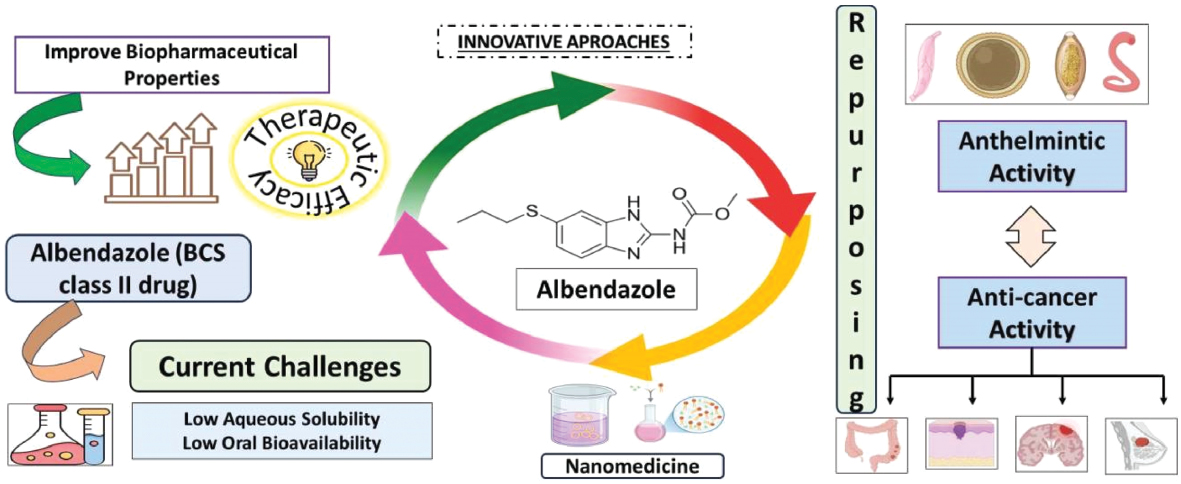
Highlights
- Albendazole (ABZ) shows promising antiparasitic and emerging anticancer potential.
- Poor solubility and bioavailability limit its clinical effectiveness.
- Nanocarriers, solid dispersions, and hybrid systems improve drug delivery.
- Formulations enhance pharmacokinetics, targeting, and therapeutic outcomes.
- Evidence supports repurposing ABZ for cancers including breast and brain.
In brief
Albendazole is a broad-spectrum antiparasitic drug with growing evidence for anticancer activity, but its clinical performance is restricted by poor aqueous solubility and low oral bioavailability. This review compiles recent advances in formulation strategies such as nanocarriers, lipid systems, and solid dispersions that improve drug absorption, targeting, and therapeutic response, highlighting its potential repurposing in oncology.
References
- WHO. Soil-transmitted helminth infections. Available from: https://www.who.int/news-room/fact-sheets/detail/soil-transmitted-helminth-infections. [Retrieved 15 Jan 2024].
- Sharma S, Goel V, Kaur P, Gadhave K, Garg N, et al. Targeted drug delivery using beeswax-derived albendazole-loaded solid lipid nanoparticles in Haemonchus contortus, an albendazole-tolerant nematode. Exp Parasitol 2023;253:108593. [PMID: 37595879 DOI: 10.1016/j.exppara.2023.108593]
- Coakley G, Buck AH, Maizels RM. Host parasite communications—messages from helminths for the immune system: parasite communication and cell-cell interactions. Mol Biochem Parasitol 2016;208(1):33-40. [PMID: 27297184 DOI: 10.1016/j.molbiopara.2016.06.003]
- Mark G. Parasites: what they are and how they affect your health. 2023. Available from: https://www.health.com/parasites-7967696?utm_source=chatgpt.com. [Retrieved on 17 Jul 2025]
- Hong ST, Yong TS. Review of successful control of parasitic infections in Korea. Infect Chemother 2020;52(3):427-40. [PMID: 32869557 DOI: 10.3947/ic.2020.52.3.427]
- Hoeppli R. The knowledge of parasites and parasitic infections from ancient times to the 17th century. Exp Parasitol 1956;5(4):398-419. [PMID: 13344503 DOI: 10.1016/0014-4894(56)90024-8]
- Jain AS, Shah HM, Joshi SV, Kharkar PS. Drugs for giardiasis, trichomoniasis, and leishmaniasis. In: Acharya PC, Kurosu M, editors. Medicinal chemistry of chemotherapeutic agents. Academic Press; 2023. pp. 431-60. [DOI: 10.1016/B978-0-323-90575-6.00006-5]
- Keystone JS, Keystone DL, Proctor EM. Intestinal parasitic infections in homosexual men: prevalence, symptoms and factors in transmission. Can Med Assoc J 1980;123(6):512-4. [PMID: 7437971]
- Kucik CJ, Martin GL, Sortor BV. Common intestinal parasites. Am Fam Physician 2004;69(5):1161-9. [PMID: 15023017]
- Ahmed M. Intestinal parasitic infections in 2023. Gastroenterology Res 2023;16(3):127-140. [PMID: 37351081 DOI: 10.14740/gr1622]
- Cruz I, Morales MA, Noguer I, Rodríguez A, Alvar J. Leishmania in discarded syringes from intravenous drug users. Lancet 2002;359(9312):1124-5. [PMID: 11943264 DOI: 10.1016/s0140-6736(02)08160-6]
- Kimblin N, Peters N, Debrabant A, Secundino N, Egen J, et al. Quantification of the infectious dose of Leishmania major transmitted to the skin by single sand flies. Proc Natl Acad Sci U S A 2008;105(29):10125-30. [PMID: 18626016 DOI: 10.1073/pnas.0802331105]
- Paul J. Introduction to infectious diseases. In: Disease causing microbes. Cham: Springer; 2024. pp. 1-63. [DOI: 10.1007/978-3-031-28567-7_1]
- Domalaon R, Okunnu O, Zhanel GG, Schweizer F. Synergistic combinations of anthelmintic salicylanilides oxyclozanide, rafoxanide, and closantel with colistin eradicates multidrug-resistant colistin-resistant Gram-negative bacilli. J Antibiot (Tokyo) 2019;72(8):605-16. [PMID: 31028351 DOI: 10.1038/s41429-019-0186-8]
- Agube CA, Ajaghaku DL, Uzochukwu KC. Evaluation of anthelmintic efficacy of equal combination of doxycycline and mepacrine. Br J Pharm 2023;8(1):1-39. [DOI: 10.5920/bjpharm.1019]
- Cook G. Use of benzimidazole chemotherapy in human helminthiases: indications and efficacy. Parasitol Today 1990;6(4):133-6. [PMID: 15463317 DOI: 10.1016/0169-4758(90)90232-s]
- El-On J. Benzimidazole treatment of cystic echinococcosis. Acta Trop 2003;85(2):243-52. [PMID: 12606103 DOI: 10.1016/s0001-706x(02)00217-6]
- Borchert M, Hellinga JR, Reber S, Krücken J, von Samson-Himmelstjerna G. Benzimidazole inhibits Haemonchus contortus microtubule dynamics by intradimer structural changes observed by in silico modeling. J Biomol Struct Dyn 2026;44(5):2597-612. [PMID: 41874537 DOI: 10.1080/07391102.2024.2444423]
- Karthik B, Ramakrishna B, Kumar BA, Kumar TK. Design and synthesis of some new benzimidazole-1, 2, 3-triazole-thiazolidine-2, 4-dione conjugates as tubulin polymerization inhibitors. Russ J Bioorg Chem 2024;50(4):1434-45. [DOI: 10.1134/S1068162024040307]
- Choi HS, Ko YS, Jin H, Kang KM, Ha IB, et al. Anticancer effect of benzimidazole derivatives, especially mebendazole, on triple-negative breast cancer (TNBC) and radiotherapy-resistant TNBC in vivo and in vitro. Molecules 2021;26(17):5118. [PMID: 34500557 DOI: 10.3390/molecules26175118]
- Ren LW, Li W, Zheng XJ, Liu JY, Yang YH, et al. Benzimidazoles induce concurrent apoptosis and pyroptosis of human glioblastoma cells via arresting cell cycle. Acta Pharmacol Sin 2022;43(1):194-208. [PMID: 34433903 DOI: 10.1038/s41401-021-00752-y]
- Tenorio JCB, Belizario VYJ, Furtado LFV, Suttiprapa S. Can benzimidazole resistance undermine the Philippines’ success in controlling and eliminating soil-transmitted helminth infections? A mini-review. Infect Microbes Dis 2024;6(4):163-9. [DOI: 10.1097/IM9.0000000000000163]
- Florio R, Veschi S, di Giacomo V, Pagotto S, Carradori S, et al. The benzimidazole-based anthelmintic parbendazole: a repurposed drug candidate that synergizes with gemcitabine in pancreatic cancer. Cancers (Basel) 2019;11(12):2042. [PMID: 31861153 DOI: 10.3390/cancers11122042]
- Bolla G, Nangia A. Novel pharmaceutical salts of albendazole. CrystEngComm 2018;20(41):6394-405. [DOI: 10.1039/c8ce01311j]
- Poovi G, Damodharan N. Lipid nanoparticles: a challenging approach for oral delivery of BCS Class-II drugs. Futur J Pharm Sci 2018;4(2):191-205. [DOI: 10.1016/j.fjps.2018.04.001]
- Lopalco A, Denora N. Nanoformulations for drug delivery: safety, toxicity, and efficacy. In: Nicolotti O, editor. Computational toxicology: methods and protocols. New York: Humana Press; 2018. pp. 347-65. [DOI: 10.1007/978-1-4939-7899-1_17]
- Boas U, Heegaard PM. Dendrimers in drug research. Chem Soc Rev 2004;33(1):43-63. [PMID: 14737508 DOI: 10.1039/b309043b]
- Chan JM, Valencia PM, Zhang L, Langer R, Farokhzad OC. Polymeric nanoparticles for drug delivery. In: Grobmyer SR, Moudgil BM, editors. Cancer nanotechnology: methods and protocols. New York: Humana Press; 2010. pp. 163-75. [DOI: 10.1007/978-1-60761-609-2_11]
- Saffoon N, Uddin R, Huda NH, Sutradhar KB. Enhancement of oral bioavailability and solid dispersion: a review. J Appl Pharm Sci 2011;1(7):13-20.
- Roy MN, Ekka D, Saha S, Roy MC. Host–guest inclusion complexes of α and β-cyclodextrins with α-amino acids. RSC Adv 2014;4(80):42383-90. [DOI: 10.1039/C4RA07877B]
- Bronze-Uhle ES, Costa BC, Ximenes VF, Lisboa-Filho PN. Synthetic nanoparticles of bovine serum albumin with entrapped salicylic acid. Nanotechnol Sci Appl 2016;10:11-21. [PMID: 28096662 DOI: 10.2147/NSA.S117018]
- Kumar S, Jana AK, Maiti M, Dhamija I. Carbodiimide-mediated immobilization of serratiopeptidase on amino-, carboxyl-functionalized magnetic nanoparticles and characterization for target delivery. J Nanopart Res 2014;16(2):2233. [DOI: 10.1007/s11051-013-2233-x]
- Patra JK, Das G, Fraceto LF, Campos EVR, Rodriguez-Torres MDP, et al. Nano based drug delivery systems: recent developments and future prospects. J Nanobiotechnology 2018;16(1):71. [PMID: 30231877 DOI: 10.1186/s12951-018-0392-8]
- Kirthiga Devi SS, Singh S, Joga R, Patil SY, Meghana Devi V, et al. Enhancing cancer immunotherapy: exploring strategies to target the PD-1/PD-L1 axis and analyzing the associated patent, regulatory, and clinical trial landscape. Eur J Pharm Biopharm 2024;200:114323. [PMID: 38754524 DOI: 10.1016/j.ejpb.2024.114323]
- Koo OM, Rubinstein I, Onyuksel H. Role of nanotechnology in targeted drug delivery and imaging: a concise review. Nanomedicine 2005;1(3):193-212. [PMID: 17292079 DOI: 10.1016/j.nano.2005.06.004]
- Manish G, Vimukta S. Targeted drug delivery system: a review. Res J Chem Sci 2011;1(2):135-8. [DOI: 10.56726/irjmets49776]
- Arora S, Singh B, Kumar S, Kumar A, Singh A, et al. Piperine loaded drug delivery systems for improved biomedical applications: current status and future directions. Health Sci Rev 2023;9:100138. [DOI: 10.1016/j.hsr.2023.100138]
- Jourdan JP, Bureau R, Rochais C, Dallemagne P. Drug repositioning: a brief overview. J Pharm Pharmacol 2020;72(9):1145-51. [PMID: 32301512 DOI: 10.1111/jphp.13273]
- Nygren P, Fryknäs M, Ågerup B, Larsson R. Repositioning of the anthelmintic drug mebendazole for the treatment for colon cancer. J Cancer Res Clin Oncol 2013;139(12):2133-40. [PMID: 24135855 DOI: 10.1007/s00432-013-1539-5]
- Yadav P, Singh R. A review on anthelmintic drugs and their future scope. Int J Pharm Pharm Sci 2011;3(3):17-21.
- Hanusova V, Skalova L, Kralova V, Matouskova P. Potential anti-cancer drugs commonly used for other indications. Curr Cancer Drug Targets 2015;15(1):35-52. [PMID: 25544649 DOI: 10.2174/1568009615666141229152812]
- Barbosa EJ, Löbenberg R, de Araujo GLB, Bou-Chacra NA. Niclosamide repositioning for treating cancer: challenges and nano-based drug delivery opportunities. Eur J Pharm Biopharm 2019;141:58-69. [PMID: 31078739 DOI: 10.1016/j.ejpb.2019.05.004]
- Nath J, Paul R, Ghosh SK, Paul J, Singha B, et al. Drug repurposing and relabeling for cancer therapy: emerging benzimidazole antihelminthics with potent anticancer effects. Life Sci 2020;258:118189. [PMID: 32781060 DOI: 10.1016/j.lfs.2020.118189]
- Alavi SE, Ebrahimi Shahmabadi H. Anthelmintics for drug repurposing: opportunities and challenges. Saudi Pharm J 2021;29(5):434-45. [PMID: 34135669 DOI: 10.1016/j.jsps.2021.04.004]
- Chai JY, Jung BK, Hong SJ. Albendazole and mebendazole as anti-parasitic and anti-cancer agents: an update. Korean J Parasitol 2021;59(3):189-225. [PMID: 34218593 DOI: 10.3347/kjp.2021.59.3.189]
- Cámara-Sánchez P, Díaz-Riascos ZV, García-Aranda N, Gener P, Seras-Franzoso J, et al. Selectively targeting breast cancer stem cells by 8-quinolinol and niclosamide. Int J Mol Sci 2022;23(19):11760. [PMID: 36233074 DOI: 10.3390/ijms231911760]
- Sonbol H, Ameen F, AlYahya S, Almansob A, Alwakeel S. Padina boryana mediated green synthesis of crystalline palladium nanoparticles as potential nanodrug against multidrug resistant bacteria and cancer cells. Sci Rep 2021;11(1):5444. [PMID: 33686169 DOI: 10.1038/s41598-021-84794-6]
- Ullah S, Azad AK, Nawaz A, Shah KU, Iqbal M, et al. 5-fluorouracil-loaded folic-acid-fabricated chitosan nanoparticles for site-targeted drug delivery cargo. Polymers (Basel) 2022;14(10):2010. [PMID: 35631891 DOI: 10.3390/polym14102010]
- Wang X, Yang Y, Liu C, Guo H, Chen Z, et al. Photo- and pH-responsive drug delivery nanocomposite based on o-nitrobenzyl functionalized upconversion nanoparticles. Polymer 2021;229:123961. [DOI: 10.1016/j.polymer.2021.123961]
- Almawash S. Oral bioavailability enhancement of anti-cancer drugs through lipid polymer hybrid nanoparticles. Pharmaceutics 2025;17(3):381. [DOI: 10.3390/pharmaceutics17030381]
- Cavegn A, Waldner S, Wang D, Sedzicki J, Kuzucu EÜ, et al. Intracellular processing of DNA-lipid nanoparticles: a quantitative assessment by image segmentation. J Control Release 2025;382:113709. [PMID: 40228670 DOI: 10.1016/j.jconrel.2025.113709]
- Loo YS, Zahid NI, Madheswaran T, Azmi IDM. Recent advances in the development of multifunctional lipid-based nanoparticles for co-delivery, combination treatment strategies, and theranostics in breast and lung cancer. J Drug Deliv Sci Technol 2022;71:103300. [DOI: 10.1016/j.jddst.2022.103300]
- Ning D, Wang ZG, Wang L, Tian YF, Jing F, et al. Lipid-centric design of plasma membrane-mimicking nanocarriers for targeted chemotherapeutic delivery. Adv Mater 2024;36(2):e2306808. [PMID: 37732588 DOI: 10.1002/adma.202306808]
- Faizi F, Mahjub R, Torabi N, Motavallihaghi S, Fallah M. Cationized albumin conjugated solid lipid nanoparticles as vectors for delivery of albendazole against cystic echinococcosis. Parasit Vectors 2024;17(1):542. [PMID: 39731191 DOI: 10.1186/s13071-024-06473-5]
- Susar H, Çelebi M, Çelebi Ç, Çoban Ö, Şen H, et al. Preparation and characterisation of liposomal formulations of levamisole and albendazole used in veterinary medicine. Rev Cient Fac Vet 2024;34(2):8. [DOI: 10.52973/rcfcv-e34401]
- Liu L, Nie J, Li L. Phospholipid complexation for bioavailability improvement of albendazole: preparation, characterization and in vivo evaluation. AAPS PharmSciTech 2023;24(1):36. [PMID: 36635447 DOI: 10.1208/s12249-022-02497-1]
- Soleymani N, Sadr S, Santucciu C, Rahdar A, Masala G, et al. Evaluation of the in-vitro effects of albendazole, mebendazole, and praziquantel nanocapsules against protoscolices of hydatid cyst. Pathogens 2024;13(9):790. [PMID: 39338980 DOI: 10.3390/pathogens13090790]
- Anwar W, Kassem AM, Salama A, Zidan MF, Ibrahim AH, et al. Optimisation of albendazole delivery and assessment of anticancer potential in hepatocellular carcinoma (HepG2 cells) using surface modified nanostructured lipid carriers. J Microencapsul 2025;42(2):161-76. [PMID: 39819283 DOI: 10.1080/02652048.2025.2451848]
- Zhang H, Zhao J, Chen B, Ma Y, Li Z, et al. Pharmacokinetics and tissue distribution study of liposomal albendazole in naturally Echinococcus granulosus infected sheep by a validated UPLC-Q-TOF-MS method. J Chromatogr B Analyt Technol Biomed Life Sci 2020;1141:122016. [PMID: 32062366 DOI: 10.1016/j.jchromb.2020.122016]
- Vinarov Z, Gancheva G, Katev V, Tcholakova SS. Albendazole solution formulation via vesicle-to-micelle transition of phospholipid-surfactant aggregates. Drug Dev Ind Pharm 2018;44(7):1130-8. [PMID: 29412014 DOI: 10.1080/03639045.2018.1438461]
- Abidi H, Ghaedi M, Rafiei A, Jelowdar A, Salimi A, et al. Magnetic solid lipid nanoparticles co-loaded with albendazole as an anti-parasitic drug: sonochemical preparation, characterization, and in vitro drug release. J Mol Liq 2018;268:11-8. [DOI: 10.1016/j.molliq.2018.06.116]
- Rafiei A, Soltani S, Ramezani Z, Abbaspour MR, Jelowdar A, et al. Ultrastructural changes on fertile and infertile hydatid cysts induced by conventional and solid lipid nanoparticles of albendazole and albendazole sulfoxide. Comp Clin Pathol 2019;28:1045-53. [DOI: 10.1007/s00580-019-02925-y]
- Permana AD, Tekko IA, McCrudden MTC, Anjani QK, Ramadon D, et al. Solid lipid nanoparticle-based dissolving microneedles: a promising intradermal lymph targeting drug delivery system with potential for enhanced treatment of lymphatic filariasis. J Control Release 2019;316:34-52. [PMID: 31655132 DOI: 10.1016/j.jconrel.2019.10.004]
- Soltani S, Rafiei A, Ramezani Z, Abbaspour MR, Jelowdar A, et al. Evaluation of the hydatid cyst membrane permeability of albendazole and albendazole sulfoxide-loaded solid lipid nanoparticles. Jundishapur J Nat Pharm Prod 2016;12(2):e34723. [DOI: 10.5812/jjnpp.34723]
- Gong Y, Zhou T, Ma R, Yang J, Zhao Y, et al. Efficacy and mechanism of energy metabolism dual-regulated nanoparticles (atovaquone-albendazole nanoparticles) against cystic echinococcosis. BMC Infect Dis 2024;24(1):778. [PMID: 39097707 DOI: 10.1186/s12879-024-09662-w]
- Li H, Song T, Qin Y, Liu W, Li X, et al. Efficiency of liposomal albendazole for the treatment of the patients with complex alveolar echinococcosis: a comparative analysis of CEUS, CT, and PET/CT. Parasitol Res 2015;114(11):4175-80. [PMID: 26239800 DOI: 10.1007/s00436-015-4649-y]
- De R, Mahata MK, Kim KT. Structure-based varieties of polymeric nanocarriers and influences of their physicochemical properties on drug delivery profiles. Adv Sci (Weinh) 2022;9(10):e2105373. [PMID: 35112798 DOI: 10.1002/advs.202105373]
- Nassef NE, Moharm IM, Atia AF, Brakat RM, Abou Hussien NM, et al. Therapeutic efficacy of chitosan nanoparticles loaded with albendazole on parenteral phase of experimental trichinellosis. J Egypt Soc Parasitol 2019;49(2):301-11. [DOI: 10.21608/jesp.2019.68134]
- Darvishi MM, Moazeni M, Alizadeh M, Abedi M, Tamaddon AM. Evaluation of the efficacy of albendazole sulfoxide (ABZ-SO)–loaded chitosan-PLGA nanoparticles in the treatment of cystic echinococcosis in laboratory mice. Parasitol Res 2020;119(12):4233-41. [PMID: 32996050 DOI: 10.1007/s00436-020-06901-2]
- Naseri M, Akbarzadeh A, Spotin A, Akbari NA, Mahami-Oskouei M, et al. Scolicidal and apoptotic activities of albendazole sulfoxide and albendazole sulfoxide-loaded PLGA-PEG as a novel nanopolymeric particle against Echinococcus granulosus protoscoleces. Parasitol Res 2016;115(12):4595-603. [PMID: 27623699 DOI: 10.1007/s00436-016-5250-8]
- Li J, Yang Y, Han X, Li J, Tian M, et al. Oral delivery of anti-parasitic agent-loaded PLGA nanoparticles: enhanced liver targeting and improved therapeutic effect on hepatic alveolar echinococcosis. Int J Nanomedicine 2023;18:3069-85. [PMID: 37312930 DOI: 10.2147/IJN.S397526]
- Yang Q, Zhou Y, Chen J, Huang N, Wang Z, et al. Gene therapy for drug-resistant glioblastoma via lipid-polymer hybrid nanoparticles combined with focused ultrasound. Int J Nanomedicine 2021;16:185-99. [PMID: 33447034 DOI: 10.2147/IJN.S286221]
- Alamdarnejad G, Sharif A, Taranejoo S, Janmaleki M, Kalaee MR, et al. Synthesis and characterization of thiolated carboxymethyl chitosan-graft-cyclodextrin nanoparticles as a drug delivery vehicle for albendazole. J Mater Sci Mater Med 2013;24(8):1939-49. [PMID: 23665921 DOI: 10.1007/s10856-013-4947-9]
- El-Wakil ES, Khodear GAM, Ahmed HES, Ibrahim GIK, Hegab F, et al. Therapeutic efficacy of albendazole and berberine loaded on bovine serum albumin nanoparticles on intestinal and muscular phases of experimental trichinellosis. Acta Trop 2023;241:106896. [PMID: 36921748 DOI: 10.1016/j.actatropica.2023.106896]
- Malkawi R, Malkawi WI, Al-Mahmoud Y, Tawalbeh J. Current trends on solid dispersions: past, present, and future. Adv Pharmacol Pharm Sci 2022;2022(1):5916013. [PMID: 36317015 DOI: 10.1155/2022/5916013]
- S’ari M, Blade H, Cosgrove S, Drummond-Brydson R, Hondow N, et al. Characterization of amorphous solid dispersions and identification of low levels of crystallinity by transmission electron microscopy. Mol Pharm 2021;18(5):1905-19. [PMID: 33797925 DOI: 10.1021/acs.molpharmaceut.0c00918]
- Patel K, Shah S, Patel J. Solid dispersion technology as a formulation strategy for the fabrication of modified release dosage forms: a comprehensive review. DARU J Pharm Sci 2022;30(1):165-89. [PMID: 35437630 DOI: 10.1007/s40199-022-00440-0]
- Simonazzi A, Cid AG, Paredes AJ, Schofs L, Gonzo EE, et al. Development and in vitro evaluation of solid dispersions as strategy to improve albendazole biopharmaceutical behavior. Ther Deliv 2018;9(9):623-38. [PMID: 30189808 DOI: 10.4155/tde-2018-0037]
- Dong CL, Zheng SD, Liu YY, Cui WQ, Hao MQ, et al. Albendazole solid dispersions prepared using PEG6000 and Poloxamer188: formulation, characterization and in vivo evaluation. Pharm Dev Technol 2020;25(9):1043-52. [PMID: 32546042 DOI: 10.1080/10837450.2020.1783553]
- Yang J, Mohylyuk V, Li S, Jones D, Andrews G. The enhancement of the aqueous solubility of Albendazole employing polymeric amorphous solid dispersion (ASD) as an approach. AAPS PharmSci360 2020. Available from:https://pureadmin.qub.ac.uk/ws/portalfiles/portal/239131095/2020.09.30._AAPS_Poster_ABZ_ASD_VM_.pdf.
- Halder S, Azad M, Iqbal H, Shuma ML, Kabir ER. Improved dissolution of albendazole from high drug loaded ternary solid dispersion: formulation and characterization. Dhaka Univ J Pharm Sci 2021;20(2):149-58. [DOI: 10.3329/dujps.v20i2.57165]
- Han MJ, Zou ZZ. Enabling a novel solvent method on Albendazole solid dispersion to improve the in vivo bioavailability. Eur J Pharm Sci 2024;196:106751. [PMID: 38508502 DOI: 10.1016/j.ejps.2024.106751]
- Kalhapure RS, Palekar S, Patel K, Monpara J. Nanocrystals for controlled delivery: state of the art and approved drug products. Expert Opin Drug Deliv 2022;19(10):1303-16. [PMID: 35930427 DOI: 10.1080/17425247.2022.2110579]
- Shah S, Joga R, Kolipaka T, Sabnis Dushyantrao C, Khairnar P, et al. Paradigm of lyotropic liquid crystals in tissue regeneration. Int J Pharm 2023;634:122633. [PMID: 36690130 DOI: 10.1016/j.ijpharm.2023.122633]
- Paredes AJ, Bruni SS, Allemandi D, Lanusse C, Palma SD. Albendazole nanocrystals with improved pharmacokinetic performance in mice. Ther Deliv 2018;9(2):89-97. [PMID: 29325510 DOI: 10.4155/tde-2017-0090]
- Liang Z, Chen M, Yan Y, Chen D, Xie S. Nanocrystal suspensions for enhancing the oral absorption of albendazole. Nanomaterials (Basel) 2022;12(17):3032. [PMID: 36080069 DOI: 10.3390/nano12173032]
- Aldeeb MME, Wilar G, Suhandi C, Elamin KM, Wathoni N. Nanosuspension-based drug delivery systems for topical applications. Int J Nanomedicine 2024;19:825-44. [PMID: 38293608 DOI: 10.2147/IJN.S447429]
- Fülöp V, Jakab G, Bozó T, Tóth B, Endrésik D, et al. Study on the dissolution improvement of albendazole using reconstitutable dry nanosuspension formulation. Eur J Pharm Sci 2018;123:70-8. [PMID: 30010031 DOI: 10.1016/j.ejps.2018.07.027]
- Mekkawy AI, Fetih G, EL-Badry M, Allam A. Development and optimization of albendazole nanosuspension as local adjuvant therapy for treatment of enterobiasis. Bull Pharm Sci Assiut Univ 2020;43(2):123-34. [DOI: 10.21608/bfsa.2020.127397]
- Said RAM, Hasan MA, Abdelzaher AM, Abdel-Raoof AM. Insights into the developments of nanocomposites for its processing and application as sensing materials. J Electrochem Soc 2020;167(3):037549. [DOI: 10.1149/1945-7111/ab697b]
- Li X, Ma W, Xu Z, Zhang N, Sharma S, et al. Injectable anticancer biodegradable hydrogel-based nanocomposites: synergistic pH-responsive paclitaxel/β-cyclodextrin nanocomplex delivery in polyvinyl alcohol hydrogel for targeted pancreatic ductal adenocarcinoma treatment. Int J Pharm 2025;677:125514. [PMID: 40221063 DOI: 10.1016/j.ijpharm.2025.125514]
- Shakir M, Faraz M, Khan MS, Al-Resayes SI. The photocatalytic, in vitro anthelmintic activity of biomolecule-inspired CDS nanoparticles. C R Chim 2015;18(9):966-78. [DOI: 10.1016/j.crci.2015.07.009]
- Zafar A, Ahmad I, Ahmad A, Ahmad M. Copper(II) oxide nanoparticles augment antifilarial activity of Albendazole: in vitro synergistic apoptotic impact against filarial parasite Setaria cervi. Int J Pharm 2016;501(1-2):49-64. [PMID: 26827921 DOI: 10.1016/j.ijpharm.2016.01.059]
- de Macedo IYL, Garcia LF, de Souza AR, da Silva AML, Fernandez C, et al. Differential pulse voltammetric determination of albendazole and mebendazole in pharmaceutical formulations based on modified sonogel carbon paste electrodes with perovskite-type LaFeO3 nanoparticles. J Electrochem Soc 2016;163(8):B428. [DOI 10.1149/2.0661608jes]
- Afifi AF, Oshiba SF. Scolicidal efficacy of selenium nanoparticles against protoscoleces of hydatid cyst. J Egypt Soc Parasitol 2018;48(2):369-78. [DOI: 10.12816/0050444]
- García A, Leonardi D, Salazar MO, Lamas MC. Modified β-cyclodextrin inclusion complex to improve the physicochemical properties of albendazole. Complete in vitro evaluation and characterization. PLoS One 2014;9(2):e88234. [PMID: 24551084 DOI: 10.1371/journal.pone.0088234]
- Ferreira MJ, García A, Leonardi D, Salomon CJ, Lamas MC, et al. 13C and 15N solid-state NMR studies on albendazole and cyclodextrin albendazole complexes. Carbohydr Polym 2015;123:130-5. [PMID: 25843843 DOI: 10.1016/j.carbpol.2015.01.031]
- Stepniak A, Buczkowski A, Zavodnik L, Belica-Pacha S, Palecz B. Study of the interaction of β-cyclodextrin with albendazole in aqueous solutions. J Mol Liq 2017;248:19-23. [DOI: 10.1016/j.molliq.2017.09.100]
- García A, Priotti J, Codina AV, Vasconi MD, Quiroga AD, et al. Synthesis and characterization of a new cyclodextrin derivative with improved properties to design oral dosage forms. Drug Deliv Transl Res 2019;9(1):273-83. [PMID: 30264285 DOI: 10.1007/s13346-018-0591-8]
- Bakhtiar NM, Akbarzadeh A, Ahmadpour E, Mahami-Oskouei M, Casulli A, et al. In vitro efficacy of albendazole-loaded β-cyclodextrin against protoscoleces of Echinococcus granulosus sensu stricto. Exp Parasitol 2022;243:108428. [PMID: 36384195 DOI: 10.1016/j.exppara.2022.108428]
- Wang J, Li B, Qiu L, Qiao X, Yang H. Dendrimer-based drug delivery systems: history, challenges, and latest developments. J Biol Eng 2022;16(1):18. [PMID: 35879774 DOI: 10.1186/s13036-022-00298-5]
- Mansuri S, Kesharwani P, Tekade RK, Jain NK. Lyophilized mucoadhesive-dendrimer enclosed matrix tablet for extended oral delivery of albendazole. Eur J Pharm Biopharm 2016;102:202-13. [PMID: 26563727 DOI: 10.1016/j.ejpb.2015.10.015]
- Duan X, Chen HL, Guo C. Polymeric nanofibers for drug delivery applications: a recent review. J Mater Sci Mater Med 2022;33(12):78. [PMID: 36462118 DOI: 10.1007/s10856-022-06700-4]
- Kamble RN, Mehtre RV, Mehta PP, Nangare P, Patil SS. Albendazole electrospun nanofiber films: in-vitro and ex-vivo assessment. BioNanoSci 2019;9:625-36. [DOI: 10.1007/s12668-019-00627-x]
- de Souza MC, Marchetti JM. Development of albendazole sulfoxide-loaded Eudragit microparticles: a potential strategy to improve the drug bioavailability. Adv Powder Technol 2012;23(6):801-7. [DOI: 10.1016/j.apt.2011.10.009]
- Buchter V, Priotti J, Leonardi D, Lamas MC, Keiser J. Preparation, physicochemical characterization and in vitro and in vivo activity against Heligmosomoides polygyrus of novel oral formulations of albendazole and mebendazole. J Pharm Sci 2020;109(5):1819-26. [PMID: 32070702 DOI: 10.1016/j.xphs.2020.02.002]
- Liu Y, Yang H, Zhu J, Yang Z, Zhao L, et al. Novel albendazole-glucan particles for enhancing intestinal absorption and improving hepatic targeting. Ann Transl Med 2022;10(24):1312. [PMID: 36660624 DOI: 10.21037/atm-22-5299]
- Chadha J, Khullar L, Gulati P, Chhibber S, Harjai K. Repurposing albendazole as a potent inhibitor of quorum sensing-regulated virulence factors in Pseudomonas aeruginosa: novel prospects of a classical drug. Microb Pathog 2024;186:106468. [PMID: 38036112 DOI: 10.1016/j.micpath.2023.106468]
- Fatima I, Ahmad R, Barman S, Gowrikumar S, Pravoverov K, et al. Albendazole inhibits colon cancer progression and therapy resistance by targeting ubiquitin ligase RNF20. Br J Cancer 2024;130(6):1046-58. [PMID: 38278978 DOI: 10.1038/s41416-023-02570-x]
- He Q, Yin Y, Pan X, Wu Y, Li X. Albendazole-induced autophagy blockade contributes to elevated apoptosis in cholangiocarcinoma cells through AMPK/mTOR activation. Toxicol Appl Pharmacol 2022;454:116214. [PMID: 36055539 DOI: 10.1016/j.taap.2022.116214]
- Song B, Park EY, Kim KJ, Ki SH. Repurposing of benzimidazole anthelmintic drugs as cancer therapeutics. Cancers (Basel) 2022;14(19):4601. [PMID: 36230527 DOI: 10.3390/cancers14194601]
- Guo Y, Patel HJ, Patel AS, Squillante E, Patel K. Albendazole nanosuspension coated granules for the rapid localized release and treatment of colorectal cancer. Colloids Surf B Biointerfaces 2025;245:114320. [PMID: 39423765 DOI: 10.1016/j.colsurfb.2024.114320]
- Ghasemi F, Black M, Vizeacoumar F, Pinto N, Ruicci KM, et al. Repurposing albendazole: new potential as a chemotherapeutic agent with preferential activity against HPV-negative head and neck squamous cell cancer. Oncotarget 2017;8(42):71512-9. [PMID: 29069723 DOI: 10.18632/oncotarget.17292]
- Cho YK, Shin EY, Uehara H, Ambati B. Antiangiogenesis effect of albendazole on the cornea. J Ocul Pharmacol Ther 2019;35(4):254-61. [PMID: 31033390 DOI: 10.1089/jop.2018.0103]
- Zhang QL, Lian DD, Zhu MJ, Li XM, Lee JK, et al. Antitumor effect of albendazole on cutaneous squamous cell carcinoma (SCC) cells. Biomed Res Int 2019;2019(1):3689517. [PMID: 31281836 DOI: 10.1155/2019/3689517]
- Zhou F, Du J, Wang J. Albendazole inhibits HIF-1α-dependent glycolysis and VEGF expression in non-small cell lung cancer cells. Mol Cell Biochem 2017;428(1-2):171-8. [PMID: 28063005 DOI: 10.1007/s11010-016-2927-3]
- Wang LJ, Lee YC, Huang CH, Shi YJ, Chen YJ, et al. Non-mitotic effect of albendazole triggers apoptosis of human leukemia cells via SIRT3/ROS/p38 MAPK/TTP axis-mediated TNF-α upregulation. Biochem Pharmacol 2019;162:154-68. [PMID: 30414389 DOI: 10.1016/j.bcp.2018.11.003]
- Chen H, Weng Z, Xu C. Albendazole suppresses cell proliferation and migration and induces apoptosis in human pancreatic cancer cells. Anticancer Drugs 2020;31(5):431-9. [PMID: 32044795 DOI: 10.1097/CAD.0000000000000914]
- Yang MH, Ha IJ, Um JY, Ahn KS. Albendazole exhibits anti-neoplastic actions against gastric cancer cells by affecting STAT3 and STAT5 activation by pleiotropic mechanism(s). Biomedicines 2021;9(4):362. [PMID: 33807326 DOI: 10.3390/biomedicines9040362]
- Wang LJ, Liou LR, Shi YJ, Chiou JT, Lee YC, et al. Albendazole-induced SIRT3 upregulation protects human leukemia K562 cells from the cytotoxicity of MCL1 suppression. Int J Mol Sci 2020;21(11):3907. [PMID: 32486166 DOI: 10.3390/ijms21113907]
- Movahedi F, Wu Y, Gu W, Xu ZP. Nanostructuring a widely used antiworm drug into the lipid-coated calcium phosphate matrix for enhanced skin tumor treatment. ACS Appl Bio Mater 2020;3(7):4230-8. [DOI: 10.1021/acsabm.0c00313]
- Maqbool F, Falconer JR, Moyle PM. Supercritical fluid assembly of albendazole liposomes targeting gastrin-releasing peptide receptor overexpressing tumors. Nanomedicine (Lond) 2020;15(13):1315-30. [PMID: 32484025 DOI: 10.2217/nnm-2020-0048]
- Marslin G, Siram K, Liu X, Khandelwal VKM, Xiaolei S, et al. Solid lipid nanoparticles of albendazole for enhancing cellular uptake and cytotoxicity against U-87 MG glioma cell lines. Molecules 2017;22(11):2040. [PMID: 29165384 DOI: 10.3390/molecules22112040]
- Albash R, Azzazy HME, Mosallam S, Hamed MIA, Darwish KM, et al. Stearyl amine-modified elastic cerosomes for boosting the anti-cancer activity of albendazole. Front Pharmacol 2025;16:1595177. [PMID: 40978467 DOI: 10.3389/fphar.2025.1595177]
- Kang BS, Choi JS, Lee SE, Lee JK, Kim TH, et al. Enhancing the in vitro anticancer activity of albendazole incorporated into chitosan-coated PLGA nanoparticles. Carbohydr Polym 2017;159:39-47. [PMID: 28038752 DOI: 10.1016/j.carbpol.2016.12.009]
- Racoviceanu R, Trandafirescu C, Voicu M, Ghiulai R, Borcan F, et al. Solid polymeric nanoparticles of albendazole: synthesis, physico-chemical characterization and biological activity. Molecules 2020;25(21):5130. [PMID: 33158183 DOI: 10.3390/molecules25215130]
- Mneimneh AT, Hayar B, Al Hadeethi S, Darwiche N, Mehanna MM. Application of Box-Behnken design in the optimization and development of albendazole-loaded zein nanoparticles as a drug repurposing approach for colorectal cancer management. Int J Biol Macromol 2024;281(Pt 4):136437. [PMID: 39414215 DOI: 10.1016/j.ijbiomac.2024.136437]
- Khot C, Kolekar K, Dabhole S, Mohite A, Nadaf S, et al. Optimized albendazole-loaded nanostructured lipid carrier gel: a redefined approach for localized skin cancer treatment. RSC Pharm 2024;1(5):1042-54. [DOI: 10.1039/D4PM00207E]
- Păduraru DN, Niculescu AG, Bolocan A, Andronic O, Grumezescu AM, et al. An updated overview of cyclodextrin-based drug delivery systems for cancer therapy. Pharmaceutics 2022;14(8):1748. [PMID: 36015374 DOI: 10.3390/pharmaceutics14081748]
- Priotti J, Baglioni MV, García A, Rico MJ, Leonardi D, et al. Repositioning of anti-parasitic drugs in cyclodextrin inclusion complexes for treatment of triple-negative breast cancer. AAPS PharmSciTech 2018;19(8):3734-41. [PMID: 30255471 DOI: 10.1208/s12249-018-1169-y]
- Qu N, Song K, Ji Y, Liu M, Chen L, et al. Albumin nanoparticle-based drug delivery systems. Int J Nanomedicine 2024;19:6945-80. [PMID: 39005962 DOI: 10.2147/IJN.S467876]
- Noorani L, Stenzel M, Liang R, Pourgholami MH, Morris DL. Albumin nanoparticles increase the anticancer efficacy of albendazole in ovarian cancer xenograft model. J Nanobiotechnology 2015;13:25. [PMID: 25890381 DOI: 10.1186/s12951-015-0082-8]
- Lu H, Noorani L, Jiang Y, Du AW, Stenzel MH. Penetration and drug delivery of albumin nanoparticles into pancreatic multicellular tumor spheroids. J Mater Chem B 2017;5(48):9591-9. [PMID: 32264572 DOI: 10.1039/c7tb02902k]
- Noorani L, Pourgholami MH, Liang M, Morris DL, Stenzel M. Albendazole loaded albumin nanoparticles for ovarian cancer therapy. Eur J Nanomed 2014;6(4):227-36. [DOI: 10.1515/ejnm-2014-0026]
- Sugawara M, Kadomura S, He X, Takekuma Y, Kohri N, et al. The use of an in vitro dissolution and absorption system to evaluate oral absorption of two weak bases in pH-independent controlled-release formulations. Eur J Pharm Sci 2005;26(1):1-8. [PMID: 15961297 DOI: 10.1016/j.ejps.2005.02.017]
- Tang Y, Liang J, Wu A, Chen Y, Zhao P, et al. Co-delivery of trichosanthin and albendazole by nano-self-assembly for overcoming tumor multidrug-resistance and metastasis. ACS Appl Mater Interfaces 2017;9(32):26648-64. [PMID: 28741923 DOI: 10.1021/acsami.7b05292]
- Koradia KD, Parikh RH, Koradia HD. Albendazole nanocrystals: optimization, spectroscopic, thermal and anthelmintic studies. J Drug Deliv Sci Technol 2018;43:369-78. [DOI: 10.1016/j.jddst.2017.11.003]
- Gaikwad NM, Chaudhari PD, Shaikh KS, Chaudhari SY, Pathare SS, et al. Dual drug-loaded polymeric mixed micelles for ovarian cancer: approach to enhanced therapeutic efficacy of albendazole and paclitaxel. J Cell Mol Med 2024;28(11):e18389. [PMID: 38864691 DOI: 10.1111/jcmm.18389]
- Ghaferi M, Zahra W, Akbarzadeh A, Ebrahimi Shahmabadi H, Alavi SE. Enhancing the efficacy of albendazole for liver cancer treatment using mesoporous silica nanoparticles: an in vitro study. EXCLI J 2022;21:236-49. [PMID: 35221842 DOI: 10.17179/excli2021-4491]
- Gothwal A, Malik S, Gupta U, Jain NK. Toxicity and biocompatibility aspects of dendrimers. In: Chauhan A, Kulhari H, editors. Pharmaceutical applications of dendrimers. Elsevier; 2020. pp. 251-74. [DOI: 10.1016/B978-0-12-814527-2.00011-1]
- Kannan B, Nandagawale A, Karnati P, Joga R, Sabanis CD, et al. Regulatory barriers to the marketing authorization of nanodrug delivery system. In: Nanotechnology and drug delivery. Jenny Stanford Publishing; 2024. pp. 61-100.
- Havelikar U, Ghorpade KB, Kumar A, Patel A, Singh M, et al. Comprehensive insights into mechanism of nanotoxicity, assessment methods and regulatory challenges of nanomedicines. Discov Nano 2024;19(1):165. [PMID: 39365367 DOI: 10.1186/s11671-024-04118-1]
- Yang J, Liu J, Wang P, Sun J, Lv X, et al. Toxic effect of titanium dioxide nanoparticles on corneas in vitro and in vivo. Aging (Albany NY) 2021;13(4):5020-33. [PMID: 33534781 DOI: 10.18632/aging.202412]
- Ilinskaya AN, Shah A, Enciso AE, Chan KC, Kaczmarczyk JA, et al. Nanoparticle physicochemical properties determine the activation of intracellular complement. Nanomedicine 2019;17:266-75. [PMID: 30794962 DOI: 10.1016/j.nano.2019.02.002]
- Liu X, Meng H. Consideration for the scale-up manufacture of nanotherapeutics—a critical step for technology transfer. View 2021;2(5):20200190. [DOI: 10.1002/VIW.20200190]
- Pensel PE, Ullio Gamboa G, Fabbri J, Ceballos L, Sanchez Bruni S, et al. Cystic echinococcosis therapy: albendazole-loaded lipid nanocapsules enhance the oral bioavailability and efficacy in experimentally infected mice. Acta Trop 2015;152:185-94. [PMID: 26409727 DOI: 10.1016/j.actatropica.2015.09.016]
- Horiuchi A, Satou T, Akao N, Koike K, Fujita K, et al. The effect of free and polyethylene glycol–liposome-entrapped albendazole on larval mobility and number in Toxocara canis infected mice. Vet Parasitol 2005;129(1-2):83-7. [PMID: 15817207 DOI: 10.1016/j.vetpar.2004.12.017]
- Panwar P, Pandey B, Lakhera PC, Singh KP. Preparation, characterization, and in vitro release study of albendazole-encapsulated nanosize liposomes. Int J Nanomedicine 2010;5:101-8. [PMID: 20309396 DOI: 10.2147/ijn.s8030]
- Ahmadnia S, Moazeni M, Mohammadi-Samani S, Oryan A. In vivo evaluation of the efficacy of albendazole sulfoxide and albendazole sulfoxide loaded solid lipid nanoparticles against hydatid cyst. Exp Parasitol 2013;135(2):314-9. [PMID: 23912040 DOI: 10.1016/j.exppara.2013.07.017]
- Maqbool F, Moyle PM, Tan MSA, Thurecht KJ, Falconer JR. Preparation of albendazole-loaded liposomes by supercritical carbon dioxide processing. Artif Cells Nanomed Biotechnol 2018;46(sup3):1186-92. [PMID: 30688100 DOI: 10.1080/21691401.2018.1536059]
- Wang FQ, Li P, Zhang JP, Wang AQ, Wei Q. A novel pH-sensitive magnetic alginate–chitosan beads for albendazole delivery. Drug Dev Ind Pharm 2010;36(7):867-77. [PMID: 20345282 DOI: 10.3109/03639040903567117]
- Liu Y, Wang XQ, Ren WX, Chen YL, Yu Y, et al. Novel albendazole–chitosan nanoparticles for intestinal absorption enhancement and hepatic targeting improvement in rats. J Biomed Mater Res B Appl Biomater 2013;101(6):998-1005. [PMID: 23529958 DOI: 10.1002/jbm.b.32908]
- Eid RK, Ashour DS, Essa EA, El Maghraby GM, Arafa MF. Chitosan coated nanostructured lipid carriers for enhanced in vivo efficacy of albendazole against Trichinella spiralis. Carbohydr Polym 2020;232:115826. [PMID: 31952620 DOI: 10.1016/j.carbpol.2019.115826]
- Torrado S, Torrado S, Torrado JJ, Cadórniga R. Preparation, dissolution and characterization of albendazole solid dispersions. Int J Pharm 1996;140(2):247-50. [DOI: 10.1016/0378-5173(96)04586-3]
- Ravichandran R. Preparation and characterization of albendazole nanosuspensions for oral delivery. Int J Green Nanotechnol Biomed 2010;2(1):B1-24.
- Chambers E, Ryan LA, Hoey EM, Trudgett A, McFerran NV, et al. Liver fluke β-tubulin isotype 2 binds albendazole and is thus a probable target of this drug. Parasitol Res 2010;107:1257-64. [PMID: 20676683 DOI: 10.1007/s00436-010-1997-5]
- Saleh NI, Khaleel A, Al-Dmour H, Al-Hindawi B, Yakushenko E. Host–guest complexes of cucurbit[7]uril with albendazole in solid state: thermal and structural properties. J Therm Anal Calorim 2013;111(1):385-92. [DOI: 10.1007/s10973-012-2376-5]
- Kim U, Shin C, Kim CY, Ryu B, Kim J, et al. Albendazole exerts antiproliferative effects on prostate cancer cells by inducing reactive oxygen species generation. Oncol Lett 2021;21(5):395. [PMID: 33777218 DOI: 10.3892/ol.2021.12656]