


Recent Advances and Future Prospects in Wearable Flexible Sensors for Motion Monitoring
1Department of Orthopedics, the Fourth Medical Center, Chinese PLA General Hospital, Beijing 100048, China
2Chinese PLA Medical School, Beijing 100853, China
3Xidian University, Xi’an 710071, China
4Department of Orthopedic Surgery, Yong Loo Lin School of Medicine, National University of Singapore, Singapore, Singapore
aThese authors contributed equally to this work.
*Correspondence to: Tianqi Wang, Department of Orthopedic Surgery, Yong Loo Lin School of Medicine, National University of Singapore, Singapore, Singapore. E-mail: tianqi.wang@u.nus.edu; Hufei Wang, Department of Orthopedics, the Fourth Medical Center, Chinese PLA General Hospital, Beijing 100048, China. E-mail: hufeiwang301@163.com; Ming Li, Department of Orthopedics, the Fourth Medical Center, Chinese PLA General Hospital, Beijing 100048, China. E-mail: liming891215@163.com
Received: May 27 2025; Revised: August 15 2025; Accepted: September 17 2025; Published Online: October 22 2025.
Cite this paper:
Chang Z, Gao J, Liu X et al. Recent Advances and Future Prospects in Wearable Flexible Sensors for Motion Monitoring. BIO Integration 2025; 6: 1–17.
DOI: 10.15212/bioi-2025-0102. Available at: https://bio-integration.org/
Download citation
© 2025 The Authors. This is an open access article distributed under the terms of the Creative Commons Attribution License (https://creativecommons.org/licenses/by/4.0/). See https://bio-integration.org/copyright-and-permissions/
Abstract
In recent years, substantial advancements have been made in the field of wearable flexible sensors. These sensors possess elasticity and conformability, coupled with enhanced data collection and processing capabilities, which lead to increases in hardware performance and significant enhancements in software data processing capabilities. These sensors can precisely measure a wide range of human physiological parameters, including heart rate, respiration, temperature, blood glucose levels, muscle activity, and ion concentrations in sweat. Beyond their fundamental functions, these sensors can transmit data in real time through wireless transmission modules. Therefore, these sensors are highly valuable for sports monitoring, and have considerable potential for personal healthcare and medical systems. This review comprehensively summarizes recent advancements in material innovation, stretchable structural designs, and energy integration technology breakthroughs in wearable flexible sensors. The applications in motion monitoring are systematically categorized by signal type into physical, chemical, and electrophysiological sensors. Finally, challenges in wearable flexible sensors for motion monitoring are discussed, and feasible strategies are proposed to guide future research.
Keywords
Energy integration, material innovation, motion monitoring, stretchable structure, wearable flexible sensors.
Introduction
Enhancements in athletes’ competitive performance have been largely attributed to scientifically designed training programs, which enable the human body to adapt to higher functional capacity levels. However, fatigue arises when the body’s physiological systems cannot sustain high-intensity exercise, and progressive accumulation of fatigue beyond tolerable limits can adversely affect athletes’ health. Therefore, real-time exercise monitoring has become a critical component in the development of scientifically based training plans, by enhancing training effectiveness and decreasing the risk of sports-related injuries caused by excessive fatigue.
The primary devices currently used for motion monitoring are first-generation wearable sensors, including smart watches and smart bracelets, which can provide real-time sensing information about the body and the environment. However, these sensors have several limitations. Their accuracy is suboptimal, and they often require high power consumption and provide limited measurement indicators. Moreover, their suboptimal design, which often results in inadequate adherence to human skin, can cause discomfort to wearers. Consequently, measurement inaccuracies for each biomarker can arise, thus preventing medical use.
The current generation of wearable technological products, flexible wearable sensors, include deformable substrates, energy supply devices, and wireless modules, and are designed to be compatible with the skin. They exhibit exceptional performance during severe deformations, such as bending, stretching, or twisting, owing to the shapeable properties of flexible materials. A thermo-sensor has been developed that maintains functional stability below 30% deformation and detects temperature changes as small as 0.2°C [1]. These flexible sensors have largely resolved the limitations of previous generations, by integrating deformability with sustainable energy harvesting capabilities, while enabling non-invasive biomarker monitoring across the entire body. Consequently, flexible wearable sensors have been widely used in motion monitoring.
Since breakthroughs in sensitivity and biosafety advanced the development of flexible wearable sensors [2, 3], extensive research has been conducted on their applications in motion monitoring. Notable achievements have been summarized in existing reviews. However, most prior reports have focused primarily on sensor categorization (e.g., strain/pressure/chemical sensors) rather than human signal monitoring mechanisms. Notably, recent studies have engineered advanced motion-oriented flexible sensors to enhance critical performance metrics including detection sensitivity, long-term stability, and response time. These innovations have been indispensable in kinematic tracking applications. Consequently, a systematic review of remarkable advancements in all flexible sensors for human motion monitoring is needed. Herein, we review recent advances in material innovation, structural design, and energy integration of flexible wearable sensors, and discuss their applications in motion monitoring in terms of physical, chemical, and electrophysiological aspects. Finally, we briefly summarize the potential challenges and prospects of wearable flexible sensors, to support new methods for motion monitoring and new directions for the development of wearable flexible sensors.
Wearable flexible sensors
Wearable flexible sensors are portable devices that acquire multimodal physiological signals, including heart rate, mechanical motion, biochemical signatures, and bioelectrical stimuli, thus enabling health monitoring and high-fidelity data acquisition. These systems typically comprise an active sensing layer for signal capture and transduction; a substrate layer providing mechanical support and bio-interface coupling; and energy modules sustaining device operation. Wearable flexible sensors require stable epidermal adhesion, functional reliability under dynamic motion, and real-time wireless data transmission. Consequently, stringent requirements are imposed on material properties across three primary dimensions. Mechanically, the devices must exhibit properties closely resembling those of human skin, including elastic modulus, compressive strength, bending degree, and stretchability. This similarity ensures that the device moves in harmony with the skin, thereby avoiding additional constraints caused by mismatched movements between the device and the skin. Physically, the device must meet criteria for both waterproofing and breathability. Waterproofing is essential to prevent liquids from penetrating the functional layer of the device and potentially leading to short-circuit failures. Breathability, in contrast, ensures that sweat secreted by the skin can be effectively discharged, thereby preventing skin allergies or other adverse reactions. Chemically, the materials used in a device, particularly those directly contacting the skin, must have excellent biocompatibility to avoid any potential harm to the human body. Over the past decade, breakthroughs have been achieved through synergistic innovations in the active layer, including conductive nanomaterials (e.g., PEDOT:PSS/graphene) for signal transduction, and the substrate layer, including biocompatible polymers (e.g., PDMS/hydrogels) providing mechanical support. The following sections systematically describe their development pathways.
Active layer material innovation
Silicon
Although silicon is inherently non-extensible, it can be engineered to exhibit extensibility through specific structural designs, such as fold, snake, network, braided, wrinkle, origami, fish-scale, reversible microcrack, and serpentine configurations. Among these, the serpentine bridge-island structure has been extensively used in flexible electronics [4]. This configuration comprises serpentine interconnects between rigid electronic components, thus enabling both in-plane and out-of-plane rotation under mechanical deformation while maintaining device function [5]. The fabrication of these precise serpentine patterns is typically achieved through advanced lithographic techniques [6]. When implemented on ultrathin substrates, this technology enables the production of conformal wearable sensors with thicknesses as small as 5 μm. These advanced manufacturing approaches facilitate the transformation of conventional rigid materials into flexible, wearable formats, particularly for the development of active layers in wearable sensor applications. Polypyrrole, which is composed of a five-membered ring, in contrast to other conjugated polymers, has greater stability in the oxidized state, low-cost monomers, ease of synthesis, interesting redox properties, and processability in aqueous and non-aqueous media.
Inorganic nanomaterials
New inorganic nanomaterials deposited on elastomers to build network structures are currently widely used. Nanomaterials, usually metal or carbon-based materials, such as nanoparticles, nanowires, nanosheets, silver nanoparticles, carbon nanotubes, and graphene, have favorable physicochemical properties and can be used as active materials to build flexible devices by standard photolithography processes. For example, carbon nanotubes were first reported as flexible transparent electrodes in 2004 [7] and have since been widely used in flexible electronic devices, including flexible energy storage devices and skin-like electronic devices [8–13]. Several research groups [2, 14, 15] have demonstrated that highly stretchable and transparent carbon nanotube films, capable of withstanding tensile strengths exceeding 100%, can be achieved through the use of spring-like carbon nanotube configurations. Carbon nanotubes offer excellent strength, elasticity, minimum hysteresis, repeatability, and fast drying capabilities [16]. Nonetheless, because the inherent lattice structure of these nanotubes often results in diminished electrical conductivity, their broader application in optoelectronic devices has been constrained. In contrast, metal nanowires, which exhibit superior conductivity, facilitate a more straightforward and cost-effective fabrication process for flexible devices. Additionally, these nanowires are favorable because of their high performance on flexible substrates [17, 18].
Novel organic conductive
Novel organic conductive polymers are deposited onto elastomers to construct networked architectures, a prevalent method in flexible sensing. Key polymers, including polypyrrole (PPy), poly (3,4-ethylenedioxythiophene):polystyrene sulfonate (PEDOT:PSS), and polyaniline (PANI), have been used as active materials, because of their intrinsic flexibility and tunable electrochemical properties. Devices have been fabricated through solution-processing techniques such as inkjet printing and spin coating. Multifunctional actuators integrated with self-powered sensing capabilities have been developed, such as PPy@graphene-bacterial cellulose (PPy@G-BC) films [19], which exhibit superior optoelectronic performance (Seebeck coefficient: 42.8 μV K⁻1), hydrophilicity (water contact angle: 37.9°), and mechanical strength (Young’s modulus: 5.55 GPa). Multiple studies [20, 21] have confirmed that PEDOT:PSS effectively enhances the gelation capability and long-term mechanical stability of MXene. Through directional freeze-casting and ice-templated self-alignment, this approach achieves enhanced sensitivity (response of 8–50 ppm ammonia), detection range expansion (~10 ppb to ~8000 ppm), and improved response/recovery times (116 and 120 s) in detecting multiple VOCs. These polymers’ critical advantages include low Young’s modulus, minimal hysteresis, biocompatibility, and ambient-temperature processability [22].
Ionic conductors
Given the inevitable damage occurring when flexible devices are attached to biological surfaces, self-healing capabilities are crucial to ensure sensors’ long-term stability. Among various materials, ionic conductors based on hydrogels containing salts are considered ideal candidates, because of their reversible cross-linked hydrogen bonds. These hydrogels exhibit a modulus that can be closely matched to that of human skin and tissues, thus enabling conformal contact [23]. Despite their soft nature, hydrogels can achieve substantial toughness through adjustments in material composition [24]. Hydrogels formed by covalent crosslinking between polymers and ionic crosslinking between Ca2+ ions and carboxyl groups have been observed to achieve ultra-high elongation exceeding 1500% [25]. Under external stretching, the ionic crosslinks dissociate to accommodate strain, whereas the covalent crosslinks ensure the reversibility of the deformation. Another notable feature of hydrogel ionic conductors is their low electrical resistance. These novel flexible electrodes exhibit nearly 100% transparency across the entire visible spectrum and can be stretched to 100–1000% [26]. Furthermore, inspired by the adhesive properties of mussels, conductive hydrogels have been engineered to exhibit strong adhesion to the skin as well as self-healing capabilities. These properties make them suitable for applications such as electromyography (EMG) electrodes for regulating cellular activity and implantable electrodes for in vivo signal recording [27].
Liquid metals
Because of their excellent electrical conductivity, flexibility, and repairability, liquid metals have become an attractive material in wearable flexible electronics. Whereas contacts based on solid metals and polymers would break, liquid metals can act as “self-healing” conductors, thus maintaining good electrical conductivity [28–32]. Their unique fluidic properties endow liquid metals with additional features such as printability and patterning capabilities. A flexible liquid metal circuit generated through a laser inscription technique has shown low resistance in thin layers at a strain of 100% [33], thus laying a strong foundation for the fabrication of flexible sensors. However, challenges remain in the development of liquid metals, such as chemical instability [34, 35] and unstable electrical interconnections between liquid metal and other metal interconnections [36].
Substrate layer material innovation
The physical and chemical properties of the substrate, the primary factors governing the flexibility and extensibility of wearable sensors, directly influence both the comfort and long-term biocompatibility of these devices. Organic materials, such as polymers, silicone, and rubber, are highly favored substrate material choices. For example, polydimethylsiloxane (PDMS), a commercial elastomer with high elongation (as much as 1000%), non-toxicity, non-flammability, hydrophobicity, and promising processability, has been used in the fabrication of microfluidics, prosthetics, and wearable sensors [37] Photolithography can be used to fabricate a range of microstructures on PDMS films, and are often selected for highly sensitive and flexible devices. Ecoflex® rubber is a highly stretchable and skin-safe silicone characterized by its high ductility and low modulus. This property profile has led to its use in sensors requiring high flexibility and elongation [38–41]. Polyimide (PI) film is a commonly used substrate, because of its flexibility, creep resistance, and tensile strength under temperatures as high as 360°C [42]. Consequently, polyimide films can be used in standard microfabrication processes, thus enabling enhanced variety in wearable sensor design and implementation.
Although synthetic materials are used predominantly for sensor substrates because of their superior performance, they often lack biodegradability. However, the field is not limited to synthetic options; natural materials such as cellulose paper, silk, and cotton have also been developed and used as sensor substrates. These textile-based materials can be integrated with sensing components to create wearable sensing systems [43, 44]. Although such systems are relatively easy to implement, they have often been less integrated and functional than their synthetic counterparts. Enhanced functionality can be achieved by modifying fibers and textiles to improve electrical conductivity and sensitivity. One study has fabricated acoustic harvesters by electrospinning the piezoelectric polymer PVDF-TrFE onto fabric-based electrodes [45]. Two-dimensional Ti3C2Tx MXene flakes were used to induce polarization locking of the electrospun PVDF-TrFE for optimal electromechanical performance of PVDF-TrFE. The mechanically robust, lightweight, and flexible device was demonstrated to detect and harvest energy in the sound frequency range of 50–1000 Hz at sound levels between 60 and 95 dB, while exhibiting a sensitivity of 37 V/Pa, a value higher than previously reported for PVDF-based sound harvesters. A recent study [46] has demonstrated the use of thermoplastic polyurethane and multi-walled carbon nanotube to fabricate a coaxial core-shell fiber. The sensor exhibited high strength; maintained stable operation; and was prepared under >300% strain, with gauge factors of 0.9, 39.5, and 349 in its working ranges. This unique single-sided electrode configuration further endows textile-based materials with extensive application potential in flexible wearable sensors.
Stretchable structure
The most effective method for creating highly adaptable devices is forming thin layers of material. Euler-Bernoulli [47] has demonstrated that the bending stiffness of a material is proportional to the cubic thickness of the object. For example, as reported in a Nature Nanotechnology article [48], researchers transferred a monocrystalline silicon nanofilm with a thickness of 100–200 nm from an insulating silicon wafer to a thin polymer substrate. Even when a material with a relatively high modulus of elasticity was used, the nanofilm could be bent to a small radius of curvature without breaking, because of a decrease in bending stiffness of several orders of magnitude.
Beyond decreasing thickness and using high-performance materials, innovative structural design can further improve mechanical stability. In general, materials with high electrical conductivity and transparency are not stretchable. However, through a structural design with custom geometry, inherently rigid materials that are also structurally stretchable can be created. Rigid materials designed to be wavy or spring-shaped can exhibit changes in geometry when the structure is pulled, thus accommodating applied strain without causing stress concentration in the material itself [5]. For example, whereas a single sheet of paper is not stretchable, a network of paper strips can be stretched considerably [49]. Another notable design is the “island-bridge” configuration, in which serpentine conductive traces interconnect high-performance rigid components [50, 51]. These conductive pathways not only decrease the effective stiffness to meet the tensile demands of the overall system but also mitigate stress on the functional components themselves.
Energy integration
Flexible wearable devices and implantable devices require efficient energy sources to operate effectively. Traditional energy storage systems are often bulky, rigid, and incompatible with the dynamic movements of the human body. To achieve true wearable autonomy, integrating flexible and stretchable power supplies into wearable systems is essential. The development of flexible power solutions must keep pace with advancements in flexible wearable sensors to ensure seamless functionality.
Current research in wearable energy technologies can be categorized into three main areas: energy storage devices (e.g., batteries and supercapacitors), energy conversion devices (e.g., solar cells and biofuel cells), and energy harvesting devices (e.g., piezoelectric, triboelectric, and thermoelectric nanogenerators). Beyond enhancing performance, the primary design objectives for these devices include achieving flexibility, thinness, and malleability. Various strategies have been used to meet these goals. For instance, the development of novel stretchable electrodes and innovative structural designs has markedly advanced the field of flexible energy storage devices [52–56] and paved the way to untethered wearable systems. Moreover, emerging technologies that harvest energy from biological systems provide promising solutions for self-powered biomedical devices. Biocompatible piezoelectric and triboelectric generators have been demonstrated to power wearables and implants in vivo, such as pacemakers, by capturing energy from natural movements such as walking, arm swinging, and clapping. These devices can also harness energy from physiological activities, including arterial pulsation [57, 58]; breathing [59–62]; and the rhythmic contractions and relaxations of the heart, lungs, and diaphragm [63, 64]. Such self-powered wearable technologies are anticipated to address the energy consumption challenges faced by implantable and wearable healthcare devices [55, 65–69], by offering a sustainable and efficient power solution for continuous operation.
Multiple types of flexible wearable energy devices can be integrated to build entire wearable systems with other electronic components. Notably, this field has rapidly evolved in recent years, and has achieved marked progress in the stability and safety of material interfaces, along with interconnection reliability between functional components [70]. Researchers have proposed and developed a fully self-powered wearable system that enables real-time monitoring and assessment of human multimodal health parameters, and is fully self-powered by highly efficient flexible thermoelectric generators [71]. The fabric strain sensor, made by printing PEDOT:PSS on a pre-stretched nylon fiber-wrapped rubber band, enabled high-fidelity and ultralow-power measurements on highly dynamic knee movements. A real-time, ultra-low-power edge computing module estimates multimodal health parameters, including time-varying metabolic energy, which are wirelessly transmitted via Bluetooth. The entire monitoring system is operated automatically and intelligently; works sustainably in both static and dynamic states; and is fully self-powered by the flexible thermoelectric generators. Despite encouraging progress in the field of flexible wearable energy, major challenges remain. One challenge is establishing a reliable connection between the power supply and all other components to ensure that normal function is maintained over long time periods, even under various mechanical deformations.
Classification of wearable sensors and their applications in motion monitoring
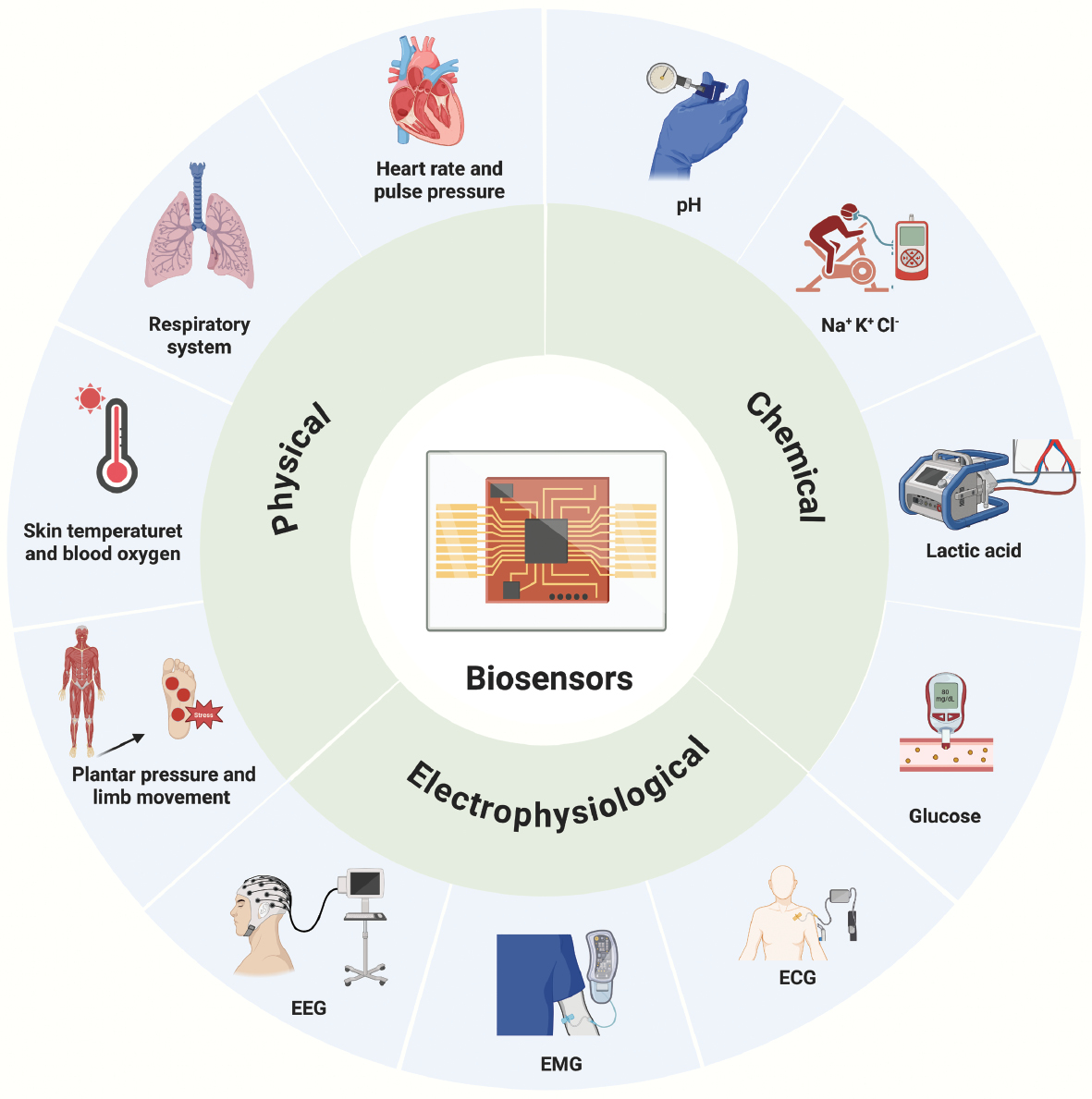
Wearable sensors can be divided into three categories according to signal type: physical, chemical, and electrophysiological. Physical sensors can detect and measure physical quantities such as temperature, pressure, displacement, velocity, and acceleration, whereas chemical sensors can identify or quantify a variety of analytes, including ions, molecules, and proteins. Electrophysiological sensors detect potential differences between electrodes in specific tissues, such as the heart via electrocardiography (ECG), the brain via electroencephalography (EEG), and muscles via electromyography (EMG).
Exercise fatigue is monitored by using various physiological, chemical, and electrophysiological indicators obtained from wearable electronic devices (Table 1). For instance, muscle activity, such as walking [72], jogging [73], and blinking [35], can be monitored in real time. This monitoring offers valuable insights for clinical gait analysis, including plantar pressure distribution, electromyography, and movement frequency. It can also be used to assess muscle fatigue and the state of exhaustion, thus potentially improving athletic performance and preventing unintentional injury. Recent advancements in flexible electronics have enabled continuous, real-time monitoring of vital physiological signals such as heart rate [74], body temperature [75], blood pressure [76], and blood oxygen levels [77] through the skin. Additionally, human sweat, a readily accessible biofluid, contains a wealth of information, including pH levels and chemical composition (e.g., metal ions, minerals, glucose, lactose, lactic acid, urea, and volatile organic compounds). This information can be crucial for the accurate diagnosis of various health conditions [78, 79]. The development of biocompatible and bioabsorbable materials has further revolutionized the field and led to the creation of flexible, implantable electronic devices. These devices can monitor internal body conditions such as intracranial pressure and temperature [80], thus markedly advancing the application of flexible sensors in motion monitoring and health diagnostics.
Table 1 Flexible Sensors in Motion Monitoring
| Measurable cues from human skin | Biomarkers | Sensor materials | Physiological value range | Ref |
|---|---|---|---|---|
| Physical | Heart rate | Gel-assisted Ag/AgCl; cowhide and silver | 60–100/min | [116, 117] |
| Breath | PI; silicon; fiber Bragg grating; textile triboelectric | 12–20/min | [118–121] | |
| Skin temperature | PANI; Ecoflex® rubber; PI; PDMS; PEI | 31.5–35.3°C | [122–124] | |
| Pulse pressure | PET; PVDF-TrFE; textile triboelectric | 30–40 mmHg | [120, 125, 126] | |
| Blood oxygen | Silicon | 95%–100% | [127] | |
| Plantar pressure | PMDS; LC; PI; copper-coated polyimide film | 0.074 MPa | [128, 129] | |
| Chemical | pH | Composite silk fibroin film | 4.5–7.0 | [130] |
| Lactic acid | Agarose hydrogels; cellulose; silk; chitosan; PPy | 5–25 mM | [128, 131] | |
| Na+ | ZnO NWs; Lox electrode; ion-selective electrode | 10–100 mM | [128, 132] | |
| Cl− | agarose hydrogels; Ag/AgCl; PEDOT; BTB (pH) | 10–100 mM | [128, 133] | |
| K+ | PAN/PVP/valinomycin-nylon sheath–core-structured yarns PAN/PVP | 1–24 mM | [128, 134] | |
| Glucose | Agarose hydrogel; Cu2O; Au | 0.02–0.6 mM | [128, 135] | |
| Electrophysiological | ECG | Natural leather; graphene electrodes | ~1 mV | [117] |
| EEG | Polymer conductive foam; conductive fabric; and copper; Ag/AgCl | ~1.5 mV | [136, 137] | |
| EMG | Au/PDMS | ~5 mV | [138] |
Physical sensors
Heart rate
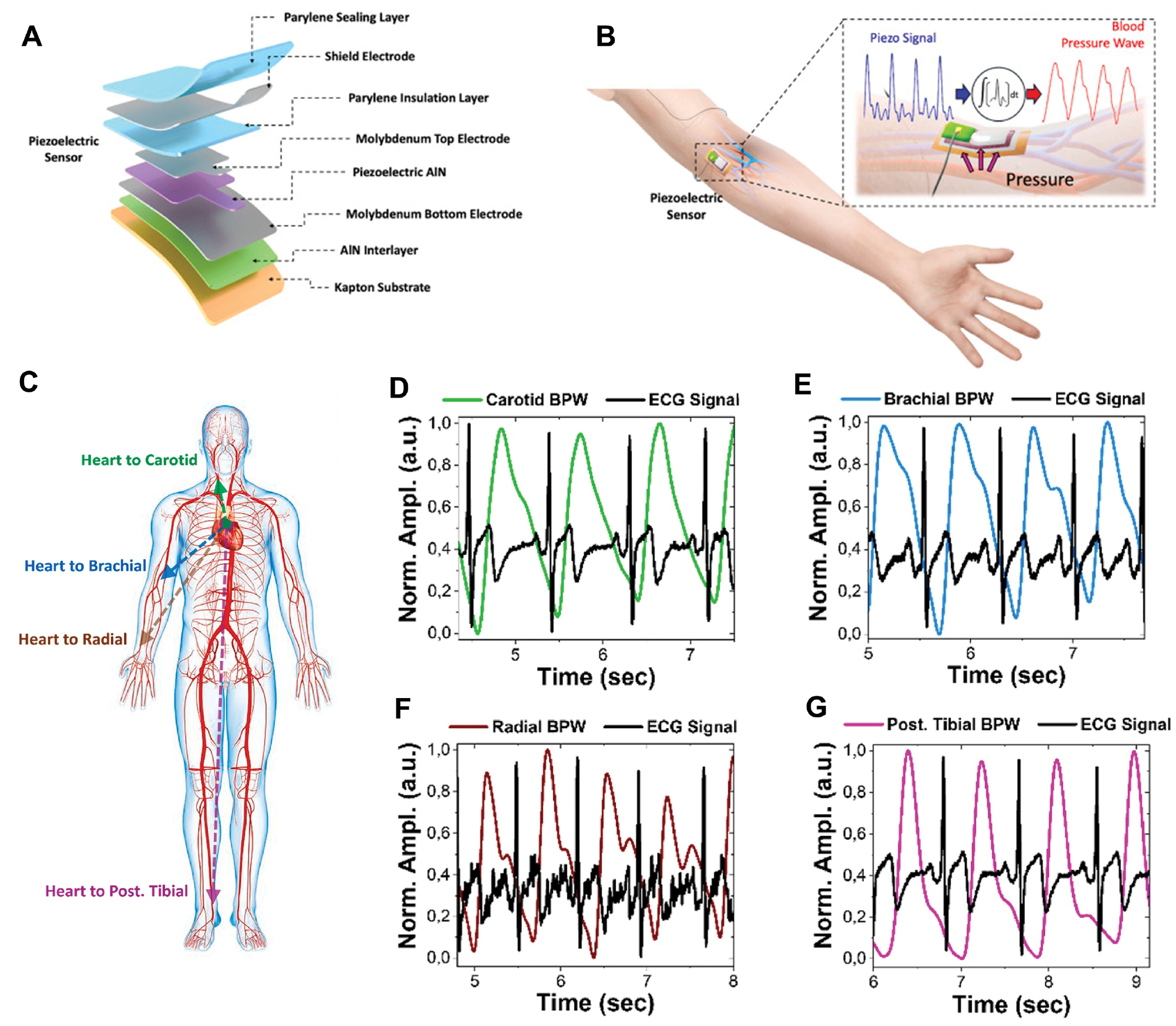
Heart rate, a critical physiological parameter, serves as an indicator of cardiac function in oxygenated blood circulation and carbon dioxide elimination through pulmonary ventilation. This vital sign is quantified by measuring the frequency of cardiac cycles. Its waveform characteristics exhibit significant variations across age groups, physiological conditions, and psychological states [81]. The effects of anatomical location on pulse waveform morphology (Figure 1A) have been systematically investigated [82] with a method that converts piezoelectric signals into blood pressure and heart rate signals (Figure 1B). The experimental results (Figure 1C–G) revealed distinct waveform patterns corresponding to different arterial locations. Furthermore, in exercise physiology monitoring applications, these pressure sensors have demonstrated exceptional capability in tracking exercise-induced cardiovascular responses, including heart rate elevation and waveform alterations. This technological advancement has substantial potential for preventing cardiovascular incidents during physical activities through real-time physiological monitoring.
Figure 1 Heart rate and pulse signal monitoring. (A) Flexible piezoelectric sensor structure. (B) Schematic illustration of the piezoelectric response generated by the sensor and converted to a blood pressure wave. (C) ECG sensor placed on the chest and piezoelectric sensors on the D) carotid, E) brachial, F) radial, and G) posterior tibial arteries. Figure 1 was reproduced from ref [82] with permission from Elsevier. Copyright 2025.
Breathing
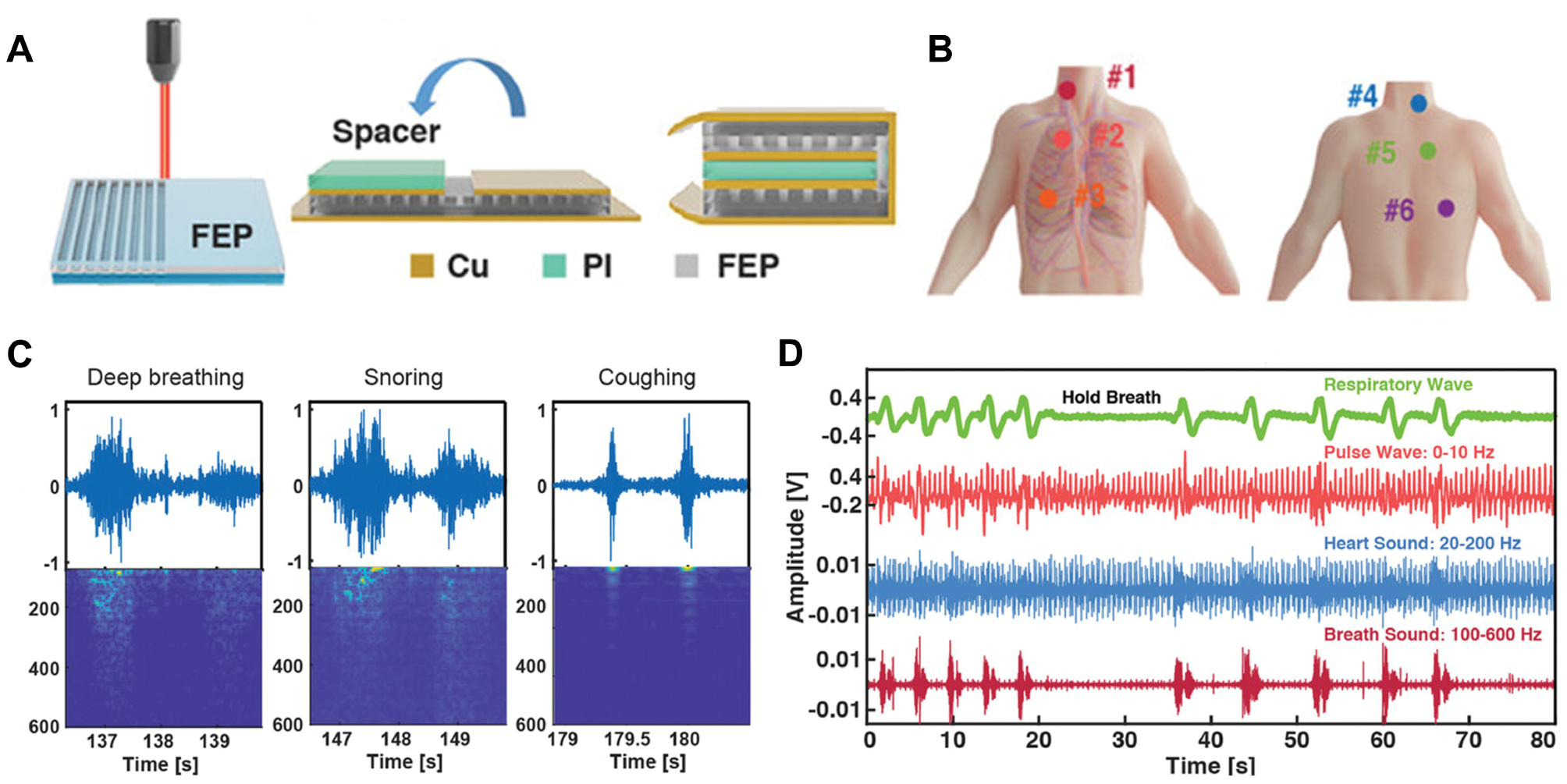
Respiration is the primary mechanism for oxygen delivery in the human body. During physical activity, respiratory parameters undergo significant changes, including variations in breathing rate, depth, and patterns (specifically, the transition between thoracic and abdominal breathing). Consequently, the development of effective respiratory monitoring techniques is crucial for physiological assessment. A recently developed flexible piezoelectret sensing system can detect breath sounds [60], while offering advantages of structural simplicity and high sensitivity (Figure 2A, B). The system uses mel-frequency cepstral coefficients for respiratory sound classification. It represents short-term power spectra of sounds by applying linear cosine transformation to the logarithmic power spectra on a nonlinear mel-frequency scale, thereby distinguishing three types of respiratory sounds: normal breathing, post-exertional panting, and snoring (Figure 2C, D). This system enables effective monitoring of parameters such as breathing depth, frequency, exercise volume, and intensity. During exercise, training intensity can be assessed according to the ratio of thoracic to abdominal breathing. As exercise intensity increases, the body shifts from abdominal to thoracic breathing to maximize oxygen uptake efficiency [83].
Figure 2 Respiratory pattern monitoring. (A) Schematic diagram of a prototype sensor. (B) Illustration of the piezoelectret sensor patches at various body locations. (C) Normal deep breathing, snoring, and coughing. (D) Typical sound recording from the left chest location during deep breathing, separated into various physiological signals of different frequency bands. Figure 2 was reproduced from ref [60] with permission from John Wiley and Sons. Copyright 2023.
Foot and lower extremity monitoring
During human movement, the limbs experience substantial strain variations. For instance, activities such as walking involve knee flexion, arm swinging, and foot compression. Detecting these movement-related signals can offer valuable insights into daily health assessments. Moreover, gait analysis is crucial in postural correction during post-injury rehabilitation [84]. Strain changes can be broadly categorized into two types according to the limb movement location: (1) motions with small skin deformation involving subtle movements of the chest, face, or neck, or (2) motions with large skin deformation involving bending movements of fingers, arms, or legs. The monitoring of movement processes focuses primarily on the latter category. Given that limb bending and walking involve substantial strain variations and high-pressure impacts, developing strain and pressure sensors with extensive measurement ranges is essential. Typically, the integration of two-dimensional active materials with flexible substrates can provide the necessary high elasticity for such applications. To date, strain sensors have been widely used to monitor significant bends in elbows, wrists, fingers, and knees [85–89]. In contrast, pressure sensors with a high measurement range have been used to measure the forces exerted by periodic footsteps and to detect various walking states [90, 91]. Beyond requiring appropriate sensitivity across a broad pressure range, high flexibility and minimal thickness are crucial to ensure comfort during long-term monitoring of the human foot. When a pressure sensor is integrated into the back of an insole, it can effectively detect and differentiate various gaits, such as sitting, standing, walking, trotting, jogging, and running (Figure 3A).
Figure 3 Foot and lower extremity monitoring. (A) Schematic of the smart insole consisting of 4 × 8 pixel arrays of multilayer e-skins, patterned electrodes, and supporting PET layers. (B) Photograph of 4 × 8 pixel arrays of multilayer e-skins with pressure applied by an upside-down Petri dish. (C) Corresponding pressure map. (D) Schematics of five walking motions on the smart insole to monitor foot pressure distribution and their corresponding pressure maps. Reproduced from ref [90] with permission from the American Chemical Society. Copyright 2018. (E) Schematic diagram of autonomous tracking of joint movements and gait parameters. Reproduced from ref [71] with permission from John Wiley and Sons. Copyright 2023.
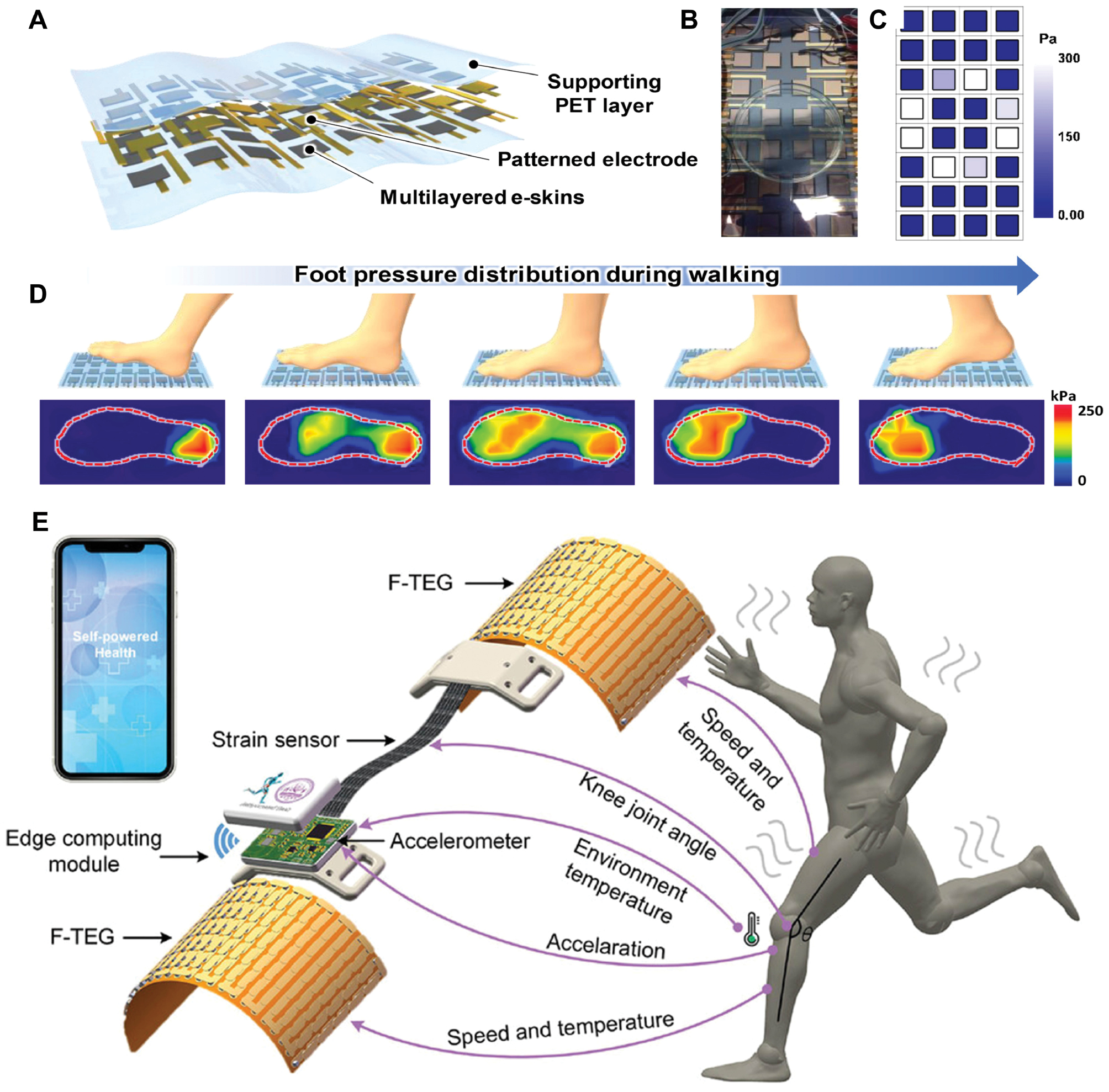
Additionally, the speed of movement can be calculated by multiplying the average step length by the step frequency, thereby representing the different speeds associated with various gaits. To gain a comprehensive understanding of foot movement, a high-resolution sensor array is essential. A multi-layered electronic skin that extends the pressure sensor range up to 353 kPa has been developed [90]. The 4 × 8 pixel electronic skin array was designed to incorporate a smart insole between two layers of flexible polyethylene terephthalate (PET) (Figure 3B). Under low-pressure conditions, the pressure distribution is displayed through an array of different mapped colors (Figure 3C). This distribution can be used to monitor the walking process and accurately detect five gait stages: initial heel contact, front foot contact, middle stand, end stand, and prespin (Figure 3D). Furthermore, a fully self-powered wearable system enabling real-time monitoring and assessments of human multimodal health parameters including knee joint movement and locomotion speed has been developed [71]. This sensor fully enables self-powered monitoring of lower limb kinematics, by using integrated energy harvesting to autonomously track joint movements and gait parameters (Figure 3E).
Chemical sensors
Human body fluids, including sweat, contain a variety of electrolytes, such as Na+, K+, Ca2+, and Cl−, as well as small molecules, such as lactic acid, glucose, urea, sugars, proteins, peptides, and ammonia. These components provide critical biological information that can be used for diagnostic purposes [92–98]. Non-invasive continuous monitoring of body fluids, particularly sweat, is essential for assessing physiological processes during exercise. Recent advancements in wearable and flexible electrochemical sensors have enabled the non-invasive and continuous monitoring of multiple biomarkers in human sweat, thus facilitating real-time health status analysis [99].
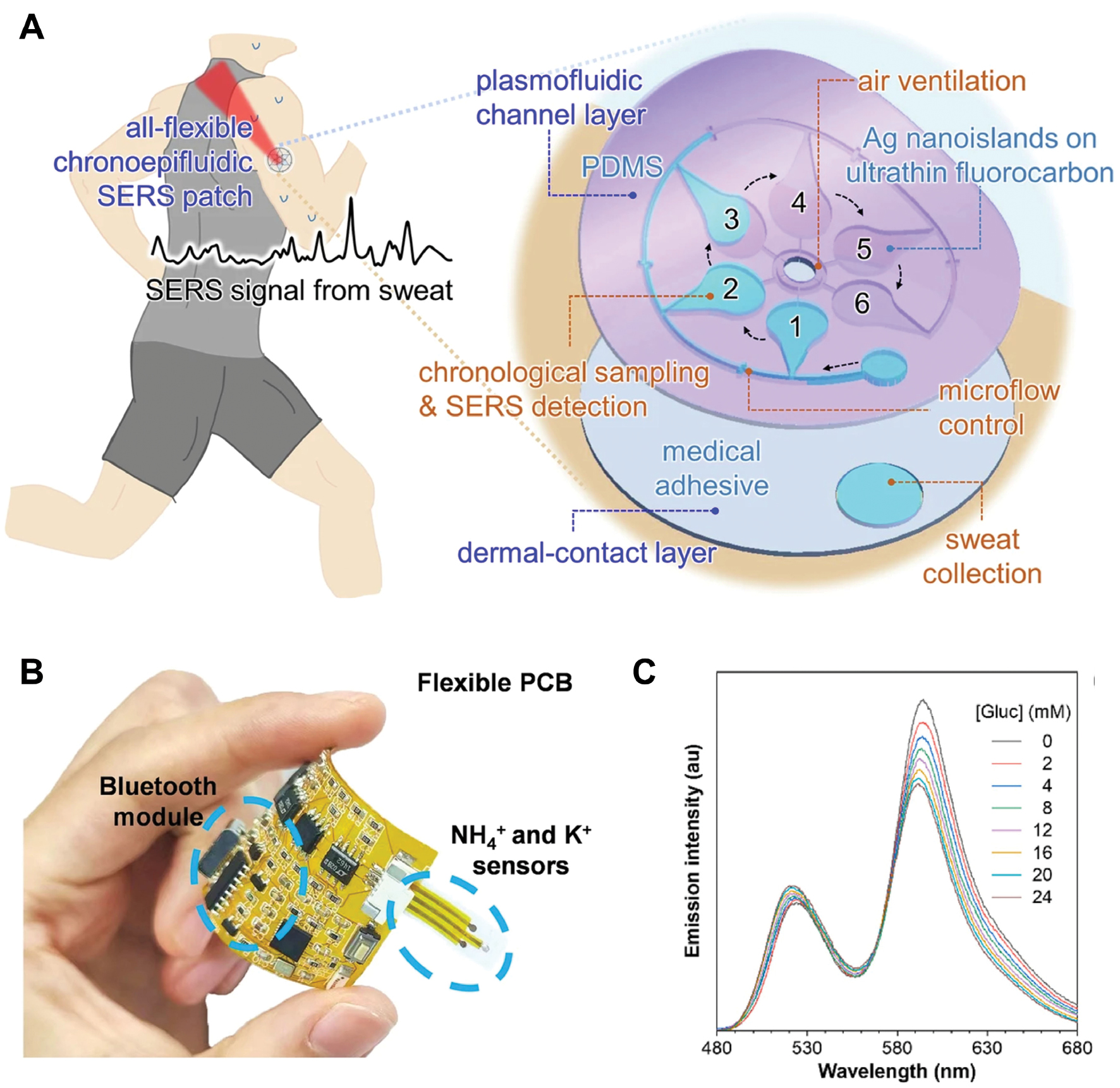
A notable development in this field, the wearable patch, integrates high-performance electrochemical sensors with a flexible printed circuit board for signal processing and wireless transmission [100–102]. This innovative device can simultaneously wirelessly measure sweat metabolites (such as lactic acid and glucose), sweat electrolytes (including Na+ and K+), and skin temperature (Figure 4). These capabilities enable prolonged monitoring of physiologically relevant analytes during exercise. Further enhancements have extended the monitoring range to include additional parameters such as pH, Ca2+, Cl−, heavy metals, and other substances [103–106]. These advances have markedly broadened the scope of real-time physiological monitoring and offered deeper insights into the body’s response to physical activity.
Figure 4 Sweat monitoring. (A) Schematic illustration of an all-flexible chronoepifluidic Surface-enhanced raman scattering (SERS) patch. Reproduced from ref [105] with permission from Springer Nature. Copyright 2025. (B) Photograph showing the flexible PCB design and glucose concentration. Reproduced from ref [103] with permission from Elsevier. Copyright 2024. (C) Emission spectra of microneedle sensors with various glucose concentrations. Reproduced from ref [104] with permission from Springer Nature. Copyright 2024.
Chemical sensors based on thin elastic microfluidic platforms have become a commonly used method to collect sweat during physical activity. These sensors contain embedded monitored reservoirs that efficiently collect and store sweat, and can detect biomarkers such as chloride ions, glucose, lactic acid, and pH. This technology is a major topic in current research on sweat collection methods. Microfluidic systems can effectively separate old and new sweat, thereby minimizing sweat evaporation and contamination. These devices enable more accurate sweat sensing with higher temporal resolution, and provide extensive data for evaluating athletic performance, physical fitness, and monitoring health and disease status. Wearable sensors can also monitor dehydration during prolonged physical exercise in real time (Figure 5A–C) [107, 108]. In rehydration tests [97], stable Na+ levels were observed, whereas a significant increase in Na+ levels was detected when participants experienced significant water loss during outdoor running. Identifying elevated levels of sweat electrolytes (Na+ and Cl−) enables personalized hydration programs to be tailored to athletes to replace excessive lost sodium and chloride ions.
Figure 5 Elastic microfluidic platforms. (A) The microfluidic sweat sensor comprises four layers. Reproduced from ref [107] with permission from the American Chemical Society. Copyright 2018. (B) Optical image of a fabricated device mounted on the forearm. (C) Colorimetric detection. Reproduced from ref [108] with permission from The American Association for the Advancement of Science. Copyright 2016. (D) Image of the autonomous sweat extraction and sensing platform (a thin layer of agonist agent hydrogel is placed underneath the iontophoresis electrodes). (E) Image of iontophoresis and sweat sensor electrodes for Na+ and Cl− sensing. (F) Schematic illustrations of the iontophoresis and sensing modes. Reproduced from ref [106] with permission from Proceedings of the National Academy of Sciences. Copyright 2017.
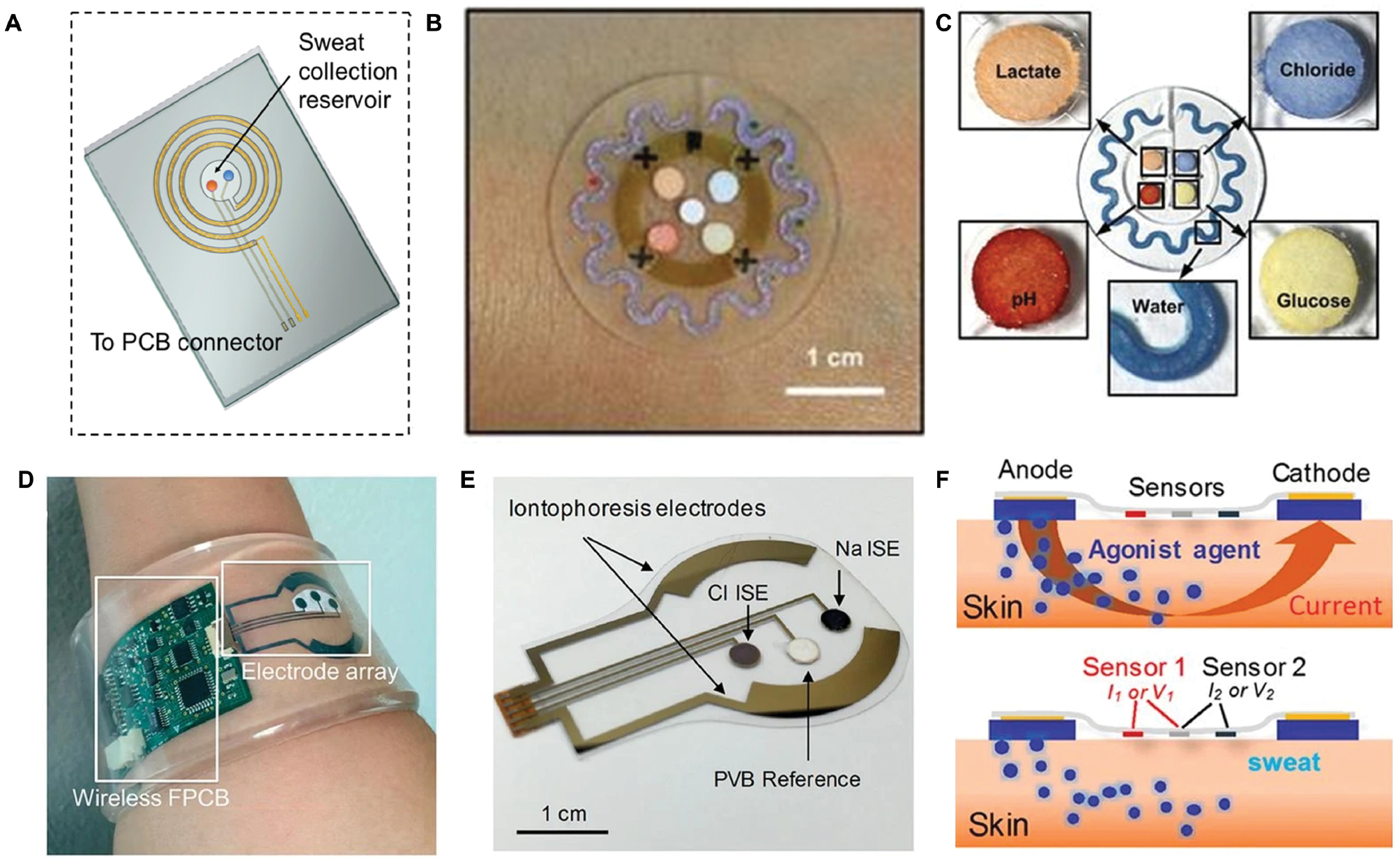
Whereas perspiration is a natural physiological response to intense physical activity, controlled sweat induction methods are often necessary to obtain sufficient sample volumes for precise electrochemical biomarker analysis. Emaminejad et al. [106] have pioneered a non-invasive sweat extraction technique using iontophoresis, which stimulates localized sweat gland activity through controlled electrical current application (Figure 5D–F). This innovative approach uses minimal electrical currents to facilitate transdermal ion transport, thereby inducing targeted sweat secretion. The integration of iontophoresis with advanced sensing elements for Na+, Cl−, and glucose detection enables real-time monitoring of sweat composition and secretion rates, and provides critical data for exercise fatigue assessment and physiological monitoring.
Electrophysiological sensors
Electrophysiology is a scientific discipline that investigates the electrical properties and activities of biological cells and tissues, primarily through the measurement of voltage fluctuations and current variations [109]. Electrophysiological sensors are crucial in monitoring bioelectric potential changes in target organs during cardiovascular, neural, and muscular activities [1, 4, 6, 109]. Various diagnostic techniques, including ECG, EEG, and EMG, are used in this field. In conventional clinical practice, these measurements are typically obtained from at least two gel-based electrodes placed in direct cutaneous contact to capture bioelectrical signals from target tissues. Commercial gel electrodes are manufactured with either conductive electrolyte gels or hydrogel formulations combined with skin adhesives. However, these conventional systems are limited by the gradual dehydration of the gel matrix, thus restricting their utility for prolonged monitoring applications.
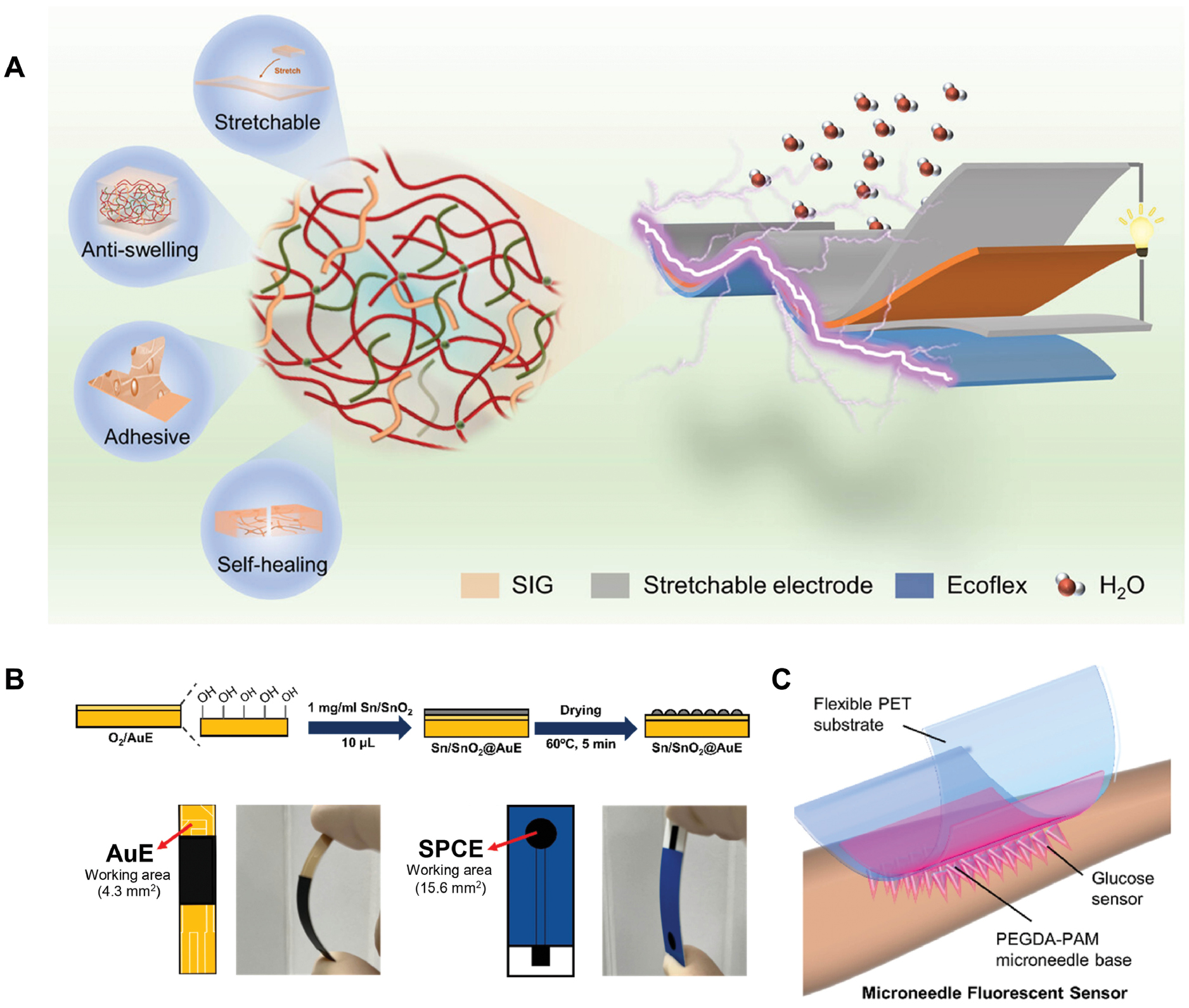
Wearable skin sensors offer a reliable platform for monitoring electrophysiological signals [110, 111]. A challenge with traditional sensors is designing thin, conformal, and biocompatible epidermal electrodes to decrease skin electrode contact impedance. The interface between the electrode and the skin is critical for extracting reliable electrophysiological signals (Figure 6). Close contact is essential to decrease skin-electrode contact impedance. The use of an electrolyte gel electrode (Figure 6A) can establish reliable contact with the skin surface. However, this method has several disadvantages, such as the inevitable dryness preventing long-term use and the potential for the ions in the gel to cause skin irritation [112]. Consequently, thin, dry electrodes have been developed (Figure 6B) to provide a longer lifespan and eliminate possible allergic effects associated with electrolyte gels [113]. Establishing fully conformal contact is challenging, because of the roughness of the skin surface, and gaps can increase interface impedance, thus leading to significant signal reduction and data inaccuracy. Microneedles can be used to overcome these limitations (Figure 6C) [103]. Although microneedles penetrate the stratum corneum, which is composed of dead cells, they are painless and are considered non-invasive. The height of the microneedles matches the thickness of the stratum corneum, thereby enabling direct contact with the wet epidermis and improving performance.
Figure 6 Electrophysiological signal monitoring. (A) Electrolyte gel electrode. Reproduced from ref [112] with permission from the American Chemical Society. Copyright 2024. (B) Illustration of as-prepared electrodes and images showing flexibility testing of a gold electrode. Reproduced from ref [113] with permission from Elsevier. Copyright 2025. (C) Microneedles. Reproduced from ref [103] with permission from Elsevier. Copyright 2024.
In recent years, the rapid development of flexible electronics and nanomaterials has brought notable opportunities for advancements in electrophysiological sensing technologies. Among the various electrophysiological monitoring techniques, myoelectric monitoring has emerged as the most prevalent method for motion tracking, and it plays a critical role in the precise monitoring of muscle movement and function.
Notable advancements in this field include the work of Kim et al. [3], who developed an innovative epidermal electronic system that achieves simultaneous conformal contact and full adhesion through van der Waals force interactions. This system had comparable sensitivity to commercial systems in detecting EMG signals across various anatomical locations, including the legs and neck. Another major development [114] is a novel dry electrode for wearable electrophysiological monitoring by using silver nanowires embedded beneath a thin layer of PDMS. When applied to the forearm for EMG detection, this encapsulated electrode exhibited response characteristics similar to those of conventional Ag/AgCl wet electrodes.
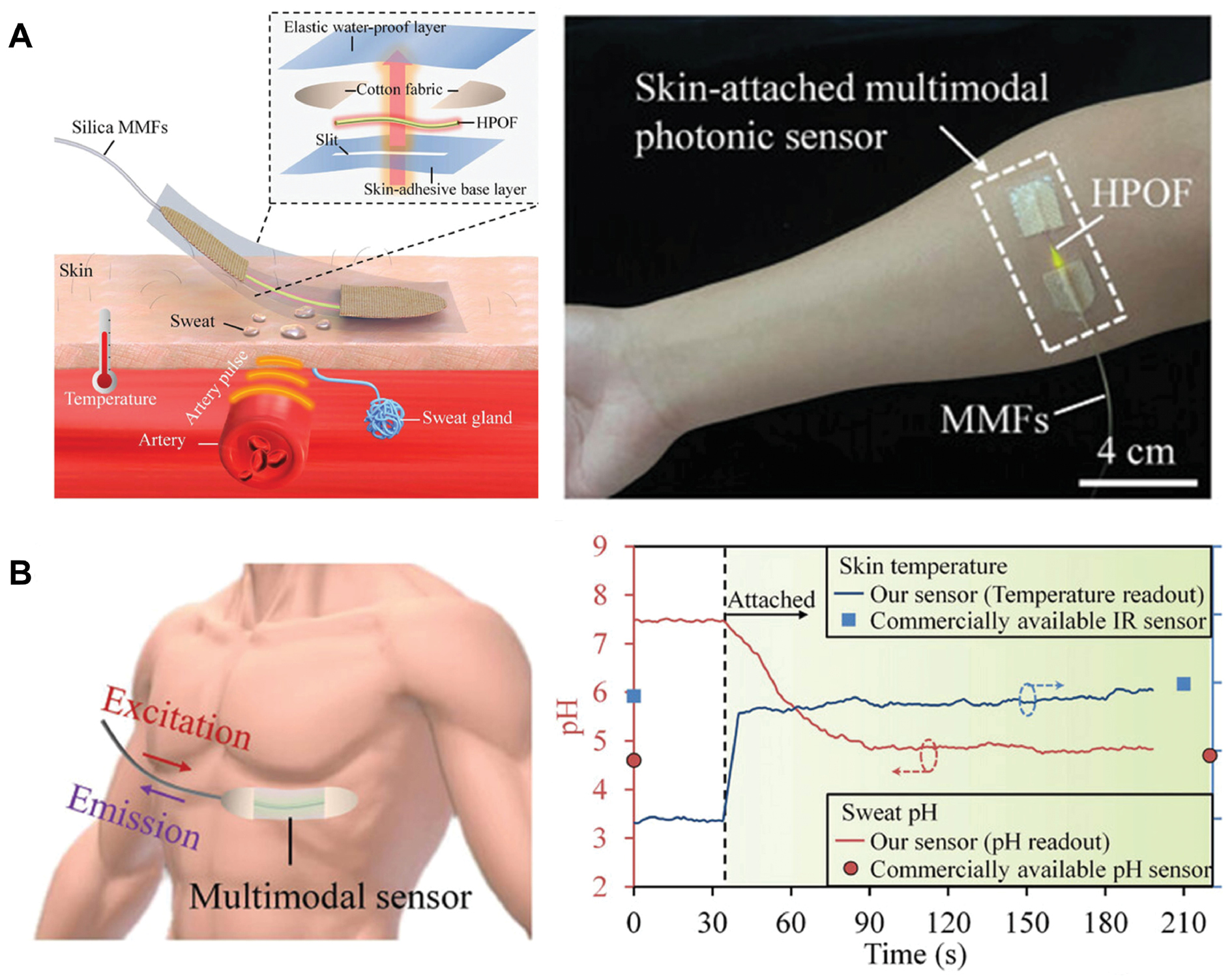
Despite these advancements in single-function sensors, the integration of multiple sensing capabilities remains a critical challenge in current research. A notable example is the development of a flexible, stretchable, and biocompatible multimodal photonic sensor that can simultaneously detect and differentiate mechanical, thermal, and chemical stimuli through a single sensor architecture (Figure 7A) [115]. The integrated sensing modalities are enabled by incorporating three distinct sensing mechanisms in a stretchable hydrogel-coated PDMS optical fiber, which shows multi-stimuli responsiveness to strain, temperature, and pH (Figure 7B).
Figure 7 Multiple sensor monitoring. (A) Illustration of the multimodal sensor attached to human skin to simultaneously and continuously monitor various physiological signals associated with strain, temperature, and pH. (B) Illustration of the sensor attached to the chest to simultaneously detect chest movements induced by cardiopulmonary activities, as well as body temperature and sweat pH. Reproduced from ref [115] with permission from John Wiley and Sons. Copyright 2024.
However, current integration technologies for multifunctional sensors face several technical challenges, including unstable electrical connections and bulky form factors. These limitations lead to interference between electrochemical redox reactions and bioimpedance measurements, and are the primary obstacles in current sensor development. Consequently, the stable integration of multiple sensors into flexible substrates while maintaining performance and reliability remains a critical focus for future research in this field.
Conclusions and future perspectives
This article reviewed recent scientific and technological progress in flexible electronic devices, specifically in materials and various sensors, and their applications in motion monitoring. Flexible sensing equipment now allows for conformal and seamless contact with the skin, as well as the integration of multi-sensors and multi-energy modes. Results can be transmitted in real time through wireless modules. This method surpasses traditional controlled laboratory detection methods, by providing more convenient and accurate biomarker data for movement monitoring.
Despite extensive progress in flexible electronics in recent years, and an abundance of literature demonstrating the feasibility of flexible wearable sensors, a considerable gap persists between laboratory research and commercial application. The primary challenge that must be addressed is the stability of highly integrated flexible sensors. The increasing demand for multi-marker detection in flexible electronics requires exploration of new materials, sensing technologies, and integration strategies to achieve the full potential of wearable sensing devices. Second, conventional data processing techniques exhibit substantial limitations in analyzing large-scale sensing data, including reliance on manual intervention, cumbersome operational procedures, and prolonged processing duration. The integration of machine learning algorithms can enhance analytical efficacy by processing high-dimensional nonlinear datasets to uncover hidden correlations, and is a critical research direction for future investigations. Finally, comparing the various human signals detected by wearable devices with standard medical test results, through long-term measurement and observation of humans, will be critical. The correlation between physiological signals and medical test results can increase the reliability of information, and will be important for both the detection of movement processes and future personal health assessments.
In summary, wearable flexible sensors have been demonstrated to have substantial value for sports monitoring. With future advancements in material innovation, stretchable structural designs, and energy integration—alongside enhanced intelligence levels and self-powering capabilities—these sensors are expected to usher in a new era for disease prevention, diagnosis, and treatment.
Author contributions
Z.C., J.G., and Z.L. contributed equally to this work. Conceptualization and design: M.L., H.W., L.Z., T.W., and J.Z.; writing—original draft preparation: J.G. and Z.C.; writing—review and editing: Z.C., H.W., J.Z., T.W., and X.L.; revision for intellectual content: all authors. All authors agree to be accountable for all aspects of the work. All authors have read and agreed to the published version of the manuscript.
Ethics statement
No human or animal studies were performed by the authors. Therefore, ethical approval and informed consent were not required.
Acknowledgements
This work was supported by the National Natural Science Foundation of China (82402814) and the Beijing Natural Science Foundation (L256032).
Conflict of interest
The authors declare that there are no conflicts of interest.
Graphical abstract
Highlights
- Research progress in wearable flexible sensors in material innovation, structure design, system integration, and energy support is reviewed.
- The potential of flexible sensors in motion monitoring is summarized.
- The challenges and future research prospects are discussed.
In brief
This review summarizes the latest advancements and prospects of wearable flexible sensors in motion monitoring, covering technological breakthroughs in materials, structural design, and energy integration. The article systematically discusses the applications of various sensors by signal type and analyzes current challenges as well as feasible future directions.
References
- Trung TQ, Ramasundaram S, Hwang BU, Lee NE. An all-elastomeric transparent and stretchable temperature sensor for body-attachable wearable electronics. Adv Mater 2016;28(3):502-9. [PMID: 26607674 DOI: 10.1002/adma.201504441]
- Tee BC, Chortos A, Berndt A, Nguyen AK, Tom A, et al. A skin-inspired organic digital mechanoreceptor. Science 2015;350(6258):313-6. [PMID: 26472906 DOI: 10.1126/science.aaa9306]
- Kim DH, Lu N, Ma R, Kim YS, Kim RH, et al. Epidermal electronics. Science 2011;333(6044):838-43. [PMID: 21836009 DOI: 10.1126/science.1206157]
- Ray TR, Choi J, Bandodkar AJ, Krishnan S, Gutruf P, et al. Bio-integrated wearable systems: a comprehensive review. Chem Rev 2019;119(8):5461-533. [PMID: 30689360 DOI: 10.1021/acs.chemrev.8b00573]
- Xu S, Zhang Y, Cho J, Lee J, Huang X, et al. Stretchable batteries with self-similar serpentine interconnects and integrated wireless recharging systems. Nat Commun 2013;4:1543. [PMID: 23443571 DOI: 10.1038/ncomms2553]
- Xie Z, Avila R, Huang Y, Rogers JA. Flexible and stretchable antennas for biointegrated electronics. Adv Mater 2020;32(15):e1902767. [PMID: 31490582 DOI: 10.1002/adma.201902767]
- Wu Z, Chen Z, Du X, Logan JM, Sippel J, et al. Transparent, conductive carbon nanotube films. Science 2004;305(5688):1273-6. [PMID: 15333836 DOI: 10.1126/science.1101243]
- Yang Z, Chen T, He R, Guan G, Li H, et al. Aligned carbon nanotube sheets for the electrodes of organic solar cells. Adv Mater 2011;23(45):5436-9. [PMID: 22021101 DOI: 10.1002/adma.201103509]
- Chen T, Wang S, Yang Z, Feng Q, Sun X, et al. Flexible, light-weight, ultrastrong, and semiconductive carbon nanotube fibers for a highly efficient solar cell. Angew Chem Int Ed Engl 2011;50(8):1815-9. [PMID: 21328646 DOI: 10.1002/anie.201003870]
- Lipomi DJ, Vosgueritchian M, Tee BC, Hellstrom SL, Lee JA, et al. Skin-like pressure and strain sensors based on transparent elastic films of carbon nanotubes. Nat Nanotechnol 2011;6(12):788-92. [PMID: 22020121 DOI: 10.1038/nnano.2011.184]
- Yu C, Masarapu C, Rong J, Wei B, Jiang H. Stretchable supercapacitors based on buckled single-walled carbon-nanotube macrofilms. Adv Mater 2009;21(47):4793-7. [PMID: 21049496 DOI: 10.1002/adma.200901775]
- Kaempgen M, Chan CK, Ma J, Cui Y, Gruner G. Printable thin film supercapacitors using single-walled carbon nanotubes. Nano Lett 2009;9(5):1872-6. [PMID: 19348455 DOI: 10.1021/nl8038579]
- Niu Z, Dong H, Zhu B, Li J, Hng HH, et al. Highly stretchable, integrated supercapacitors based on single-walled carbon nanotube films with continuous reticulate architecture. Adv Mater 2013;25(7):1058-64. [PMID: 23255187 DOI: 10.1002/adma.201204003]
- Wang S, Xu J, Wang W, Wang GN, Rastak R, et al. Skin electronics from scalable fabrication of an intrinsically stretchable transistor array. Nature 2018;555(7694):83-8. [PMID: 29466334 DOI: 10.1038/nature25494]
- Kim Y, Chortos A, Xu W, Liu Y, Oh JY, et al. A bioinspired flexible organic artificial afferent nerve. Science 2018;360(6392):998-1003. [PMID: 29853682 DOI: 10.1126/science.aao0098]
- Fay CD, Mannering N, Jeiranikhameneh A, Mokhtari F, Foroughi J, et al. Wearable carbon nanotube-spandex textile yarns for knee flexion monitoring. Adv Sensor Res 2023;2(1):2200021. [DOI: 10.1002/adsr.202200021]
- Nguyen VH, Papanastasiou DT, Resende J, Bardet L, Sannicolo T, et al. Advances in flexible metallic transparent electrodes. Small 2022;18(19):e2106006. [PMID: 35195360 DOI: 10.1002/smll.202106006]
- Wang B, Facchetti A. Mechanically flexible conductors for stretchable and wearable E-skin and E-textile devices. Adv Mater 2019;31(28):e1901408. [PMID: 31106490 DOI: 10.1002/adma.201901408]
- Weng M, Zhou J, Zhou P, Shang R, You M, et al. Multi-functional actuators made with biomass-based graphene-polymer films for intelligent gesture recognition and multi-mode self-powered sensing. Adv Sci (Weinh) 2024;11(22):e2309846. [PMID: 38531061 DOI: 10.1002/advs.202309846]
- Mohseni Taromsari S, Salari M, Shi HH, Habibpour S, Saadatnia Z, et al. PEDOT:PSS-facilitated directionally 3-D assembled MXene-based aerogel for high-performance chemoresistive sensing & breath analysis. Adv Mater 2025;37(6):e2406349. [PMID: 39707652 DOI: 10.1002/adma.202406349]
- Manjakkal L, Pullanchiyodan A, Yogeswaran N, Hosseini ES, Dahiya R. A wearable supercapacitor based on conductive PEDOT:PSS-coated cloth and a sweat electrolyte. Adv Mater 2020;32(24):e1907254. [PMID: 32390218 DOI: 10.1002/adma.201907254]
- Sun Y, He W, Jiang C, Li J, Liu J, et al. Wearable biodevices based on two-dimensional materials: from flexible sensors to smart integrated systems. Nanomicro Lett 2025;17(1):109. [PMID: 39812886 DOI: 10.1007/s40820-024-01597-w]
- Huang J, Xue J, Huang J, Zhang X, Zhang H, et al. An injectable hyaluronic acid/lithium calcium silicate soft tissue filler with vascularization and collagen regeneration. Bioact Mater 2024;44:256-68. [PMID: 39507373 DOI: 10.1016/j.bioactmat.2024.10.014]
- Dou X, Wang H, Yang F, Shen H, Wang X, et al. One-step soaking strategy toward anti-swelling hydrogels with a stiff “Armor”. Adv Sci (Weinh) 2023;10(9):e2206242. [PMID: 36683238 DOI: 10.1002/advs.202206242]
- Sun JY, Zhao X, Illeperuma WR, Chaudhuri O, Oh KH, et al. Highly stretchable and tough hydrogels. Nature 2012;489(7414):133-6. [PMID: 22955625 DOI: 10.1038/nature11409]
- Keplinger C, Sun JY, Foo CC, Rothemund P, Whitesides GM, et al. Stretchable, transparent, ionic conductors. Science 2013;341(6149):984-7. [PMID: 23990555 DOI: 10.1126/science.1240228]
- Han L, Lu X, Wang M, Gan D, Deng W, et al. A mussel-inspired conductive, self-adhesive, and self-healable tough hydrogel as cell stimulators and implantable bioelectronics. Small 2017;13(2):1601916. [PMID: 27779812 DOI: 10.1002/smll.201601916]
- Gao Y, Ota H, Schaler EW, Chen K, Zhao A, et al. Wearable microfluidic diaphragm pressure sensor for health and tactile touch monitoring. Adv Mater 2017;29(39):1701985. [PMID: 28833673 DOI: 10.1002/adma.201701985]
- Zhao Z, Xia K, Hou Y, Zhang Q, Ye Z, et al. Designing flexible, smart and self-sustainable supercapacitors for portable/wearable electronics: from conductive polymers. Chem Soc Rev 2021;50(22):12702-43. [PMID: 34643198 DOI: 10.1039/d1cs00800e]
- Zarepour A, Ahmadi S, Rabiee N, Zarrabi A, Iravani S. Self-healing MXene- and graphene-based composites: properties and applications. Nanomicro Lett 2023;15(1):100. [PMID: 37052734 DOI: 10.1007/s40820-023-01074-w]
- He CL, Liang FC, Veeramuthu L, Cho CJ, Benas JS, et al. Super tough and spontaneous water-assisted autonomous self-healing elastomer for underwater wearable electronics. Adv Sci (Weinh) 2021;8(21):e2102275. [PMID: 34519441 DOI: 10.1002/advs.202102275]
- Li Z, Lu J, Ji T, Xue Y, Zhao L, et al. Self-healing hydrogel bioelectronics. Adv Mater 2024;36(21):e2306350. [PMID: 37987498 DOI: 10.1002/adma.202306350]
- Pan C, Kumar K, Li J, Markvicka EJ, Herman PR, et al. Visually imperceptible liquid-metal circuits for transparent, stretchable electronics with direct laser writing. Adv Mater 2018;30(12):e1706937. [PMID: 29405442 DOI: 10.1002/adma.201706937]
- Ling Y, An T, Yap LW, Zhu B, Gong S, et al. Disruptive, soft, wearable sensors. Adv Mater 2020;32(18):e1904664. [PMID: 31721340 DOI: 10.1002/adma.201904664]
- Debbarma S, Bhadra S. A Flexible wearable electrooculogram system with motion artifacts sensing and reduction. IEEE Trans Biomed Circuits Syst 2022;16(2):324-35. [PMID: 35439139 DOI: 10.1109/TBCAS.2022.3168236]
- Li M, Wu Y, Zhang L, Wo H, Huang S, et al. Liquid metal-based electrical interconnects and interfaces with excellent stability and reliability for flexible electronics. Nanoscale 2019;11(12):5441-9. [PMID: 30855048 DOI: 10.1039/c8nr09503e]
- Chen B, Zhang L, Li H, Lai X, Zeng X. Skin-inspired flexible and high-performance MXene@polydimethylsiloxane piezoresistive pressure sensor for human motion detection. J Colloid Interface Sci 2022;617:478-88. [PMID: 35290805 DOI: 10.1016/j.jcis.2022.03.013]
- Demidenko NA, Kuksin AV, Molodykh VV, Pyankov ES, Ichkitidze LP, et al. Flexible strain-sensitive silicone-CNT sensor for human motion detection. Bioengineering (Basel) 2022;9(1):36. [PMID: 35049745 DOI: 10.3390/bioengineering9010036]
- Wang Z, Zhang X, Cao T, Wang T, Sun L, et al. Antiliquid-interfering, antibacteria, and adhesive wearable strain sensor based on superhydrophobic and conductive composite hydrogel. ACS Appl Mater Interfaces 2021;13(38):46022-32. [PMID: 34542266 DOI: 10.1021/acsami.1c15052]
- Zhang C, Ouyang W, Zhang L, Li D. A dual-mode fiber-shaped flexible capacitive strain sensor fabricated by direct ink writing technology for wearable and implantable health monitoring applications. Microsyst Nanoeng 2023;9:158. [PMID: 38144391 DOI: 10.1038/s41378-023-00634-9]
- Zhao T, Fu Y, Sun C, Zhao X, Jiao C, et al. Wearable biosensors for real-time sweat analysis and body motion capture based on stretchable fiber-based triboelectric nanogenerators. Biosens Bioelectron 2022;205:114115. [PMID: 35219020 DOI: 10.1016/j.bios.2022.114115]
- Thaweeskulchai T, Schulte A. Diode laser and polyimide tape enables cheap and fast fabrication of flexible microfluidic sensing devices. Micromachines (Basel) 2022;13(12):2214. [PMID: 36557513 DOI: 10.3390/mi13122214]
- Lee YD, Chung WY. Wireless sensor network based wearable smart shirt for ubiquitous health and activity monitoring. Sens Actuators B Chem 2009;140(2):390-5. [DOI: 10.1016/j.snb.2009.04.040]
- Imani S, Bandodkar AJ, Mohan AM, Kumar R, Yu S, et al. A wearable chemical-electrophysiological hybrid biosensing system for real-time health and fitness monitoring. Nat Commun 2016;7:11650. [PMID: 27212140 DOI: 10.1038/ncomms11650]
- Mokhtari F, Usman KAS, Zhang J, Komljenovic R, Simon Ž, et al. Enhanced acoustoelectric energy harvesting with Ti3C2Tx MXene in an all-fiber nanogenerator. ACS Appl Mater Interfaces 2025;17(2):3214-28. [PMID: 39743311 DOI: 10.1021/acsami.4c15178]
- Chen Z, Qian D, Xie D, Gao C, Shi J, et al. Structure and wiring optimized TT/MT double-helical fiber sensors: fabrication and applications in human motion monitoring and gesture recognition. Adv Sci (Weinh) 2025;12(12):e2416564. [PMID: 39903805 DOI: 10.1002/advs.202416564]
- Reddy JN, Nampally P. A dual mesh finite domain method for the analysis of functionally graded beams. Compos Struct 2020;251:112648. [PMID: 32834325 DOI: 10.1016/j.compstruct.2020.112648]
- Sun Y, Choi WM, Jiang H, Huang YY, Rogers JA. Controlled buckling of semiconductor nanoribbons for stretchable electronics. Nat Nanotechnol 2006;1(3):201-7. [PMID: 18654187 DOI: 10.1038/nnano.2006.131]
- Guo CF, Sun T, Liu Q, Suo Z, Ren Z. Highly stretchable and transparent nanomesh electrodes made by grain boundary lithography. Nat Commun 2014;5:3121. [PMID: 24469072 DOI: 10.1038/ncomms4121]
- Zhang Y, Ren E, Li A, Cui C, Guo R, et al. A porous self-healing hydrogel with an island-bridge structure for strain and pressure sensors. J Mater Chem B 2021;9(3):719-30. [PMID: 33306084 DOI: 10.1039/d0tb01926g]
- Wu Y, Mechael SS, Carmichael TB. Wearable E-textiles using a textile-centric design approach. Acc Chem Res 2021;54(21):4051-64. [PMID: 34665618 DOI: 10.1021/acs.accounts.1c00433]
- Wang C, Zheng W, Yue Z, Too CO, Wallace GG. Buckled, stretchable polypyrrole electrodes for battery applications. Adv Mater 2011;23(31):3580-4. [PMID: 21728189 DOI: 10.1002/adma.201101067]
- Lee Y-H, Kim J-S, Noh J, Lee I, Kim HJ, et al. Wearable textile battery rechargeable by solar energy. Nano Lett 2013;13(11):5753-61. [PMID: 24164580 DOI: 10.1021/nl403860k]
- Gaikwad AM, Zamarayeva AM, Rousseau J, Chu H, Derin I, et al. Highly stretchable alkaline batteries based on an embedded conductive fabric. Adv Mater 2012;24(37):5071-6. [PMID: 22760812 DOI: 10.1002/adma.201201329]
- Jia Y, Jiang Q, Sun H, Liu P, Hu D, et al. Wearable thermoelectric materials and devices for self-powered electronic systems. Adv Mater 2021;33(42):e2102990. [PMID: 34486174 DOI: 10.1002/adma.202102990]
- Wang C, Zhang M, Xia K, Gong X, Wang H, et al. Intrinsically stretchable and conductive textile by a scalable process for elastic wearable electronics. ACS Appl Mater Interfaces 2017;9(15):13331-8. [PMID: 28345872 DOI: 10.1021/acsami.7b02985]
- Yang Y, Sun N, Wen Z, Cheng P, Zheng H, et al. Liquid-metal-based super-stretchable and structure-designable triboelectric nanogenerator for wearable electronics. ACS Nano 2018;12(2):2027-34. [PMID: 29420011 DOI: 10.1021/acsnano.8b00147]
- Metshein M, Abdullayev A, Gautier A, Larras B, Frappe A, et al. Sensor-location-specific joint acquisition of peripheral artery bioimpedance and photoplethysmogram for wearable applications. Sensors (Basel) 2023;23(16):7111. [PMID: 37631647 DOI: 10.3390/s23167111]
- Park DY, Joe DJ, Kim DH, Park H, Han JH, et al. Self-powered real-time arterial pulse monitoring using ultrathin epidermal piezoelectric sensors. Adv Mater 2017;29(37):1702308. [PMID: 28714239 DOI: 10.1002/adma.201702308]
- Han L, Liang W, Xie Q, Zhao J, Dong Y, et al. Health monitoring via heart, breath, and Korotkoff sounds by wearable piezoelectret patches. Adv Sci (Weinh) 2023;10(28):e2301180. [PMID: 37607132 DOI: 10.1002/advs.202301180]
- Jin L, Liu Z, Altintas M, Zheng Y, Liu Z, et al. Wearable piezoelectric airflow transducers for human respiratory and metabolic monitoring. ACS Sens 2022;7(8):2281-92. [PMID: 35868024 DOI: 10.1021/acssensors.2c00824]
- Singh SU, Chatterjee S, Lone SA, Ho HH, Kaswan K, et al. Advanced wearable biosensors for the detection of body fluids and exhaled breath by graphene. Mikrochim Acta 2022;189(6):236. [PMID: 35633385 DOI: 10.1007/s00604-022-05317-2]
- Zheng Q, Shi B, Fan F, Wang X, Yan L, et al. In vivo powering of pacemaker by breathing-driven implanted triboelectric nanogenerator. Adv Mater 2014;26(33):5851-6. [PMID: 25043590 DOI: 10.1002/adma.201402064]
- Dagdeviren C, Yang BD, Su Y, Tran PL, Joe P, et al. Conformal piezoelectric energy harvesting and storage from motions of the heart, lung, and diaphragm. Proc Natl Acad Sci U S A 2014;111(5):1927-32. [PMID: 24449853 DOI: 10.1073/pnas.1317233111]
- Du X, Tian M, Sun G, Li Z, Qi X, et al. Self-powered and self-sensing energy textile system for flexible wearable applications. ACS Appl Mater Interfaces 2020;12(50):55876-83. [PMID: 33269916 DOI: 10.1021/acsami.0c16305]
- Zamarayeva AM, Ostfeld AE, Wang M, Duey JK, Deckman I, et al. Flexible and stretchable power sources for wearable electronics. Sci Adv 2017;3(6):e1602051. [PMID: 28630897 DOI: 10.1126/sciadv.1602051]
- Ma H, Liu Q, Cheng P, Shen L, Ma J, et al. Wearable motion smartsensors self-powered by core-shell Au@Pt methanol fuel cells. ACS Sens 2021;6(12):4526-34. [PMID: 34910879 DOI: 10.1021/acssensors.1c02236]
- Wang J, Qian S, Yu J, Zhang Q, Yuan Z, et al. Flexible and wearable PDMS-based triboelectric nanogenerator for self-powered tactile sensing. Nanomaterials (Basel) 2019;9(9):1304. [PMID: 31547316 DOI: 10.3390/nano9091304]
- Zhou H, Zhang Y, Qiu Y, Wu H, Qin W, et al. Stretchable piezoelectric energy harvesters and self-powered sensors for wearable and implantable devices. Biosens Bioelectron 2020;168:112569. [PMID: 32905930 DOI: 10.1016/j.bios.2020.112569]
- Lin J, Chen X, Zhang P, Xue Y, Feng Y, et al. Wireless bioelectronics for in vivo pressure monitoring with mechanically-compliant hydrogel biointerfaces. Adv Mater 2024;36(26):e2400181. [PMID: 38419474 DOI: 10.1002/adma.202400181]
- Yuan J, Zhang Y, Wei C, Zhu R. A fully self-powered wearable leg movement sensing system for human health monitoring. Adv Sci (Weinh) 2023;10(29):e2303114. [PMID: 37590377 DOI: 10.1002/advs.202303114]
- Zou P, Wang Y, Cai H, Peng T, Pan T, et al. Wearable iontronic FMG for classification of muscular locomotion. IEEE J Biomed Health Inform 2022;26(7):2854-63. [PMID: 35536817 DOI: 10.1109/JBHI.2022.3173968]
- Hui Z, Chen R, Chang J, Gong Y, Zhang X, et al. Solution-processed sensing textiles with adjustable sensitivity and linear detection range enabled by twisting structure. ACS Appl Mater Interfaces 2020;12(10):12155-64. [PMID: 32053344 DOI: 10.1021/acsami.0c00564]
- Tavares C, Leitão C, Lo Presti D, Domingues MF, Alberto N, et al. Respiratory and heart rate monitoring using an FBG 3D-printed wearable system. Biomed Opt Express 2022;13(4):2299-311. [PMID: 35519242 DOI: 10.1364/BOE.452115]
- Zhang H, Zhang Y, Liu Y, Zhang Q, Zhang Y, et al. Self-assembled and multilayer-overlapped ESM-PDA@rGO nanofilm-based flexible wearable sensor for real-time body temperature monitoring. ACS Appl Mater Interfaces 2023;15(49):57626-35. [PMID: 38035389 DOI: 10.1021/acsami.3c13700]
- Ismail SNA, Nayan NA, Mohammad Haniff MAS, Jaafar R, May Z. Wearable two-dimensional nanomaterial-based flexible sensors for blood pressure monitoring: a review. Nanomaterials (Basel) 2023;13(5):852. [PMID: 36903730 DOI: 10.3390/nano13050852]
- Chen H, Xu Y, Zhang J, Wu W, Song G. Self-powered flexible blood oxygen monitoring system based on a triboelectric nanogenerator. Nanomaterials (Basel) 2019;9(5):778. [PMID: 31117275 DOI: 10.3390/nano9050778]
- Jin H, Abu-Raya YS, Haick H. Advanced materials for health monitoring with skin-based wearable devices. Adv Healthc Mater 2017;6(11):1700024. [PMID: 28371294 DOI: 10.1002/adhm.201700024]
- Yuan Y, Liu B, Li H, Li M, Song Y, et al. Flexible wearable sensors in medical monitoring. Biosensors (Basel) 2022;12(12):1069. [PMID: 36551036 DOI: 10.3390/bios12121069]
- Kang SK, Murphy RK, Hwang SW, Lee SM, Harburg DV, et al. Bioresorbable silicon electronic sensors for the brain. Nature 2016;530(7588):71-6. [PMID: 26779949 DOI: 10.1038/nature16492]
- Yang T, Jiang X, Zhong Y, Zhao X, Lin S, et al. A wearable and highly sensitive graphene strain sensor for precise home-based pulse wave monitoring. ACS Sens 2017;2(7):967-74. [PMID: 28750520 DOI: 10.1021/acssensors.7b00230]
- Cinquino M, Demir SM, Shumba AT, Schioppa EJ, Fachechi L, et al. Enhancing cardiovascular health monitoring: simultaneous multi-artery cardiac markers recording with flexible and bio-compatible AlN piezoelectric sensors. Biosens Bioelectron 2025;267:116790. [PMID: 39332253 DOI: 10.1016/j.bios.2024.116790]
- Cheng Y, Wang R, Sun J, Gao L. A stretchable and highly sensitive graphene-based fiber for sensing tensile strain, bending, and torsion. Adv Mater 2015;27(45):7365-71. [PMID: 26479040 DOI: 10.1002/adma.201503558]
- Capecci M, Serpicelli C, Fiorentini L, Censi G, Ferretti M, et al. Postural rehabilitation and Kinesio taping for axial postural disorders in Parkinson’s disease. Arch Phys Med Rehabil 2014;95(6):1067-75. [PMID: 24508531 DOI: 10.1016/j.apmr.2014.01.020]
- Ma Y, Liu N, Li L, Hu X, Zou Z, et al. A highly flexible and sensitive piezoresistive sensor based on MXene with greatly changed interlayer distances. Nat Commun 2017;8(1):1207. [PMID: 29089488 DOI: 10.1038/s41467-017-01136-9]
- Tao LQ, Wang DY, Tian H, Ju ZY, Liu Y, et al. Self-adapted and tunable graphene strain sensors for detecting both subtle and large human motions. Nanoscale 2017;9(24):8266-73. [PMID: 28585963 DOI: 10.1039/c7nr01862b]
- Yan C, Wang J, Kang W, Cui M, Wang X, et al. Highly stretchable piezoresistive graphene-nanocellulose nanopaper for strain sensors. Adv Mater 2014;26(13):2022-7. [PMID: 24343930 DOI: 10.1002/adma.201304742]
- Park JJ, Hyun WJ, Mun SC, Park YT, Park OO. Highly stretchable and wearable graphene strain sensors with controllable sensitivity for human motion monitoring. ACS Appl Mater Interfaces 2015;7(11):6317-24. [PMID: 25735398 DOI: 10.1021/acsami.5b00695]
- Guo Y, Guo Z, Zhong M, Wan P, Zhang W, et al. A flexible wearable pressure sensor with bioinspired microcrack and interlocking for full-range human-machine interfacing. Small 2018;14(44):e1803018. [PMID: 30247809 DOI: 10.1002/smll.201803018]
- Lee Y, Park J, Cho S, Shin YE, Lee H, et al. Flexible ferroelectric sensors with ultrahigh pressure sensitivity and linear response over exceptionally broad pressure range. ACS Nano 2018;12(4):4045-54. [PMID: 29648803 DOI: 10.1021/acsnano.8b01805]
- Tao LQ, Zhang KN, Tian H, Liu Y, Wang DY, et al. Graphene-paper pressure sensor for detecting human motions. ACS Nano 2017;11(9):8790-5. [PMID: 28800221 DOI: 10.1021/acsnano.7b02826]
- Choi J, Ghaffari R, Baker LB, Rogers JA. Skin-interfaced systems for sweat collection and analytics. Sci Adv 2018;4(2):eaar3921. [PMID: 29487915 DOI: 10.1126/sciadv.aar3921]
- Tai LC, Gao W, Chao M, Bariya M, Ngo QP, et al. Methylxanthine drug monitoring with wearable sweat sensors. Adv Mater 2018;30(23):e1707442. [PMID: 29663538 DOI: 10.1002/adma.201707442]
- Anastasova S, Crewther B, Bembnowicz P, Curto V, Ip HM, et al. A wearable multisensing patch for continuous sweat monitoring. Biosens Bioelectron 2017;93:139-45. [PMID: 27743863 DOI: 10.1016/j.bios.2016.09.038]
- Dang W, Manjakkal L, Navaraj WT, Lorenzelli L, Vinciguerra V, et al. Stretchable wireless system for sweat pH monitoring. Biosens Bioelectron 2018;107:192-202. [PMID: 29471280 DOI: 10.1016/j.bios.2018.02.025]
- McCaul M, Porter A, Barrett R, White P, Stroiescu F, et al. Wearable platform for real-time monitoring of sodium in sweat. Chemphyschem 2018;19(12):1531-6. [PMID: 29573322 DOI: 10.1002/cphc.201701312]
- Gao W, Emaminejad S, Nyein HYY, Challa S, Chen K, et al. Fully integrated wearable sensor arrays for multiplexed in situ perspiration analysis. Nature 2016;529(7587):509-14. [PMID: 26819044 DOI: 10.1038/nature16521]
- Chen X, Lin X, Mo D, Xia X, Gong M, et al. High-sensitivity, fast-response flexible pressure sensor for electronic skin using direct writing printing. RSC Adv 2020;10(44):26188-96. [PMID: 35519730 DOI: 10.1039/d0ra04431h]
- Li J, Gu P, Pan H, Qiao Z, Wang J, et al. A facile yet versatile strategy to construct liquid hybrid energy-saving windows for strong solar modulation. Adv Sci (Weinh) 2023;10(10):e2206044. [PMID: 36670052 DOI: 10.1002/advs.202206044]
- Choi J, Kang D, Han S, Kim SB, Rogers JA. Thin, soft, skin-mounted microfluidic networks with capillary bursting valves for chrono-sampling of sweat. Adv Healthc Mater 2017;6(5):1601355. [PMID: 28105745 DOI: 10.1002/adhm.201601355]
- Lee H, Song C, Hong YS, Kim M, Cho HR, et al. Wearable/disposable sweat-based glucose monitoring device with multistage transdermal drug delivery module. Sci Adv 2017;3(3):e1601314. [PMID: 28345030 DOI: 10.1126/sciadv.1601314]
- Kinnamon D, Ghanta R, Lin KC, Muthukumar S, Prasad S. Portable biosensor for monitoring cortisol in low-volume perspired human sweat. Sci Rep 2017;7(1):13312. [PMID: 29042582 DOI: 10.1038/s41598-017-13684-7]
- Hu Y, Pan Z, De Bock M, Tan TX, Wang Y, et al. A wearable microneedle patch incorporating reversible FRET-based hydrogel sensors for continuous glucose monitoring. Biosens Bioelectron 2024;262:116542. [PMID: 38991372 DOI: 10.1016/j.bios.2024.116542]
- Huang M, Ma X, Wu Z, Li J, Shi Y, et al. Ammonium sensing patch with ultrawide linear range and eliminated interference for universal body fluids analysis. Nanomicro Lett 2024;17(1):92. [PMID: 39710734 DOI: 10.1007/s40820-024-01602-2]
- Jeon J, Lee S, Chae S, Lee JH, Kim H, et al. All-flexible chronoepifluidic nanoplasmonic patch for label-free metabolite profiling in sweat. Nat Commun 2025;16(1):8017. [PMID: 40866379 DOI: 10.1038/s41467-025-63510-2]
- Emaminejad S, Gao W, Wu E, Davies ZA, Yin Yin Nyein H, et al. Autonomous sweat extraction and analysis applied to cystic fibrosis and glucose monitoring using a fully integrated wearable platform. Proc Natl Acad Sci U S A 2017;114(18):4625-30. [PMID: 28416667 DOI: 10.1073/pnas.1701740114]
- Nyein HYY, Tai LC, Ngo QP, Chao M, Zhang GB, et al. A wearable microfluidic sensing patch for dynamic sweat secretion analysis. ACS Sens 2018;3(5):944-52. [PMID: 29741360 DOI: 10.1021/acssensors.7b00961]
- Koh A, Kang D, Xue Y, Lee S, Pielak RM, et al. A soft, wearable microfluidic device for the capture, storage, and colorimetric sensing of sweat. Sci Transl Med 2016;8(366):366ra165. [PMID: 27881826 DOI: 10.1126/scitranslmed.aaf2593]
- Zhao H, Su R, Teng L, Tian Q, Han F, et al. Recent advances in flexible and wearable sensors for monitoring chemical molecules. Nanoscale 2022;14(5):1653-69. [PMID: 35040855 DOI: 10.1039/d1nr06244a]
- Patel S, Ershad F, Lee J, Chacon-Alberty L, Wang Y, et al. Drawn-on-skin sensors from fully biocompatible inks toward high-quality electrophysiology. Small 2022;18(36):e2107099. [PMID: 36073141 DOI: 10.1002/smll.202107099]
- Yoon S, Yoon H, Zahed MA, Park C, Kim D, et al. Multifunctional hybrid skin patch for wearable smart healthcare applications. Biosens Bioelectron 2022;196:113685. [PMID: 34655969 DOI: 10.1016/j.bios.2021.113685]
- He W, Li P, Wang H, Hu Y, Lu B, et al. Robustly and intrinsically stretchable ionic gel-based moisture-enabled power generator with high human body conformality. ACS Nano 2024;18(19):12096-104. [PMID: 38687972 DOI: 10.1021/acsnano.3c08543]
- Hartanto DT, Tung JY, Aziz GDA, Kusumastuti Y, Shirosaki Y, et al. Microwave plasma treated Sn/SnO2 and graphite nanocomposites to synergistically promote electrochemical sensing performance toward dopamine and uric acid. Anal Chim Acta 2025;1343:343668. [PMID: 39947790 DOI: 10.1016/j.aca.2025.343668]
- Choi SB, Lee H, Lee J, Kim JW. Static electricity-based motion artifact-free electrocardiography with novel Ti3C2Tx MXene/Ag nanowire/polymer hybrid dry electrodes. J Mater Chem B 2023;11(36):8754-64. [PMID: 37656424 DOI: 10.1039/d3tb01301d]
- Guo J, Tuo J, Sun J, Li Z, Guo X, et al. Stretchable multimodal photonic sensor for wearable multiparameter health monitoring. Adv Mater 2025;37(5):e2412322. [PMID: 39670687 DOI: 10.1002/adma.202412322]
- Chi YM, Jung TP, Cauwenberghs G. Dry-contact and noncontact biopotential electrodes: methodological review. IEEE Rev Biomed Eng 2010;3:106-19. [PMID: 22275204 DOI: 10.1109/RBME.2010.2084078]
- Huang Y, Song Y, Gou L, Zou Y. A novel wearable flexible dry electrode based on cowhide for ECG measurement. Biosensors (Basel) 2021;11(4):101. [PMID: 33915714 DOI: 10.3390/bios11040101]
- Di Tocco J, Presti DL, Zaltieri M, D’Alesio G, Filosa M, et al. A wearable system based on flexible sensors for unobtrusive respiratory monitoring in occupational settings. IEEE Sens J 2021;21(13):14369-78. [DOI: 10.1109/jsen.2020.3036443]
- Issatayeva A, Beisenova A, Tosi D, Molardi C. Fiber-optic based smart textiles for real-time monitoring of breathing rate. Sensors (Basel) 2020;20(12):3408. [PMID: 32560320 DOI: 10.3390/s20123408]
- Fang Y, Zou Y, Xu J, Chen G, Zhou Y, et al. Ambulatory cardiovascular monitoring via a machine-learning-assisted textile triboelectric sensor. Adv Mater 2021;33(41):e2104178. [PMID: 34467585 DOI: 10.1002/adma.202104178]
- Fang Y, Xu J, Xiao X, Zou Y, Zhao X, et al. A deep-learning-assisted on-mask sensor network for adaptive respiratory monitoring. Adv Mater 2022;34(24):e2200252. [PMID: 35306703 DOI: 10.1002/adma.202200252]
- Hong SY, Lee YH, Park H, Jin SW, Jeong YR, et al. Stretchable active matrix temperature sensor array of polyaniline nanofibers for electronic skin. Adv Mater 2016;28(5):930-5. [PMID: 26630502 DOI: 10.1002/adma.201504659]
- Chen X, Ren Z, Guo H, Cheng X, Zhang H. Self-powered flexible and transparent smart patch for temperature sensing. Appl Phys Lett 2020;116(4):043902. [DOI: 10.1063/1.5134526]
- Wang Z, Li H, Chen Y, Cao Y, Ma Y, et al. Ultrathin flexible inorganic device for long-term monitoring of light and temperature. IEEE Trans Electron Dev 2021;68(7):3558-61. [DOI: 10.1109/ted.2021.3080658]
- Wang J, Zhu Y, Wu Z, Zhang Y, Lin J, et al. Wearable multichannel pulse condition monitoring system based on flexible pressure sensor arrays. Microsyst Nanoeng 2022;8:16. [PMID: 35186321 DOI: 10.1038/s41378-022-00349-3]
- Sekine T, Gaitis A, Sato J, Miyazawa K, Muraki K, et al. Low operating voltage and highly pressure-sensitive printed sensor for healthcare monitoring with analogic amplifier circuit. ACS Appl Electron Mater 2019;1(2):246-52. [DOI: 10.1021/acsaelm.8b00088]
- Dcosta JV, Ochoa D, Sanaur S. Recent progress in flexible and wearable all organic photoplethysmography sensors for SpO2 monitoring. Adv Sci (Weinh) 2023;10(31):e2302752. [PMID: 37740697 DOI: 10.1002/advs.202302752]
- Nagamine K, Mano T, Nomura A, Ichimura Y, Izawa R, et al. Noninvasive sweat-lactate biosensor emplsoying a hydrogel-based touch pad. Sci Rep 2019;9(1):10102. [PMID: 31300711 DOI: 10.1038/s41598-019-46611-z]
- Farooq M, Iqbal T, Vazquez P, Farid N, Thampi S, et al. Thin-film flexible wireless pressure sensor for continuous pressure monitoring in medical applications. Sensors (Basel) 2020;20(22):6653. [PMID: 33233742 DOI: 10.3390/s20226653]
- Hou C, Zhang F, Chen C, Zhang Y, Wu R, et al. Wearable hydration and pH sensor based on protein film for healthcare monitoring. Chem Pap 2021;75(9):4927-34. [DOI: 10.1007/s11696-021-01627-6]
- Choi YM, Lim H, Lee HN, Park YM, Park JS, et al. Selective nonenzymatic amperometric detection of lactic acid in human sweat utilizing a multi-walled carbon nanotube (MWCNT)-polypyrrole core-shell nanowire. Biosensors (Basel) 2020;10(9):111. [PMID: 32872302 DOI: 10.3390/bios10090111]
- Zhao C, Li X, Wu Q, Liu X. A thread-based wearable sweat nanobiosensor. Biosens Bioelectron 2021;188:113270. [PMID: 34074569 DOI: 10.1016/j.bios.2021.113270]
- Possanzini L, Decataldo F, Mariani F, Gualandi I, Tessarolo M, et al. Textile sensors platform for the selective and simultaneous detection of chloride ion and pH in sweat. Sci Rep 2020;10(1):17180. [PMID: 33057081 DOI: 10.1038/s41598-020-74337-w]
- Mo L, Ma X, Fan L, Xin JH, Yu H. Weavable, large-scaled, rapid response, long-term stable electrochemical fabric sensor integrated into clothing for monitoring potassium ions in sweat. Chem Eng J 2023;454:140473. [DOI: 10.1016/j.cej.2022.140473]
- Franco FF, Hogg RA, Manjakkal L. Cu2O-based electrochemical biosensor for non-invasive and portable glucose detection. Biosensors (Basel) 2022;12(3):174. [PMID: 35323444 DOI: 10.3390/bios12030174]
- Liao LD, Chen CY, Wang IJ, Chen SF, Li SY, et al. Gaming control using a wearable and wireless EEG-based brain-computer interface device with novel dry foam-based sensors. J Neuroeng Rehabil 2012;9:5. [PMID: 22284235 DOI: 10.1186/1743-0003-9-5]
- Li G, Wu J, Xia Y, Wu Y, Tian Y, et al. Towards emerging EEG applications: a novel printable flexible Ag/AgCl dry electrode array for robust recording of EEG signals at forehead sites. J Neural Eng 2020;17(2):026001. [PMID: 32000145 DOI: 10.1088/1741-2552/ab71ea]
- He K, Liu Z, Wan C, Jiang Y, Wang T, et al. An on-skin electrode with anti-epidermal-surface-lipid function based on a zwitterionic polymer brush. Adv Mater 2020;32(24):e2001130. [PMID: 32374473 DOI: 10.1002/adma.202001130]