


Functional Hydrogels Based on Bioactive Polysaccharides from Traditional Chinese Medicine: Advanced Biomaterial Strategies for Skin Wound Healing
1School of Pharmaceutical Sciences, Guangzhou University of Chinese Medicine, Guangzhou, China
2Increase Pharm (Hengqin) Institute Co., Ltd., Zhuhai, China
3Department of Pharmacy, The Seventh Affiliated Hospital, Sun Yat-sen University, Shenzhen, China
4Shenzhen Key Laboratory of Chinese Medicine Active Substance Screening and Translational Research, The Seventh Affiliated Hospital, Sun Yat-sen University, Shenzhen, China
5Medicine College, Jingchu University of Technology, Jingmen, China
6Department of Biomedical Sciences, Faculty of Health Sciences, University of Macau, Taipa, Macao SAR, China
7Ministry of Education Frontiers Science Center for Precision Oncology, University of Macau, Taipa, Macao SAR, China
aThese authors contributed equally to this work.
*Correspondence to: Aifang Cheng, University of Macau, Taipa, Macao SAR, RP China, E-mail: chengaf@um.edu.mo; Benjie Zhou, The Seventh Affliated Hospital of Sun Yat-sen University, 628 Zhenyuan Rd., Guangmig Dist., Shenzhen, PR China, E-mail: zhoubenjie@sysush.com; Shengchang Tao, The Seventh Affliated Hospital of Sun Yat-sen University, 628 Zhenyuan Rd., Guangmig Dist., Shenzhen, PR China, E-mail: taoshch@mail.sysu.edu.cn
Received: January 6 2026; Revised: March 21 2026; Accepted: June 4 2026; Published Online: July 6 2026
Cite this paper:
Wang H, Li J, Chen W et al. Functional Hydrogels Based on Bioactive Polysaccharides from Traditional Chinese Medicine: Advanced Biomaterial Strategies for Skin Wound Healing. BIO Integration 2026; 7: 1–37.
DOI: 10.15212/bioi-2026-0006. Available at: https://bio-integration.org/
Download citation
© 2026 The Authors. This is an open access article distributed under the terms of the Creative Commons Attribution License (https://creativecommons.org/licenses/by/4.0/). See https://bio-integration.org/copyright-and-permissions/
Abstract
Skin wound healing, especially in chronic non-healing conditions, such as diabetic foot ulcers and infected wounds, remains a formidable clinical challenge due to the complex pathophysiologic mechanisms and prolonged repair processes. Hydrogels have emerged as ideal wound dressing platforms because of the high water content, excellent moisture-retention capacity, superior biocompatibility, and structural similarity to the extracellular matrix. In recent years bioactive polysaccharides derived from Traditional Chinese Medicine (TCM), including Bletilla striata polysaccharide (BSP), Astragalus polysaccharide (APS), and Dendrobium officinale polysaccharide (DOP), have attracted increasing attention for the construction of functional wound-healing hydrogels. This growing interest is driven by the intrinsic multifunctional bioactivities, such as anti-inflammatory, antioxidant, immunomodulatory, pro-angiogenic, and hemostatic effects, which position bioactive polysaccharides as promising “all-in-one” therapeutic biomaterials. This review systematically summarizes recent advances in TCM polysaccharide-based functional hydrogels for skin wound healing applications. We highlight design and fabrication strategies, encompassing physical and chemical crosslinking approaches for constructing diverse network architectures, as well as functionalization strategies that incorporate bioactive components or leverage advanced manufacturing techniques to achieve tailored properties. Furthermore, we comprehensively discuss the therapeutic performance of these hydrogels in various in vitro and in vivo wound models with particular emphasis on the underlying mechanisms of action, such as modulation of macrophage polarization, scavenging of reactive oxygen species, enhancement of angiogenesis, acceleration of cell proliferation and migration, and regulation of extracellular matrix remodeling. Finally, existing challenges and future research perspectives are critically analyzed. Overall, functional hydrogels based on bioactive TCM polysaccharides that integrate traditional medical wisdom with modern biomedical engineering represent a highly promising platform for the development of next-generation, effective, and intelligent wound repair materials.
Keywords
Biomaterial, diabetic wound, hydrogel, Traditional Chinese Medicine polysaccharide, wound healing.
Introduction
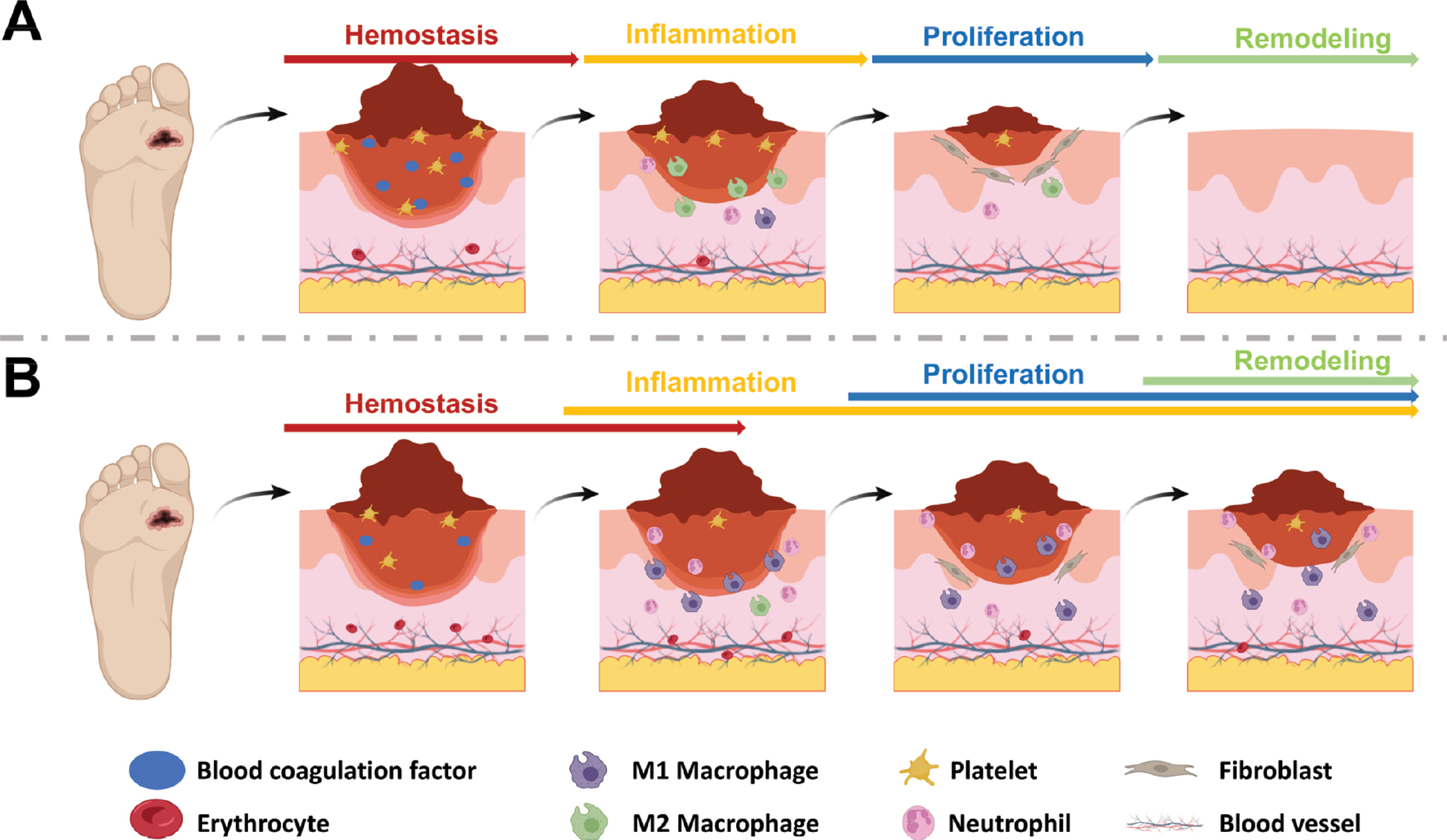
The skin, which serves as the primary physical barrier of the human body, is crucial for maintaining homeostasis and defending against external insults. Skin injuries from various factors initiate a complex healing process, which is a dynamic, multi-stage cascade involving the following overlapping phases: hemostasis; inflammation; proliferation; and remodeling [1, 2]. The hemostasis phase involves vasoconstriction and platelet aggregation to form a clot. Hemostasis forms a clot, inflammation clears debris and pathogens [3, 4], proliferation involves tissue rebuilding and angiogenesis [5, 6], and remodeling focuses on scar maturation. These phases are regulated by cytokines, growth factors, and the extracellular matrix (ECM) [7]. However, under certain pathologic conditions, such as diabetes mellitus, severe infection, ischemia, aging, or immunocompromise, the normal healing cascade is disrupted, leading to delayed or stalled healing and the formation of chronic non-healing wounds [8–10]. Diabetic wounds, particularly diabetic foot ulcers (DFUs), represent one of the most prevalent types of chronic wounds [11]. The comparison of normal and chronic wound healing processes with diabetic foot ulcers as a representative model is illustrated in Figure 1.
Figure 1 Comparison of normal and chronic wound healing processes with diabetic foot ulcers as a representative model. (A) In the normal wound healing process, which consists of four stages (hemostasis, inflammation, proliferation, and remodeling), various cells and signaling molecules coordinate with each other. (B) In the diabetic wound healing process, which also consists of the four stages (hemostasis, inflammation, proliferation, and remodeling), each stage takes longer than that in the normal wound healing process. This results in prolonged inflammation and impaired cell function, hindering the healing process.
Key characteristics of DFUs include persistent inflammation driven by hyperglycemia and advanced glycation end products (AGEs) [12–16], oxidative stress from excessive reactive oxygen species (ROS) [17–19], impaired angiogenesis [20–22], neuropathy [23], dysfunctional fibroblasts and keratinocytes [24, 25], and increased infection susceptibility due to a compromised immune environment [26–28]. Whereas infected wounds, especially with drug-resistant bacteria, like methicillin-resistant Staphylococcus aureus (MRSA), further challenge healing through biofilm formation [19, 29–31]. Aged skin also heals poorly due to cellular senescence and structural decline [32–34]. These complex mechanisms underscore the difficulty in treating chronic wounds. An ideal dressing should protect the wound, maintain moisture, manage exudate, permit gas exchange, and be biocompatible and easy to use [35, 36]. While traditional dressings, like gauze, are cost-effective, traditional dressings often adhere to wounds and fail to maintain optimal moisture. Modern alternatives (e.g., films and foams) improve moisture management but are largely passive, offering limited bioactive support for complex wounds [13, 16, 37]. In addition, synthetic polymers may raise biocompatibility concerns. There is therefore a pressing need for advanced, multifunctional dressings that can actively intervene in the pathologic wound microenvironment. In recent years, hydrogels have emerged as promising candidates that are characterized by three-dimensional, water-absorbent polymer networks [38–41]. The high-water content and porous structure mimic a moist, ECM-like environment, supporting cell activities, absorbing exudate, and allowing gas exchange. Hydrogels can encapsulate and controllably release bioactive agents (e.g., drugs and growth factors), enhancing localized therapy while minimizing systemic side effects [40, 42]. Injectable formulations can also conform to irregular wounds.
Natural polysaccharides, such as chitosan (CS), alginate, and hyaluronic acid, are favored for hydrogel fabrication due to the abundance, biocompatibility, and inherent bioactivity [40, 41, 43, 44]. Common natural polysaccharides used for hydrogels include CS, sodium alginate (SA), hyaluronic acid (HA), cellulose, starch, pectin, and gellan gum. These polysaccharides can be crosslinked via various physical or chemical methods to form hydrogels, demonstrating potential in wound healing, drug delivery, and tissue engineering. Of particular interest are polysaccharides derived from Traditional Chinese Medicine plants (TCMPs) [45–48]. Numerous studies have demonstrated that specific TCMPs exhibit remarkable anti-inflammatory, antioxidant, immunomodulatory, pro-angiogenic, antibacterial, or hemostatic properties, unlike common polysaccharides [49–51]. For example, Bletilla striata polysaccharide (BSP) is renowned for excellent hemostatic and wound-healing effects [52–59]. Astragalus polysaccharide (APS) excels in immunomodulation and antioxidation [49, 60–62]. Dendrobium officinale polysaccharide (DOP) has good anti-inflammatory, antioxidant, and moisturizing properties [50, 63, 64]. Gastrodia elata polysaccharide (GEP) possesses antioxidant and neuroprotective activities beneficial for aging skin wounds [33, 65, 66]. Glycyrrhiza polysaccharide (GP) is known for anti-inflammatory activity [51].
This inherent bioactivity allows TCMP-based hydrogels to function not merely as passive scaffolds but as active therapeutic systems, potentially improving efficacy while simplifying design and reducing the need for high drug loading [67, 68]. Furthermore, the long history of TCM use in China and other Asian countries provides a unique cultural context and a degree of empirical safety validation for developing biomaterials based on TCMPs.
Although research on natural polysaccharide-based hydrogels for wound healing has made significant strides, systematic reviews focusing specifically on functional hydrogels constructed from polysaccharides derived from TCM sources are relatively scarce. Considering the unique bioactive profiles of TCMPs and the potential advantages in addressing the complex microenvironments of chronic wounds (e.g., inflammation, oxidative stress, and infection), a thorough examination of the progress in this specific subfield is highly valuable.
Therefore, this review aims to summarize recent advances in TCMP-based functional hydrogels for wound healing. The review will focus on the following: (1) the sources, structures, and bioactivities of key TCMPs; (2) strategies for fabricating functional (e.g., injectable and antibacterial) hydrogels; (3) wound model efficacy and mechanisms, especially DFUs; and (4) current challenges and future directions. We seek to provide a comprehensive resource that highlights the unique value of TCMPs and aids in designing next-generation, clinically translatable wound dressings.
TCM polysaccharides for wound healing hydrogels: sources, structures, and bioactivities
TCM boasts a rich history spanning thousands of years and possesses a vast repository of medicinal plant resources. Modern research has identified polysaccharides as crucial components responsible for the pharmacological activities of many Chinese herbs. These TCMPs are not only abundant and structurally diverse but also frequently exhibit unique, multifaceted bioactivities. These properties make TCMPs highly promising candidates in the field of biomedical materials, particularly for developing functional hydrogel dressings for wound healing. This section focuses on several TCMPs that have garnered significant attention in wound healing hydrogel research, outlining the sources, structural features, and bioactivities relevant to wound repair.
Overview of major TCM sources and the active polysaccharides
Polysaccharides from numerous TCM sources have been studies for constructing wound healing hydrogels. Some well-studied or representative examples are discussed below.
BSP
BSP is derived from the dried tubers of Bletilla striata (Orchidaceae). BSP is a typical glucomannan that is primarily composed of D-mannose and D-glucose residues linked by β-(1→4) glycosidic bonds (approximate 4:1 ratio) with minor O-acetylation [52, 59, 69]. BSP is renowned for excellent intrinsic hemostatic properties, which rapidly promote platelet aggregation and coagulation. BSP also has activities, such as promoting fibroblast proliferation, inducing vascular endothelial growth factor (VEGF) expression, stimulating angiogenesis, and exhibiting antibacterial effects [52, 55, 58]. These properties make BSP an ideal natural material for developing hemostatic and pro-healing wound dressings.
APS
APS is extracted from the dried roots of Astragalus membranaceus (Fabaceae). APS is a complex mixture of heteropolysaccharides with major monosaccharide components, including glucose, galactose, arabinose, rhamnose, and galacturonic acid, which are linked by various glycosidic bonds and exhibit a wide molecular weight distribution [49, 62, 70]. APS is well-known for significant immunomodulatory activity and is capable of activating macrophages and regulating T cell subsets. In addition, APS exhibits multiple pharmacologic effects, including antioxidant (ROS scavenging), anti-inflammatory (inhibiting inflammatory cytokines), promoting fibroblast proliferation, and stimulating angiogenesis, showing great potential in improving the microenvironment of diabetic wounds and accelerating healing [49, 60, 62, 71].
DOP
DOP is isolated from the stems of Dendrobium officinale (Orchidaceae). DOP is also a glucomannan with a backbone of β-(1→4) linked mannose and glucose residues, typically with a higher mannose ratio (4.47:1) [72]. DOP features O-acetyl groups at the C-2 or C-3 position, which are crucial for maintaining conformation and bioactivity [50]. DOP has good anti-inflammatory (inhibiting NF-κB pathway), antioxidant, moisturizing, fibroblast-proliferating, and immunomodulatory activities, positioning DOP as a promising ingredient for anti-aging and tissue repair applications [73, 74].
GEP
GEP is extracted from the dried tubers of Gastrodia elata (Orchidaceae). While detailed structural studies of GEP remain relatively limited, emerging evidence reveals a broader spectrum of pharmacologic activities relevant to wound healing. Beyond established antioxidant, free radical scavenging, and neuroprotective effects, GEP exhibits significant anti-inflammatory activity by inhibiting pro-inflammatory cytokines, such as TNF-α and IL-6 [33, 66]. GEP also demonstrates immunomodulatory properties, including the ability to regulate macrophage polarization [75, 76]. Furthermore, GEP promotes keratinocyte migration, a critical process for re-epithelialization [77]. It is evident that GEP holds considerable potential for the treatment of chronic non-healing wounds, particularly in the context of ageing skin, where impaired cellular function and dysregulated inflammation impede the process of repair. GEP-based hydrogels have been shown to promote the repair of aging skin wounds by mitigating oxidative stress and modulating related signaling pathways in wound healing applications [33, 78].
In addition to these core polysaccharides, numerous other TCMPs have shown potential for wound healing applications. Table 1 summarizes the sources and main bioactivities.
Table 1 Other Potential TCMP for Wound Healing: Sources and Main Bioactivities
| Polysaccharide (Abbr.) | TCM Source (Latin Name) | Main Wound Healing-related Bioactivities | Ref |
|---|---|---|---|
| Glycyrrhiza polysaccharide (GP) | Glycyrrhiza uralensis (Fabaceae) | Anti-inflammatory, antioxidant, immunomodulatory, metal-ion binding | [51, 217] |
| Konjac glucomannan (KGM) | Amorphophallus konjac (Araceae) | Excellent gelling/film-forming, moisturizing, prebiotic, easily oxidized for Schiff base hydrogels | [46, 125, 130, 131, 218] |
| Lycium barbarum polysaccharide (LBP) | Lycium barbarum (Solanaceae) | Potent antioxidant, immunomodulatory, anti-aging, pro-angiogenic | [140, 175] |
| Poria cocos polysaccharide (PCP) | Poria cocos (Polyporaceae) | Immunomodulatory, anti-inflammatory, acid-induced self-gelation | [45, 136] |
| Aloe polysaccharide (AP) | Aloe barbadensis (Liliaceae) | Moisturizing, anti-inflammatory, immunomodulatory, fibroblast proliferation promotion, collagen synthesis promotion | [126, 129, 141, 219] |
| Lentinan (LNT) | Lentinus edodes (Shiitake) | Potent immunomodulation, pro-angiogenic, anti-inflammatory | [157, 220] |
| Mesona chinensis polysaccharide (MCP) | Mesona chinensis (Lamiaceae) | Antioxidant, pH-responsive gelling properties | [144, 221] |
| Tamarind seed polysaccharide (TSP) | Tamarindus indica (Fabaceae) | Thickening, mucoadhesive, gelling | [128, 138, 139, 173, 222] |
| Hypericum perforatum callus extract (HPCE) | Hypericum perforatum (Hypericaceae) | Anti-fibrotic, anti-inflammatory | [172] |
Overview of extraction, isolation, and purification methods
As shown in Figure 2, the process of TCMPs from raw botanical material to a purified, bioactive macromolecule involves a series of critical and meticulously controlled steps, as follows: extraction; preliminary separation; and sophisticated purification. The extraction of TCMPs typically begins with hot water extraction, which leverages the inherent solubility of polysaccharides in hot water [79, 80]. Alternative methods, like enzyme-, ultrasound-, or microwave-assisted extraction, are also used to enhance efficiency. Following extraction, the crude polysaccharide solution undergoes preliminary separation. Subsequently, ethanol precipitation is commonly used as a cornerstone technique. Adding ethanol to the aqueous extract causes the hydrophilic polysaccharides to precipitate, which are then collected by centrifugation or filtration [81]. This technique effectively removes undesirable small molecule impurities.
Figure 2 Flowchart of extraction, purification, and modification of polysaccharides from traditional Chinese medicinal plants. (A) Several representative medicinal plants commonly used for extracting polysaccharides from Traditional Chinese Medicine. (B) Representative methods commonly used for extracting polysaccharides from Traditional Chinese Medicine, including enzymatic extraction method and reflux extraction method. (C) Common precipitation fractionation method (alcohol precipitation method) in the separation of polysaccharides from Traditional Chinese Medicine. (D) Polysaccharide purification methods, including protein removal by the Sevage method, adsorption de-colorization by activated carbon, and fractionation purification by gel chromatography.
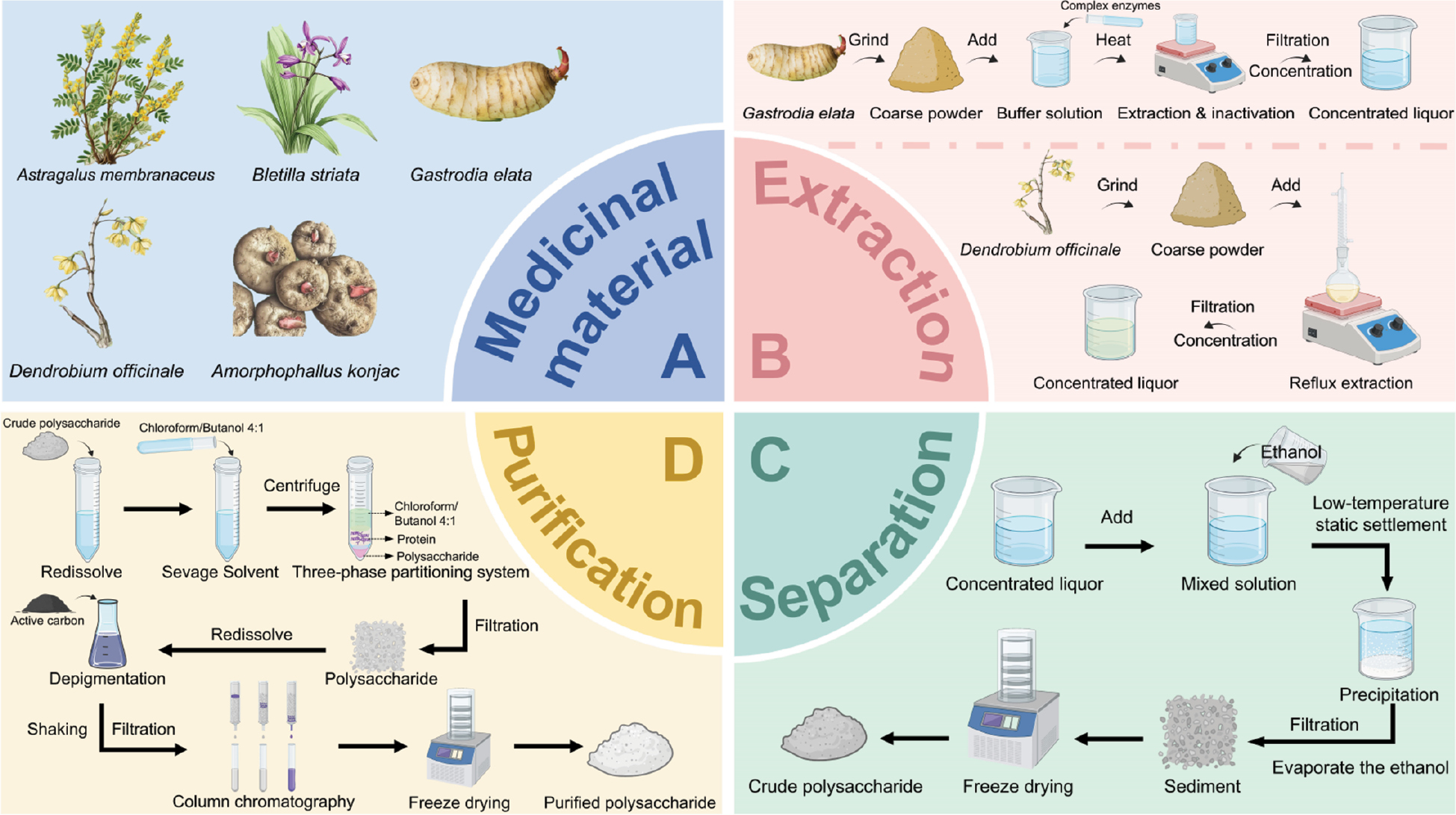
Further purification steps are indispensable to obtain polysaccharides with higher purity and structural uniformity. These steps are necessary and include deproteinization (e.g., using the Sevage method with chloroform/n-butanol or enzymatic methods) to eliminate co-extracted proteins, decolorization (e.g., via activated carbon adsorption) to remove pigments, and dialysis to remove residual salts and very small molecules by selective diffusion through a semi-permeable membrane [82].
Finally, for high-resolution separation, column chromatography is applied (e.g., DEAE-cellulose or Sephadex gel columns) to separate based on charge or molecular size, respectively, yielding polysaccharide fractions with relatively uniform structure and molecular weight, narrow molecular weight distributions, and consistent biological activity [83, 84]. These multi-stage processes ensure the quality, purity, and structural integrity of TCMPs, which are crucial for subsequent structural characterization, activity studies, material fabrication, and application in functional hydrogels [85].
Structure-activity relationship
The biological activities of TCMPs are intimately linked to the complex structures. Several common TCM plants and their polysaccharides are listed in Figure 3A. The main or monosaccharide compositions and key structural features of representative TCMPs are summarized in Table 2. Key structural features influencing activity include are discussed below.
Figure 3 The chemical structures of representative polysaccharides from Traditional Chinese Medicine (TCM) used for wound healing hydrogels and a schematic diagram illustrating the common crosslinking mechanisms used to fabricate polysaccharide-based hydrogels from TCM. (A) Representative sources of polysaccharides from medicinal plants and the chemical structures. (B) Common chemical crosslinking mechanisms, including free radical polymerization, enzymatic crosslinking method, Schiff-Base, and photo-induced crosslinking method. (C) Common physical crosslinking mechanisms, including ionic bonding crosslinking, crystal crosslinking, hydrogen bonding crosslinking, and hydrophobic association.
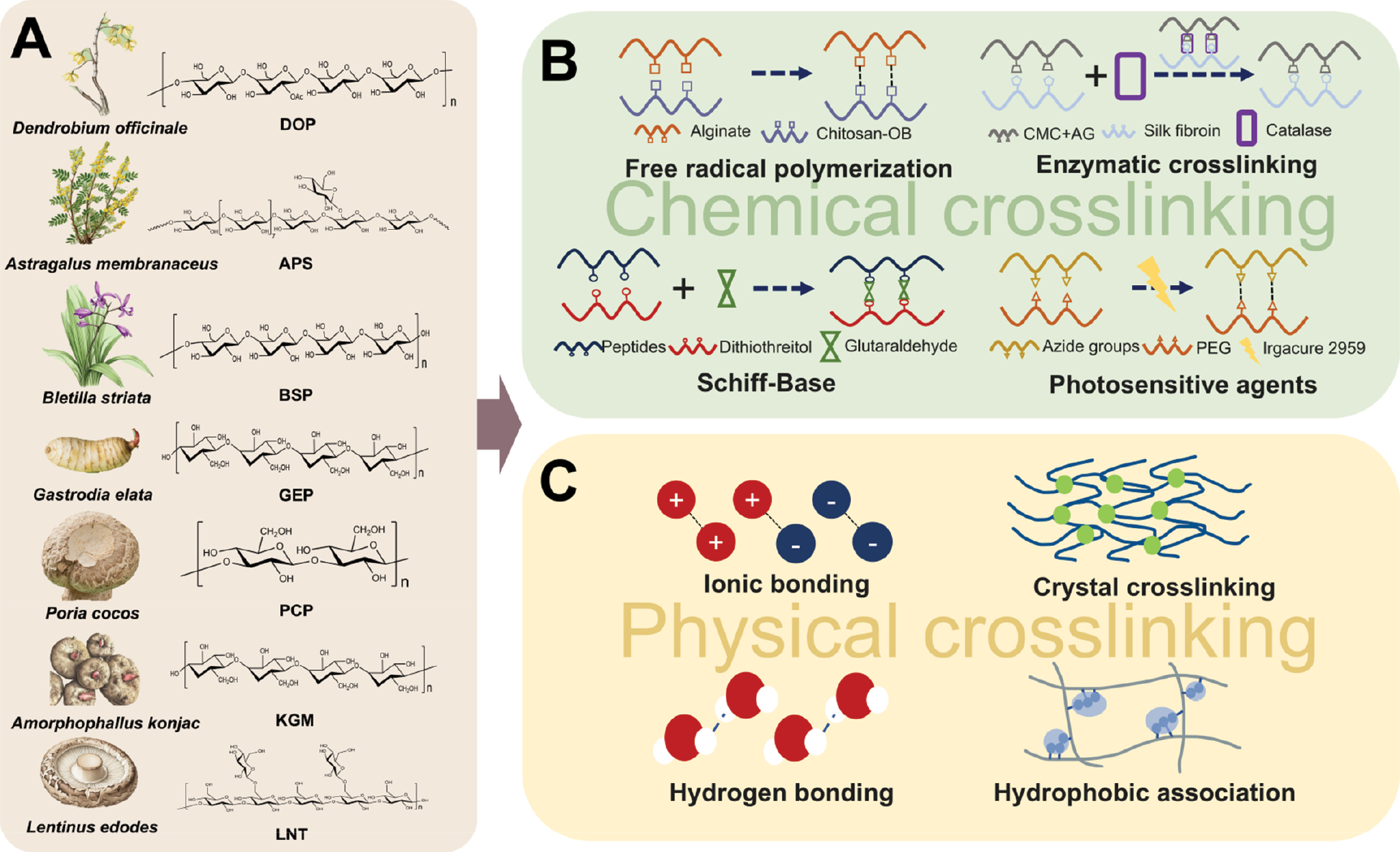
Table 2 Summary of Representative TCM Polysaccharides used in Wound Healing Hydrogels
| Polysaccharide (Abbr.) | TCM Source (Latin Name) | Major Monosaccharides | Key Structural Features | Primary Wound Healing Bioactivities | Ref |
|---|---|---|---|---|---|
| BSP | Bletilla striata | Mannose, glucose (~4:1) | β-(1→4) glucomannan backbone, minor acetylation | Potent hemostasis, cell proliferation, pro-angiogenic, antibacterial | [68, 69] |
| APS | Astragalus membranaceus | Glucose, galactose, arabinose, rhamnose, GalA | Complex heteropolysaccharide, various linkages, broad MW distribution | Immunomodulation (Mφ, T cells), antioxidant, anti-inflammatory, pro-angiogenic | [113, 117, 120] |
| DOP | Dendrobium officinale | Mannose, glucose (mannose-rich) | β-(1→4) glucomannan backbone, O-acetylation | Anti-inflammatory, antioxidant, moisturizing, immunomodulatory, cell proliferation | [50, 63] |
| GEP | Gastrodia elata | Glucose | α-(1→4)-Glcp or α-(1→4,6)-Glcp backbone | Antioxidant, neuroprotective, (potentially promotes aging wound healing via antioxidation) | [33, 223, 224] |
| GP | Glycyrrhiza uralensis | (Diverse, acidic/neutral) | (Diverse, contains uronic acid) | Anti-inflammatory, antioxidant, immunomodulatory, metal-ion binding | [51, 217] |
| KGM | Amorphophallus konjac | Mannose, glucose (~1.6:1) | High MW β-(1→4) glucomannan, minor acetylation, easily oxidized (OKGM) | Excellent gelling/film-forming/moisturizing, prebiotic, (matrix) carrier | [46, 125] |
| LBP | Lycium barbarum | Arabinose, galactose, glucose, rhamnose | Proteoglycan complex | Potent antioxidant, immunomodulatory, anti-aging, pro-angiogenic | [140, 175] |
| PCP | Poria cocos | Glucose | β-(1→3) backbone, β-(1→6) branches, acid-induced gelation | Immunomodulatory, anti-inflammatory, anti-tumor | [136] |
| AP | Aloe barbadensis | Mannose | β-(1→4) acetylated mannan (acemannan) | Moisturizing, anti-inflammatory, immunomodulatory, cell proliferation | [126, 129] |
| LNT | Lentinus edodes | Glucose | β-(1→3) backbone, β-(1→6) branches | Potent immunomodulation (Mφ, NK, T cells), anti-inflammatory, pro-angiogenic, promotes diabetic wound healing | [157, 220] |
| TSP | Tamarindus indica | Galactose, xylose, glucose | Galactoxyloglucan | Thickening, mucoadhesive, gelling (with specific molecules, like TP) | [128, 139] |
Molecular weight (MW)
Polysaccharides with different MWs may exhibit distinct biological activities. For example, an optimal MW range might be more readily recognized by immune cells or possess better solubility and rheologic properties [86, 87]. Studies have demonstrated that the MW of APS significantly influences immunologic activity. With a MW of approximately 10 kDa, APS is the main active component that exerts immunomodulatory effects [88]. In addition, another study reported that Lycium barbarum polysaccharide (LBP) fractions within a medium MW range (10⁵–10⁶ Da) are optimally recognized by immune cells [89].
Monosaccharide composition
The types and proportions of constituent monosaccharides affect the overall properties. Polysaccharides containing uronic acids are typically negatively charged, which influences the ion-binding capacity and bioactivity [90–92]. For example, an increase in uronic acid content, which is induced by ultrasonic treatment of Sagittaria sagittifolia L. polysaccharide, has been shown to enhance antioxidant and anti-tumor activities [90]. In addition, polysaccharides from Trichosanthes kirilowii seed shell, which contain glucuronic acid, have significant hypoglycemic activity by inhibiting α-glucosidase [93].
Glycosidic linkage type
The types of linkages in the main chain and branches (e.g., α or β configuration and linkage positions like 1→3, 1→4, and 1→6) determine the polysaccharide chain conformation (e.g., helix and random coil) and flexibility, which in turn affects interactions with receptors and biological activity. For example, the specific conformation of β-glucans (e.g., lentinan [LNT] and Poria cocos polysaccharide [PCP]) is considered key to the immunomodulatory activity [94–96]. Ganoderma lucidum β-glucan (GLP-D), featuring a β-(1→3)-linked backbone with β-(1→6)-linked side chains, adopts an optimized branched conformation after ultrasonic degradation that enhances solubility and bioactivity [97]. This specific glycosidic linkage pattern enables GLP-D to exert immunomodulatory effects by promoting lymphocyte proliferation through gut microbiota modulation, particularly via Lactobacillus and Alistipes.
Degree of branching and side chain structure
The presence, length, position, and composition of side chains influence the spatial structure, solubility, and bioactivity of the polysaccharide [90, 98]. A neutral polysaccharide from Astragalus membranaceus with a 1,4-α-D-glucopyranosyl main chain and side chains attached at the O-6 position has been characterized. This specific branching pattern directly dictates the dual bioactivity. Inhibiting macrophage NF-κB pathway for immunomodulation, while promoting endothelial cell proliferation for tissue repair showed that the O-6 substituted structure is the key determinant of the therapeutic effects on immune dysregulation and tissue damage [99].
Higher-order structure and conformation
Polysaccharides may adopt specific 3D conformations in solution (e.g., triple helix), which can be critical for biological functions, particularly immunomodulation [94, 100, 101]. For example, the triple-helix conformation of lentinan, which is derived from the β-(1→3)-D-glucan backbone with β-(1→6)-branches, is essential for the immunomodulatory activity because this specific structure enables high-affinity binding to the Dectin-1 receptor on immune cells [102].
Chemical modification
Naturally occurring modifications (e.g., acetylation, methylation, and sulfation) or artificially introduced modifications (e.g., oxidation, carboxymethylation, and grafting) can significantly alter the physicochemical properties and biological functions. For example, the degree of DOP acetylation directly influences the anti-inflammatory activity [103]. Proper acetyl group retention is essential for optimal immunomodulatory function, while complete deacetylation significantly weakens the anti-inflammatory effects [104]. Similarly, oxidation of polysaccharides, such as oxidized konjac glucomannan (OKGM), oxidized Bletilla striata polysaccharide (OBSP), and oxidized Ganoderma lucidum polysaccharide (OGLP), to introduce aldehyde groups enables constructing Schiff base crosslinking hydrogels [46, 56, 105].
Key bioactivities relevant to wound healing mechanisms
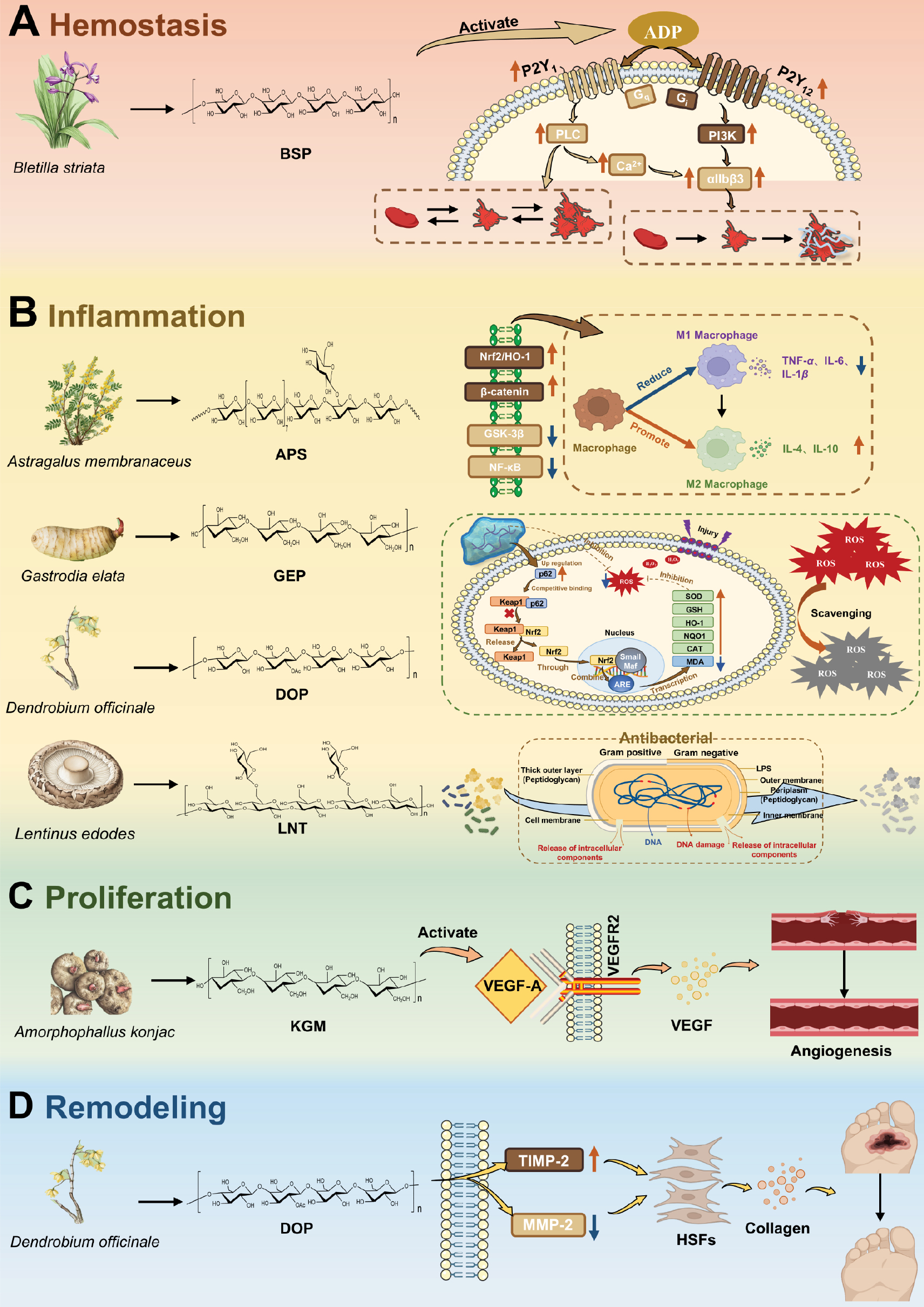
The favorability of TCMPs in wound healing stems largely from the inherent, multi-target biological activities that can intervene in multiple key stages of the healing process. Several common TCMPs are listed in Figure 6 for the biological activities in intervening in multiple key stages of the healing process. The primary wound healing biological activities of representative TCMPs are summarized in Table 2.
Anti-inflammatory and immunomodulatory activities
Chronic wounds often exhibit dysregulated inflammation and immune imbalance. Various TCMPs (e.g., LNT, BSP, DOP, GP, and AP) effectively modulate the inflammatory microenvironment, as follows: (1) inhibiting the production of pro-inflammatory cytokines (e.g., TNF-α, IL-1β, and IL-6); (2) promoting the release of anti-inflammatory cytokines (e.g., IL-10); (3) skewing macrophage polarization from the pro-inflammatory M1 phenotype towards the pro-resolving M2 phenotype; and (4) regulating the function of other immune cells (e.g., T cells and neutrophils) to restore immune homeostasis, thereby breaking the vicious cycle of chronic inflammation and creating a favorable environment for tissue repair [106–109].
Antioxidant activity
ROS levels are typically elevated in wound sites, especially chronic wounds, causing oxidative damage and delaying healing. Many TCMPs (e.g., APS, GEP, DOP, GP, and LBP) and systems loaded with phenolic compounds (e.g., tea polyphenols [TPs], catechin, and ferulic acid [FA]) possess the ability to directly scavenge various free radicals [e.g., 2,2-diphenyl-1-picrylhydrazyl (DPPH), 2,2′-azinobis(3-ethylbenzothiazoline-6-sulfonic acid) {ABTS}, and superoxide anion] or indirectly enhance endogenous antioxidant systems (e.g., by activating the Nrf2/HO-1 pathway), thus mitigating oxidative stress damage and protecting cells [110, 111].
Pro-angiogenic activity
Angiogenesis is crucial during the proliferative phase for supplying oxygen and nutrients to the regenerating tissue. Polysaccharides, like BSP, APS, and DOP, have been shown to upregulate the expression of key pro-angiogenic factors, such as VEGF and bFGF, stimulating endothelial cell proliferation, migration, and tube formation, thereby promoting vascularization at the wound site [49, 112–114].
Promotion of cell proliferation and migration
Fibroblasts and keratinocytes are key cell types involved in granulation tissue formation and re-epithelialization. TCMPs, like BSP, AP, and APS, can directly or indirectly stimulate the proliferation and migration of these cells by activating relevant signaling pathways (e.g., MAPK and PI3K/Akt) or modulating the wound microenvironment (reducing inflammation/ROS and increasing growth factors) [115–117].
ECM deposition and remodeling
TCMPs can influence ECM dynamics through various mechanisms. For examples, BSP promotes collagen deposition by stimulating fibroblast proliferation and enhancing the synthesis and secretion of types I and III collagen, contributing to granulation tissue formation and wound strength [118, 119]. APS helps maintain ECM homeostasis by regulating the balance between matrix metalloproteinases (MMPs) and their tissue inhibitors (TIMPs), which prevents excessive ECM degradation and supports organized tissue remodeling [120]. Other TCMPs (e.g., Calvatia gigantea polysaccharides and Angelica sinensis polysaccharides) may also promote fibroblast collagen synthesis and potentially regulate the MMP/TIMP balance, contributing to functional tissue regeneration and potentially reducing excessive scarring [121, 122].
Antibacterial activity
While most polysaccharides have limited intrinsic antibacterial activity (CS and CS derivatives being notable exceptions), some TCMPs (like BSP) or their composites have shown moderate inhibitory effects. More commonly, TCMP hydrogels serve as carriers for antibacterial drugs or nanomaterials [123, 124].
Hemostatic activity
BSP, due to its unique structure and properties, exhibits rapid and effective physical hemostasis by absorbing blood fluid, concentrating blood cells and clotting factors, and activating intrinsic coagulation pathways, making BSP an ideal natural hemostatic agent [52, 59].
Moisturizing and barrier function
Abundant hydrophilic groups (hydroxyl and carboxyl) on polysaccharide chains impart excellent moisture absorption and retention capabilities, helping maintain a moist wound environment and forming a physical barrier against external contaminants [125, 126].
The unique and diverse bioactivities of these TCMPs, when combined with the favorable physicochemical properties of hydrogels, provide a rich toolbox for designing functional dressings targeting specific pathologic microenvironments in wounds. The subsequent sections will explore how these polysaccharides are used to construct functional hydrogels and delve into the application efficacy and mechanisms in wound healing.
Fabrication strategies for TCM polysaccharide-based hydrogels
Translating the excellent bioactivities of TCMPs into functional hydrogel dressings suitable for wound healing requires sophisticated design and fabrication strategies. Researchers have leveraged the abundant functional groups (such as hydroxyl, carboxyl, and amino groups) present on the polysaccharide chains and the unique physical and chemical properties for crosslinking. Various physical and chemical crosslinking methods and functionalization methods are demonstrated in Figure 3B-C and Tables 3 and 4, which transform the TCMP s into hydrogels with specific network structures, physical and chemical properties, and biological functions. This section systematically introduces the main strategies recently used to construct TCMP-based hydrogels.
Table 3 Summary of Crosslinking Strategies for TCM Polysaccharide Hydrogels
| Crosslinking Type | Specific Method | TCMP Example(s) | Other Component(s) Example | Key Property/Purpose | Ref |
|---|---|---|---|---|---|
| Physical | Ionic crosslinking | GP, KGM/pectin | Ca2+, Mg2+ | Physical gelation | [51] |
| Hydrogen bonding | BSP/KGM, TSP/TP, DOP/PVA | – | Network reinforcement | [19, 53] | |
| Freeze-thaw | AP/PVA, DOP/PVA | PVA | Enhanced mechanics, anti-freeze | [129] | |
| Chemical | Schiff base | OBSP, OKGM, OGLP, OGEP | CS, CMC, gelatin | Self-healing, injectable | [46, 54, 105, 130, 131, 137] |
| Boronate ester | AP, DOP | PVA, borax/BA | Self-healing, pH/glucose responsive | [129] | |
| Photocrosslinking | BSPMA, CSMA | GelMA | Rapid in situ gelation, shape control | [46, 134, 135] | |
| Other covalent | BSP, KGM | AA (grafting), genipin | Network stability | [52] | |
| Multiple Network | DN/IPN | OBSP/Gel-ADH, PVA/DOP/AP, OKGM/CMCS/CMCSMA | TP, PVA, CMCSMA | Enhanced mechanics | [46, 56, 74] |
Table 4 Summary of Functionalization Strategies for TCM Polysaccharide Hydrogels
| Function | Strategy | Specific Example (TCMP System) | Purpose/Application | Ref |
|---|---|---|---|---|
| Injectable | Thermo-sensitivity/dynamic bonds/photocure | BSP/CS; OKGM/CMCS; CSMA/OBSP | Minimally invasive delivery | [58, 131, 134] |
| Self-healing | Dynamic bonds (Schiff base, boronate) | OKGM/CMCS; AP/PVA | Extended service life | [129, 131] |
| Tissue Adhesion | Incorporate adhesive groups (dopamine) | Conductive polyphenol MN (GelMA/DA) | Dressing fixation, sealing | [46, 142] |
| Antibacterial | Load agents/nanomaterials/photosensitizers | OKGM/CMCS+BBR; OKGM/CS-Arg+PF; GA/OKGM+MXene@TiO2; APS+MnO2 | Infected wound treatment | [31, 49, 130, 131] |
| Antioxidant | Intrinsic TCMP/load antioxidants | GEP/PUE; APS; DOP; GP; OKGM/CS-Arg+PF; OBSP/Gel-ADH+TP | ROS scavenging, chronic wound | [33, 49, 56, 74, 130] |
| Conductive | Incorporate conductive materials | APS/CMC/SA+PPy; conductive polyphenol MN | Electrical stimulation therapy | [61, 142] |
| Stimuli-Responsive | Incorporate responsive moieties | BSP+CD-Fc (ROS); MCP (pH); (phenylboronic acid, glucose) | Smart release/diagnosis | [40, 57, 144] |
| Drug/Factor Release | Network encapsulation/microspheres/liposomes | GEP+GAS; GEP+PUE; OKGM/CMCS+Exo; BSPMA+PPD-Lipo; HAQA-MN+M-KD | Sustained/targeted delivery | [33, 66, 131, 135, 145] |
| Advanced Mfg. | Microfluidics/3D print/spray/microneedle | BSPMA microspheres; GEP/CMC Print; CSMA/OBSP Spray; HAQA-MN+M-KD | Precision structure/delivery | [60, 134, 135, 145] |
Crosslinking mechanisms and network construction
The 3D network structure is fundamental to hydrogel function. The nature (reversibility and dynamics) and density of crosslinks determine the hydrogel mechanical properties, swelling behavior, degradation rate, and drug release profile. The primary crosslinking mechanisms for TCMPs are discussed below.
Physical crosslinking
Physical crosslinking relies on non-covalent interactions, like hydrogen bonds, ionic interactions, hydrophobic interactions, or chain entanglement. Physical crosslinking is generally mild, avoids chemical crosslinkers, offers good biocompatibility, and some physical crosslinks (e.g., hydrogen bonds and dynamic ionic coordination) are reversible, potentially imparting stimuli-responsiveness or self-healing properties. These interactions can be categorized into four main types of physical crosslinking strategies in TCMP-based hydrogels. First, ionic crosslinking utilizes electrostatic interactions between negatively charged polysaccharides (e.g., negatively charged polysaccharides containing uronic acid, like Glycyrrhiza polysaccharide [GP], pectin, and alginate, or modified negatively charged polysaccharides, like carboxymethyl cellulose [CMC]) and multivalent cations (commonly Ca2+, Mg2+, Zn2+, and Fe3+). For example, GP has been shown to form physically crosslinked hydrogels with Ca2+ [51]. KGM and pectin blends also use Ca2+ and Mg2+ co-crosslinking [127]. Second, hydrogen bonding is a prevalent mechanism that is facilitated by the abundant hydroxyl groups on polysaccharide chains, which form extensive intra- and inter-molecular networks. This mechanism often acts synergistically with other crosslinking methods to enhance gel stability and mechanical properties. For example, hydrogen bonding between BSP and KGM chains contributes to the improved properties of BSP/KGM blend hydrogels [53]. Phenolic hydroxyl groups in TPs can also form hydrogen bonds with groups on polysaccharide chains (like TSP, BSP, and gelatin), inducing gelation or strengthening the network [56, 128]. Third, freeze-thaw cycling is a technique primarily applied to polyvinyl alcohol (PVA) and PVA blends with polysaccharides (e.g., AP and DOP). Repeated freeze-thaw cycles induce the formation of PVA microcrystalline domains acting as physical crosslinks, while polysaccharide chains participate in hydrogen bonding, yielding hydrogels with enhanced toughness and elasticity [74, 129]. Fourth, although less common as a primary mechanism in pure TCMP hydrogels, hydrophobic and host-guest interactions have a contributory role in blends or after hydrophobic modification. For example, cyclodextrin-ferrocene host-guest interactions were used to create ROS-responsive BSP-releasing hydrogels [57].
Chemical crosslinking
Chemical crosslinking forms stable covalent bonds to construct the network, generally yielding hydrogels with higher mechanical strength and stability. Based on the nature of the covalent bonds, crosslinking can be categorized into static and dynamic covalent crosslinking.
Dynamic covalent crosslinking has emerged as a popular strategy for constructing self-healing and injectable hydrogels because these bonds can reversibly break and reform under specific conditions, such as changes in pH, temperature, light, or redox environment. This imparts valuable properties, like flowability, moldability, and self-repair capabilities. Several key dynamic covalent bonds are used. Schiff base bonds, which are formed rapidly between aldehyde and primary amine groups under mild conditions, represent one of the most widely used methods for TCMP-based hydrogels. This typically involves oxidizing polysaccharides, such as BSP or HA, to introduce aldehydes, which then react with amino-containing polymers, like CS or gelatin [46, 54, 105, 130–132]. Boronate ester bonds, which are formed between boronic acid derivatives and cis-diol-containing molecules (e.g., PVA or some polysaccharides), are notably pH-sensitive, enabling the construction of hydrogels responsive to physiologic or pathologic environments [40, 129, 133]. In addition, acylhydrazone bonds (from aldehyde and acylhydrazide groups) and disulfide bonds (leveraging the redox reversibility of thiol groups) are also utilized to confer dynamic and responsive characteristics to the hydrogel networks.
Other covalent crosslinking methods provide alternative routes to form permanent networks. For example, photo-induced crosslinking involves modifying polysaccharides with photopolymerizable groups (e.g., methacryloyl). Rapid free-radical polymerization forms a covalently crosslinked network upon exposure to light in the presence of a photoinitiator, enabling in situ gelation and precise control over gel shape, which is highly suitable for injectable or sprayable dressings [46, 134, 135]. Enzymatic crosslinking utilizes biocompatible enzymes, like horseradish peroxidase or transglutaminase, to catalyze bond formation under mild conditions. Furthermore, traditional chemical crosslinkers, such as glutaraldehyde (though limited by toxicity), genipin (a natural alternative), or 1-ethyl-3-(3-dimethylaminopropyl)carbodiimide (EDC)/N-hydroxysuccinimide (NHS) coupling agents, are used to create covalent linkages between functional groups on the polymer chains.
Hydrogel types and structures
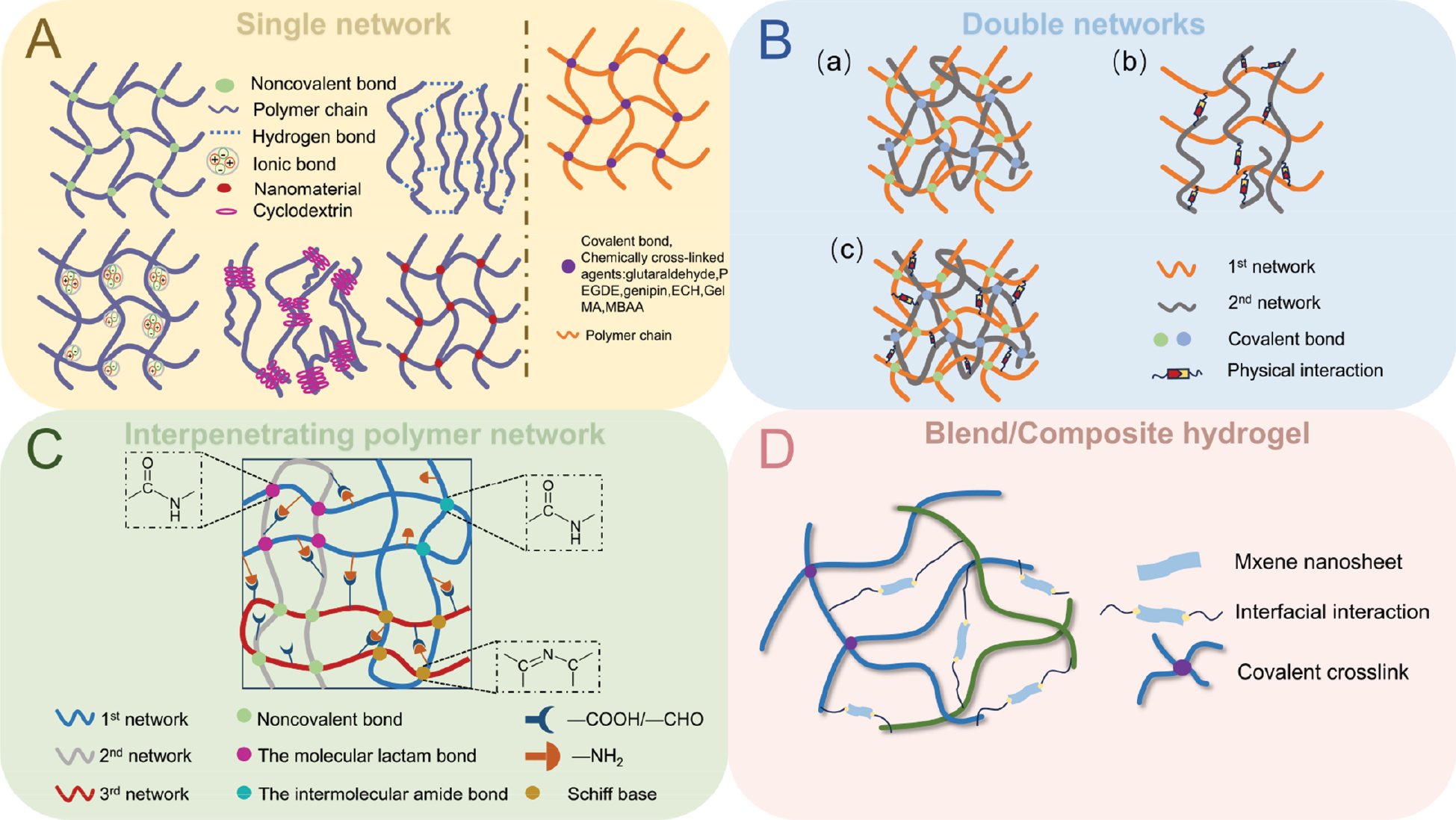
Various types and structures of TCMP-based hydrogels can be constructed based on the chosen crosslinking mechanisms and components, as shown in Figure 4.
Figure 4 Schematic diagram of different hydrogel network structures. (A) Single-network hydrogels formed by a single polymer, including physical crosslinked single-network hydrogels and chemical crosslinked single-network hydrogels. (B) Dual-network (DN) hydrogels, usually formed sequentially through different crosslinking mechanisms. (C) Interpenetrating polymer network (IPN) hydrogels, formed by interweaving two independent crosslinking networks. (D) Blended/composite hydrogels, in which different polymers are physically mixed or co-crosslinked.
Single-component TCMP hydrogels
Single-component TCMP hydrogels are formed by self-crosslinking of a single TCMP. This process is relatively challenging and usually requires specific polysaccharide structures and induction conditions. For example, the alkali-soluble fraction of Poria cocos polysaccharide (PCP) can self-assemble into a gel under acidic conditions via hydrogen bonding and other interactions [136].
Composite/blend hydrogels
The most common type of composite/blend hydrogen, in which TCMP is mixed with one or more other polymers (natural or synthetic) and crosslinked physically or chemically. This strategy allows for synergistic property enhancement, improving mechanical strength, biocompatibility, or introducing specific functionalities. These blends typically fall into two main categories: TCMP is combined with other natural polysaccharides or proteins, such as BSP/CS [58], APS/CMC/alginate [61], GLP/CMC/alginate [105, 137], KGM/pectin [127], TSP/alginate [138], TSP/gellan gum [139], LBP/gelatin [140], AP/gelatin [141], BSP/gelatin [54], and KGM/CS [132]; and TCMP is combined with synthetic polymers, such as AP/PVA [126, 129] and DOP/PVA [74].
Interpenetrating/semi-interpenetrating/double network hydrogels
Interpenetrating/semi-interpenetrating/double network (IPN/Semi-IPN/DN) hydrogels involve intertwining two or more independent polymer networks without covalent links (IPNs). Some networks are crosslinked (semi-IPN) or sequentially form two distinct networks (DNs). This structural design often significantly enhances the mechanical strength, toughness, and fatigue resistance of hydrogels, overcoming the weakness of single-network polysaccharide hydrogels. Examples include DN hydrogels formed by Schiff base (OKGM/CMCS) and photo-crosslinking (CMCSMA) [46]. Systems, like PVA/DOP [74] and OBSP/Gel-ADH [56], also form DN structures with enhanced mechanics.
Functional hydrogel design
To meet the complex demands of different wound healing stages, researchers use various strategies to impart specific functionalities to TCMP-based hydrogels.
Injectability
Injectability is achieved through several mechanisms, such as thermosensitive gelation (e.g., chitosan/β-glycerophosphate systems) [58], in situ chemical crosslinking via Schiff base reactions (e.g., OKGM/CMCS and OBSP/Gel-ADH) [56, 131], and photopolymerization [134]. These approaches enable minimally invasive delivery and conformal filling of irregular wound defects. For example, a thermosensitive BSP/CS hydrogel remains fluid at room temperature but rapidly gels at body temperature, allowing easy injection without surgical implantation [58].
Self-healing
Self-healing hydrogels are constructed using dynamic reversible crosslinks (primarily Schiff base bonds [54, 131] and boronate ester bonds [129]). These reversible bonds enable the hydrogel to autonomously repair structural damage, which maintains integrity and functionality. For example, an AP/PVA hydrogel crosslinked via boronate ester bonds exhibits pH-dependent self-healing behavior under physiologic conditions [129].
Tissue adhesiveness
Tissue adhesiveness is crucial for dressings or sealants requiring firm fixation to the wound or tissue. Achieved by incorporating adhesive moieties (e.g., dopamine/catechol analogues) or utilizing polymer-tissue interactions (e.g., electrostatic attraction and hydrogen bonding) [46, 142]. Researchers have designed a BSP-based dual-dynamic crosslinked hydrogel by incorporating a PVA-borax dynamic chemical network and tannic acid (TA) as a physical crosslinking center. TA is strategically introduced to impart tissue adhesion, utilizing its catechol groups to achieve strong bonding to wet tissues and easy detachment without residue [143].
Antibacterial property
Antibacterial properties are essential for infected wounds. Strategies involving antibacterial properties include: (1) utilizing the intrinsic antibacterial activity of components like CS; (2) loading antibacterial drugs, including antibiotics, peptides, natural molecules, like berberine (BBR) [131]; (3) incorporating inorganic antibacterial nanoparticles (e.g., AgNPs, ZnO, and TiO2) [31]; (4) introducing photothermal/photodynamic agents (e.g., MXene@TiO2 and Fe3+-doped nanoparticles [PF NPs]) [31, 130]; and (5) integrating nanozymes, like manganese dioxide (MnO2), that exhibit peroxidase/catalase-like activities [49].
Antioxidant property
Antioxidant properties are achieved by leveraging the intrinsic activity of TCMPs (e.g., APS, GEP, and DOP) or loading antioxidants, such as tea polyphenols (TPs) [56], catechin [46], ferulic acid (FA) [134], and puerarin (PUE) [33]. A GEP-based hydrogel was developed with a hierarchical delivery design. PUE was first encapsulated in gelatin microspheres (PUE-Ms), then loaded into a Schiff-base crosslinked network formed by oxidized GEP (OGEP) and gastrodin-grafted chitosan (GAS/CS). This microsphere-in-hydrogel structure enables sustained PUE release via dual barrier control, providing prolonged antioxidant protection for aged skin wound healing [33].
Conductivity
Conductivity is for applications involving electrical stimulation or biosignal monitoring. Conductive hydrogels are created by incorporating conductive polymers, such as polypyrrole (PPy) or nanomaterials, including graphene oxide (GO), into the hydrogel matrix [61], which enables applications involving electrical stimulation or biosignal monitoring. Such materials combine tissue-like softness with electrical functionality, making the materials suitable for neural interfaces, cardiac patches, and wearable sensors.
Stimuli-responsiveness
Stimuli-responsiveness is used to design hydrogels that respond to changes in the wound microenvironment (e.g., pH, ROS, enzymes, and glucose concentration) for “smart” drug release or functional modulation. Examples include ROS-responsive BSP release using thioether or boronate ester linkages [57], glucose-responsive hydrogels using phenylboronic acid [40], and pH-responsive MCP microcapsules for intestinal delivery [144].
Controlled release of drugs/active factors
The hydrogel network effectively encapsulates and controls the release of various agents, such as: growth factors (e.g., EGF) [141], TCM small molecule active ingredients (e.g., gastrodin [GAS], PUE, kinsenoside [KD], and resveratrol) [33, 58, 66, 145]; cytokines/chemokines; and exosomes (Exo) [131]. Release of active factors is controlled by hydrogel degradation and diffusion barriers for sustained, localized therapy.
Advanced manufacturing techniques
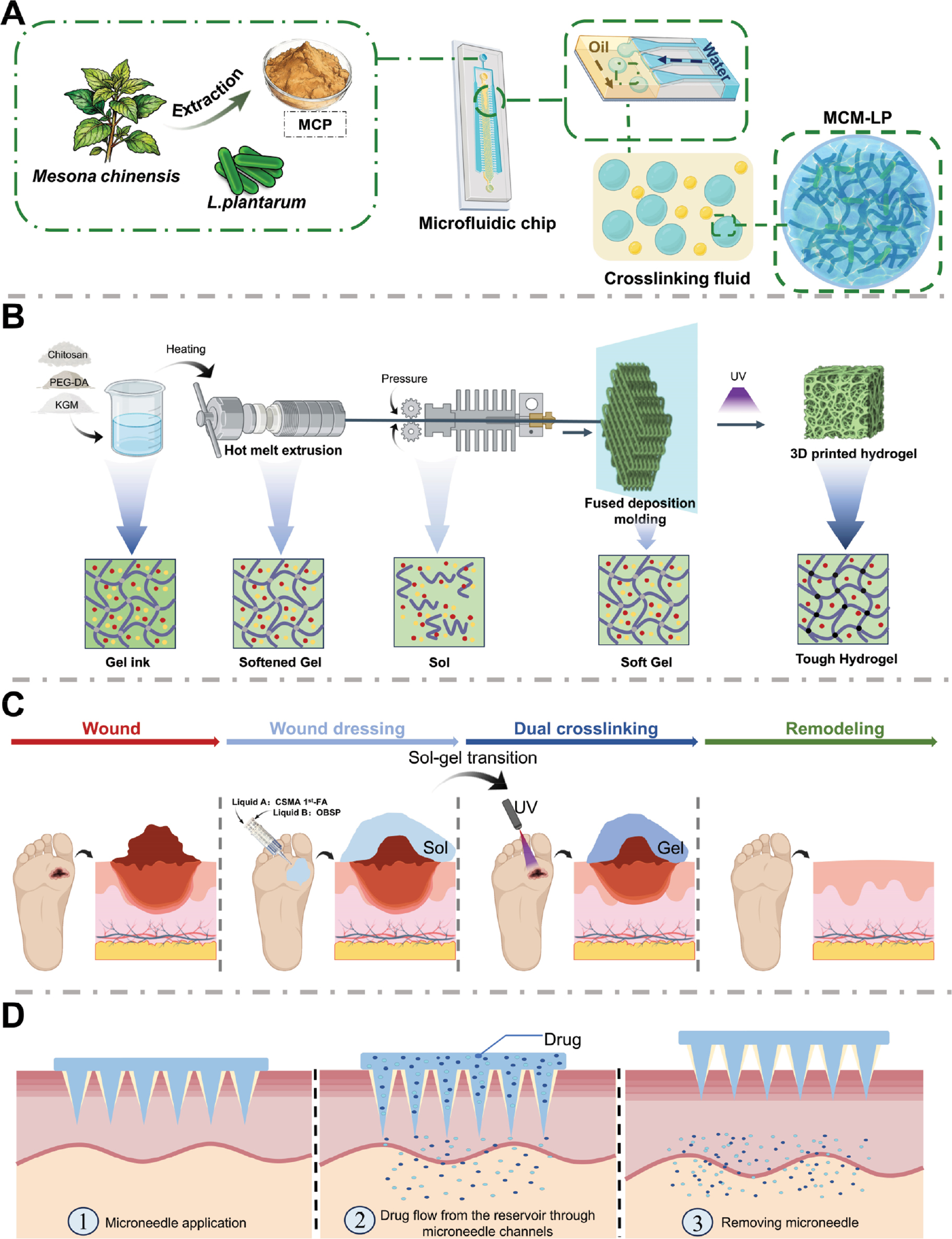
In addition to traditional molding, advanced manufacturing techniques are being applied to TCMP-based hydrogels for more precise structural control and functional integration. The process flow chart for preparing TCMP hydrogels using advanced manufacturing techniques is shown in Figure 5.
Figure 5 Flowchart of the preparation process of Traditional Chinese Medicine polysaccharide hydrogel. (A) Microfluidic hydrogel preparation process: Two or more liquids flow through the microfluidic chip channels and form uniform microspheres after flowing out. (B) 3D printing hydrogel preparation process: The hydrogel precursor is thermally extruded and layered stacked, cooled to room temperature, or irradiated with ultraviolet light for curing and shaping. (C) Spray molding hydrogel preparation process: The spray gun sprays two precursor solutions onto the irregular wound surface, quickly forming a uniform hydrogel layer. (D) Microneedle technology hydrogel preparation process: The drug is loaded onto the microneedle array. The tip of the microneedle can penetrate the skin stratum corneum and release the drug encapsulated inside.
Microfluidics
Microfluidics enable precise fluid manipulation at the microscale to produce hydrogel microspheres, microcapsules, or microfibers with uniform size and controlled structure. Examples include fabricating BSPMA hydrogel microspheres (HMs) loaded with PPD-liposomes [135] and pH-responsive MCP microcapsules for probiotic encapsulation [144].
3D printing
3D printing allows layer-by-layer construction of hydrogel scaffolds with complex 3D architectures and gradient functionalities tailored to specific wound shapes and needs. For example, 3D printing using bioinks based on GEP and CMC mixtures [60].
Electrospinning
Electrospinning produces nano/micro-scale fiber membranes and is often combined with hydrogels to create composite dressings leveraging the advantages of both fibrous scaffolds and hydrogel matrices.
Spray forming
Spray forming allows rapid in situ gelation by spraying precursor solutions onto the wound, particularly suitable for large, irregular wounds. An example of spray forming is the dual-component spray system of CSMA/FA and OBSP, which forms a hydrogel film via dual Schiff base and photo cross-linking [134].
Microneedle technology
Fabricating hydrogels into microneedle arrays enables painless penetration of the stratum corneum for efficient transdermal delivery of drugs or active agents into the epidermis or dermis. Examples of microneedle arrays include KD-loaded HA-based hydrogel microneedles and conductive polyphenol microneedles for diabetic wound treatment [142, 145].
Researchers can tailor TCMP-based hydrogel dressings to meet specific clinical needs through these sophisticated fabrication strategies, endowing the TCMP-based hydrogen dressings with favorable physical properties and the ability to actively participate in and modulate the complex wound healing process.
Mechanical properties and degradation behavior of TCMP-based hydrogels
A systematic comparison of mechanical properties and degradation behavior among TCMP-based hydrogels is presented to reveal clear structure-property relationships. DN hydrogels, such as OBSP/Gel-ADH/TP, exhibit significantly enhanced mechanical strength and toughness via synergistic Schiff-base and hydrogen bonding [56]. Similarly, OKGM/CMCS DN hydrogels achieve improved compressive modulus through increased crosslinking density, while PVA/DOP DN hydrogels demonstrate superior elasticity [74, 132]. In contrast, physically crosslinked hydrogels (e.g., Ca2+-crosslinked GP) show lower mechanical strength but offer rapid gelation and injectability [51]. Schiff-base crosslinked hydrogels exhibit pH-responsive degradation, which accelerates in the acidic microenvironment of infected chronic wounds [54, 131]. Most TCMP hydrogels are designed to degrade within 7–21 days in vivo, matching the proliferative phase of diabetic wound healing [56, 105]. Correspondingly, in vitro degradation studies typically show similar or slightly faster degradation rates, depending on the testing medium (e.g., PBS, collagenase, lysozyme, or simulated wound fluid) [61, 122]. However, the lack of standardized testing protocols for in vitro and in vivo degradation currently limits direct cross-study comparison and clinical translation because key parameters, such as Young’s modulus, elongation at break, in vitro degradation medium composition, enzyme concentration, sampling intervals, and full in vivo degradation curves, are inconsistently reported.
Unique advantages of TCMP-based hydrogels
Although conventional hydrogels have demonstrated utility as wound dressings, conventional hydrogels often function primarily as passive scaffolds or inert delivery vehicles [146]. This category includes materials derived from synthetic polymers, such as polyvinyl alcohol and polyacrylamide, as well as common natural polysaccharides, including alginate, CS, and hyaluronic acid [147]. In contrast, hydrogels constructed from TCMPs exhibit distinct advantages that position the hydrogels as next-generation active therapeutic materials. These advantages can be broadly categorized into three interconnected features: natural multi-target bioactivity; superior biocompatibility and safety; and inherent structural modifiability.
Natural multi-target bioactivity
TCMP-based hydrogels possess intrinsic target therapeutic activities that conventional hydrogels lack. BSP exhibits hemostatic and pro-angiogenic activity, APS is known for immunomodulation and antioxidation, and DOP provides anti-inflammatory and moisturizing effects, as shown in Figure 6 [94, 148–150]. These inherent bioactivities enable TCMP hydrogels to simultaneously address multiple pathological features of chronic wounds, including inflammation, oxidative stress, impaired vascularization, and infection [61, 113, 151]. Conventional hydrogels require exogenous drug loading to achieve similar therapeutic effects, which increase complexity, cost, and stability concerns [152]. TCMP hydrogels overcome these limitations through bioactivity intrinsically linked to the structure.
Figure 6 Illustration of the sources, structural characteristics, core biological activities of key polysaccharides in Traditional Chinese Medicine, and corresponding stages of wound healing in the treatment of diabetic foot. (A) In the hemostasis stage of the treatment process for diabetic foot, BSP can cause platelet deformation and aggregation by activating the ADP receptor signaling pathway, thereby exerting a hemostatic effect. (B) In the inflammatory stage of the treatment process for diabetic foot, APS, GEP, DOP, and LNT can exert anti-inflammatory effects through promoting the polarization of macrophages to M2 type, antioxidation, and antibacterial pathways. (C) KGM can promote angiogenesis by up-regulating VEGF in the proliferation stage of the treatment process for diabetic foot. (D) DOP can up-regulate TIMP-2 and inhibit the expression of MMP-2 mRNA in the healing stage of the treatment process for diabetic foot, promoting the secretion of collagen by adult skin fibroblasts HSFs, thereby accelerating the repair of diabetic foot skin wounds.
Excellent biocompatibility and safety
TCMPs derive from medicinal plants with centuries of clinical use in TCM, providing a unique empirical foundation for their safety. The majority of TCMPs are constituted of naturally occurring monosaccharides that are linked by glycosidic bonds. These bonds are recognizable to endogenous enzymes, thereby facilitating predictable biodegradation into non-toxic metabolites [153, 154]. Both in vitro and in vivo evaluations consistently confirm high safety with cytotoxicity assays showing excellent cell viability and implantation studies revealing only mild transient inflammatory responses that resolve over time, which is comparable or superior to many synthetic polymers [48]. Furthermore, physical crosslinking strategies avoid toxic chemical residues and even chemically crosslinked systems utilize biocompatible reactions, such as Schiff base formation without hazardous catalysts [155]. In contrast, conventional synthetic hydrogels may raise concerns regarding monomer toxicity, non-degradable polymer accumulation, or inflammatory responses to degradation byproducts.
Inherent structural modifiability
The polysaccharide chains of TCMPs carry abundant functional groups (primarily hydroxyl and carboxyl moieties), which serve as versatile handles for chemical modification and crosslinking [156]. This structural richness enables multiple design strategies. Chemical derivatization allows the introduction of new functional groups. For example, oxidation of hydroxyl groups to aldehydes produces derivatives, such as OBSP and OKGM [46, 56, 105]. These aldehydes readily form dynamic Schiff base bonds with amino groups, imparting injectability and self-healing properties to the resulting hydrogels.
Applications and mechanisms underlying TCM polysaccharide-based hydrogels in skin wound healing
Building on the preceding overviews of TCMP bioactivities and hydrogel fabrication strategies, this part now explores the specific applications and mechanisms underlying skin wound healing. The intrinsic properties of TCMPs, including anti-inflammatory, antioxidant, immunomodulatory, and pro-angiogenic activities, together with the crosslinking and fabrication methods that transform the TCMPs into functional platforms, provide the foundation for therapeutic efficacy. The following discussion focuses on how these engineered hydrogel systems perform in different wound models, examining the regulatory mechanisms across each phase of healing from hemostasis to tissue remodeling. By integrating recent representative advances, this overview elucidates the synergistic, multi-target actions through which TCMP-based hydrogels promote wound repair, offering insights for the clinical translation.
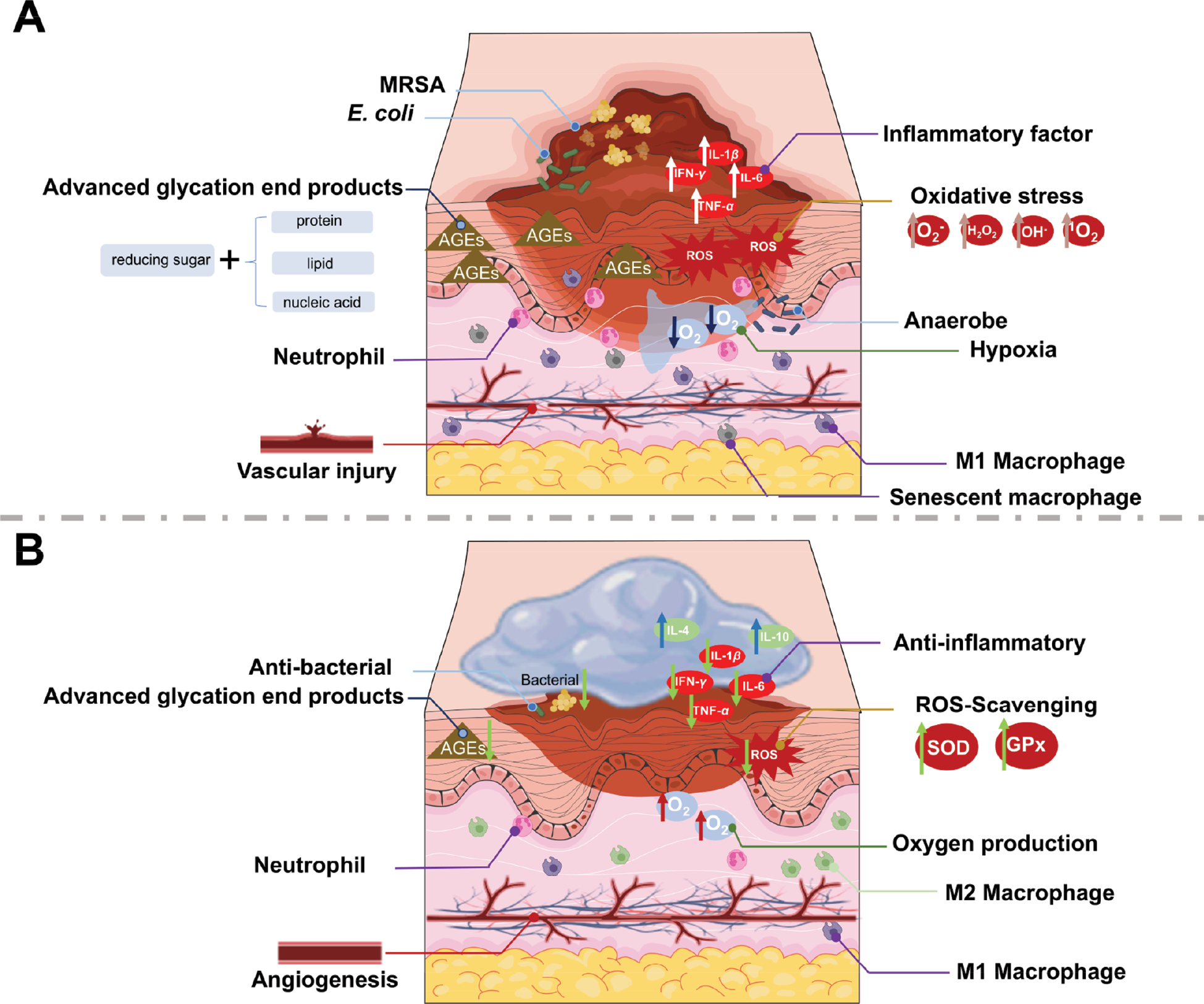
The combination of the excellent bioactivities of TCMPs and the unique physicochemical properties of hydrogels offers highly promising therapeutic strategies for skin wound healing, particularly for challenging chronic non-healing wounds. Hydrogels based on TCMPs not only serve as physical barriers, maintain a moist environment, and absorb exudate but also actively intervene in multiple pathophysiologic aspects of the healing process by releasing the polysaccharide or loaded active components. These interventions target key stages, such as hemostasis, infection control, inflammation modulation, oxidative stress regulation, angiogenesis, cell proliferation and migration, and tissue remodeling, which are shown in Figures 6 and 7.
Figure 7 Multifunctional polysaccharide hydrogel of Traditional Chinese Medicine for the complex microenvironment of diabetic wounds. (A) The microenvironment of diabetic wounds, characterized by increased levels of advanced glycation end products (AGEs), increased inflammatory factors, oxidative stress (ROS), hypoxia, increased bacteria, and damaged blood vessels. (B) The microenvironment of diabetic wounds after treatment with the multifunctional hydrogel, characterized by decreased levels of advanced glycation end products (AGEs), increased anti-inflammatory factors, decreased pro-inflammatory factors, restored antioxidant and oxygen-producing functions, reduced bacteria, increased M2 macrophages, and promotion of angiogenesis.
Rapid hemostasis
Rapid and effective hemostasis following injury represents the crucial first step in initiating the normal healing process, particularly in cases of severe hemorrhage. Some TCMPs, such as BSP, are highly regarded for their inherent hemostatic properties. Hydrogels based on BSP exert hemostatic function through multiple mechanisms: First, the hydrogels achieve physical absorption and concentration by rapidly absorbing the aqueous components of blood, thereby concentrating erythrocytes, platelets, and clotting factors directly at the wound site [52, 59]. Second, BSP actively promotes platelet aggregation and activation through molecular interactions with platelet surfaces, triggering the release of coagulation-related factors [59]. In addition, evidence suggests that BSP may activate the intrinsic coagulation pathway, further accelerating the clotting cascade.
Studies have demonstrated that hydrogels based on BSP and BSP derivatives (e.g., OBSP) exhibit superior hemostatic performance in various animal bleeding models (e.g., mouse liver injury and tail amputation models), significantly reducing bleeding time and blood loss compared to traditional gauze or other controls [52, 54, 59]. For example, a self-healing hydrogel (BG-gel) formed by Schiff base crosslinking between OBSP and cationic gelatin showed much shorter hemostasis times in mouse liver and tail bleeding models compared to control and gauze groups [54]. Another study using a BSP/polyacrylic acid (PAA) IPN hydrogel prepared by free-radical polymerization also demonstrated good in vivo hemostatic capability [52]. These findings confirm the potential of BSP-based hydrogels as rapid hemostatic dressings.
Combating infection
Infection is a primary cause of wound healing failure, particularly in diabetic wounds or extensive burns. The presence of bacteria (especially resistant strains, like MRSA) and biofilm formation triggers persistent inflammation, damages newly formed tissue, and severely impedes healing. TCMP-based hydrogels use various strategies to combat wound infection.
Utilizing intrinsic antibacterial properties
CS and CS derivatives (e.g., CMC and CSMA), are often used as blending components in TCMP hydrogels. CS and CS derivatives possess inherent broad-spectrum antibacterial activity, primarily by disrupting bacterial cell membrane integrity [58, 134]. Some TCMPs, like BSP, have also been reported to exhibit moderate antibacterial effects [55].
Loading antibacterial drugs or active molecules
Encapsulating antibiotics, antimicrobial peptides, natural antibacterial molecules (e.g., berberine [BBR]), or essential oils within the TCMP hydrogel matrix allows for localized, sustained release. For example, a self-healing hydrogel based on OKGM and CMCS loaded with BBR and exosomes (Exos) effectively inhibited E. coli and S. aureus in vitro and in vivo, successfully treating infected wounds in mice [131].
Combining photothermal/photodynamic therapy
Combining photothermal/photodynamic therapy (PTT/PDT) introduces nanomaterials capable of absorbing light and generating heat or ROS (e.g., MXene@TiO2 and Fe3+-doped nanoparticles [PF NPs]) [31, 130]. Upon near-infrared (NIR) light irradiation, localized hyperthermia or ROS production kills bacteria. For example, a GA/OKGM hydrogel loaded with MXene@TiO2 combined with NIR irradiation and electrical stimulation achieved effective bacterial clearance and enhanced healing in an MRSA-infected wound model [31]. An OKGM/CS-Arg hydrogel loaded with PF NPs generated mild photothermal effects (~45°C) under NIR, effectively killing MRSA while synergistically promoting cell migration and angiogenesis [130].
Utilizing nanozymes
Utilizing nanozymes integrates nanomaterials with enzyme-mimicking activities. For example, MnO2 nanozymes in an APS/MnO2 hydrogel exhibit peroxidase (POD)-like) and catalase (CAT)-like) activities. The nanozymes decompose endogenous H2O2 to produce O2, alleviating hypoxia and potentially inhibiting anaerobic bacteria or altering the microenvironment [49].
The integration of these antibacterial strategies endows TCMP-based hydrogels with significant advantages in managing infected wounds.
Inflammation modulation and immunoregulation
While inflammation is an essential initial phase of wound healing, uncontrolled or prolonged inflammatory responses, which are characteristic of chronic wounds, significantly hinder the repair process. Macrophages have a central regulatory role and the timely phenotypic transition from the pro-inflammatory M1 state to the pro-resolving M2 phenotype is crucial for healing progression. TCMPs and their derived hydrogels have demonstrated effectiveness in modulating the inflammatory wound microenvironment through several interconnected mechanisms.
A key aspect of the immunomodulatory activity lies in regulating macrophage polarization. Hydrogels constructed from GLP [105], LNT [157, 158], APS [49], and BSP [55], among others, have been shown in vitro and in vivo to induce M2 macrophage polarization. This finding is evidenced by upregulated expression of M2 markers (e.g., CD206, Arg-1, and IL-10) and downregulated expression of M1 markers (e.g., iNOS, CD86, TNF-α, and IL-1β). This polarization shift helps resolve excessive inflammation and promotes angiogenesis and tissue regeneration. In addition, these hydrogels contribute to modulating inflammatory cytokine secretion. By inhibiting inflammatory signaling pathways, like NF-κB and MAPK, TCMP-based hydrogels can reduce the production of pro-inflammatory cytokines (TNF-α, IL-1β, and IL-6) while potentially promoting anti-inflammatory cytokines, like IL-10 [159–161]. For example, DOP-based hydrogels exert anti-inflammatory effects by inhibiting the NF-κB pathway [74]. Microneedle hydrogels loaded with KD have been shown to suppress macrophage glycolysis by inhibiting the IRE1α/XBP1 signaling axis, promoting M2 polarization, and alleviating inflammation [145]. In addition to macrophages, TCMPs may also influence other immune cells, including neutrophils and lymphocytes, contributing to a more balanced and coordinated immune response that supports overall tissue homeostasis.
Through a combination of immunomodulatory mechanisms that include reprogramming macrophage polarization, regulating cytokine profiles, and modulating broader immune cell activity, TCMP-based hydrogels are capable of actively transforming the dysregulated inflammatory environment characteristic of chronic wounds. By shifting the wound microenvironment from a state of persistent inflammation to one that supports resolution and healing, these functional hydrogels directly address a core pathophysiologic impediment. This reorientation establishes a more conducive foundation for the subsequent stages of tissue repair and regeneration.
Oxidative stress regulation
Chronic wounds, particularly diabetic ulcers, frequently experience significant oxidative stress, characterized by an imbalance between excessive ROS production and insufficient antioxidant defenses. Excess ROS can damage cellular components, such as DNA, proteins, and lipids, exacerbate inflammation, and impair cellular proliferation and angiogenesis. TCMP-based hydrogels address this challenge and regulate oxidative stress through several key mechanisms. First, many TCMPs and the bioactive compounds the TCMPs carry possess direct ROS scavenging ability. TCMPs (e.g., APS, GEP, and DOP) and loaded phenolic compounds (e.g., TP, catechin, FA, and PUE) possess the ability to directly scavenge various free radicals [33, 162, 163]. For example, a GEP-based hydrogel loaded with PUE showed good free radical scavenging ability in vitro and mitigated oxidative stress in aging skin wounds in vivo by activating the AMPK/DAF16 pathway [33]. A dual-network hydrogel based on OBSP/Gel-ADH loaded with TP also exhibited excellent antioxidant properties [56]. Second, some TCMPs can enhance the endogenous antioxidant capacity of cells. This is often achieved by activating critical intracellular antioxidant signaling pathways, such as the Nrf2/HO-1 pathway, leading to the upregulation of antioxidant enzymes (e.g., SOD, CAT, and GSH-Px) and strengthening the cell defense mechanisms [164, 165]. Third, the incorporation of nanozymes with enzyme-mimicking activity further bolsters antioxidant function. For instance, MnO2 nanozymes exhibit catalase-like activity, decomposing hydrogen peroxide (H2O2) and thereby reducing ROS levels in the wound microenvironment [49].
By effectively mitigating oxidative stress through these combined strategies, TCMP-based hydrogels help establish a more favorable biochemical environment that supports cell viability, reduces inflammatory damage, and promotes tissue regeneration [166].
Promoting angiogenesis
Neovascularization is critical during the proliferative phase of healing by supplying essential oxygen and nutrients and removing metabolic waste [167]. Angiogenesis is often impaired in chronic wounds, especially diabetic wounds. TCMP-based hydrogels promote angiogenesis through several mechanisms.
Upregulating key growth factors
Polysaccharides, like BSP, APS, LBP, DOP, and LNT, have been shown to stimulate local cells (e.g., macrophages and fibroblasts) or act directly on endothelial cells to upregulate the expression of key pro-angiogenic factors, like VEGF and bFGF [55, 120, 135, 157, 168].
Promoting endothelial cell function
In vitro studies have demonstrated that TCMP treatment can enhance the proliferation, migration, and tube formation capabilities of human umbilical vein endothelial cells (HUVECs). For example, a GelMA hydrogel loaded with LNT significantly enhanced HUVEC proliferation, migration, and tube formation under high glucose conditions, potentially via activation of the AMPK/DAF16 signaling pathway [157].
Improving the microenvironment
By reducing inflammation, mitigating oxidative stress, and alleviating hypoxia (e.g., via MnO2 nanozyme oxygen generation), TCMPs create conditions conducive to neovascularization. In vivo models treated with TCMP-based hydrogels typically show a significant increase in new blood vessel density (e.g., via CD31 immunohistochemical staining) at the wound site, indicating improved revascularization and accelerated healing [169].
Enhancing cell proliferation and migration
The proliferation and migration of fibroblasts and keratinocytes are essential processes for granulation tissue formation and re-epithelialization during wound healing. TCMP-based hydrogels promote these cellular behaviors through multiple mechanisms, including direct stimulation of cell signaling pathways, indirect modulation of the wound microenvironment, and provision of a biomimetic scaffold that supports cell adhesion and motility.
Direct stimulation
Several TCMPs have been shown to directly enhance the proliferation and migration of skin cells. BSP promotes fibroblast proliferation by activating the MAPK signaling pathway [115, 170]. Studies using BSP-based hydrogels demonstrated significantly increased viability of L929 fibroblasts in CCK-8 assays with Ki67 immunostaining confirming elevated proliferation rates [120]. Similarly, AP stimulates keratinocyte proliferation and migration through upregulation of the EGFR/PKC-dependent signaling pathways, as evidenced by scratch wound assays showing accelerated closure of HaCaT monolayers [116]. DOP has been reported to stimulate fibroblast proliferation via the PI3K/Akt signaling axis [7].
Indirect stimulation
Modulation of the wound microenvironment (reducing inflammation/oxidative stress and increasing growth factor concentration) indirectly promotes cellular functions. For example, GLP hydrogels promote M2 macrophage polarization, which in turn secretes growth factors, such as TGF-β, that stimulate fibroblast activity [105]. The antioxidant activity of TCMPs, including ROS scavenging by APS and GEP, protects cells from oxidative damage and preserves the proliferative capacity [33, 49].
Providing a biomimetic scaffold
The 3D network structure of the hydrogel provides physical support for cell adhesion, growth, and migration, mimicking the role of the natural ECM. In vitro cell assays (e.g., CCK-8 proliferation, scratch, and Transwell migration assays) and in vivo histologic analyses (e.g., Ki67 immunostaining) confirm the positive effects of TCMP-based hydrogels on fibroblast and keratinocyte functions, directly contributing to granulation tissue formation and wound closure [120, 171].
Facilitating ECM remodeling and reducing scarring
The final phase of healing involves ECM remodeling and scar maturation. Ideal healing aims to restore the original tissue structure and function with minimal scarring. TCMP-based hydrogels may influence ECM remodeling through the following ways.
Promoting organized collagen deposition
Histologic analysis (e.g., Masson’s trichrome staining) of wounds treated with many TCMP-based hydrogels shows increased deposition of collagen (types I and III) with an organization more similar to the reticular pattern of normal skin, rather than the parallel bundles present in scar tissue [33, 120]. This relates to the modulation of fibroblast function by TCMPs.
Regulating MMP/TIMP balance
ECM remodeling requires precise control of matrix metalloproteinases (MMPs) and their tissue inhibitors (TIMPs). Excessive MMP activity, which is characteristic of chronic wounds, leads to premature degradation of newly formed ECM, while insufficient activity impairs remodeling. TCMP-based hydrogels help restore MMP/TIMP balance through multiple mechanisms. Studies have shown that APS downregulates MMP-9 expression, while upregulating TIMP-1 in diabetic wounds, thereby protecting newly deposited collagen from excessive degradation [120]. The antioxidant properties of TCMPs also contribute to MMP regulation because ROS are known to activate MMPs through oxidative modification of the pro-domain [110].
Inhibiting excessive fibrosis
TCMPs may help suppress the fibrotic processes that lead to excessive scarring (e.g., hypertrophic scars and keloids) by exerting anti-inflammatory and antioxidant effects and modulating fibroblast/myofibroblast activity. For example, hydrogels loaded with HPCE showed potential anti-fibrotic effects [172] and Trichosanthes polysaccharide-based hydrogels were reported to reduce scar hyperplasia [173].
Promoting skin appendage regeneration
Some studies observed better regeneration of skin appendages, like hair follicles in wounds treated with TCMP-based hydrogels compared to controls, suggesting promotion of repair closer to intact skin structure [174]. Histologic examination of healed wounds revealed nascent hair follicle structures in APS hydrogel-treated groups, whereas control wounds showed only fibrotic tissue [120]. Similarly, BSP-based hydrogels promoted regeneration of sebaceous glands and partial hair follicle recovery in diabetic wound models [55]. This appendage regeneration suggests that TCMP hydrogels support a more complete, scarless healing process rather than simple wound closure.
In summary, TCMP-based hydrogels facilitate ECM remodeling through promotion of organized collagen deposition, regulation of MMP/TIMP balance, inhibition of excessive fibrosis, and support of skin appendage regeneration. These effects contribute to improved structural and functional outcomes, moving beyond simple wound closure toward true tissue regeneration.
Antioxidant/immune regulatory hydrogels for diabetic wounds
The complex pathologic microenvironment of chronic wounds, particularly diabetic ulcers, is characterized by persistent inflammation, excessive oxidative stress, hypoxia, impaired angiogenesis, and heightened susceptibility to infection. These multifaceted abnormalities often render single function dressings inadequate. Consequently, developing multifunctional TCMP based hydrogels that integrate complementary properties, such as antibacterial, anti-inflammatory, antioxidant, pro-angiogenic, and cell proliferative activities, has emerged as a major research focus. Through careful material selection, prioritizing TCMPs with inherent multi-target bioactivities, combined with chemical modification, incorporation of functional components including nanozymes, drugs, growth factors, and Exos, and advanced structural design, such as double network and IPN, researchers have engineered various multifunctional systems tailored to diabetic wound environments.
APS/MnO2 nanozyme hydrogel
This system combines the immunomodulatory and antioxidant activities of APS with the multifunctional effects of MnO2 nanozymes. The MnO2 nanozymes exhibit catalase- and peroxidase-like activities, enabling the nanozymes to decompose endogenous H2O2 to generate oxygen, thereby alleviating wound hypoxia. Simultaneously, the nanozymes scavenge excess ROS, reducing oxidative stress. The APS component further promotes M2 macrophage polarization and modulates the inflammatory microenvironment. This synergistic approach effectively improves the hypoxic and oxidative stress conditions characteristic of diabetic wounds, which accelerates healing [49]. The APS/MnO2 hydrogel offers simpler composition and lower cost compared to photothermal or exosome-loaded systems but the relatively weak mechanical strength limits use in load-bearing or deeply undermined wounds.
OKGM/CS-Arg/PF NP hydrogels
This multifunctional hydrogel system is constructed by integrating PF NPs into a dynamic Schiff base crosslinked network formed between OKGM and arginine-modified chitosan (CS-Arg). The OKGM/CS-Arg matrix provides inherent self-healing and injectable properties due to reversible imine bonds, allowing the hydrogel to adapt to irregular wound shapes and autonomously repair structural damage. PF NPs, which are composed of Fe3+-doped polydopamine nanoparticles, contribute multiple therapeutic functions. PF NPs exhibit mild photothermal effects under near-infrared irradiation that effectively kill MRSA without causing thermal damage to surrounding tissues. PF NPs possess intrinsic antioxidant activity that scavenges reactive oxygen species and they promote M2 macrophage polarization, thereby modulating the inflammatory microenvironment. This integrated system synergistically combines physical antibacterial effects, chemical antioxidant activity, and biological immunomodulation for comprehensive treatment of infected wounds [130]. Unlike antibiotic-based hydrogels, this system avoids drug resistance issues, yet the dependence on near-infrared (NIR) irradiation and the mild photothermal effect (~45 °C) require careful dose control to avoid insufficient bacterial killing.
OKGM/CMCS + BBR + Exo hydrogels
This composite hydrogel system is fabricated by incorporating BBR and Exos into a dynamic Schiff base crosslinked network of OKGM and CMCS. The OKGM/CMCS matrix imparts self-healing and injectable characteristics through reversible covalent bonding, enabling minimally invasive application and prolonged structural integrity at the wound site. BBR, a natural alkaloid with broad-spectrum antibacterial activity, provides effective clearance of wound pathogens. The Exos, which are derived from mesenchymal stem cells, deliver a rich cargo of growth factors, cytokines, and microRNAs that collectively promote angiogenesis, modulate inflammatory responses, and stimulate cell proliferation and migration. The combination achieves synergistic therapeutic effects. BBR creates a bacteria-controlled environment conducive to healing, while Exos actively drive tissue regeneration, resulting in accelerated infected wound closure with reduced inflammation and enhanced vascularization [131]. In contrast to the GA/OKGM+MXene@TiO2 system, this hydrogel achieves antibacterial activity without external equipment but the high cost and limited stability of Exos pose challenges for clinical translation.
GA/OKGM + MXene@TiO2 hydrogels
This advanced hydrogel system is constructed by incorporating MXene@TiO2 nanosheets into a GA and OKGM composite matrix. The hydrogel network is formed through multiple interactions, including hydrogen bonding and dynamic covalent Schiff base linkages, providing structural stability and self-healing capacity. MXene@TiO2 nanosheets serve as multifunctional nanoagents with several key properties. MXene@TiO2 nanosheets exhibit strong photothermal conversion efficiency under NIR irradiation, generating localized hyperthermia that effectively eliminates bacteria, including drug-resistant strains. MXene@TiO2 nanosheets possess photocatalytic activity that produces ROS to enhance antibacterial effects. In addition, MXene@TiO2 nanosheets confer electrical conductivity to the hydrogel matrix. This conductive property enables synergistic combination with exogenous electrical stimulation, which has been shown to promote cell migration, proliferation, and angiogenesis. The integrated system thus combines photothermal antibacterial therapy, photocatalytic disinfection, and electrical stimulation within a single wound dressing platform for comprehensive infected wound management [31]. Although this system provides the strongest antibacterial effect among all listed hydrogels (>99% MRSA killing), the system requires specialized NIR devices and carries a risk of thermal damage if irradiation parameters are not precisely optimized.
OBSP/Gel-ADH + TP hydrogels
This double network hydrogel is engineered by combining OBSP, adipic acid dihydrazide-modified gelatin (Gel-ADH), and TPs. The first network forms through dynamic Schiff base reactions between aldehyde groups on OBSP and hydrazide groups on Gel-ADH, providing injectability and self-healing properties. The second network arises from hydrogen bonding and hydrophobic interactions among TP molecules, significantly enhancing mechanical strength and toughness. OBSP retains the intrinsic hemostatic and pro-healing activities of native BSP. Gel-ADH provides cell adhesion sites supporting fibroblast attachment and proliferation. TPs deliver potent antioxidant and anti-inflammatory effects by scavenging ROS and inhibiting pro-inflammatory cytokine production. This design achieves both robust mechanical performance suitable for wound protection and multifunctional bioactivity for accelerated tissue regeneration [56]. This double-network design offers superior mechanical strength and antioxidant activity compared to single-network hydrogels, making the design more suitable for wounds under mechanical stress, although the fabrication is more complex.
CSMA/FA/OBSP spray hydrogels
This sprayable hydrogel combines CSMA, FA, and OBSP for rapid in situ gelation via dual crosslinking. Upon spraying, Schiff base reactions between OBSP aldehyde groups and CSMA amino groups form an initial gel within seconds. Subsequent UV irradiation triggers CSMA photopolymerization, creating a secondary network that enhances mechanical strength. This spray format enables uniform coverage of irregular, dynamic wounds. CSMA provides antibacterial activity and photocuring capability. FA offers antioxidant effects by scavenging free radicals and OBSP delivers pro-healing effects, including hemostasis and fibroblast promotion. The system achieves rapid protection, bacterial inhibition, and active healing for complex wound scenarios [134]. The spray format enables rapid coverage of irregular wounds, a unique advantage over pre-formed hydrogels. However, the dual crosslinking (Schiff base + photocuring) increases procedural complexity and requires UV equipment.
KD-loaded HAQA microneedles
This microneedle platform encapsulates macrophage membrane-coated kinsenoside (M-KD) within an antibacterial and antioxidant hyaluronic acid-based microneedle matrix (HAQA-MN). The HAQA matrix, modified with quaternary ammonium and antioxidant groups, provides structural support for skin penetration and transdermal delivery. The macrophage membrane coating enables immune evasion and targeted delivery to inflammatory cells. KD, a bioactive compound derviedfrom Anoectochilus roxburghii, promotes M2 polarization and reduces inflammation by inhibiting the IRE1α/XBP1 signaling axis. This design achieves painless stratum corneum penetration, sustained KD release, and combined targeting with antibacterial/antioxidant activity for comprehensive diabetic wound treatment [145]. Microneedle technology allows painless transdermal delivery and targeted immunomodulation, offering advantages for chronic DFUs with poor drug penetration but the manufacturing process is sophisticated and the dosage per patch is limited.
In summary, these multifunctional designs embody the principle of multi-target intervention for complex wound pathologies and generally demonstrate superior therapeutic outcomes in animal models compared to single-function controls. Photothermal systems (GA/OKGM+MXene@TiO2) or high-dose antibacterial carriers (OKGM/CMCS+BBR) are preferred for infected DFUs with biofilm formation, despite the equipment dependence or cost. Exo- or growth factor-loaded platforms (OKGM/CMCS+BBR+Exo) offer superior regenerative outcomes for ischemic or poorly granulating wounds at the expense of stability and expense. For superficial, non-infected diabetic wounds, simpler and more cost-effective options, such as APS/MnO2 or OBSP/Gel-ADH/TP hydrogels, may suffice. Future designs should aim to combine the strengths of multiple strategies while mitigating the respective limitations.
Combination therapy strategies
Combining TCMP-based hydrogels with other physical or biological therapies may yield synergistic benefits (Table 5).
Table 5 Summary of in vivo Efficacy of Representative TCM Polysaccharide Hydrogels in Wound Healing Models
| TCMP Hydrogel System (Composition, Key Feature) | Wound Model | Key Healing Outcomes | Main Mechanism Highlighted | Ref |
|---|---|---|---|---|
| OBSP/cationic gelatin (Schiff base, self-healing) | Mouse full-thickness skin defect | Accelerated healing, ↑collagen, ↓inflammation | Hemostasis, promotes cell proliferation | [54] |
| OGLP/CMC/SA (Schiff base/ionic, DN) | Diabetic rat full-thickness skin defect | Accelerated healing, ↑angiogenesis, ↑collagen, ↓inflammation | M2 macrophage polarization, antioxidant | [105] |
| LNT/GelMA (photocrosslinked, LNT release) | Diabetic mouse full-thickness skin defect | Accelerated healing, ↑↑angiogenesis (CD31, VEGF), promotes M2 | AMPK/DAF16 activation (potential), immunomodulation, pro-angiogenic | [157] |
| APS/MnO2 nanozyme (in situ gel, O2-generating, antioxidant) | Diabetic rat full-thickness skin defect | Accelerated healing, improved hypoxia, ↓ROS, promotes M2, ↑collagen/angio | Nanozyme activity (CAT/POD-like), APS immunomod./antioxidant | [49] |
| OKGM/CMCS + BBR + Exo (Schiff base, injectable, self-healing) | MRSA-infected mouse full-thickness defect | Accelerated healing, effective bacterial clearance, ↓inflammation, ↑angio/collagen | Synergy: BBR (antibacterial) + Exo (pro-repair), hydrogel barrier | [131] |
| GEP + PUE/gelatin microspheres (thermosensitive, PUE release) | D-galactose-induced aging mouse skin wound | Accelerated healing, ↑SOD/GSH-Px, ↓MDA, ↑collagen, ↑angiogenesis | Antioxidant (activates AMPK/DAF16), anti-inflammatory | [33] |
| CSMA/FA/OBSP (spray, dual crosslink: Schiff + photo) | MRSA-infected rat/minipig skin defect | Accelerated healing, antibacterial, hemostasis, promotes fibroblast recruitment | Rapid film formation, synergy (FA antioxidant, CSMA antibacterial, OBSP pro-healing) | [134] |
| Conductive polyphenol MN + electroacupuncture | Diabetic rat skin wound | Accelerated healing, ↓inflammatory cytokines, ↑angiogenesis, alleviates depression | Synergy: local (MN+ES) & systemic (EA neuro-immune modulation) | [142] |
| HAQA-MN + M-KD (microneedle, macrophage membrane-coated KD release) | Diabetic/infected mouse skin wound | Accelerated healing, ↓↓inflammation (IL-6, TNF-α), promotes M2, antibacterial, antioxidant | Targets macrophage metabolism (inhibits IRE1α/XBP1), MN delivery, membrane coating | [145] |
| BSP/CMC/carbomer 940 (composite hydrogel) | Diabetic rat skin wound | Accelerated healing, promotes epithelialization & granulation, ↓inflammation | BSP pro-healing, CMC moisturizing, carbomer thickening | [135] |
Note: Arrows indicate the direction of change in key cytokine or protein compared with the control group: ↑ indicates increase/upregulation; ↑↑ indicates a highly significant increase; ↓ indicates decrease/downregulation; ↓↓ indicates a highly significant decrease.
Combination with electrical stimulation (ES)
Endogenous electric fields play a role in wound healing and exogenous ES is thought to promote cell migration, angiogenesis, and inhibit infection. Conductive TCMP-based hydrogels (e.g., APS/CMC/SA/PPy hydrogels) can serve as electrodes or conduits for electrical signals, potentially enhancing the efficacy of ES in treating diabetic wounds [61]. One study combined conductive polyphenol microneedles with electroacupuncture (EA) using local wound intervention and distal acupoint stimulation (modulating neuro-immune-endocrine networks) to synergistically promote diabetic wound healing and alleviate depressive-like behaviors [142].
Combination with photobiomodulation (PBM)
Low-level light therapy (LLLT) using specific wavelengths (e.g., red and near-infrared) has shown anti-inflammatory effects and promotes cell proliferation and angiogenesis. Combining TCMP-based hydrogels (e.g., LBP-rich hydrogel) with PBM might synergistically repair UV-induced photodamage [175].
Biosafety evaluation
Biosafety is paramount for the clinical application of medical materials. TCMP-based hydrogels reported in the literature generally undergo necessary biocompatibility assessments.
In vitro cytotoxicity
Most studies use MTT or CCK-8 assays to evaluate the toxicity of hydrogel extracts on relevant cell lines (e.g., fibroblasts L929, NIH-3T3, keratinocytes HaCaT, and endothelial cells HUVECs). The results typically show good cytocompatibility within some concentration ranges with high cell viability [65, 135]. Live/dead staining is also commonly used to visualize cell viability on the hydrogel surface [120, 176].
Hemocompatibility
Hemolysis assays assess the damage to red blood cells upon contact with the material. Reported TCMP-based hydrogels usually exhibit low hemolysis rates (< 5%), which meets standards for medical materials [137, 177].
In vivo biocompatibility
Histopathologic examination (e.g., H&E staining) of tissues after subcutaneous implantation or wound application assesses local inflammatory response and tissue compatibility. The results generally indicate good tissue compatibility for TCMP-based hydrogels, inducing only mild, transient inflammation that resolves over time, without significant necrosis or fibrous encapsulation [178, 179].
In summary, functional hydrogels based on TCM polysaccharides, through their unique bioactivities and tunable physicochemical properties, can positively influence multiple critical stages of wound healing. The multi-target, multi-pathway mechanisms offer new directions for developing more effective therapeutic strategies, especially for complex, non-healing chronic wounds.
Challenges and future perspectives
Functional hydrogels based on TCMPs have demonstrated significant potential and unique advantages in the field of skin wound healing. Through ingenious material design and functional integration, researchers have developed various advanced dressings possessing multiple activities, including hemostatic, antibacterial, anti-inflammatory, antioxidant, pro-angiogenic, and cell-proliferative properties, yielding encouraging results in vitro and in animal models. However, translating these research achievements into safe, effective, and widely applicable clinical products still faces numerous challenges. Concurrently, advances in materials science, biology, and TCM offer new opportunities and future directions for this field.
Guiding principles from TCM for hydrogel design
TCM is not merely a collection of medicinal materials but a comprehensive theoretical system developed over millennia of clinical practice. Several core TCM principles offer valuable guidance for the rational design of polysaccharide-based hydrogels for wound healing, providing a conceptual framework that distinguishes TCMP-based materials from conventional dressings.
Holism
The TCM concept of holism emphasizes the human body as an integrated system where local wound healing is influenced by systemic status. This principle aligns with the modern understanding that chronic wounds, particularly diabetic ulcers, reflect systemic metabolic and immunologic dysfunction rather than isolated tissue defects. TCMP-based hydrogels embody this holistic perspective by not only providing local wound coverage but also delivering bioactive polysaccharides that exert systemic immunomodulatory effects. For example, APS and LNT modulate macrophage polarization and systemic immune responses, addressing the underlying immune dysregulation that perpetuates chronic wounds [49, 157]. This holistic approach suggests that optimal wound dressings should consider both local and systemic factors, a perspective increasingly validated by contemporary research.
Treatment based on syndrome differentiation
TCM treats wounds according to the specific “syndrome” patterns, which encompass both local manifestations and systemic status. This principle inspires the design of wound dressings tailored to specific pathologic features, moving beyond one-size-fits-all approaches. For infected wounds with heat-toxin syndrome, hydrogels incorporating potent antibacterial agents, such as BBR or photothermal nanoparticles provide targeted intervention [31, 131].
According to TCM, DFUs can be categorized into three patterns: (1) The Qi-Yin deficiency pattern exhibits shortness of breath, spontaneous sweating, fatigue, and heavy or numb limbs with occasional soreness and pain. Ulcers are superficial and pale with scant exudate. (2) The Qi deficiency with a blood stasis pattern exhibits fatigue, shortness of breath, spontaneous sweating, limb numbness, purplish-dark skin, and non-healing ulcers with a thin, clear exudate. (3) The damp-heat exuberance pattern exhibits facial flushing, thirst, swelling or pain of the affected limb, bluish-purple toes, and erythema and swelling of the ulcer surface with a copious, thick, purulent discharge [180]. The following treatments are available: (1) Huangqi Xiaoke decoction, Liuwei Dihuang Wan, and Shengmai Yin are all effective for treating diabetic foot patients with Qi-Yin deficiency. These formulas contain herbs, such as Astragalus membranaceus, Rehmannia glutinosa, and Ophiopogon japonicus. Therefore, treatment can be combined with hydrogels containing APS, Rehmannia polysaccharides, and Ophiopogon japonicus polysaccharides [181–184]. (2) Huanglian Jiangtang Decoction, Simiao Tongluo decoction, and Ruyi Jinhuang San effectively treat diabetic foot patients with damp-heat exuberance. These formulas contain herbs, such as Coptis chinensis, Scrophularia ningpoensis, Rheum palmatum, and Trichosanthes kirilowii. Therefore, treatment can be combined with hydrogels containing Coptis chinensis polysaccharides, Scrophularia ningpoensis polysaccharides, Rheum palmatum polysaccharides, and Trichosanthes kirilowii polysaccharides [185–189]. (3) Huanma Zhitong decoction and Buyang Huanwu decoction are effective for treating diabetic foot patients with Qi deficiency and blood stasis. These formulas contain herbs, such as Astragalus membranaceus and Angelica sinensis. Therefore, treatment can be combined with hydrogels containing APS and Angelica sinensis polysaccharides [183, 190, 191].
Monarch-Minister-Assistant-Courier formulation principle
The “Monarch-Minister-Assistant-Courier” principle, which has guided TCM formula composition for centuries, specifies the hierarchical roles of different components in a therapeutic system. This hierarchical framework offers a rational basis for designing multicomponent hydrogel systems. An illustrative example could position APS as the monarch (primary immunomodulatory and antioxidant effects), BSP as the minister (enhancing hemostasis and angiogenesis), TPs as the assistant (providing additional antioxidant protection while countering potential excessive inflammation), and the hydrogel matrix as the courier (enabling localized, sustained delivery) [56]. Emerging studies on OKGM/CMCS/BBR/Exo hydrogels similarly reflect this principle. The hydrogel matrix serves as courier, BBR provides assistant functions, and Exos deliver minister-like regenerative signals that enhance the monarch-like effects of the TCMP components [131]. This structured approach to combination therapy moves beyond empirical mixing toward rationally designed synergistic systems guided by established therapeutic principles.
Compatibility and synergy
TCM emphasizes that properly combined ingredients achieve effects greater than the sum of individual components, a concept increasingly validated in modern TCMP hydrogel research. The synergy arises from multiple mechanisms. Different components may target distinct but complementary pathways. One component may enhance the bioavailability or stability of another or the combination may produce emergent properties not present in individual components. The OKGM/CMCS/BBR/Exo hydrogel system exemplifies such synergy. The hydrogel matrix provides structural support and self-healing properties, BBR offers antibacterial activity and Exos deliver regenerative signals with the combination achieving superior healing outcomes compared to any single component alone [131]. Similarly, the combination of photothermal nanoparticles with immunomodulatory polysaccharides produces synergistic antibacterial and pro-regenerative effects through complementary mechanisms [130]. Understanding and quantifying these synergistic interactions represents an important direction for future research.
Relevance to modern wound healing concepts
Remarkably, these ancient TCM principles align closely with our contemporary understanding of wound pathophysiology and modern biomaterials design. The holistic perspective corresponds to the recognition that chronic wounds require systemic as well as local intervention with growing appreciation for neuro-immune-endocrine interactions in wound healing. Syndrome differentiation parallels the emerging concept of personalized medicine and the development of wound microenvironment-responsive materials that adapt to specific pathologic conditions. The monarch-minister-assistant-courier framework provides a rational basis for designing multi-component, multifunctional hydrogels that address multiple pathologic targets simultaneously, an approach increasingly recognized as essential for complex chronic wounds in which single-target interventions prove insufficient. This convergence of traditional wisdom and modern science positions TCMP-based hydrogels as uniquely sophisticated therapeutic platforms that embody principles validated by both millennia of clinical practice and cutting-edge research.
Current research challenges
The translation of drug research into clinical practice encounters a series of significant challenges at every stage, from initial laboratory discovery to final clinical application. The clinical translation of TCMP-based hydrogels requires coordinated optimization across raw material standardization, material fabrication, preclinical validation, and regulatory approval, as illustrated in Figure 8.
Figure 8 Clinical transformation roadmap of hydrogel. From top-to-bottom, there are five modules (basic research, preclinical research, GMP production, clinical trials, and market application). On the left side of each module are the challenges and difficulties faced in that stage.
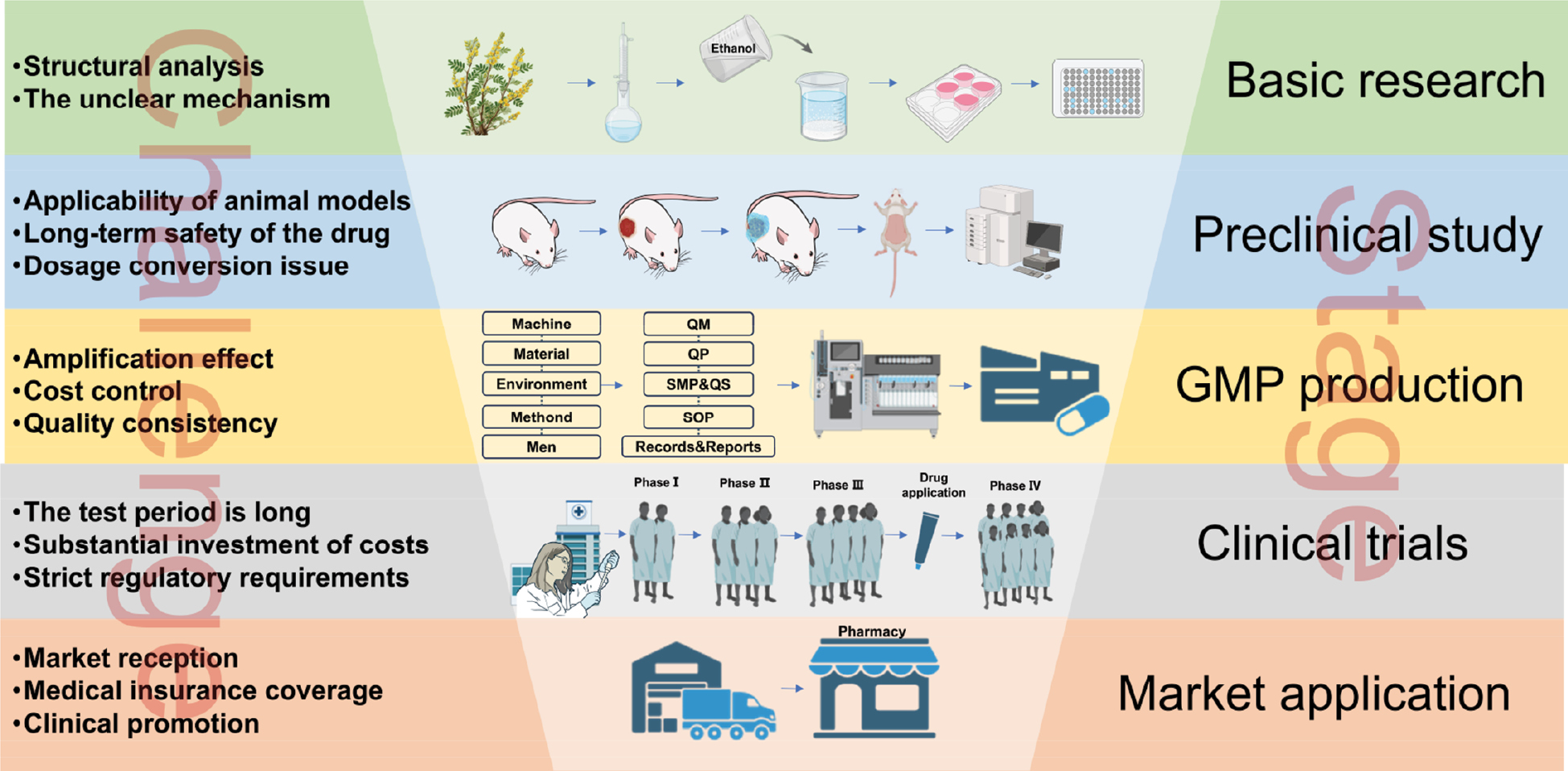
Standardization and quality control of raw materials
Heterogeneity of Raw materials and structural complexity
The standardization of TCMP-based hydrogels faces inherent challenges stemming from both the natural variability of herbal sources and the intrinsic structural complexity of polysaccharides. Factors including geographical origin, harvest time, and storage conditions of medicinal herbs can significantly affect the content, structure, and bioactivity of the polysaccharides, leading to inconsistent product performance across batches [79, 192]. This source variability is compounded by the structural heterogeneity of TCMPs, which are often complex mixtures of heteropolysaccharides with broad molecular weight distributions, diverse monosaccharide compositions, varied glycosidic linkages and branching patterns, and multiple modifications, such as acetylation. Precise structural elucidation, including higher-order conformations, remains analytically challenging, which limits deep understanding of structure-activity relationships and impedes the establishment of meaningful quality control standards [79]. Establishing standardized protocols for herb cultivation, harvesting, processing, and polysaccharide extraction and purification is therefore essential for ensuring consistent product quality and enabling meaningful comparison across studies.
Extraction efficiency and purity
Current extraction methods may suffer from low efficiency, high energy consumption, residual organic solvents, or potential degradation of polysaccharide structure [193]. Developing green, efficient extraction and purification techniques that preserve the natural bioactivity of polysaccharides is crucial.
Optimization and balancing of hydrogel properties
Mechanical performance
Simple natural polysaccharide hydrogels often exhibit poor mechanical properties (e.g., low strength and brittleness), which fails to meet the clinical requirements for dressing strength, toughness, and elasticity [194, 195]. While strategies, like blending and double networks, can improve mechanics, finely tuning the balance between enhanced mechanical properties and maintaining good biocompatibility, degradability, and active release characteristics remains challenging.
Controllable degradation behavior
The degradation rate of a hydrogel dressing needs to match the pace of wound healing [196, 197]. Too rapid degradation may lead to premature loss of support or burst release of drugs, while too slow degradation might impede new tissue growth or necessitate surgical removal [197]. Precisely controlling the degradation behavior of TCMP-based hydrogels in complex in vivo environments with varying enzymes, pH, ROS levels is a challenge [198].
Complexity of functional integration
Constructing multifunctional hydrogels often involves multiple components and complex fabrication processes. Ensuring compatibility and synergy among different functional components while avoiding potential interference or toxicity requires careful design and thorough evaluation.
In vivo behavior and safety assessment
Long-term biosafety
Although most studies report good short-term biocompatibility, the long-term in vivo fate of degradation products, potential immunogenicity, and long-term effects on surrounding tissues and systemic health require more in-depth and comprehensive evaluation [199, 200].
Simulation of complex wound models
Existing animal models (e.g., mice and rats), while valuable, differ from the complex pathologic microenvironment of human chronic wounds (especially DFUs). Notably, large animal model validation for TCMP-based hydrogels remains extremely limited. Only a few studies have used porcine models (e.g., the CSMA/FA/OBSP spray hydrogel tested in minipigs) [134]. Chronic infected models (e.g., STZ-diabetic mice with MRSA/S. aureus) are increasingly used to mimic clinical DFUs [201–203].
Scale-up production and clinical translation
Cost-effectiveness and accessibility
Stable supply of herbal resources, complex extraction/purification processes, and advanced hydrogel fabrication techniques can lead to high production costs, limiting large-scale application and accessibility [204, 205]. Developing cost-effective, scalable manufacturing processes is key to clinical translation.
Bench-to-bedside transition
Translating laboratory findings into standardized products meeting regulatory requirements for drugs/medical devices involves overcoming significant engineering, pharmaceutical, and regulatory hurdles. This includes establishing robust quality control systems, conducting standardized preclinical safety and efficacy evaluations, and designing and executing large-scale, multi-center clinical trials [206]. Currently, most research on TCMP-based hydrogels remains at the basic research or animal testing stage.
Deeper mechanistic understanding
TCMPs often exert effects through multiple targets and pathways. The precise molecular mechanisms (e.g., interactions with specific receptors and key regulated signaling pathways) need further elucidation. Understanding these complex interaction networks is vital for optimizing design and guiding clinical applications.
Future research directions and perspectives
Despite the challenges, the future of TCMP-based hydrogels in wound healing is promising with several exciting directions warranting attention.
Precise chemical modification and structure-function-guided design
Precise chemical modification and structure-function-guided design leverages a deeper understanding of TCMP structure-activity relationships using site-specific, controllable chemical modifications (e.g., grafting functional groups at specific positions and controlling acetylation degree) to precisely tune solubility, gelling properties, degradability, bioactivity, and targeting ability for “on-demand” design.
Intelligent and responsive hydrogel systems
Intelligent and responsive hydrogel systems develop “smart” hydrogel dressings capable of sensing changes in the wound microenvironment (e.g., pH, temperature, enzyme activity, specific biomarkers, and bacterial signals) and responding accordingly (e.g., on-demand drug release and altering structure or properties) [57, 145]. Further exploration could involve integrating microsensors for real-time monitoring of wound status, which enables diagnosis-therapy integration, as illustrated in Figure 9 examples, given “intelligent” hydrogels that respond (release drugs) by sensing changes in the pH value, temperature, enzyme activity, and specific biomarkers of the wound microenvironment.
Figure 9 Conceptual diagram of intelligent responsive hydrogel. (A) Schematic diagram of drug controlled-release system of pH-responsive hydrogel. (a) Schematic diagram of drug controlled-release system of anionic pH-responsive hydrogel and cationic pH-responsive hydrogel. The drug diffuses from the hydrogel when the anion is in an alkaline environment. The drug diffuses from the hydrogel when the cation is in an acidic environment. (b) Schematic diagram of drug controlled-release system of chemical bond-type pH-responsive hydrogel (taking Schiff base bond as an example). (B) Schematic diagram of drug controlled-release system of chemical-responsive hydrogel. (a) Response schematic diagram of glucose-responsive hydrogel (taking borate ester bond as an example). (b) Schematic diagram of enzyme-responsive hydrogel for controlled-release of drugs. (C) Response schematic diagram of ROS-responsive hydrogel. (D) Schematic diagram of positive thermosensitive hydrogel drug controlled-release system. When the temperature exceeds the maximum critical dissolution temperature (UCST), the hydrogel shrinks and the drug diffuses from the hydrogel.
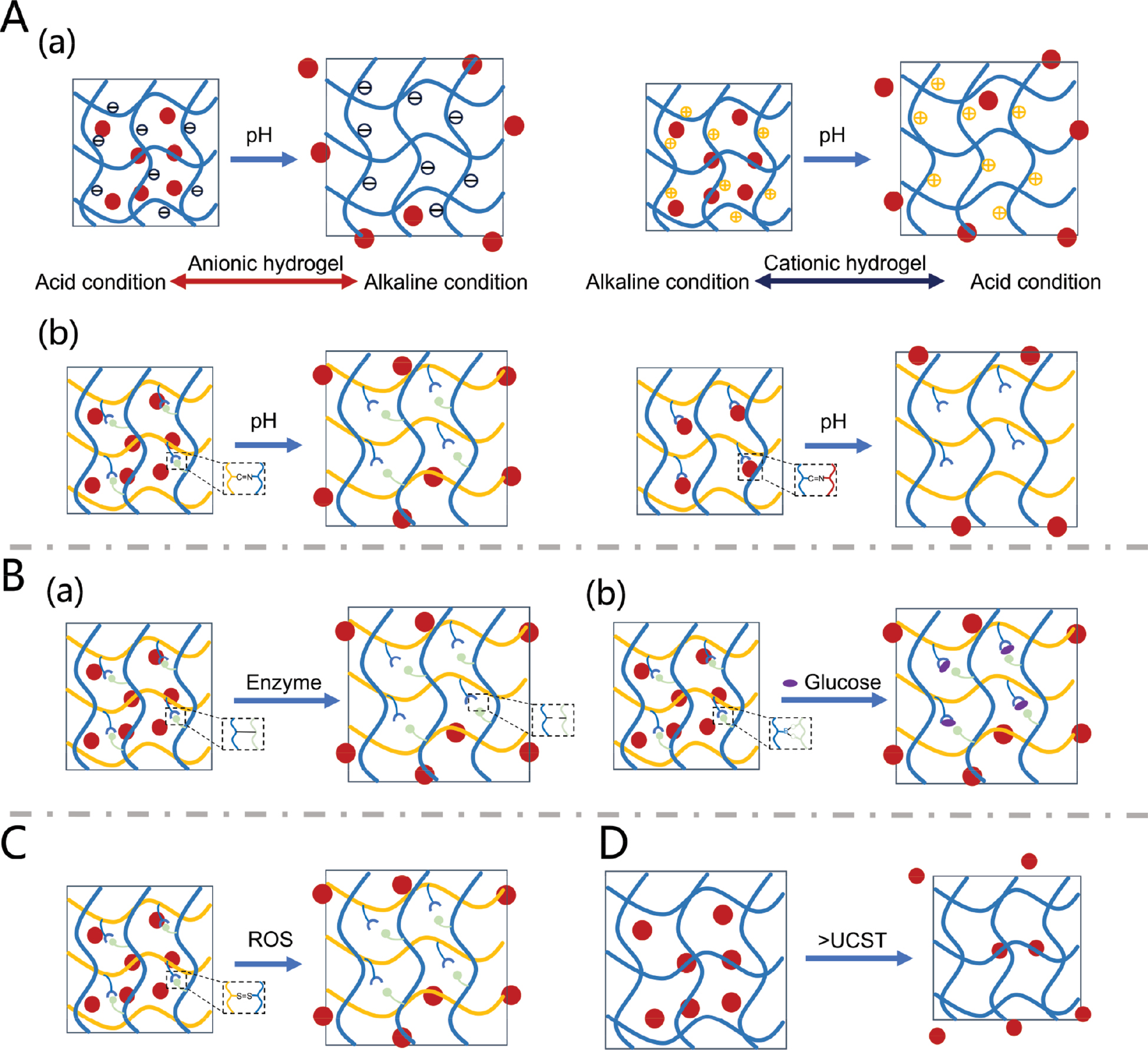
Multimodal synergistic therapeutic strategies
Multimodal synergistic therapeutic strategies combine TCMP-based hydrogels organically with other therapeutic modalities, such as gene therapy (delivering siRNA and miRNA), cell therapy (loading stem cells and Exos) [131], physical therapies (phototherapy [PTT/PDT/PBM]) [130, 175], and electrical stimulation [ES] (ultrasound and magnetic fields) [61, 142] to achieve synergistic effects for treating complex, refractory wounds, as illustrated in Figure 10.
Figure 10 Schematic diagram of multimodal combined therapy.
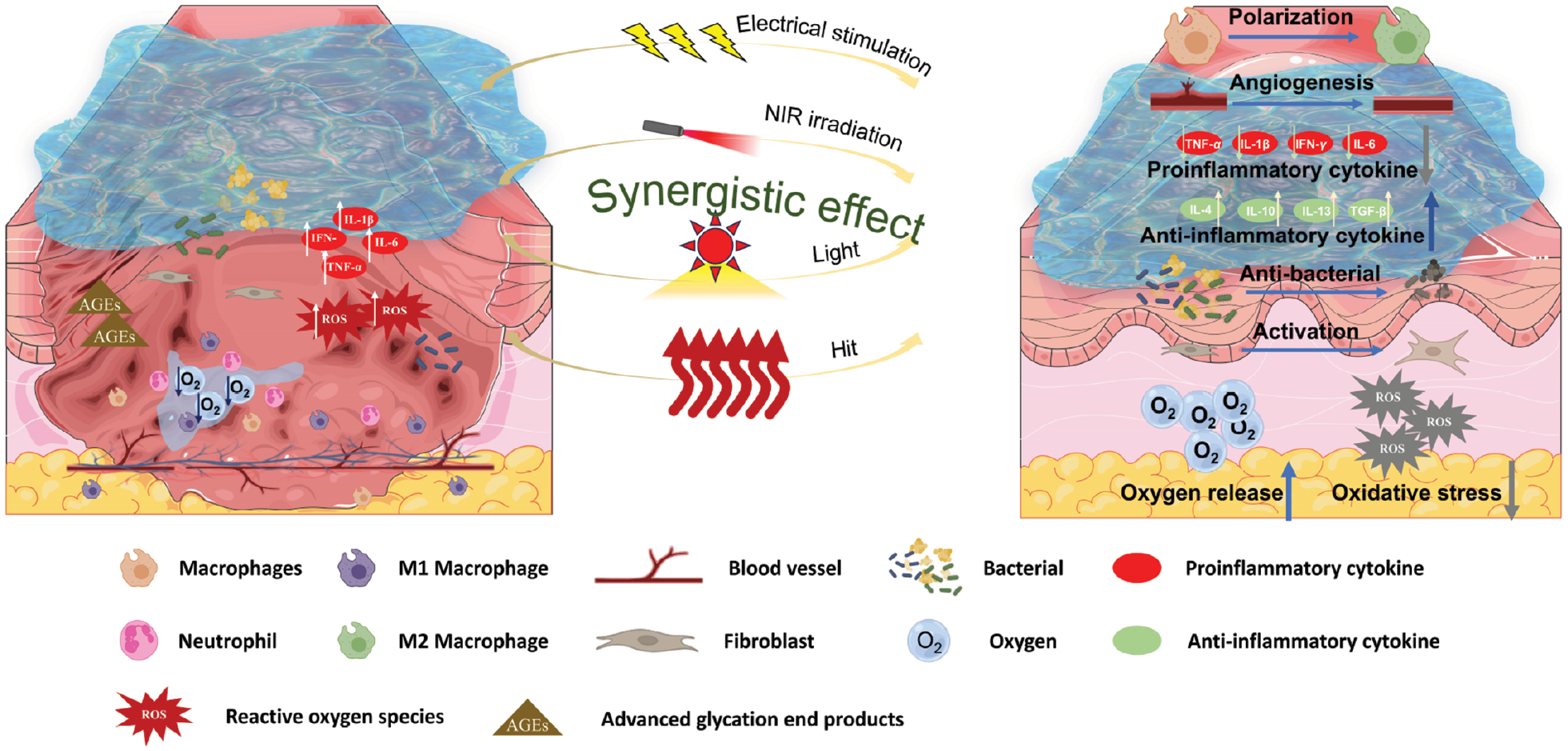
Biomimetic design and advanced manufacturing
Biomimetic design and advanced manufacturing mimic the structure and composition of the natural ECM, utilizing advanced manufacturing techniques, like 3D/4D printing [60], microfluidics [135], and electrospinning to create TCMP-based hydrogel scaffolds with biomimetic micro/nano-architectures, functional gradients, or specific spatial arrangements, thereby better guiding tissue regeneration and functional recovery (e.g., multilayered hydrogels and gradient drug/growth factor release).
Deep integration of TCM theory and modern technology (Figure 11)
Figure 11 Innovative design of hydrogel integrating Traditional Chinese Medicine theory with modern technology.
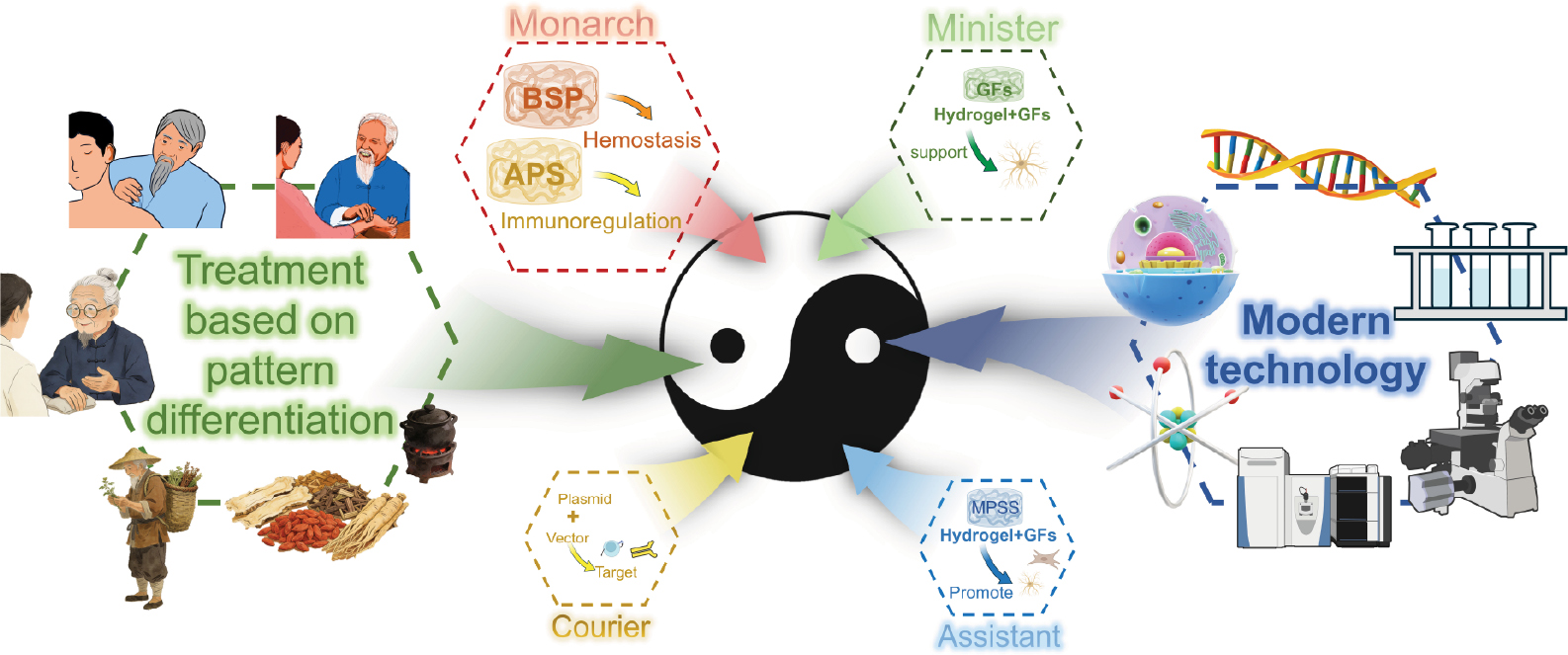
Returning to the TCM principles introduced in Section 5.1, future research should pursue deeper integration of these concepts with advanced biomaterials engineering. Systematic investigation of the “Monarch-Minister-Assistant-Courier” principle in hydrogel design requires quantitative approaches to optimize component ratios and validate synergistic effects using modern pharmacologic methods. Exploring composite polysaccharides extracted from classic TCM formulas may reveal emergent properties not present in single polysaccharides. Integration of TCM syndrome differentiation with wound diagnostics, potentially using biomarker panels or biosensor-integrated dressings, could enable truly personalized treatments tailored to individual patient characteristics. Advances in systems biology and network pharmacology offer tools to elucidate the multi-target mechanisms through which TCMP combinations achieve the therapeutic effects, potentially revealing new targets for intervention and providing scientific validation for traditional formulation principles.
Many classic prescriptions in China have adopted the principle of “Monarch-Minister-Assistant-Courier,” such as Liuwei Dihuang decoction. The Liuwei Dihuang decoction is composed of six medicinal ingredients and follows the principle of “Monarch-Minister-Assistant-Courier” [207, 208]. Studies have shown that the Liuwei Dihuang decoction is beneficial for treating type 2 diabetes and can effectively promote the healing of diabetic wounds. The monarch, Rehmannia glutinosa polysaccharide, can effectively improve hyperglycemia, vascular inflammation, and oxidative stress in streptozotocin-induced diabetic mice [209]. The minister, Fructus Corni polysaccharide and Chinese yam (Dioscorea opposita) polysaccharide, can effectively improve diabetes and enhance the effect of the sovereign drug [210, 211]. The assistant, Poria cocos polysaccharide, reduces peripheral insulin resistance by inhibiting the PI3K/AKT pathway, thereby alleviating diabetes and diabetic ulcers [212]. Alisma polysaccharide downregulates the expression of miR-126, thereby improving insulin sensitivity [213]. The phenolic components in Moutan Cortex provide heat-clearing, anti-inflammatory, and microcirculation-protecting effects, providing the best internal environment for the polysaccharides to exert their functions [214]. The polysaccharides and phenolic components in this formula, along with other non-polysaccharide components, work together to inhibit oxidative stress and inflammation at the etiologic, pathologic, and tissue damage levels, thereby intervening in diabetes and promoting wound healing.
In addition to Liuwei Dihuang decoction, Tuo-Li-Xiao-Du-San (TLXDS) is a classic prescription for treating DFUs [215]. TLXDS consists of four herbs: Danggui (Radix Angelica sinensis); Huangqi (Radix Astragali); Baizhi (Angelica dahurica); and Zaojiaoci (thorns of Gleditsia sinensis). Angelica sinensis contains polysaccharides and volatile oils, which can exert anti-inflammatory and immunomodulatory effects [216]. APS have immunomodulatory and pro-angiogenic effects, enhancing the therapeutic effect of Angelica sinensis on DFUs. Polysaccharides from Angelica dahurica can increase the content of collagen fibers and myofibroblasts at the wound site, promote coagulation and granulation tissue formation, and accelerate wound healing, further enhancing the healing of DFUs. The thorns of Gleditsia sinensis has antibacterial and anti-inflammatory effects, further synergizing the treatment of DFU healing. TLXDS has been proven to significantly improve wound healing in streptozotocin-induced diabetic rats. The mechanism of action includes reducing inflammation, promoting angiogenesis, and collagen deposition, and TLXDS can be used to treat various refractory wounds.
Designing combination polysaccharide drugs based on the “Monarch-Minister-Assistant-Courier” principle holds promise for developing polysaccharide-based therapeutics with enhanced synergistic advantages. Future research should further explore the structural basis and molecular mechanisms of polysaccharide synergy to provide a more robust scientific foundation for the modernization of traditional Chinese medicine.
In-depth mechanistic studies and novel target discovery
In-depth mechanistic studies and novel target discovery uses multi-omics technologies (genomics, transcriptomics, proteomics, metabolomics, and microbiomics) and high-resolution imaging techniques to more systematically and deeply unravel the molecular mechanisms and signaling networks by which TCMP-based hydrogels promote wound healing, potentially identifying new therapeutic targets.
Strengthening clinical translation research
The clinical translation of TCM polysaccharide-based hydrogels is a systematic whole-chain project spanning from basic research to clinical application, which must be advanced in strict compliance with the standardized pathway encompassing basic research, preclinical research, clinical trials, registration, application and approval, industrialization, and clinical promotion. First, at the laboratory stage, we perform origin identification, standardized extraction, purification, and quality control of TCM polysaccharide raw materials, clarify the physicochemical properties and batch uniformity, and conduct structural design, preparation process optimization, in vitro biocompatibility, and functional verification of hydrogel materials. Subsequently, systematic in vivo safety and efficacy evaluations are conducted in line with GLP guidelines, and pilot-scale amplification of preparations, process stability verification, and quality standard establishment are completed under GMP conditions to provide reliable data support for subsequent applications. Next, based on product positioning, the product is classified as a medical device or pharmaceutical product and phase Ⅰ–Ⅲ clinical trials are sequentially implemented under the GCP framework to systematically verify safety and clinical value. Complete research data are subsequently compiled and submitted to NMPA for registration and application, and marketing authorization is granted upon passing technical review, on-site inspection, and sampling testing. Finally, large-scale production is achieved under GMP conditions with post-marketing clinical monitoring and clinical promotion carried out thereafter. Throughout the entire process, key issues must be focused on addressing (including the uniformity of TCM polysaccharide raw materials) the mechanical and degradation properties of hydrogels, in vivo safety and efficacy, as well as the long research and development cycle, high costs, and market positioning.
Guided by the TCM “Monarch-Minister-Assistant-Courier” compatibility theory, this review systematically links the full research chain of TCM polysaccharides, including source screening, structure, structure-activity relationship, hydrogel construction, functional design, diabetic foot wound repair mechanisms, and clinical translation. The review integrates TCM theory with modern materials science, biomedical engineering, and regenerative medicine, overcoming the isolation between hydrogel design and TCM active component applications. With an integrated framework of “TCM theory, polysaccharide structure, material construction, biological function, clinical translation,” this review summarizes key progress of TCM polysaccharide-based hydrogels for diabetic foot wounds, providing new insights and guidance for developing efficient, safe, and targeted repair materials.
In conclusion, the field of functional hydrogels based on TCM polysaccharides is vibrant and full of opportunities. By fostering interdisciplinary collaboration (materials science, chemistry, biology, pharmacy, TCM, and engineering), overcoming current challenges, and pursuing continuous innovation, it is anticipated that more effective, safer, and smarter next-generation wound repair products will be developed, bringing significant benefits to millions of wound patients globally.
Conclusion
Functional hydrogels based on TCMPs represent a significant advancement in wound care. These materials uniquely combine the biocompatibility of natural polymers with the inherent bioactivity of TCMPs, offering multifunctional properties, including anti-inflammatory, antioxidant, and pro-healing effects. By incorporating dynamic crosslinking strategies and functional additives, these hydrogels demonstrate excellent injectability, self-healing capability, and microenvironmental responsiveness. Research in diabetic and infected wound models confirms that TCMP-based hydrogels effectively accelerate wound closure through mechanisms involving inflammation modulation, oxidative stress reduction, and enhanced angiogenesis. While challenges in standardization and clinical translation remain, future research focusing on structure-activity relationships and intelligent system design will further advance this field. Overall, TCMP-based hydrogels bridge traditional medicine and modern biomaterials, providing a promising platform for next-generation wound dressings that address the complexities of chronic wound healing.
Data availability statement
Data sharing is not applicable to this article because no new data were created or analyzed.
Ethics statement
No direct interactions with human or animal subjects were involved. Therefore, ethical approval and informed consent were not required.
Author contributions
HW: Formal analysis, Investigation, Methodology, Writing–original draft, Writing–review & editing. JL: Investigation, Methodology, Visualization, Writing–original draft, Writing–review & editing. WC: Formal analysis, Methodology, Validation. SL: Investigation, Visualization, Writing–review & editing. FX: Investigation, Formal analysis, Visualization. SX: Investigation, Formal analysis, Methodology. RL: Data Curation, Formal analysis. AC: Funding acquisition, Resources, Writing–review & editing. BZ: Funding acquisition, Resources, Supervision. ST: Conceptualization, Funding acquisition, Resources, Supervision, Writing–original draft, Writing–review & editing. All the authors read and approved the final manuscript.
Funding
This study was supported by Guangdong Basic and Applied Basic Research Foundation (2026A1515011052), the National Natural Science Foundation of China for Young Scholars (82304775), the Natural Science Foundation of Guangdong Province (2022A1515010833), Shenzhen Key Laboratory of Chinese Medicine Active Substance Screening and Translational Research (ZDSYS20220606100801003), 2025 Research Project Findings of Guangdong Provincial Health Economics Association (2025-WJMZ-20), Guangdong Health Information Net Association Research Project for Young Scholars (QN-202507-0002), Funding Scheme for Scientific Research and Innovation (0167/2023/RIA3) from Macau FDCT, Start-up Research Grant (SRG2023-00061-FHS), Multi-Year Research Grant (MYRG GRG2024-00266-FHS) from the University of Macau, and Guangzhou University of Chinese Medicine Graduate Student High-Level Research Incentive and Support Project (A1-2601-26-429-112Z002).
Acknowledgments
The figures in this manuscript were conceptualized by the authors, partially created using some components and schematic elements from BioRender.com and bio art.niaid.nih.gov, and finalized and assembled using Microsoft PowerPoint.
Conflict of interest
The authors declare that there are no conflicts of interest.
Abbreviations
AGEs, advanced glycation end products; AP, Aloe polysaccharide; APS, Astragalus polysaccharide; BBR, berberine; BSP, Bletilla striata polysaccharide; CAT, catalase; CMC, carboxymethyl cellulose; CMCS, carboxymethyl chitosan; CS, chitosan; CSMA, methacrylated chitosan; DFUs, diabetic foot ulcers; DN, double network; DOP, Dendrobium officinale polysaccharide; ECM, extracellular matrix; EGF, epidermal growth factor; ES, electrical stimulation; Exos, exosomes; FA, ferulic acid; GAS, gastrodin; GEP, Gastrodia elata polysaccharide; GLP, Ganoderma lucidum polysaccharide; GP, Glycyrrhiza polysaccharide; GSH-Px, glutathione peroxidase; HA, hyaluronic acid; HMs, hydrogel microspheres; HPCE, Hypericum perforatum callus extract; HUVECs, human umbilical vein endothelial cells; IL-10, interleukin-10; IPN, interpenetrating polymer network; KD, kinsenoside; KGM, konjac glucomannan; LBP, Lycium barbarum polysaccharide; LLLT, low-level light therapy; LNT, lentinan; MCP, Mesona chinensis polysaccharide; MDA, malondialdehyde; M-KD, macrophage membrane-coated kinsenoside; MMPs, matrix metalloproteinases; MRSA, methicillin-resistant Staphylococcus aureus; MW, molecular weight; NIR, near-infrared; OBSP, oxidized Bletilla striata polysaccharide; OGLP, oxidized Ganoderma lucidum polysaccharide; OKGM, oxidized konjac glucomannan; PAA, polyacrylic acid; PBM, photobiomodulation; PCP, Poria cocos polysaccharide; PF NPs, Fe3+-doped nanoparticles; POD, peroxidase; PPy, polypyrrole; PTT/PDT, photothermal therapy/photodynamic therapy; PUE, puerarin; ROS, reactive oxygen species; SA, sodium alginate; SOD, Superoxide Dismutase; TCM, Traditional Chinese Medicine; TCMP(s), Traditional Chinese Medicine polysaccharide(s); TIMPs, tissue inhibitors of metalloproteinases; TP, tea polyphenols; TSP, tamarind seed polysaccharide; UV, ultraviolet; VEGF, vascular endothelial growth factor.
Graphical abstract
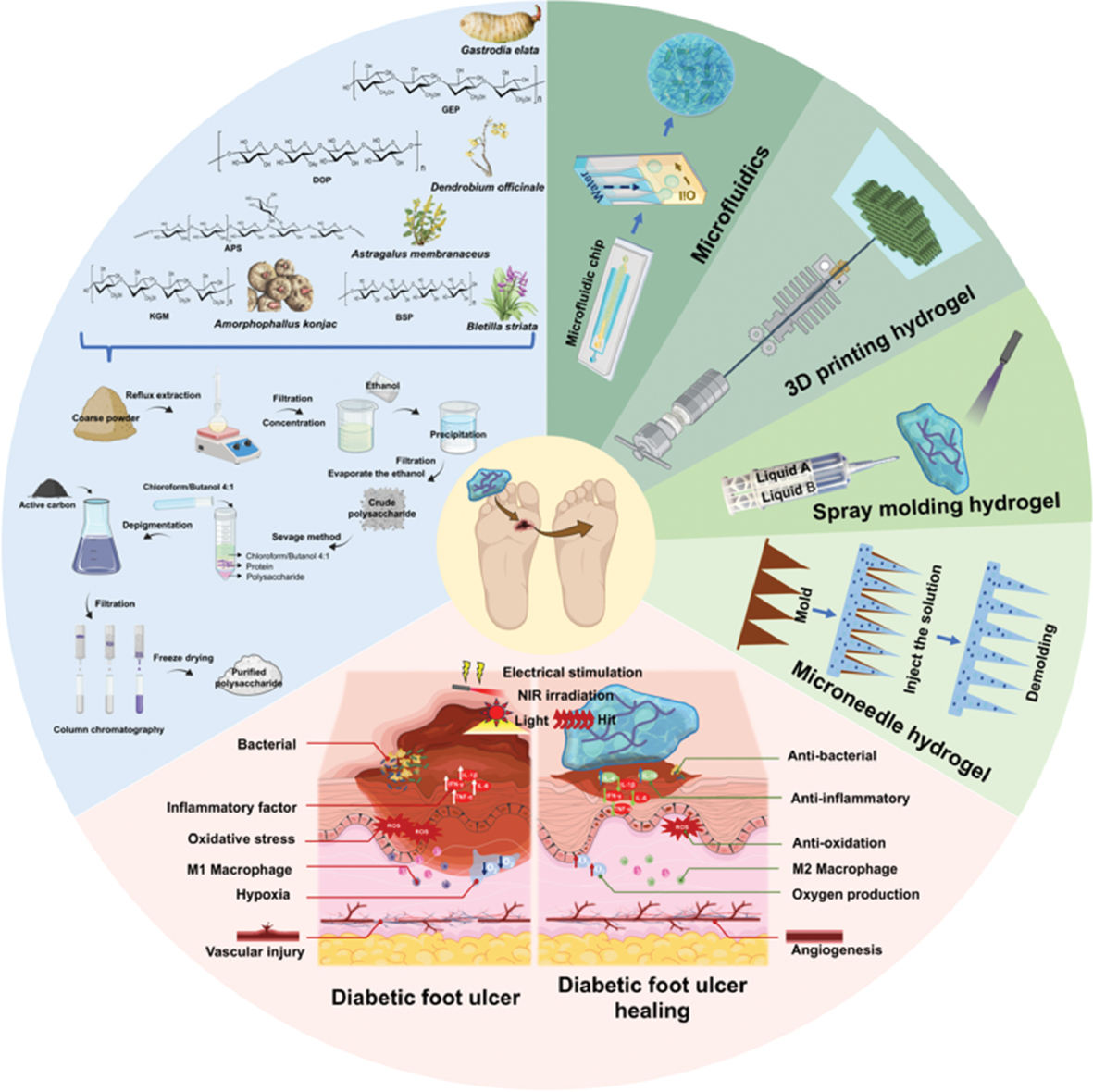
Highlights
- TCM polysaccharides (BSP, APS, and DOP) possess inherent anti-inflammatory, antioxidant, and pro-healing properties that actively regulate the wound microenvironment.
- Advanced hydrogel systems utilize ionic bonding, dynamic covalent bonds, and other strategies to achieve injectable, self-healing, and stimuli-responsive functions.
- TCM polysaccharides hydrogels demonstrate targeted efficacy in chronic wounds through macrophage polarization, ROS scavenging, and angiogenesis promotion.
- Intelligent TCM-inspired designs show promise for scalable production and clinical application as next-generation wound dressings.
In brief
This review highlights functional hydrogels based on bioactive TCM polysaccharides for advanced wound healing. These hydrogels combine natural polysaccharide bioactivity with tunable material properties to address chronic wound microenvironments. Through innovative crosslinking and functionalization, the hydrogels demonstrate multifunctional efficacy in diabetic and infected wound models. Future work should focus on smart systems, TCM-theory integration, and clinical translation.
References
- Zhang R, Tang P, Chen Z, Tang M, Yang K, et al. Microneedle hierarchical structure construction for promoting multi-stage wound healing. Int J Pharm 2025;674:125474. [PMID: 40086651 DOI: 10.1016/j.ijpharm.2025.125474]
- Zhou J, Sun Z, Wang X, Wang S, Jiang W, et al. Low-temperature cold plasma promotes wound healing by inhibiting skin inflammation and improving skin microbiome. Front Bioeng Biotechnol 2025;13:1511259. [PMID: 40051835 DOI: 10.3389/fbioe.2025.1511259]
- Cioce A, Cavani A, Cattani C, Scopelliti F. Role of the skin immune system in wound healing. Cells 2024;13(7):624. [PMID: 38607063 DOI: 10.3390/cells13070624]
- Peña OA, Martin P. Cellular and molecular mechanisms of skin wound healing. Nat Rev Mol Cell Biol 2024;25(8):599-616. [PMID: 38528155 DOI: 10.1038/s41580-024-00715-1]
- Kohlhauser M, Mayrhofer M, Kamolz LP, Smolle C. An update on molecular mechanisms of scarring-a narrative review. Int J Mol Sci 2024;25(21):11579. [PMID: 39519131 DOI: 10.3390/ijms252111579]
- Yang B, Xu J, Liu S, Wu C, Li Y, et al. Applications of bioactive herbal extracts in dressing materials for skin wound repair: ingredients, mechanisms and innovations. Interdiscip Med 2025;3(4):e20240117. [DOI: 10.1002/INMD.20240117]
- Li J, Zhao Q, Gao X, Dai T, Bai Z, et al. Dendrobium officinale Kinura et Migo glycoprotein promotes skin wound healing by regulating extracellular matrix secretion and fibroblast proliferation on the proliferation phase. Wound Repair Regen 2024;32(1):55-66. [PMID: 38113346 DOI: 10.1111/wrr.13144]
- Wong SL, Demers M, Martinod K, Gallant M, Wang Y, et al. Diabetes primes neutrophils to undergo NETosis, which impairs wound healing. Nat Med 2015;21(7):815-9. [PMID: 26076037 DOI: 10.1038/nm.3887]
- Dhanraj P, Boodhoo K, van de Vyver M. Delayed immune response upon injury in diabetic wounds impedes healing. Immun Inflamm Dis 2025;13(2):e70142. [PMID: 39891428 DOI: 10.1002/iid3.70142]
- Nielsen TB, Pantapalangkoor P, Yan J, Luna BM, Dekitani K, et al. Diabetes exacerbates infection via hyperinflammation by signaling through TLR4 and RAGE. mBio 2017;8(4):e00818-17. [PMID: 28830942 DOI: 10.1128/mBio.00818-17]
- Dawi J, Tumanyan K, Tomas K, Misakyan Y, Gargaloyan A, et al. Diabetic foot ulcers: pathophysiology, immune dysregulation, and emerging therapeutic strategies. Biomedicines 2025;13(5):1076. [PMID: 40426903 DOI: 10.3390/biomedicines13051076]
- Fan Y, Yang J, Xie Y, Yang X, Zhu H, et al. Inflammatory memory-activated biomimetic nanovesicles regulate neutrophil plasticity and metabolic reprogramming for rapid diabetic wound healing via targeting miR-193a-5p/TLR4/JNK/P38 MAPK pathways. J Nanobiotechnology 2025;23(1):115. [PMID: 39962468 DOI: 10.1186/s12951-025-03193-5]
- Yang X, Li W, Liu Y, Cao N, He Y, et al. Charged fibrous dressing to promote diabetic chronic wound healing. Adv Healthc Mater 2024;13(2):e2302183. [PMID: 37830231 DOI: 10.1002/adhm.202302183]
- Guo Q, Yin T, Huang W, Nan R, Xiang T, et al. Hybrid hydrogels for immunoregulation and proangiogenesis through mild heat stimulation to accelerate whole-process diabetic wound healing. Adv Healthc Mater 2024;13(18):e2304536. [PMID: 38519046 DOI: 10.1002/adhm.202304536]
- Yang M, Xu Y, Cheng Q, He Y, Xu Z, et al. Injectable polysaccharide-based hydrogel with glucose responsiveness as an immunoregulatory platform for enhanced diabetic wound healing. ACS Appl Mater Interfaces 2025;17(22):32038-53. [DOI: 10.1021/acsami.5c06112]
- Huang C, Dong L, Zhao B, Lu Y, Huang S, et al. Anti-inflammatory hydrogel dressings and skin wound healing. Clin Transl Med 2022;12(11):e1094. [PMID: 36354147 DOI: 10.1002/ctm2.1094]
- Deng L, Du C, Song P, Chen T, Rui S, et al. The role of oxidative stress and antioxidants in diabetic wound healing. Oxid Med Cell Longev 2021;2021:8852759. [PMID: 33628388 DOI: 10.1155/2021/8852759]
- Meng T, Qin W, Liu B. SIRT1 antagonizes oxidative stress in diabetic vascular complication. Front Endocrinol (Lausanne) 2020;11:568861. [PMID: 33304318 DOI: 10.3389/fendo.2020.568861]
- Shen Y, Li S, Hou X, Yu J, Zhu Y, et al. Ultrasound-triggered nanocomposite “lever” hydrogels with a full repair system accelerates diabetic foot ulcer repair. Adv Sci (Weinh) 2025;12(23):e2500720. [PMID: 40344623 DOI: 10.1002/advs.202500720]
- Hattori Y, Hattori K, Machida T, Matsuda N. Vascular endotheliitis associated with infections: its pathogenetic role and therapeutic implication. Biochem Pharmacol 2022;197:114909. [PMID: 35021044 DOI: 10.1016/j.bcp.2022.114909]
- Sun D, Wang J, Toan S, Muid D, Li R, et al. Molecular mechanisms of coronary microvascular endothelial dysfunction in diabetes mellitus: focus on mitochondrial quality surveillance. Angiogenesis 2022;25(3):307-29. [PMID: 35303170 DOI: 10.1007/s10456-022-09835-8]
- Bi J, Zhou W, Tang Z. Pathogenesis of diabetic complications: exploring hypoxic niche formation and HIF-1α activation. Biomed Pharmacother 2024;172:116202. [PMID: 38330707 DOI: 10.1016/j.biopha.2024.116202]
- Jinyi L, Xianguang D, Yuhan D, Haoyue H, Zhongyu X, et al. Metabolic reprogramming in diabetic foot ulcers: mechanisms, therapeutic implications and future perspectives. Metabolism 2026;175:156455. [PMID: 41285352 DOI: 10.1016/j.metabol.2025.156455]
- Malik MNH, Waqas SF, Zeitvogel J, Cheng J, Geffers R, et al. Congenital deficiency reveals critical role of ISG15 in skin homeostasis. J Clin Invest 2022;132(3):e141573. [PMID: 34847081 DOI: 10.1172/JCI141573]
- Meng L, Lu Y, Wang X, Cheng C, Xue F, et al. NPRC deletion attenuates cardiac fibrosis in diabetic mice by activating PKA/PKG and inhibiting TGF-β1/Smad pathways. Sci Adv 2023;9(31):eadd4222. [PMID: 37531438 DOI: 10.1126/sciadv.add4222]
- Clayton SM, Shafikhani SH, Soulika AM. Macrophage and neutrophil dysfunction in diabetic wounds. Adv Wound Care (New Rochelle) 2024;13(9):463-84. [PMID: 38695109 DOI: 10.1089/wound.2023.0149]
- Tu C, Lu H, Zhou T, Zhang W, Deng L, et al. Promoting the healing of infected diabetic wound by an anti-bacterial and nano-enzyme-containing hydrogel with inflammation-suppressing, ROS-scavenging, oxygen and nitric oxide-generating properties. Biomaterials 2022;286:121597. [PMID: 35688112 DOI: 10.1016/j.biomaterials.2022.121597]
- Xin H, Cai Z, Hao J, An J, Li Y, et al. Macro/microgel-encapsulated, biofilm-armored living probiotic platform for regenerating bacteria-infected diabetic wounds. Adv Healthc Mater 2025;14(7):e2403476. [PMID: 39831829 DOI: 10.1002/adhm.202403476]
- Qiao B, Wang J, Qiao L, Maleki A, Liang Y, et al. ROS-responsive hydrogels with spatiotemporally sequential delivery of antibacterial and anti-inflammatory drugs for the repair of MRSA-infected wounds. Regen Biomater 2024;11:rbad110. [PMID: 38173767 DOI: 10.1093/rb/rbad110]
- Zhang M, Li W, Yin L, Chen M, Zhang J, et al. Multifunctional double-network hydrogel with antibacterial and anti-inflammatory synergistic effects contributes to wound healing of bacterial infection. Int J Biol Macromol 2024;271(Pt 2):132672. [PMID: 38810855 DOI: 10.1016/j.ijbiomac.2024.132672]
- Qiu X, Nie L, Liu P, Xiong X, Chen F, et al. From hemostasis to proliferation: accelerating the infected wound healing through a comprehensive repair strategy based on GA/OKGM hydrogel loaded with MXene@TiO2 nanosheets. Biomaterials 2024;308:122548. [PMID: 38554642 DOI: 10.1016/j.biomaterials.2024.122548]
- Das P, Maresch M, Dey N, Sulaiman N, Ashour AG, et al. Programmed wound healing in aged skin may be enhanced by mesenchymal cell loaded gene-activated scaffolds. APL Bioeng 2025;9(2):026112. [PMID: 40290726 DOI: 10.1063/5.0240504]
- Xin C, Jia P, Zhao Y, Cheng Z, Liu W, et al. Antioxidant effects of Gastrodia elata polysaccharide-based hydrogels loaded with puerarin/gelatin microspheres for D-galactose-induced aging-skin wound healing. Int J Biol Macromol 2025;296:139809. [PMID: 39805458 DOI: 10.1016/j.ijbiomac.2025.139809]
- Su X, Geng X, Zhang Y, Shi Y, Zhao L. Microenvironmental pH modulating oxygen self-boosting microalgal prodrug carboxymethyl chitosan/hyaluronic acid/puerarin hydrogel for accelerating wound healing in diabetic rats. Int J Biol Macromol 2024;282(Pt 1):136669. [PMID: 39437940 DOI: 10.1016/j.ijbiomac.2024.136669]
- Vartanian A. Diabetic wound dressings. Nat Rev Mater 2024;9(2):92. [DOI: 10.1038/s41578-024-00647-4]
- Zeng Q, Qi X, Shi G, Zhang M, Haick H. Wound dressing: from nanomaterials to diagnostic dressings and healing evaluations. ACS Nano 2022;16(2):1708-33. [PMID: 35050565 DOI: 10.1021/acsnano.1c08411]
- Bei Z, Ye L, Tong Q, Ming Y, Yang T, et al. Thermostimulated shrinking and adhesive hydrogel dressing for treating chronic diabetic wounds. Cell Rep Phys Sci 2024;5(11):102289. [DOI: 10.1016/j.xcrp.2024.102289]
- Liang Y, He J, Guo B. Functional hydrogels as wound dressing to enhance wound healing. ACS Nano 2021;15(8):12687-722. [PMID: 34374515 DOI: 10.1021/acsnano.1c04206]
- Majeed F, Razzaq A, Rehmat S, Azhar I, Mohyuddin A, et al. Enhanced dye sequestration with natural polysaccharides-based hydrogels: a review. Carbohydr Polym 2024;330:121820. [PMID: 38368085 DOI: 10.1016/j.carbpol.2024.121820]
- Zhang X, Liang Y, Huang S, Guo B. Chitosan-based self-healing hydrogel dressing for wound healing. Adv Colloid Interface Sci 2024;332:103267. [PMID: 39121832 DOI: 10.1016/j.cis.2024.103267]
- Graça MFP, Miguel SP, Cabral CSD, Correia IJ. Hyaluronic acid-based wound dressings: a review. Carbohydr Polym 2020;241:116364. [PMID: 32507198 DOI: 10.1016/j.carbpol.2020.116364]
- Du J, Zhou T, Peng W. Functional polysaccharide-based hydrogel in bone regeneration: from fundamentals to advanced applications. Carbohydr Polym 2025;352:123138. [PMID: 39843049 DOI: 10.1016/j.carbpol.2024.123138]
- Long W, Li S, Yang Y, Chen A, Xu M, et al. Self-cross-linked chitosan/albumin-bound nanoparticle hydrogel for inhibition of postsurgery malignant glioma recurrence. ACS Appl Mater Interfaces 2023;15(49):56774-85. [PMID: 38038221 DOI: 10.1021/acsami.3c12873]
- Wu Q, Hu Y, Yu B, Hu H, Xu FJ. Polysaccharide-based tumor microenvironment-responsive drug delivery systems for cancer therapy. J Control Release 2023;362:19-43. [PMID: 37579973 DOI: 10.1016/j.jconrel.2023.08.019]
- Yan R, Wang Y, Li W, Sun J. Promotion of chronic wound healing by plant-derived active ingredients and research progress and potential of plant polysaccharide hydrogels. Chin Herb Med 2025;17(1):70-83. [PMID: 39949811 DOI: 10.1016/j.chmed.2024.11.005]
- Yang J, Wang T, Zhang L, Fan P, Zhao J, et al. Injectable hemostatic hydrogel adhesive with antioxidant, antibacterial and procoagulant properties for hemorrhage wound management. J Colloid Interface Sci 2024;673:395-410. [DOI: 10.1016/j.jcis.2024.05.207]
- Xu H, Nie W, Dai L, Luo R, Lin D, et al. Recent advances in natural polysaccharides-based controlled release nanosystems for anti-cancer phototherapy. Carbohydr Polym 2023;301(Pt A):120311. [PMID: 36436872 DOI: 10.1016/j.carbpol.2022.120311]
- Wang B, Wang X, Xiong Z, Lu G, Ma W, et al. A review on the applications of Traditional Chinese medicine polysaccharides in drug delivery systems. Chin Med 2022;17(1):12. [PMID: 35033122 DOI: 10.1186/s13020-021-00567-3]
- Zhang X, Wen S, Liu Q, Cai W, Ning K, et al. Multi-functional nanozyme-integrated astragalus polysaccharide hydrogel for targeted phased therapy in diabetic wound healing. Nano Today 2025;62:102739. [DOI: 10.1016/j.nantod.2025.102739]
- Hou Y, Zhao J, Yin J, Geng F, Nie S. The synergistic gelation of Dendrobium officinale polysaccharide (Dendronans) with xanthan gum and its rheological and texture properties. Food Hydrocoll 2023;141:108674. [DOI: 10.1016/j.foodhyd.2023.108674]
- Yang Y, Yu M, Mo Y, Cheng Y, Huang B, et al. Metal-ion-binding properties of glycyrrhiza polysaccharide extracted from Licorice: structural characterization and potential application in drug delivery. Carbohydr Polym 2024;346:122658. [PMID: 39245514 DOI: 10.1016/j.carbpol.2024.122658]
- Xiang J, Wang Y, Yang L, Zhang X, Hong Y, et al. A novel hydrogel based on Bletilla striata polysaccharide for rapid hemostasis: synthesis, characterization and evaluation. Int J Biol Macromol 2022;196:1-12. [PMID: 34843815 DOI: 10.1016/j.ijbiomac.2021.11.166]
- Shang J, Duan L, Zhang W, Li X, Ma C, et al. Characterization and evaluation of Bletilla striata polysaccharide/konjac glucomannan blend hydrogel for wound healing. J Appl Biomater Funct Mater 2023;21:22808000231176202. [PMID: 37798869 DOI: 10.1177/22808000231176202]
- Zhang HY, Wang KT, Zhang Y, Cui YL, Wang Q. A self-healing hydrogel wound dressing based on oxidized Bletilla striata polysaccharide and cationic gelatin for skin trauma treatment. Int J Biol Macromol 2023;253(Pt 6):127189. [PMID: 37783245 DOI: 10.1016/j.ijbiomac.2023.127189]
- Li X, Bai L, Zhang X, Fang Q, Chen G, et al. Application of Bletilla striata polysaccharide hydrogel for wound healing among in diabetes. Colloids Surf B Biointerfaces 2024;241:114033. [PMID: 38936033 DOI: 10.1016/j.colsurfb.2024.114033]
- Ma H, Axi Y, Lu Y, Dai C, Huang S, et al. A dual network cross-linked hydrogel with multifunctional Bletilla striata polysaccharide/gelatin/tea polyphenol for wound healing promotion. Int J Biol Macromol 2024;265(Pt 1):130780. [DOI: 10.1016/j.ijbiomac.2024.130780]
- Zhang L, Wang K, Zhou L, Zhu Y, Chen X, et al. Self-assembled ROS-triggered Bletilla striata polysaccharide-releasing hydrogel dressing for inflammation-regulation and enhanced tissue-healing. Int J Biol Macromol 2024;278(Pt 4):135194. [PMID: 39256120 DOI: 10.1016/j.ijbiomac.2024.135194]
- Zhao S, Zhang J, Qiu M, Hou Y, Li X, et al. Mucoadhesive and thermosensitive Bletilla striata polysaccharide/chitosan hydrogel loaded nanoparticles for rectal drug delivery in ulcerative colitis. Int J Biol Macromol 2024;254(Pt 1):127761. [PMID: 38287598 DOI: 10.1016/j.ijbiomac.2023.127761]
- Lin HF, Wang YY, Liu FZ, Yang ZW, Cui H, et al. Natural Bletilla striata polysaccharide-based hydrogels for accelerating hemostasis. Gels 2025;11(1):48. [PMID: 39852020 DOI: 10.3390/gels11010048]
- Yan J, Wang Y, Zhang X, Zhao X, Ma J, et al. Snakegourd root/Astragalus polysaccharide hydrogel preparation and application in 3D printing. Int J Biol Macromol 2019;121:309-16. [PMID: 30300696 DOI: 10.1016/j.ijbiomac.2018.10.008]
- Tang L, Xie S, Wang D, Wei Y, Ji X, et al. Astragalus polysaccharide/carboxymethyl chitosan/sodium alginate based electroconductive hydrogels for diabetic wound healing and muscle function assessment. Carbohydr Polym 2025;350:123058. [PMID: 39647958 DOI: 10.1016/j.carbpol.2024.123058]
- Xiang H, Tao W, Su Y, Jiang Y, He Y, et al. Effects of astragalus polysaccharide on the physicochemical properties of heat-induced whey protein gels by simultaneous rheology and Fourier transform infrared spectroscopy. J Dairy Sci 2025;108(5):4626-37. [PMID: 40139364 DOI: 10.3168/jds.2025-26374]
- Chen WH, Wu JJ, Li XF, Lu JM, Wu W, et al. Isolation, structural properties, bioactivities of polysaccharides from Dendrobium officinale Kimura et. Migo: a review. Int J Biol Macromol 2021;184:1000-13. [PMID: 34197847 DOI: 10.1016/j.ijbiomac.2021.06.156]
- Chu W, Wang P, Ma Z, Peng L, Wang Z, et al. Ultrasonic treatment of Dendrobium officinale polysaccharide enhances antioxidant and anti-inflammatory activity in a mouse D-galactose-induced aging model. Food Sci Nutr 2022;10(8):2620-30. [PMID: 35959255 DOI: 10.1002/fsn3.2867]
- Xin C, Cheng Z, Liu W, Li W, Zhu H. The antibacterial and hemostatic activity of Gastrodia elata polysaccharide-based hydrogel embedded with drug-carrying microspheres accelerates diabetic wound healing. Chem Eng J 2024;492:152403. [DOI: 10.1016/j.cej.2024.152403]
- Yu W, Zhao Y, Jia P, Liu W, Cheng Z, et al. Preparation and evaluation of gastrodin microsphere-loaded Gastrodia elata polysaccharides composite hydrogel on UVB-induced skin damage in vitro and in vivo. Int J Biol Macromol 2024;277(Pt 2):134303. [PMID: 39084431 DOI: 10.1016/j.ijbiomac.2024.134303]
- Li R, Wu Y, He L, Yang R, Luo K, et al. Chinese herb-crosslinked polysaccharide hydrogel loading DFO accelerates diabetes wound healing. Mater Des 2025;254:114128. [DOI: 10.1016/j.matdes.2025.114128]
- Li M, Jia L, Wang X, Kong Q, Wang H, et al. Study on network cross-linked hydrogel with cationic Bletilla striata polysaccharide/carbopol as a drug delivery system. Int J Biol Macromol 2025;305(Pt 1):140778. [PMID: 39924033 DOI: 10.1016/j.ijbiomac.2025.140778]
- Wang Y, Han S, Li R, Cui B, Ma X, et al. Structural characterization and immunological activity of polysaccharides from the tuber of Bletilla striata. Int J Biol Macromol 2019;122:628-35. [PMID: 30391591 DOI: 10.1016/j.ijbiomac.2018.10.201]
- Sheng Z, Liu J, Yang B. Structure differences of water soluble polysaccharides in Astragalus membranaceus induced by origin and their bioactivity. Foods 2021;10(8):1755. [PMID: 34441532 DOI: 10.3390/foods10081755]
- Ye C, Xu J, Shi L, Zong C, Ji W, et al. Injectable natural Tremella-derived hydrogel for reversing ferroptosis-mediated osteoporotic microenvironment imbalance and promoting osteoregeneration. Biomaterials 2026;324:123532. [PMID: 40660644 DOI: 10.1016/j.biomaterials.2025.123532]
- Zhang X, Duan S, Tao S, Huang J, Liu C, et al. Polysaccharides from Dendrobium officinale inhibit proliferation of osteosarcoma cells and enhance cisplatin-induced apoptosis. J Funct Foods 2020;73:104143. [DOI: 10.1016/j.jff.2020.104143]
- Gao N, Huang Y, Jing S, Zhang M, Liu E, et al. Environment-responsive dendrobium polysaccharide hydrogel embedding manganese microsphere as a post-operative adjuvant to boost cascaded immune cycle against melanoma. Theranostics 2024;14(10):3810-26. [PMID: 38994034 DOI: 10.7150/thno.94354]
- Liu W, Yao C, Wang D, Du G, Ji Y, et al. Dynamic double-networked hydrogels by hybridizing PVA and herbal polysaccharides: improved mechanical properties and selective antibacterial activity. Gels 2024;10(12):821. [PMID: 39727579 DOI: 10.3390/gels10120821]
- Li Y, Wang LM, Xu JZ, Tian K, Gu CX, et al. Gastrodia elata attenuates inflammatory response by inhibiting the NF-κB pathway in rheumatoid arthritis fibroblast-like synoviocytes. Biomed Pharmacother 2017;85:177-81. [PMID: 27936399 DOI: 10.1016/j.biopha.2016.11.136]
- Chen JQ, Yuan WY, Miao W, Gong SL, Zhou J, et al. In vitro and in vivo immune-enhancing effects of polysaccharides with different molecular weights and structural characteristics from Gastrodia elata Blume. Int J Biol Macromol 2025;295:139526. [PMID: 39788267 DOI: 10.1016/j.ijbiomac.2025.139526]
- Liu J, Yang X, Huang X, Luo Y, Zhang Q, et al. Antioxidant and anti-inflammatory effects of crude Gastrodia elata polysaccharides in UVB-induced acute skin damage. Antioxidants (Basel) 2025;14(7):894. [PMID: 40722999 DOI: 10.3390/antiox14070894]
- Wang R, Xin C, Liang J, Cheng Z, Liu W, et al. Glycyrrhizic acid-containing Gastrodia elata polysaccharide/chitosan hydrogel promotes macrophage M2 polarization and accelerates aging skin wound healing. Biomater Adv 2026;180:214571. [PMID: 41135443 DOI: 10.1016/j.bioadv.2025.214571]
- Teng H, Xiao H, Li X, Huang J, Zhang B, et al. Recent advances in the anti-aging effects of natural polysaccharides: sources, structural characterization, action mechanisms and structure-activity relationships. Trends Food Sci Technol 2025;160(5606):105000. [DOI: 10.1016/j.tifs.2025.105000]
- Ai S, Fan X, Fan L, Sun Q, Liu Y, et al. Extraction and chemical characterization of Angelica sinensis polysaccharides and its antioxidant activity. Carbohydr Polym 2013;94(2):731-36. [PMID: 23544627 DOI: 10.1016/j.carbpol.2013.02.007]
- Le XN, Long DP, Yin SS, Qing RY, Chi ZZ, et al. The efficient separation of bioactive components from Eucommia ulmoides Oliver using membrane filtration technology and its mechanisms in preventing alcoholic liver disease. Carbohydr Polym 2025;351:123100. [PMID: 39779014 DOI: 10.1016/j.carbpol.2024.123100]
- Gu J, Zhang H, Wen C, Zhang J, He Y, et al. Purification, characterization, antioxidant and immunological activity of polysaccharide from Sagittaria sagittifolia L. Food Res Int 2020;136:109345. [PMID: 32846537 DOI: 10.1016/j.foodres.2020.109345]
- Yu Y, Feng Z, Liu J, Hou X, Zhou X, et al. γ-Ray-triggered drug release of reactive oxygen species-sensitive nanomedicine for enhanced concurrent chemoradiation therapy. ACS Omega 2021;6(30):19445-57. [PMID: 34368532 DOI: 10.1021/acsomega.1c01500]
- Zou YF, Zhang YY, Paulsen BS, Fu YP, Huang C, et al. Prospects of Codonopsis pilosula polysaccharides: structural features and bioactivities diversity. Trends Food Sci Technol 2020;103:1-11. [DOI: 10.1016/j.tifs.2020.06.012]
- Zhang X, Xia J, Zhang Q, Huo C, Shan P, et al. Enzyme diagnostic criteria for polysaccharide purity: a model study using polymer reference standards. Glycosci Ther 2026;2(2):100037. [DOI: 10.1016/j.glycos.2026.100037]
- Li K, Cui LJ, Cao YX, Li SY, Shi LX, et al. UHPLC Q-exactive MS-based serum metabolomics to explore the effect mechanisms of immunological activity of Astragalus polysaccharides with different molecular weights. Front Pharmacol 2020;11:595692. [PMID: 33390982 DOI: 10.3389/fphar.2020.595692]
- Zhu H, Xu L, Wang J, Zhang Z, Xu X, et al. Rheological behaviors of ethanol-fractional polysaccharides from Dendrobium officinale in aqueous solution: effects of concentration, temperature, pH, and metal ions. Food Hydrocoll 2023;137(2):108311. [DOI: 10.1016/j.foodhyd.2022.108311]
- Li K, Cao YX, Jiao SM, Du GH, Du YG, et al. Structural characterization and immune activity screening of polysaccharides with different molecular weights from Astragali Radix. Front Pharmacol 2020;11:582091. [PMID: 33390949 DOI: 10.3389/fphar.2020.582091]
- Li CY, Zhang Q, Shi XY, Long J, Yu BX, et al. Structural characterization of polysaccharides from Lygodium japonicum (Thunb.) Sw. and its inhibition ability in calcium oxalate renal stone. Phytomedicine 2025;142:156734. [PMID: 40318530 DOI: 10.1016/j.phymed.2025.156734]
- Wang Z, Zheng Y, Lai Z, Hu X, Wang L, et al. Effect of monosaccharide composition and proportion on the bioactivity of polysaccharides: a review. Int J Biol Macromol 2024;254(Pt 2):127955. [PMID: 37944714 DOI: 10.1016/j.ijbiomac.2023.127955]
- Bian B, Miao X, Zhao X, Lai C, Chen Y, et al. Impacts of monosaccharide composition on immunomodulation by cello-pentaose, manno-pentaose, and xylo-pentaose: unraveling the underlying molecular mechanisms. Carbohydr Polym 2024;334:122006. [PMID: 38553211 DOI: 10.1016/j.carbpol.2024.122006]
- Guan QY, Zhao XH. Monosaccharide composition and in vivo immuno-stimulatory potential of soluble yam (Dioscorea opposita Thunb.) polysaccharides in response to a covalent Se incorporation. Food Chem 2022;396:133741. [PMID: 35878444 DOI: 10.1016/j.foodchem.2022.133741]
- Song Q, Zhang K, Gu L, Zhang C. Isolation, purification, structural characterization, and hypoglycemic activity of polysaccharide from Trichosanthes kirilowii Maxim. Seed shell. J Food Process Preserv 2023;2023:1400862. [DOI: 10.1155/2023/1400862]
- Zhu L, Gong H, Gan X, Bu Y, Liu Y, et al. “Processing-structure-activity” relationships of polysaccharides in Chinese Materia Medica: a comprehensive review. Carbohydr Polym 2025;358:123503. [PMID: 40383564 DOI: 10.1016/j.carbpol.2025.123503]
- Qu Z, Liu H, Yang J, Zheng L, Huang J, et al. Selective utilization of medicinal polysaccharides by human gut Bacteroides and Parabacteroides species. Nat Commun 2025;16(1):638. [PMID: 39809740 DOI: 10.1038/s41467-025-55845-7]
- Yuan Q, Liu W, Hao W, Chen Y, Xiao Y, et al. Glycosidic linkages of fungus polysaccharides influence the anti-inflammatory activity in mice. J Adv Res 2025;67:161-72. [PMID: 38309691 DOI: 10.1016/j.jare.2024.01.037]
- Wang X, Ma L, Wang Y, Xu J, Long J, et al. Water-soluble β-glucan from G. lucidum as a potential functional food ingredient with gut microbiota-regulating and immune-enhancing activities. Int J Biol Macromol 2025;319(Pt 1):145361. [PMID: 40541876 DOI: 10.1016/j.ijbiomac.2025.145361]
- Fernandes PAR, Coimbra MA. The antioxidant activity of polysaccharides: a structure-function relationship overview. Carbohydr Polym 2023;314:120965. [PMID: 37173007 DOI: 10.1016/j.carbpol.2023.120965]
- Hu L, Sun Q, Liu Z, Huang H, Zhao E, et al. Structural characterization of APSN from Astragalus membranaceus and its potential therapeutic effect on immune dysregulation and tissue damage. J Agric Food Chem 2025;73(7):4042-54. [PMID: 39918058 DOI: 10.1021/acs.jafc.4c08632]
- Chen JQ, Miao W, Liu Y, Zhou J, Han J, et al. Structural characterization, molecular dynamic simulation, and conformational visualization of a water-soluble glucan with high molecular weight from Gastrodia elata Blume. Int J Biol Macromol 2024;263(Pt 1):130207. [PMID: 38365156 DOI: 10.1016/j.ijbiomac.2024.130207]
- Fu YL, Shi L. Methods of study on conformation of polysaccharides from natural products: a review. Int J Biol Macromol 2024;263(Pt 1):130275. [PMID: 38373563 DOI: 10.1016/j.ijbiomac.2024.130275]
- Zhen C, Guo J, Li R, Xiao H, Yang J, et al. Comprehensive mechanisms and advanced delivery strategies of lentinan in antitumor therapy: a review. Colloids Surf B Biointerfaces 2026;258:115228. [PMID: 41197335 DOI: 10.1016/j.colsurfb.2025.115228]
- Guo X, Yang M, Wang C, Nie S, Cui SW, et al. Acetyl-glucomannan from Dendrobium officinale: structural modification and immunomodulatory activities. Front Nutr 2022;9:1016961. [PMID: 36245489 DOI: 10.3389/fnut.2022.1016961]
- Shan Z, Wang Y, Jin Z, Liu J, Wang N, et al. Insight into the structural and immunomodulatory relationships of polysaccharides from Dendrobium officinale-an in vivo study. Food Hydrocoll 2023;139:108560. [DOI: 10.1016/j.foodhyd.2023.108560]
- Li F, Liu T, Liu X, Han C, Li L, et al. Ganoderma lucidum polysaccharide hydrogel accelerates diabetic wound healing by regulating macrophage polarization. Int J Biol Macromol 2024;260(Pt 2):129682. [PMID: 38266851 DOI: 10.1016/j.ijbiomac.2024.129682]
- Ren L, Zhang J, Zhang T. Immunomodulatory activities of polysaccharides from Ganoderma on immune effector cells. Food Chem 2021;340:127933. [PMID: 32882476 DOI: 10.1016/j.foodchem.2020.127933]
- Fu L, Qian Y, Wang C, Xie M, Huang J, et al. Two polysaccharides from Porphyra modulate immune homeostasis by NF-κB-dependent immunocyte differentiation. Food Funct 2019;10(4):2083-93. [PMID: 30916102 DOI: 10.1039/c9fo00023b]
- Wang X, Liu L, Zhang X, Xie D, Hu H, et al. The polysaccharide from Aralia continentalis Kitagawa enhances immune responses via activating the MAPKs and NF-κB signaling pathways in RAW 264.7 macrophages. Chem Biol Technol Agric 2024;11(1):145. [DOI: 10.1186/s40538-024-00649-y]
- Yuan D, Li C, Huang Q, Fu X, Dong H. Current advances in the anti-inflammatory effects and mechanisms of natural polysaccharides. Crit Rev Food Sci Nutr 2023;63(22):5890-910. [PMID: 35021901 DOI: 10.1080/10408398.2022.2025535]
- Hu B, Ouyang Y, Zhao T, Wang Z, Yan Q, et al. Antioxidant hydrogels: antioxidant mechanisms, design strategies, and applications in the treatment of oxidative stress-related diseases. Adv Healthc Mater 2024;13(11):e2303817. [PMID: 38166174 DOI: 10.1002/adhm.202303817]
- Halliwell B. Understanding mechanisms of antioxidant action in health and disease. Nat Rev Mol Cell Biol 2024;25(1):13-33. [PMID: 37714962 DOI: 10.1038/s41580-023-00645-4]
- Italiano JE Jr, Richardson JL, Patel-Hett S, Battinelli E, Zaslavsky A, et al. Angiogenesis is regulated by a novel mechanism: pro- and antiangiogenic proteins are organized into separate platelet α granules and differentially released. Blood 2008;111(3):1227-33. [PMID: 17962514 DOI: 10.1182/blood-2007-09-113837]
- Liu X, Guo C, Yang W, Wang W, Diao N, et al. Composite microneedles loaded with Astragalus membranaceus polysaccharide nanoparticles promote wound healing by curbing the ROS/NF-κB pathway to regulate macrophage polarization. Carbohydr Polym 2024;345:122574. [PMID: 39227108 DOI: 10.1016/j.carbpol.2024.122574]
- Zhou L, Huang L, Yue H, Ding K. Structure analysis of a heteropolysaccharide from fruits of Lycium barbarum L. and anti-angiogenic activity of its sulfated derivative. Int J Biol Macromol 2018;108:47-55. [PMID: 29174358 DOI: 10.1016/j.ijbiomac.2017.11.111]
- Chen SH, Lien PH, Lin FH, Chou PY, Chen CH, et al. Aligned core–shell fibrous nerve wrap containing Bletilla striata polysaccharide improves functional outcomes of peripheral nerve repair. Int J Biol Macromol 2023;241:124636. [PMID: 37119896 DOI: 10.1016/j.ijbiomac.2023.124636]
- Cheng CY, Hsu SH, Chokkalingam U, Dai YS, Shih PC, et al. Aloe polysaccharide promotes keratinocyte proliferation, migration, and differentiation by upregulating the EGFR/PKC-dependent signaling pathways. Sci Rep 2025;15(1):8196. [PMID: 40064981 DOI: 10.1038/s41598-025-91201-x]
- Zhang D, Zhu Y, Li Z, Luo M, Liang X, et al. The role of Astragalus polysaccharides in promoting IEC-6 cell migration from polyamine-mediated Ca2+ regulation. Int J Biol Macromol 2022;207:179-92. [PMID: 35217086 DOI: 10.1016/j.ijbiomac.2022.02.109]
- Tang Z, Dan N, Chen Y. Utilizing epoxy Bletilla striata polysaccharide collagen sponge for hemostatic care and wound healing. Int J Biol Macromol 2024;259(Pt 1):128389. [PMID: 38000600 DOI: 10.1016/j.ijbiomac.2023.128389]
- Zhang J, Wang W, Liu D, Shi H, Song X, et al. A hydrogel based on Bletilla striata polysaccharide and hyaluronic acid topically administers tetramethylpyrazine for diabetic wound therapy. Eur Polym J 2024;215:113209. [DOI: 10.1016/j.eurpolymj.2024.113209]
- Zhao M, Xiang J, Meng Y, Sun H, Yang W, et al. Astragalus polysaccharide hydrogels with drug-carrying super self-assembly from natural herbs promote wound healing. ACS Nano 2025;19(23):21571-88. [PMID: 40459062 DOI: 10.1021/acsnano.5c03744]
- Meng X, Zhao W, Zhao Y, Guo J, Ding X, et al. Isolation and structural identification of the homogeneous polysaccharide CGPA1 from Calvatia gigantea with wound healing effects. Carbohydr Polym 2025;363:123727. [PMID: 40441836 DOI: 10.1016/j.carbpol.2025.123727]
- Tao H, Pei J, Yang Q, Kang X, Han L. Hydroalcoholic gel of Angelica sinensis polysaccharides: antioxidant activity and promotion of wound healing. Int J Biol Macromol 2025;322(Pt 4):146956. [PMID: 40848800 DOI: 10.1016/j.ijbiomac.2025.146956]
- Xu H, Che Y, Zhou R, Wang L, Huang J, et al. Research progress of natural polysaccharide-based and natural protein-based hydrogels for bacteria-infected wound healing. Chem Eng J 2024;496:153803. [DOI: 10.1016/j.cej.2024.153803]
- Zhou Z, Xiao J, Guan S, Geng Z, Zhao R, et al. A hydrogen-bonded antibacterial curdlan-tannic acid hydrogel with an antioxidant and hemostatic function for wound healing. Carbohydr Polym 2022;285:119235. [PMID: 35287859 DOI: 10.1016/j.carbpol.2022.119235]
- Waresindo WX, Priyanto A, Sihombing YA, Hapidin DA, Edikresnha D, et al. Konjac glucomannan-based hydrogels with health-promoting effects for potential edible electronics applications: a mini-review. Int J Biol Macromol 2023;248:125888. [PMID: 37473898 DOI: 10.1016/j.ijbiomac.2023.125888]
- Zhang Q, Zhang M, Wang T, Chen X, Li Q, et al. Preparation of aloe polysaccharide/honey/PVA composite hydrogel: antibacterial activity and promoting wound healing. Int J Biol Macromol 2022;211:249-58. [PMID: 35568151 DOI: 10.1016/j.ijbiomac.2022.05.072]
- Wu X, Zhang X, Xian Y, Liu Y, Luo L, et al. Konjac glucomannan/pectin/Ca-Mg hydrogel with self-releasing alkalinity to recover phosphate in aqueous solution. Int J Biol Macromol 2023;252:126355. [PMID: 37607653 DOI: 10.1016/j.ijbiomac.2023.126355]
- Xie S, Cui H, Xie F, Song Z, Zhang H, et al. Gelation of tamarind seed polysaccharide induced by tea polyphenols: screening, gelling kinetics, and properties. Food Hydrocoll 2025;167:111464. [DOI: 10.1016/j.foodhyd.2025.111464]
- Xiao S, Lao Y, Liu H, Li D, Wei Q, et al. Highly stretchable anti-freeze hydrogel based on aloe polysaccharides with high ionic conductivity for multifunctional wearable sensors. Int J Biol Macromol 2024;254(Pt 2):127931. [PMID: 37944728 DOI: 10.1016/j.ijbiomac.2023.127931]
- Zhou S, Zhang X, Ni W, He Y, Li M, et al. An immune-regulating polysaccharide hybrid hydrogel with mild photothermal effect and anti-inflammatory for accelerating infected wound healing. Adv Healthc Mater 2024;13(20):e2400003. [PMID: 38711313 DOI: 10.1002/adhm.202400003]
- Yang P, Ju Y, Liu X, Li Z, Liu H, et al. Natural self-healing injectable hydrogels loaded with exosomes and berberine for infected wound healing. Mater Today Bio 2023;23:100875. [PMID: 38075251 DOI: 10.1016/j.mtbio.2023.100875]
- Zhang C, Yang X, Hu W, Han X, Fan L, et al. Preparation and characterization of carboxymethyl chitosan/collagen peptide/oxidized konjac composite hydrogel. Int J Biol Macromol 2020;149:31-40. [PMID: 31954789 DOI: 10.1016/j.ijbiomac.2020.01.127]
- Rao X, Niu Y, Zhang Q, Chen X, Zhou F, et al. Microenvironment-responsive immunoregulatory hydrogel exerts multi-regulation and synergistic reprogramming of macrophages to promote diabetic wound healing. Chem Eng J 2025;522:167896. [DOI: 10.1016/j.cej.2025.167896]
- Zhong G, Lei P, Guo P, Yang Q, Duan Y, et al. A photo-induced cross-linking enhanced A and B combined multi-functional spray hydrogel instantly protects and promotes of irregular dynamic wound healing. Small 2024;20(23):e2309568. [PMID: 38461520 DOI: 10.1002/smll.202309568]
- Guo P, Lei P, Luo L, Yang Q, Yang Q, et al. Microfluidic-engineered Chinese herbal nanocomposite hydrogel microspheres for diabetic wound tissue regeneration. J Nanobiotechnology 2024;22(1):724. [PMID: 39568066 DOI: 10.1186/s12951-024-02998-0]
- Li W, Fang K, Yuan H, Li D, Li H, et al. Acid-induced Poria cocos alkali-soluble polysaccharide hydrogel: gelation behaviour, characteristics, and potential application in drug delivery. Int J Biol Macromol 2023;242(Pt 2):124383. [PMID: 37030457 DOI: 10.1016/j.ijbiomac.2023.124383]
- Zou Y, Yang Y, Pei J, Sun P, Wang Y. Ganoderma lucidum polysaccharide/carboxymethyl Chitosan hydrogels modulate macrophage polarization for wound healing. Biomacromolecules 2025;26(4):2675-89. [PMID: 40153544 DOI: 10.1021/acs.biomac.5c00112]
- Pal D, Nayak AK. Novel tamarind seed polysaccharide-alginate mucoadhesive microspheres for oral gliclazide delivery: in vitro-in vivo evaluation. Drug Deliv 2012;19(3):123-31. [DOI: 10.3109/10717544.2012.657717]
- Nayak AK, Pal D, Santra K. Tamarind seed polysaccharide-gellan mucoadhesive beads for controlled release of metformin HCl. Carbohydr Polym 2014;103:154-63. [PMID: 24528714 DOI: 10.1016/j.carbpol.2013.12.031]
- Wang H, Rao P, Xie Z, Jiang J, Qiu Y, et al. Exploring the interaction between Lycium barbarum polysaccharide and gelatin: insights into gelation behaviors, water mobility, and structural changes. Food Hydrocoll 2024;148:109415. [DOI: 10.1016/j.foodhyd.2023.109415]
- Garcia-Orue I, Santos-Vizcaino E, Uranga J, de la Caba K, Guerrero P, et al. Agar/gelatin hydro-film containing EGF and Aloe vera for effective wound healing. J Mater Chem B 2023;11(29):6896-910. [DOI: 10.1039/D2TB02796H]
- Hou Y, Guo X, Ran J, Lu X, Xie C. Conductive polyphenol microneedles coupled with electroacupuncture to accelerate wound healing and alleviate depressive-like behaviors in diabetes. Bioact Mater 2025;44:516-30. [PMID: 39584064 DOI: 10.1016/j.bioactmat.2024.11.001]
- Zhang X, Mu Y, Zhao L, Hong Y, Shen L. Self-healing, antioxidant, and antibacterial Bletilla striata polysaccharide-tannic acid dual dynamic crosslinked hydrogels for tissue adhesion and rapid hemostasis. Int J Biol Macromol 2024;270(Pt 2):132182. [PMID: 38723806 DOI: 10.1016/j.ijbiomac.2024.132182]
- Lei P, Luo L, Guo P, Yang Q, Shi W, et al. Microfluidic design and preparation of hydrogel microcapsules of Mesona chinensis polysaccharide: characterization, pH-responsive behavior and gastrointestinal protection for Lactobacillus plantarum. Int J Biol Macromol 2025;301:140446. [PMID: 39884599 DOI: 10.1016/j.ijbiomac.2025.140446]
- Lu L, Liao J, Xu C, Xiong Y, Zhou J, et al. Kinsenoside-loaded microneedle accelerates diabetic wound healing by reprogramming macrophage metabolism via inhibiting IRE1α/XBP1 signaling axis. Adv Sci (Weinh) 2025;12:e2502293. [PMID: 40279546 DOI: 10.1002/advs.202502293]
- Cao H, Duan L, Zhang Y, Cao J, Zhang K. Current hydrogel advances in physicochemical and biological response-driven biomedical application diversity. Signal Transduct Target Ther 2021;6(1):426. [PMID: 34916490 DOI: 10.1038/s41392-021-00830-x]
- Liang X, Huang C, Liu H, Chen H, Shou J, et al. Natural hydrogel dressings in wound care: design, advances, and perspectives. Chin Chem Lett 2024;35(10):109442. [DOI: 10.1016/j.cclet.2023.109442]
- Li Y, Cao Z, Li Q, Wang C, Zhou Z, et al. Effects of Dendrobium polysaccharides on the functions of human skin fibroblasts and expression of matrix metalloproteinase-2 under high-glucose conditions. Int J Endocrinol 2021;2021:1092975. [PMID: 33777140 DOI: 10.1155/2021/1092975]
- Zhen Z, Wei S, Yunfei W, Jie X, Jienan X, et al. Astragalus polysaccharide improves diabetic ulcers by promoting M2-polarization of macrophages to reduce excessive inflammation via the β-catenin/NF-κB axis at the late phase of wound-healing. Heliyon 2024;10(4):e24644. [PMID: 38390059 DOI: 10.1016/j.heliyon.2024.e24644]
- Dong L, Liu XX, Wu SX, Mei Y, Liu MJ, et al. Rhizoma Bletillae polysaccharide elicits hemostatic effects in platelet-rich plasma by activating adenosine diphosphate receptor signaling pathway. Biomed Pharmacother 2020;130:110537. [PMID: 32717630 DOI: 10.1016/j.biopha.2020.110537]
- Zeng X, Chen B, Wang L, Sun Y, Jin Z, et al. Chitosan@Puerarin hydrogel for accelerated wound healing in diabetic subjects by miR-29ab1 mediated inflammatory axis suppression. Bioact Mater 2023;19:653-65. [PMID: 35600974 DOI: 10.1016/j.bioactmat.2022.04.032]
- Choi W, Kohane DS. Hybrid nanoparticle-hydrogel systems for drug delivery depots and other biomedical applications. ACS Nano 2024;18(34):22780-92. [PMID: 39140388 DOI: 10.1021/acsnano.4c06888]
- Ye D, Zhao Q, Ding D, Ma BL. Preclinical pharmacokinetics-related pharmacological effects of orally administered polysaccharides from traditional Chinese medicines: a review. Int J Biol Macromol 2023;252:126484. [PMID: 37625759 DOI: 10.1016/j.ijbiomac.2023.126484]
- Xue H, Li P, Bian J, Gao Y, Sang Y, et al. Extraction, purification, structure, modification, and biological activity of traditional Chinese medicine polysaccharides: a review. Front Nutr 2022;9:1005181. [PMID: 36159471 DOI: 10.3389/fnut.2022.1005181]
- Hu W, Wang Z, Xiao Y, Zhang S, Wang J. Advances in crosslinking strategies of biomedical hydrogels. Biomater Sci 2019;7(3):843-55. [PMID: 30648168 DOI: 10.1039/c8bm01246f]
- Zhang R, Liu X, Zhang W, Cui B, Du Y, et al. A review of polysaccharide-based hydrogels: From structural modification to biomedical applications. Int J Biol Macromol 2025;310:143519.
- Jia Z, Chen L, Gu D, Li X, Wen T, et al. Lentinan-loaded GelMA hydrogel accelerates diabetic wound healing through enhanced angiogenesis and immune microenvironment modulation. Int J Biol Macromol 2024;264(Pt 2):130716. [PMID: 38458275 DOI: 10.1016/j.ijbiomac.2024.130716]
- Hu S, Li X, Xu X. Lentinus edodes-derived β-glucan inhibits human cervical cancer progression through a potential target of DMBT1 on HeLa cell. Glycosci Ther 2026;2(2):100035. [DOI: 10.1016/j.glycos.2026.100035]
- Guo R, Liao J, Sun Y, Wang Y, Li P, et al. A review of advances in the extraction, structural characterization, gel properties, and biological activity mechanisms of Dendrobium officinale polysaccharides. Int J Biol Macromol 2025;311(Pt 2):143756. [PMID: 40318733 DOI: 10.1016/j.ijbiomac.2025.143756]
- Wei X, Li N, Wu X, Cao G, Qiao H, et al. The preventive effect of Glycyrrhiza polysaccharide on lipopolysaccharide-induced acute colitis in mice by modulating gut microbial communities. Int J Biol Macromol 2023;239:124199. [DOI: 10.1016/j.ijbiomac.2023.124199]
- Chen G, Jiang N, Zheng J, Hu H, Yang H, et al. Structural characterization and anti-inflammatory activity of polysaccharides from Astragalus membranaceus. Int J Biol Macromol 2023;241:124386. [PMID: 37054858 DOI: 10.1016/j.ijbiomac.2023.124386]
- Zhang W, Liu X, Sun X, Han R, Yu N, et al. Comparison of the antioxidant activities and polysaccharide characterization of fresh and dry Dendrobium officinale Kimura et Migo. Molecules 2022;27(19):6654. [PMID: 36235191 DOI: 10.3390/molecules27196654]
- Liu P, Zhao H, Luo Y. Anti-aging implications of Astragalus Membranaceus (Huangqi): a well-known Chinese tonic. Aging Dis 2017;8(6):868-86. [PMID: 29344421 DOI: 10.14336/AD.2017.0816]
- Zhang Q, Liu J, Duan H, Li R, Peng W, et al. Activation of Nrf2/HO-1 signaling: an important molecular mechanism of herbal medicine in the treatment of atherosclerosis via the protection of vascular endothelial cells from oxidative stress. J Adv Res 2021;34:43-63. [PMID: 35024180 DOI: 10.1016/j.jare.2021.06.023]
- Ni Y, Hu Y, Zhu L, Jiang X, Zhang H, et al. Lycium barbarum polysaccharide-derived nanoparticles protect visual function by inhibiting RGC ferroptosis and microglial activation in retinal ischemia‒reperfusion mice. Adv Healthc Mater 2024;13(26):e2304285. [PMID: 38994661 DOI: 10.1002/adhm.202304285]
- Yu Q, Zheng Z, Zhang H, Xie E, Chen L, et al. Effects of reactive oxygen species and antioxidant strategies on wound healing in diabetes. Interdiscip Med 2025;3(2):e20240062. [DOI: 10.1002/INMD.20240062]
- Moreira HR, Marques AP. Vascularization in skin wound healing: where do we stand and where do we go? Curr Opin Biotechnol 2022;73:253-62. [PMID: 34555561 DOI: 10.1016/j.copbio.2021.08.019]
- Liu L, Yan A, Zeng J, Geng S, Li X, et al. A tri-component hydrogel composed of Bletilla striata polysaccharide, carboxymethyl chitosan and cinnamaldehyde: potent enhancement of diabetic wound healing. Carbohydr Polym 2026;373:124536. [PMID: 41320351 DOI: 10.1016/j.carbpol.2025.124536]
- Zhang G, Huang J, Hao S, Zhang J, Zhou N. Radix Astragalus polysaccharide accelerates angiogenesis by activating AKT/eNOS to promote nerve regeneration and functional recovery. Front Pharmacol 2022;13:838647. [PMID: 35431954 DOI: 10.3389/fphar.2022.838647]
- Niu X, Yu J, Huang Q, Yu J, Yang Y, et al. Immunoenhancement activity of Bletilla striata polysaccharide through MAPK and NF-κB signalling pathways in vivo and in vitro. Autoimmunity 2022;55(8):650-60. [PMID: 35892187 DOI: 10.1080/08916934.2022.2103801]
- Hao Y, Wang J, Zhang H, Liu Q, Wang X, et al. Konjac glucomannan/Bletilla striata polysaccharide composite hydrogel: a promising anti-inflammatory dressing for accelerated wound healing. Carbohydr Polym 2025;361:123639. [PMID: 40368564 DOI: 10.1016/j.carbpol.2025.123639]
- Zivari-Ghader T, Shokouhi B, Kosari-Nasab M, Davaran S, Hamishehkar H, et al. Hypericum perforatum callus extract-loaded composite hydrogel with diverse bioactivities for enhanced wound healing and fibrosis prevention. Small 2024;20(52):e2407112. [PMID: 39498666 DOI: 10.1002/smll.202407112]
- Chen G, Yang C, Xu X, Yang L, Zhang Y, et al. Multifunctional hydrogel dressing composed of trichosanthes polysaccharide and carboxymethyl chitosan accelerates cachectic wound healing and reduces scar hyperplasia. Carbohydr Polym 2025;357:123378. [DOI: 10.1016/j.carbpol.2025.123378]
- Hu Z, Zhao K, Rao X, Chen X, Niu Y, et al. Microenvironment-responsive Bletilla polysaccharide hydrogel with photothermal antibacterial and macrophage polarization-regulating properties for diabetic wound healing. Int J Biol Macromol 2024;283(Pt 4):137819. [PMID: 39566777 DOI: 10.1016/j.ijbiomac.2024.137819]
- Neves LMG, Parizotto NA, Tim CR, Floriano EM, Lopez RFV, et al. Polysaccharide-rich hydrogel formulation combined with photobiomodulation repairs UV-induced photodamage in mice skin. Wound Repair Regen 2020;28(5):645-55. [PMID: 32590890 DOI: 10.1111/wrr.12826]
- Cheng Y, Wang Y, Wang Y, Tan PC, Yu S, et al. Microenvironment-feedback regulated hydrogels as living wound healing materials. Nat Commun 2025;16(1):6050. [PMID: 40593660 DOI: 10.1038/s41467-025-60858-3]
- Li W, Yang J, Kong W, Fan P, Guan D, et al. A polysaccharide-based self-gelling powder with antibacterial and antioxidant capacities for acute hemostasis and efficient infected wound healing. Adv Healthc Mater 2025;14(18):e2501101. [PMID: 40394939 DOI: 10.1002/adhm.202501101]
- Liu M, Jin J, Zhong X, Liu L, Tang C, et al. Polysaccharide hydrogels for skin wound healing. Heliyon 2024;10(15):e35014. [PMID: 39144923 DOI: 10.1016/j.heliyon.2024.e35014]
- Sepe F, Valentino A, Marcolongo L, Petillo O, Calarco A, et al. Polysaccharide hydrogels as delivery platforms for natural bioactive molecules: from tissue regeneration to infection control. Gels 2025;11(3):198. [PMID: 40136903 DOI: 10.3390/gels11030198]
- Zhou W, Zheng H, Q L, Ni X, Wei Y. Research progress on influencing factors of ulcer healing and traditional Chinese and Western medicine treatment in patients with diabetic foot. Diabetes New World 2024;21(01):195-8 [in Chinese].
- Sun C, J. L. Clinical study on Huangqi Xiaoke Decoction combined with Metformin Hydrochloride Tablets for type 2 diabetes mellitus of qi-yin deficiency pattern in 38 cases. J New Chin Med 2019;51(01):108-11 [in Chinese].
- Jiang Yanhua, Zhuo Huaying, Hengyan C. Clinical efficacy of combined application of Liuwei Dihuang Pill and Shengmai Yin on patients with type 2 diabetes mellitus of qi-yin deficiency pattern. Diabetes New World 2025;28(17):10-3 [in Chinese].
- Chen H, Z Y. Application of Astragalus membranaceus in diabetes of qi-yin deficiency pattern. Sichuan Traditional Chinese Medicine 2025;43(03):214-8 [in Chinese].
- Zhang Z, C L. Study on the effect of Liuwei Dihuang Pills combined with metformin on blood glucose levels in patients with type 2 diabetes. Modern Diagnosis Treatment 2023;34(23):3487-9 [in Chinese].
- Li N, Wu Z, Xia M, Chen Y. Clinical effect of Huanglian Jiangtang Decoction combined with metformin on type 2 diabetes mellitus with damp-heat internal retention pattern. Chinese and Foreign Medical Research 2025;4(34):94-6 [in Chinese].
- Cui L, Liu M, Chang X, Sun K. The inhibiting effect of the Coptis chinensis polysaccharide on the type II diabetic mice. Biomed Pharmacother 2016;81:111-9. [DOI: 10.1016/j.biopha.2016.03.038]
- Zheng Y, Wang J, Jiang J, Zhou D, J. R. Effects of Scrophularia ningpoensis polysaccharide on glycolipid metabolism and hepatic insulin signaling pathway in type 2 diabetic rats. Chin Tradit Herb Drugs 2020;51(06):1586-92 [in Chinese].
- Zhang L, X. L. Role of TGF-β1 in the treatment of diabetic skin wounds with rhubarb polysaccharide. Progress of Anatomical Sciences 2015;21(06):586-8 [in Chinese].
- Chen T, Zhang M, Li J, Surhio MM, Li B, et al. Structural characterization and hypoglycemic activity of Trichosanthes peel polysaccharide. LWT 2016;70:55-62. [DOI: 10.1016/j.lwt.2016.02.024]
- Liu Y, Liu X, R. W. Effect analysis of modified Buyang Huanwu Decoction on diabetic foot of qi deficiency and blood stasis pattern. J Chin Burn Wounds Surface Ulcers 2024;36(06):429-33 [in Chinese].
- Z Z. Preliminary study on the preventive and therapeutic effects of Angelica sinensis polysaccharide on type 2 diabetes. Health Road 2017;16(11):38-9 [in Chinese].
- Guo Y, Wang L, Liu K, Li M, Jin Y, et al. A rapid and accurate UHPLC method for determination of monosaccharides in polysaccharides of different sources of radix astragali and its immune activity analysis. Molecules 2024;29(10):2287. [DOI: 10.3390/molecules29102287]
- Chen Z, Cheng L, He Y, Wei X. Extraction, characterization, utilization as wound dressing and drug delivery of Bletilla striata polysaccharide: a review. Int J Biol Macromol 2018;120 (Pt B):2076-85. [PMID: 30195614 DOI: 10.1016/j.ijbiomac.2018.09.028]
- Xiang Q, Hao Y, Xia Z, Liao M, Rao X, et al. Biomedical applications and nutritional value of specific food-derived polysaccharide-based hydrogels. Adv Nutr 2024;15(11):100309. [PMID: 39349098 DOI: 10.1016/j.advnut.2024.100309]
- Raina N, Pahwa R, Thakur VK, Gupta M. Polysaccharide-based hydrogels: new insights and futuristic prospects in wound healing. Int J Biol Macromol 2022;223(Pt A):1586-603. [PMID: 36395945 DOI: 10.1016/j.ijbiomac.2022.11.115]
- Pan M, Shui T, Zhao Z, Xiang L, Yan B, et al. Engineered Janus hydrogels: biomimetic surface engineering and biomedical applications. Natl Sci Rev 2024;11(10):nwae316. [PMID: 39411354 DOI: 10.1093/nsr/nwae316]
- Zhao J, Chen L, Ma A, Bai X, Zeng Y, et al. Recent advances in coaxial electrospun nanofibers for wound healing. Mater Today Bio 2024;29:101309. [DOI: 10.1016/j.mtbio.2024.101309]
- Zhang Q, Chen W, Li G, Ma Z, Zhu M, et al. A factor-free hydrogel with ROS scavenging and responsive degradation for enhanced diabetic bone healing. Small 2024;20(24):e2306389. [PMID: 38168513 DOI: 10.1002/smll.202306389]
- Wang S, Wei Y, Wang Y, Cheng Y. Cyclodextrin regulated natural polysaccharide hydrogels for biomedical applications-a review. Carbohydr Polym 2023;313:120760. [DOI: 10.1016/j.carbpol.2023.120760]
- Zhang L, Yang J, Ding C, Sun S, Zhang S, et al. Application of polysaccharide-based crosslinking agents based on schiff base linkages for biomedical scaffolds. Carbohydr Polym 2024;345:122585. [DOI: 10.1016/j.carbpol.2024.122585]
- Da Silva J, Calheiros D, Gonçalves T, Silva EA, Carvalho E, et al. Alginate-based hydrogels loaded with human β-defensin-2 promote healing of MRSA-infected wounds in a diabetic model: a preclinical proof-of-concept study. Clin Exp Med 2025;25(1):250. [PMID: 40663184 DOI: 10.1007/s10238-025-01798-6]
- Wang R, Qi Y, Liu W, Cheng Z, Li W, et al. Multifunctional Gastrodia elata polysaccharide-based triple-network hydrogel promotes Staphylococcus aureus infected diabetes wound. Carbohydr Polym 2025;367:123983. [PMID: 40817529 DOI: 10.1016/j.carbpol.2025.123983]
- Lee JH, Ja Kwak J, Shin HB, Jung HW, Lee YK, et al. Comparative efficacy of silver-containing dressing materials for treating MRSA-infected wounds in rats with streptozotocin-induced diabetes. Wounds 2013;25(12):345-54. [PMID: 25867747]
- Cao X, Yu W, Chen Y, Yang S, Zhao ZK, et al. Engineering yeast for high-level production of diterpenoid sclareol. Metab Eng 2023;75:19-28. [PMID: 36371032 DOI: 10.1016/j.ymben.2022.11.002]
- Zhao X, Zhang G, Zhang S, Liu R, Zhang M, et al. Multifunctional chitosan-gelatin hydrogel inspired by traditional Chinese medicine for promoting malignant wound healing. Int J Biol Macromol 2025;316(Pt 1):144461. [PMID: 40403813 DOI: 10.1016/j.ijbiomac.2025.144461]
- Carneiro CFD, Drude N, Hülsemann M, Collazo A, Toelch U. Mapping strategies towards improved external validity in preclinical translational research. Expert Opin Drug Discov 2023;18(11):1273-85. [PMID: 37691294 DOI: 10.1080/17460441.2023.2251886]
- Dai B, Wu Q, Zeng C, Zhang J, Cao L, et al. The effect of Liuwei Dihuang decoction on PI3K/Akt signaling pathway in liver of type 2 diabetes mellitus (T2DM) rats with insulin resistance. J Ethnopharmacol 2016;192:382-9. [DOI: 10.1016/j.jep.2016.07.024]
- Li N, Yao Y, An E. Clinical efficacy of Bolus of six Drugs Including Rehmannia as an adjunct to metformin in the treatment of senile type-2 diabetes mellitus and its influence on insulin resistance, inflammatory factors and blood glucose-related indicators. Pak J Med Sci 2023;39(5):1429-33. [PMID: 37680806 DOI: 10.12669/pjms.39.5.7262]
- Zhou J, Xu G, Yan J, Li K, Bai Z, et al. Rehmannia glutinosa (Gaertn.) DC. polysaccharide ameliorates hyperglycemia, hyperlipemia and vascular inflammation in streptozotocin-induced diabetic mice. J Ethnopharmacol 2015;164:229-38. [PMID: 25698243 DOI: 10.1016/j.jep.2015.02.026]
- Wang D, Li C, Fan W, Yi T, Wei A, et al. Hypoglycemic and hypolipidemic effects of a polysaccharide from Fructus Corni in streptozotocin-induced diabetic rats. Int J Biol Macromol 2019;133:420-7. [PMID: 31026522 DOI: 10.1016/j.ijbiomac.2019.04.160]
- Zhao S, Deng Z, Xing B, Hu X, Xu W, et al. Yam polysaccharide ameliorates high-fat and fructose diet-induced gestational diabetes mellitus in mice via gut microbiota remodeling. Clin Exp Obstet Gynecol 2025;52(12):45098. [DOI: 10.31083/CEOG45098]
- Lee Y, Kuo T, Yang G, Yang W. Poria cocos as a functional food for diabetes and diabetes-related foot ulcers. AgriFood J Agric Prod Food 2026;2(1):30-8. [DOI: 10.1002/agf2.70010]
- Qian ZK, Cui F, Ling YX, Zhu WJ, Li XQ, et al. Alisma orientalis (Sam.) juzep polysaccharide-regulated glucose-lipid metabolism in experimental rats and cell model of diabetes mellitus with regulation of miR-126. Pharmacogn Mag 2019;15(65):652-8. [DOI: 10.4103/pm.pm_441_18]
- Ha DT, Trung TN, Hien TT, Dao TT, Yim N, et al. Selected compounds derived from Moutan Cortex stimulated glucose uptake and glycogen synthesis via AMPK activation in human HepG2 cells. J Ethnopharmacol 2010;131(2):417-24. [DOI: 10.1016/j.jep.2010.07.010]
- Zhang XN, Ma ZJ, Wang Y, Li YZ, Sun B, et al. The four-herb Chinese medicine formula Tuo-Li-Xiao-Du-San accelerates cutaneous wound healing in streptozotocin-induced diabetic rats through reducing inflammation and increasing angiogenesis. J Diabetes Res 2016;2016:1-11. [PMID: 27057551 DOI: 10.1155/2016/5639129]
- Huang Q, Chang J, Zheng S, Niu S, Cao Q, et al. An experimental study on mechanism of Danggui Buxue Decoction in promoting wound healing of diabetic foot ulcer in vitro. Med Pharm J Chin PLA 2022;34(2):12-5 [in Chinese].
- Song W, Wang Y, Li G, Xue S, Zhang G, et al. Modulating the gut microbiota is involved in the effect of low-molecular-weight Glycyrrhiza polysaccharide on immune function. Gut Microbes 2023;15(2):2276814. [PMID: 37948152 DOI: 10.1080/19490976.2023.2276814]
- Shimokawa C, Mizutani W, Motegi H, Gokan N, Tomita J, et al. Prebiotic effects of insoluble konjac glucomannan derived from edible “konnyaku” on weight control. Microorganisms 2025;13(4):877. [PMID: 40284712 DOI: 10.3390/microorganisms13040877]
- Kudlacik-Kramarczyk S, Drabczyk A, Glab M, Alves-Lima D, Lin H, et al. Investigations on the impact of the introduction of the Aloe vera into the hydrogel matrix on cytotoxic and hydrophilic properties of these systems considered as potential wound dressings. Mater Sci Eng C Mater Biol Appl 2021;123:111977. [PMID: 33812605 DOI: 10.1016/j.msec.2021.111977]
- Wang S, Nie F, Lin Z, Cao R, Xu J, et al. Construction of an innovative nanogel and its applications for achieving chemo-immunotherapy of tumors. ACS Appl Mater Interfaces 2024;16(44):59895-906. [PMID: 39462999 DOI: 10.1021/acsami.4c13445]
- Zeng XQ, Jiang WB, Li H, Li QQ, Kokini JL, et al. Interactions of Mesona chinensis Benth polysaccharides with different polysaccharides to fabricate food hydrogels: a review. Food Hydrocoll 2023;139(11):108556. [DOI: 10.1016/j.foodhyd.2023.108556]
- Nayak AK, Pal D, Santra K. Development of calcium pectinate-tamarind seed polysaccharide mucoadhesive beads containing metformin HCl. Carbohydr Polym 2014;101:220-30. [DOI: 10.1016/j.carbpol.2013.09.024]
- Huo J, Lei M, Li F, Hou J, Zhang Z, et al. Structural characterization of a polysaccharide from Gastrodia elata and its bioactivity on gut microbiota. Molecules 2021;26(15):4443. [PMID: 34361604 DOI: 10.3390/molecules26154443]
- Yang L, Qin SH, Zi CT. Research progress of Gastrodia elata Blume polysaccharides: a review of chemical structures and biological activities. Front Chem 2024;12:1395222. [PMID: 39015542 DOI: 10.3389/fchem.2024.1395222]